Cost of starting almond farm in Kenya: a full 1-acre budget for 250 trees, drip lines and manure, plus almond yield per acre in Kenya and profitability.
Cost of Starting Almond Farm in Kenya: The Short Answer
In the base budget in this guide, the cost of starting almond farm in Kenya on one acre is about KSh 665,000 in the first year. That pays for 250 grafted trees planted 4 m by 4 m, drip irrigation, a fence, manure, planting labour and one year of upkeep. The farm earns nothing in years one and two, earns a small amount in year three, and pays back the full investment during year seven.
That is a long wait, so you should see the numbers before you start. This guide lists the cost of every item, shows how the drip lines are laid out, and works out the yearly cost and income from year 1 to year 7. It also covers almond yield per acre in Kenya, what profitability looks like at different kernel prices, and the net return per kilogram of kernels.
All figures are planning estimates. Input prices change by county and by season, so use the tables as a template and replace each price with a quote from your own supplier. The yields and kernel prices follow the common planning model for highland Kenya. Check them against what growers near you are seeing.
The budget at a glance
| Item | Base case |
|---|---|
| Trees per acre | 250 grafted trees at 4 m by 4 m (260 seedlings bought, including 10 spares) |
| Seedling price used | KSh 1,000 each |
| Establishment cost | KSh 593,100 |
| Total cost in year 1 | KSh 665,100 |
| First harvest | Year 3, about 100 kg of clean kernels |
| Yield in year 5 | About 480 kg of kernels per acre |
| Yield in year 7 | About 880 kg of kernels per acre |
| Kernel price used | KSh 900 to KSh 1,000 per kg |
| Cumulative result at end of year 5 | -KSh 588,500 |
| Cumulative result at end of year 7 | +KSh 307,500 |
| Net cash per year at full yield | About KSh 508,000 |
Assumptions Behind the Budget
Every budget depends on its assumptions, so read these before you use the numbers.
The farm is one acre, which is 4,047 square metres, in a highland area between 1,200 and 2,200 metres above sea level where sweet almond gets enough cool hours. The trees are grafted sweet almond (Prunus dulcis) bought from a certified nursery. The land is already yours, so there is no purchase or lease cost. You have a reliable source of water, such as a borehole, a river, a dam or a large roof catchment, and the cost of that source is not in the budget. All labour is paid at local rates. If you and your family do some of the work, your cash cost will be lower. There is no loan, so no interest is counted, and prices are held flat over the seven years.
The yields are in kilograms of clean, shelled kernels. In-shell nuts weigh roughly three times as much as the kernels they contain, so make sure any buyer quotes you the same measure you are using.
Spacing: Why This Budget Uses 4 m by 4 m
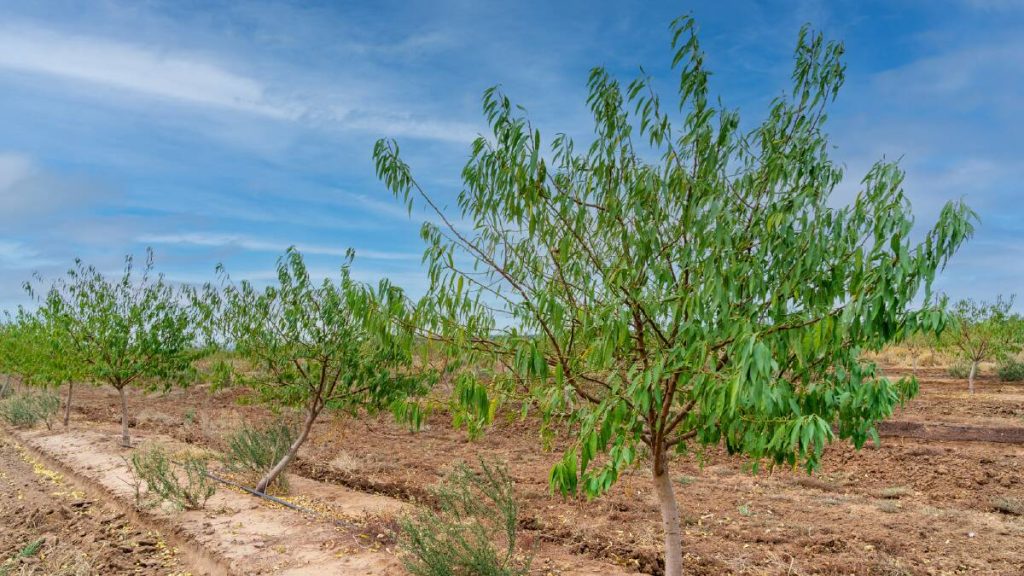
Spacing is the first decision, because it sets how many trees you buy, how much drip line you lay and how much manure you carry. The table shows the common options.
| Spacing | Trees per acre | Seedling cost at KSh 1,000 each |
|---|---|---|
| 4 m by 4 m | About 250 | KSh 250,000 |
| 5 m by 5 m | About 160 | KSh 160,000 |
| 6 m by 6 m | About 112 | KSh 112,000 |
| 7 m by 7 m | About 82 | KSh 82,000 |
This budget uses 4 m by 4 m because many investors plan for the highest tree count per acre. Closer trees fill the ground sooner and give more nuts in the early years. They also cost more to buy, water and feed. In a few years the branches of neighbouring trees will touch, so the trees need strict pruning to keep sunlight reaching the centre of each one. Some growers remove every second tree later on to give the rest more room. Talk to your nursery about this before you settle on the layout.
A wider spacing such as 6 m by 6 m cuts the seedling bill by more than half and lowers the drip, manure and labour costs too. It fills the ground more slowly. If money or water is tight, a wider spacing is a sound choice.
Seedling Costs
Seedlings are the largest single item in the budget. Certified grafted sweet almond seedlings sell for KSh 800 to KSh 2,500 each. The price depends on the age and size of the plant, the variety and the number you order. This budget uses KSh 1,000.
At 4 m by 4 m an acre holds about 250 trees. Buy 10 extra, for 260 in all, so that you can replace any tree that dies in the first season. Dead trees replaced late fall behind their neighbours and never catch up.
Most almond varieties need pollen from a second variety. A common plan is three rows of a main variety such as Nonpareil for every one row of a pollinizer such as Carmel or Mission. On this block that means about 190 main trees and 60 pollinizers, plus spares in the same ratio. Ask your nursery to confirm which varieties flower at the same time in your area, and write the split on your order.
| Price per seedling | Cost for 260 seedlings |
|---|---|
| KSh 800 | KSh 208,000 |
| KSh 1,000 | KSh 260,000 |
| KSh 1,500 | KSh 390,000 |
| KSh 2,500 | KSh 650,000 |
Do not try to save money with cheap, un-grafted seedlings sold by the roadside. A seedling sold for KSh 150 to KSh 400 is often an Indian almond (Terminalia catappa) or a plant grown from seed. Neither will give you a reliable nut crop, and every other cost in this budget is wasted if the tree is wrong. Check each seedling for the healed graft bump 8 to 15 cm above the soil, and ask the nursery for the KEPHIS papers, the variety names and a receipt.
Land Preparation and Planting Costs
The table below covers everything you need to get the trees into the ground, except the seedlings and the irrigation system.
| Item | Working | Cost (KSh) |
|---|---|---|
| Soil test | Laboratory analysis, a few samples | 5,000 |
| Clearing, ploughing and subsoiling | One acre | 20,000 |
| Marking the layout | Pegs, twine and labour | 5,000 |
| Digging holes, planting and staking labour | 250 × 80 | 20,000 |
| Farmyard manure | 5 tonnes at 3,500 per tonne | 17,500 |
| Double superphosphate (DSP) | 62.5 kg at 130 per kg | 8,100 |
| Trichoderma biological fungicide | 12.5 kg at 1,200 per kg | 15,000 |
| Stakes and nursery tape | 250 × 50 | 12,500 |
| Mulching labour | Spreading mulch around each tree | 5,000 |
| Subtotal | 108,100 |
The planting hole blend
Each hole is 60 cm wide, 60 cm long and 60 cm deep. Keep the topsoil and the subsoil in separate heaps. Mix the topsoil with 20 kg of fully decomposed farmyard manure, 250 g of DSP and 50 g of Trichoderma, then use that mixture to fill the hole around the roots.
For 250 holes this comes to 5,000 kg of manure, 62.5 kg of DSP and 12.5 kg of Trichoderma, which are the quantities in the table. Use manure that is fully decomposed. Fresh manure can burn young roots and carry weed seeds into the orchard. If your soil test shows a pH below 5.5, add the cost of agricultural lime to this table and spread it several months before planting.
Plant at the start of the rains, in March and April or in October and November. Set each tree so that the graft union stays 8 to 15 cm above the final soil level, water it with about 20 litres on the day, and spread mulch around the base while keeping it 10 cm away from the stem.
Drip Irrigation Layout for One Acre
Almond trees do best with drip irrigation, because the water goes to the roots and very little is wasted. Here is how the system is laid out for the 4 m by 4 m block.
The layout
A block of 250 trees at 4 m spacing is about 64 m long and 64 m wide. It has 16 rows, spaced 4 m apart, with 16 trees in each row. On sloping land run the rows along the contour so that water does not run down the slope.
Lay one drip line along each row, which gives 16 lines of 64 m, or about 1,024 m in total. Give each tree two emitters of 4 litres per hour, one on each side of the trunk and about 30 to 40 cm away from it. Move the emitters further out as the tree grows, so that the water reaches the whole root zone.
A main pipe carries water from the tank or pump to one edge of the block. A sub-main pipe runs across the head of the rows and feeds each drip line. A valve in the sub-main splits the block into two zones of eight rows each. Running the zones one after the other keeps the flow low enough for a small pump.
How much water the system must deliver
Two emitters of 4 litres per hour give each tree 8 litres per hour. A mature tree that needs 40 to 80 litres a week in dry months therefore runs for 5 to 10 hours a week. For the whole acre, that is 10,000 to 20,000 litres a week, or about 1,400 to 2,900 litres a day. Young trees need much less. In the first year, 10 to 20 litres per tree per week in dry weather is a reasonable starting point, and you can increase it as the trees grow.
A 5,000-litre tank is a buffer, not a water source. At peak demand it would run dry in less than two days, so you need a borehole, river, dam or other supply that refills it. The cost of that supply is outside this budget and varies a great deal from site to site.
Pressure, filter and care
Most drip emitters need about 0.5 to 1 bar of pressure to deliver water evenly. A tank on a short stand does not give that much, so the budget includes a small pump. If your tank can sit on high ground, 5 to 10 metres above the orchard, you may not need the pump.
A screen or disc filter is essential, because small particles block emitters quickly. Clean the filter every week in the first season and flush the ends of the lines once a month. Check each tree every few weeks to make sure both emitters are working. A blocked emitter can leave a tree without water for weeks before you notice it.
Drip system costs
| Item | Cost (KSh) |
|---|---|
| Drip line, 1,024 m with built-in emitters, at about 40 per metre | 41,000 |
| Main and sub-main pipes, about 70 m at 400 per metre | 28,000 |
| Screen or disc filter | 12,000 |
| Valves, connectors and fittings | 15,000 |
| 5,000-litre tank with a stand | 30,000 |
| Small pump | 22,000 |
| Installation labour | 12,000 |
| Total | 160,000 |
Year 1 Budget in Full
The table brings the first-year costs together. Establishment costs are the one-time items. Running costs are the cost of looking after the young trees through their first year.
| Item | Cost (KSh) |
|---|---|
| Land preparation and planting | 108,100 |
| Seedlings (260 at KSh 1,000) | 260,000 |
| Drip irrigation | 160,000 |
| Fence, about 260 m at 250 per metre | 65,000 |
| Establishment total | 593,100 |
| Labour for weeding, watering and spraying | 48,000 |
| Fertiliser top dressing | 10,000 |
| Water and power | 6,000 |
| Pest and disease control | 8,000 |
| Running costs in year 1 | 72,000 |
| Total cost in year 1 | 665,100 |
If your land is already fenced, take off KSh 65,000, which brings the year 1 total down to KSh 600,100. In years one and two you can grow short-season legumes between the rows to earn a little income and help pay for weeding, but keep them well away from the tree basins so they do not compete for water.
Running Costs from Year 2 to Year 5
After the first year the costs change shape. Establishment costs are finished, but labour, manure, water and pest control rise each year as the trees grow. From year three you also pay for bees and for harvesting and shelling the nuts.
| Cost item | Year 2 | Year 3 | Year 4 | Year 5 |
|---|---|---|---|---|
| Labour | 54,000 | 66,000 | 80,000 | 100,000 |
| Manure and fertiliser | 20,000 | 30,000 | 45,000 | 60,000 |
| Water and power | 10,000 | 14,000 | 20,000 | 28,000 |
| Pest and disease control | 10,000 | 14,000 | 18,000 | 24,000 |
| Bee hire | 0 | 6,000 | 6,000 | 6,000 |
| Harvest, hulling, shelling and packing (KSh 120 per kg of kernels) | 0 | 12,000 | 28,800 | 57,600 |
| Total (KSh) | 94,000 | 142,000 | 197,800 | 275,600 |
A few notes on these numbers. Labour grows because there is more pruning, spraying, watering and, from year three, harvesting to do. Manure and fertiliser rise towards the full rate of 30 to 40 kg of manure per tree each year. For 250 trees that is 7.5 to 10 tonnes a year, plus balanced NPK, potash and a leaf spray of boron and zinc before flowering. Bee hire assumes two to three hives per acre at about KSh 2,000 each per season. The harvest line is charged per kilogram of kernels, so it rises with the crop.
Almond Yield per Acre in Kenya
Yield decides whether the farm makes money, so it is worth looking at closely. The base case uses the following yields in clean kernels.
| Year | Kernels per tree | Kernels per acre (250 trees) |
|---|---|---|
| 1 | 0 | 0 kg |
| 2 | 0 | 0 kg |
| 3 | 0.4 kg | 100 kg |
| 4 | 0.96 kg | 240 kg |
| 5 | 1.92 kg | 480 kg |
| 6 | 2.88 kg | 720 kg |
| 7 | 3.52 kg | 880 kg |
These acre-level figures match the standard planning model for a well-managed commercial almond block, where mature trees give about 22 kg of in-shell nuts and the kernels weigh a little over a third of that. We have used the same acre-level yield for a close 4 m by 4 m spacing. That is a cautious choice. A dense orchard can give more per acre in the early years if it is pruned and watered well, but we do not count on it here. The per-tree figures are lower than in a wide orchard because each tree has less room.
Your own yield will depend on five things: the variety, the number of cool hours your site gets, how well the flowers are pollinated, how steadily the trees are watered, and how well pests and diseases are controlled. Frost during flowering can also cut a crop badly. If a similar orchard already operates near you, ask the owner for real yield records before you rely on the table.
Year 1 to Year 5 ROI
Return on investment, or ROI, here means the net result divided by the total money spent. The table shows each year, using the costs above and the yields from the last section.
| Year | Kernels (kg) | Price per kg (KSh) | Revenue (KSh) | Costs (KSh) | Net (KSh) | Cumulative net (KSh) |
|---|---|---|---|---|---|---|
| 1 | 0 | none | 0 | 665,100 | -665,100 | -665,100 |
| 2 | 0 | none | 0 | 94,000 | -94,000 | -759,100 |
| 3 | 100 | 900 | 90,000 | 142,000 | -52,000 | -811,100 |
| 4 | 240 | 900 | 216,000 | 197,800 | 18,200 | -792,900 |
| 5 | 480 | 1,000 | 480,000 | 275,600 | 204,400 | -588,500 |
| Total, years 1 to 5 | 786,000 | 1,374,500 | -588,500 |
At the end of year 5 the orchard has earned KSh 786,000 and cost KSh 1,374,500, so the cumulative result is a loss of KSh 588,500. That is an ROI of about -43 percent over five years. This is normal for an orchard. The money goes out first and the crop comes later. The useful signs are that year 4 is the first year with a positive net, and that year 5 adds more than KSh 200,000.
Years 6 and 7
The full payback happens after year 5, as the trees reach full yield.
| Year | Kernels (kg) | Price per kg (KSh) | Revenue (KSh) | Costs (KSh) | Net (KSh) | Cumulative net (KSh) |
|---|---|---|---|---|---|---|
| 6 | 720 | 1,000 | 720,000 | 332,400 | 387,600 | -200,900 |
| 7 | 880 | 1,000 | 880,000 | 371,600 | 508,400 | 307,500 |
The farm passes break-even during year 7. Over seven years the orchard has cost KSh 2,078,500 and earned KSh 2,386,000, which is a net gain of KSh 307,500, or about 15 percent of the money spent. If yields hold at 880 kg and costs stay near the year 7 level, each later year adds about KSh 508,000 in net cash. One year of full production returns about 86 percent of the whole establishment cost of KSh 593,100.
Net Return per Kilogram of Kernels
Another way to read the numbers is to divide each year’s running cost by the kilograms sold.
| Year | Running cost per kg (KSh) | Sale price per kg (KSh) | Net per kg (KSh) |
|---|---|---|---|
| 3 | 1,420 | 900 | -520 |
| 4 | 824 | 900 | 76 |
| 5 | 574 | 1,000 | 426 |
| 6 | 462 | 1,000 | 538 |
| 7 | 422 | 1,000 | 578 |
In year 3 each kilogram costs more to produce than it sells for, because the crop is still small. By year 7 each kilogram costs about KSh 422 to produce and sells for about KSh 1,000, which leaves about KSh 578.
These figures leave out the establishment cost. If you spread everything over the first seven years, the full cost is KSh 2,078,500 for 2,420 kg of kernels, or about KSh 859 per kg. The average sale price over the same period is about KSh 986 per kg, so the net return per kilogram to the end of year 7 is about KSh 127. That number rises every year after that, because the establishment cost is spread over more kilograms.
What if Prices or Seedling Costs Are Different?
Kernel price and seedling price are the two inputs that change the result most. The first table keeps the yields and costs the same and changes only the price per kilogram, applied to every year of sales.
| Kernel price case | Cumulative net, end of year 5 (KSh) | End of year 6 (KSh) | End of year 7 (KSh) | Break-even year |
|---|---|---|---|---|
| Low: KSh 800 per kg | -718,500 | -474,900 | -142,500 | Year 8 |
| Base: KSh 900 to 1,000 per kg | -588,500 | -200,900 | 307,500 | Year 7 |
| High: KSh 1,200 per kg | -390,500 | 141,100 | 825,500 | Year 6 |
The second table keeps the base kernel price and changes only what you pay for each seedling.
| Seedling price | Extra cost against base | Cumulative net, end of year 7 (KSh) |
|---|---|---|
| KSh 800 | -52,000 | 359,500 |
| KSh 1,000 (base) | 0 | 307,500 |
| KSh 1,500 | 130,000 | 177,500 |
| KSh 2,500 | 390,000 | -82,500 |
The tables show that a high seedling price pushes break-even into year 8, and a low kernel price does the same. A good price for kernels and a fair price for seedlings bring break-even forward by a year. Before you commit, get quotes for seedlings, and talk to buyers about the price they would pay for clean kernels in your first harvest year.
Ways to Improve the Return
There are practical ways to lift the result without changing the yield figures.
Buy all seedlings in one order. Nurseries usually give a better price on a larger volume, and one delivery saves on transport. Do part of the work yourself where you can. Digging holes, mulching, weeding and watering are the largest labour items, and family labour lowers the cash cost directly. If you keep livestock, use your own manure, which can remove most of the manure cost.
Grow short-season legumes between the rows in years one and two, keeping a clear ring around each tree. The crop gives a small income and helps cover weeding costs. Join other growers to share a beekeeper, a hulling and shelling service and a buyer. A group that can offer a steady supply often gets a better price than one farmer selling small amounts.
Dry and sort nuts with care, because buyers pay more for clean, dry, whole kernels. Agree on a price and a delivery date with a buyer before the first harvest, so that you are not forced to accept whatever you are offered on the day.
Main Risks and How to Manage Them
The biggest risk is a wrong seedling, which is why the first step is to buy grafted sweet almond with proper papers. The second is a wrong site. If your farm sits below about 1,200 metres, the trees may not get enough cool hours, and flowering will be poor.
Water is the third risk. A drip system without a dependable water source will not protect the crop in a dry spell, so confirm your supply before you buy trees. Pests and diseases are the fourth, and a weekly walk through the orchard to catch problems early costs far less than a spray programme after an outbreak. Frost at flowering, hail and strong winds can all reduce a crop in a given year, so do not plan your finances around a perfect harvest every season.
Price and market access are the last risk. Almond kernels sell well in the main towns today, but prices move. Plan a budget that still works at the low price case, and look for buyers before the trees begin to bear.
A Simple First-Year Plan
The first year is when most of the money is spent, so a clear order of work helps.
- Three to four months before planting, take soil samples, test the drainage, and confirm your altitude and water source.
- Order your seedlings early, naming the varieties and the split between main and pollinizer trees, and book a delivery date at the start of the rains.
- Clear and plough the land, mark the layout, and dig the holes. Apply lime first if the soil test calls for it.
- Install the drip system and test it for leaks and even flow before the trees go in.
- Plant the trees with the graft union above the soil, stake them, water them and mulch them.
- Walk the block every week. Replace dead trees, clean the filter, check the emitters, and weed around each tree.
Frequently Asked Questions
What is the cost of starting almond farm in Kenya per acre?
In this budget, the first-year cost for one acre with 250 trees at 4 m by 4 m is about KSh 665,100. That includes KSh 593,100 to establish the farm and KSh 72,000 to run it in year one. The figure falls by KSh 65,000 if your land is already fenced, and it changes with seedling price, labour rates and your water source.
How many almond trees fit on one acre?
At 4 m by 4 m, an acre holds about 250 trees. At 5 m by 5 m it holds about 160, at 6 m by 6 m about 112, and at 7 m by 7 m about 82.
What is the almond yield per acre in Kenya?
Under the planning model used here, an acre gives about 100 kg of clean kernels in year 3, 480 kg in year 5 and 880 kg by year 7. Real yields depend on the site, the variety, pollination, water and pest control.
Is almond farming in Kenya profitable?
It can be, but it is a long-term investment. In the base case the farm breaks even in year 7 and then earns about KSh 508,000 a year in net cash at full yield. At a low kernel price of KSh 800 per kg, break-even moves to year 8. At KSh 1,200 per kg it comes in year 6.
How much does a drip irrigation system for one acre cost?
The system in this guide costs about KSh 160,000. It includes 1,024 m of drip line, pipes, a filter, valves, a 5,000-litre tank on a stand, a small pump and installation. The cost of the water source itself is separate.
How much water does an almond orchard need?
A mature tree needs about 40 to 80 litres a week in dry months. For 250 trees that is 10,000 to 20,000 litres a week. Young trees need much less.
Can I start with a smaller or wider layout to cut costs?
Yes. A 6 m by 6 m layout has only about 112 trees, which cuts the seedling, drip, manure and labour costs sharply. The trees fill the ground more slowly, but it is a sound choice if your budget or your water is limited.
Get a Quote for Certified Grafted Sweet Almond Seedlings
Fruit Africa Veriplant supplies KEPHIS-inspected, true-to-type grafted sweet almond seedlings to farmers across East Africa. Send your acreage, your spacing and your planting date, and ask for a written quote that names the varieties, the rootstock and the price per seedling.
- Head Office Location: Ruiru, Kiambu County, Kenya
- Nursery Distribution Bases: Murang’a, Nairobi, and Embu
- Phone Direct: +254 714 994 444
- WhatsApp Assistance: Message us on WhatsApp
- Official Email: sales@fruitafrica.org
- Official Website: www.fruitafrica.org
- Request a Quote: fruitafrica.org/request-for-quotation/
Summary
The cost of starting almond farm in Kenya on one acre with 250 trees is about KSh 665,000 in the first year, and most of it is spent before the first harvest. In the base case the farm loses money for the first three years, turns positive in year four, and passes break-even during year seven. After that a full-yield acre can return about KSh 508,000 a year.
The result depends most on three things: the seedlings you buy, the price you get for kernels, and a steady water supply. Buy certified grafted trees, test your site, get written quotes, and set up your buyers early. Then build your own version of these tables with local prices, and test it against the low price case before you plant.