- Discover how overhead micro-sprinklers regulate humidity to build thicker stem calipers and stronger root systems in Hass avocado seedlings quality.
Hass Avocado Seedlings: How Micro-Sprinklers Improve Stem Caliper and Root Development
A farmer walks into a nursery in Kandara to collect an order of Hass avocado seedlings for a new two acre block. Two rows stand side by side, same age, same grafting batch, same variety. One row has stems you can feel under your fingers, firm and round. The other row looks thinner, slightly floppy near the top, leaves a little pale. Nothing was wrong with the scion wood or the rootstock seed.
This is the part of avocado farming that buyers rarely see and nurseries rarely explain well. Hass avocado seedlings are not simply grown. They are shaped, week by week, by how much water the roots receive, how evenly that water is spread across the nursery bed, and how much air is left in the root zone after each watering round.
This article looks at what actually happens inside a nursery bed when overhead micro-sprinklers are used, how that affects stem caliper and root architecture in Hass avocado seedlings, and what a farmer buying seedlings in Kenya should look for and ask about before placing an order.
Why Hass Avocado Seedling Quality Starts in the Nursery
An avocado tree spends two to three years producing its first meaningful harvest and ten or more years in full production after that. Whatever happens in the first six to twelve months, while the plant is still in a nursery bag or bed, sets the direction for everything that follows. A seedling that leaves the nursery with a weak root system or a soft stem does not simply catch up once it reaches the field.
Nursery conditions in Kenya vary widely. A nursery at altitude in Kiambu or Murang’a deals with cooler nights and slower, steadier growth. A nursery in a lower, hotter zone pushes seedlings through faster growth cycles with higher water demand and faster drying of the growing media. Rainfall patterns, wind exposure, and the quality of water available to the nursery all shape how irrigation needs to be managed, and no single nursery routine works the same way in every part of the country. What stays constant is the underlying biology.
What Makes a High-Quality Hass Avocado Seedling?
Farmers often judge seedlings mainly on height, and height is the easiest thing to see at a glance. Height on its own tells you very little about whether a seedling will establish well.
A good Hass avocado seedling shows a combination of signs together, not any single feature in isolation. The stem should feel firm when gently squeezed near the base, not soft or hollow. The graft union should be well healed, with no cracking, oozing, or dieback above or below the joint. Leaves should sit a healthy green, without the pale yellowing that often points to nutrient or root problems, and without the scorched, curled edges that point to drought stress or poor water quality. The root ball should hold together when lifted from the bag or tray, showing a network of fine white or light coloured roots rather than a tangled mass of thick roots circling the container.
Understanding Stem Caliper in Hass Avocado Seedlings
Stem caliper is simply the diameter of the stem, usually measured a short distance above the graft union or at a fixed point on the trunk. Nursery staff who handle large numbers of seedlings often check this by feel and by eye, sometimes backed up with callipers for a sample of plants, to compare batches and track how a planting is developing week to week.
Stem thickness matters for several practical reasons. A thicker stem usually carries more vascular tissue, meaning more capacity to move water and nutrients between roots and leaves. A thicker stem also tends to hold up better during handling, loading, transport, and the first strong winds the plant meets in an open field, where a thin stem is more likely to bend, snap near the graft union, or need staking to survive its first season.
There is no single official Kenyan standard figure for what stem caliper a Hass avocado seedling must reach before sale. Nurseries use caliper as one working measure among several, comparing seedlings of the same age and batch against each other rather than against a fixed external number.
Why Root Architecture Matters Before Orchard Planting
Roots do the work that nothing above the soil can do for the plant. They anchor the tree, pull in water and nutrients, and store some of the sugars the plant produces.
A seedling with a dense network of fine feeder roots spread evenly through the growing media generally handles the move to the field far better than one with a few thick roots and little branching. Fine roots are what pick up moisture from the soil immediately after transplanting, during the window when the plant is most vulnerable and before new roots have had time to grow into the surrounding field soil.
This is why a nursery operator looks at roots with the same seriousness given to the stem and the canopy. A tall seedling with a poor root system is not a high quality plant, no matter how good it looks above the soil line.
How Overhead Micro-Sprinklers Work in an Avocado Nursery
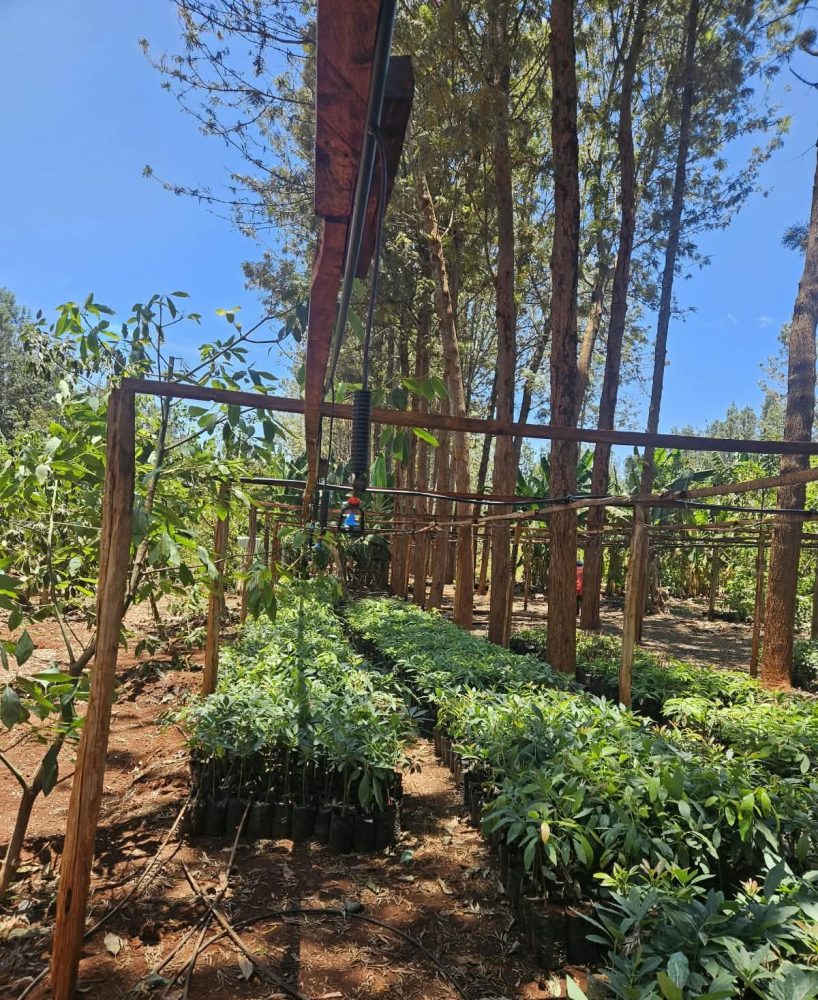
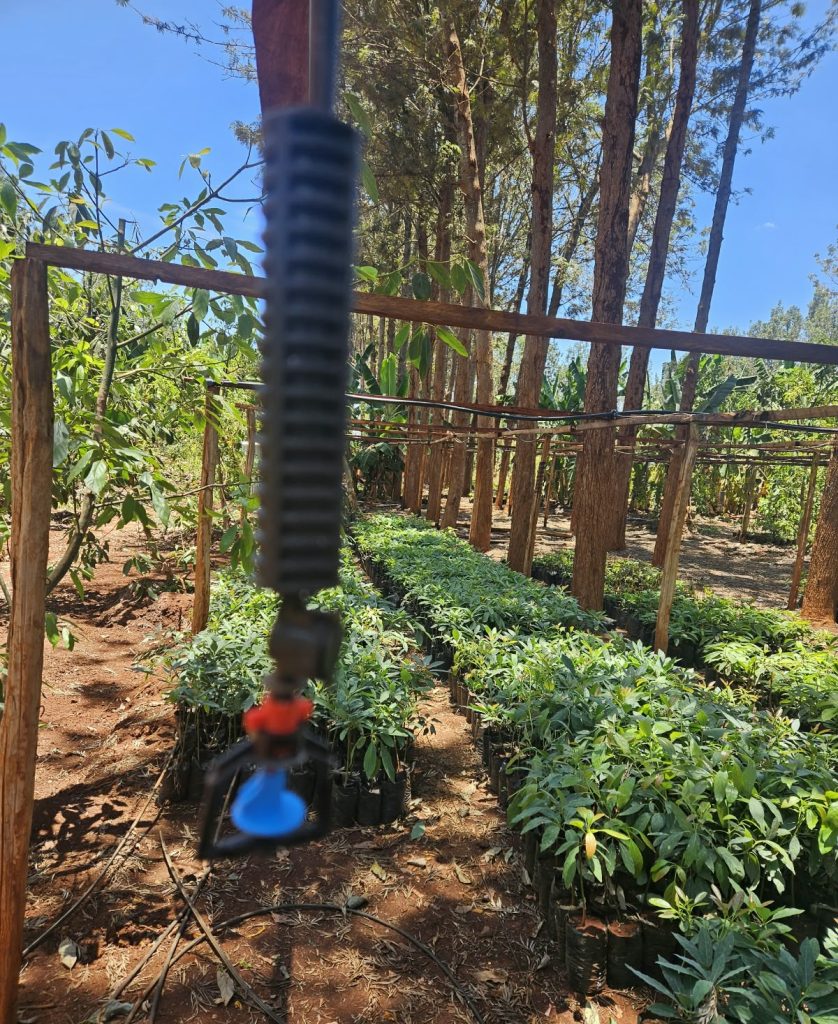
Overhead micro-sprinklers are small sprinkler heads mounted above the nursery bed or bag rows, usually on raised risers or a low frame, that throw a fine spray of water downward and outward over a set radius. Unlike drip irrigation, which delivers water through emitters placed directly at or near each plant, micro-sprinklers wet a broader area, covering several seedlings from a single head and allowing water to settle onto the growing media from above.
The spray radius, nozzle type, and operating pressure of each sprinkler head determine how far the water throws and how fine the droplets are. Nursery layout is built around this radius, with rows and bed widths spaced so that neighbouring sprinkler heads overlap just enough to avoid dry gaps between them, without so much overlap that some areas receive double the water of others.
How Micro-Sprinkler Irrigation Affects Seedling Growth
The link between micro-sprinkler irrigation and seedling quality is not direct. Micro-sprinklers do not grow thicker stems or better roots by themselves.
Water Distribution
Micro-sprinklers spread water across a wider footprint than drip emitters, which helps keep the whole surface of a nursery bed moist rather than concentrating water in small, isolated wet patches around individual plants. This matters for Hass avocado nurseries because the fine feeder roots a seedling develops close to the surface benefit from consistent moisture across the growing media, not just directly under the stem.
Root-Zone Moisture
What matters for root growth is not how much water lands on the surface of the media, but how much actually reaches the depth where roots are active, and how long that moisture stays at a level the roots can use without drowning them. A light, frequent sprinkle from an overhead system can sometimes wet only the top few centimetres of media, leaving deeper roots dry even though the surface looks damp.
Oxygen Around the Roots
Roots breathe. They take in oxygen from air spaces in the growing media and release carbon dioxide, a process that needs those air spaces to remain open rather than fully flooded with water. When media stays saturated for long periods, water fills the pore spaces that would otherwise hold air, and roots begin to suffer from a lack of oxygen even though they are sitting in plenty of water. This is one of the main reasons that adding more water does not automatically produce a better seedling. Past a certain point, additional water pushes air out of the root zone and starts working against root health rather than supporting it.
Shoot Growth and Stem Development
Stems thicken through a steady supply of water, light, and nutrients that lets the plant keep building new tissue without repeated shocks of drought or waterlogging. A seedling that swings between dry stress and soggy media tends to put more energy into surviving each swing than into building a strong, evenly thickened stem. Where irrigation is uniform and root-zone moisture stays in a workable range, seedlings generally show steadier shoot extension and stem thickening over time, since the plant is not constantly recovering from one extreme or the other.
Micro-Sprinklers vs Drip Irrigation for Avocado Seedlings
Both systems are used in Kenyan avocado nurseries, and neither is universally better. The right choice depends on nursery scale, layout, water source, labour, and the grower’s own management capacity.
| Factor | Overhead Micro-Sprinklers | Drip Irrigation |
| Water distribution | Wide coverage over several plants per head | Targeted at or near each plant |
| Root-zone wetting | Wets a broad surface area, depth depends on run time | Wets a smaller, more concentrated zone |
| Installation | Simpler riser and header layout | More emitters and lines to lay out and tune |
| Maintenance | Nozzles need regular checking for blockage and wear | Emitters prone to blockage from fine particles |
| Nursery suitability | Good for dense beds of small seedlings | Good for larger bagged plants spaced further apart |
| Evaporation | Higher, since water is airborne and surface spread | Lower, water placed closer to the root zone |
| Foliage wetting | Wets leaves, which needs airflow to dry quickly | Keeps foliage mostly dry |
| Disease considerations | Wet foliage can favour some leaf and stem diseases if airflow is poor | Dry foliage lowers this particular risk |
| Uniformity | Depends heavily on pressure, overlap and layout | Depends on emitter consistency and line pressure |
| Scalability | Straightforward to expand across uniform beds | More labour intensive to expand and maintain |
Micro-sprinklers tend to make practical sense where a nursery is running dense beds of young seedlings that benefit from broad surface coverage, where labour for checking many individual drip emitters is limited, and where nozzle maintenance can be kept up consistently. Drip irrigation becomes more attractive once seedlings are larger, spaced further apart in bigger bags, and where a nursery wants to keep foliage dry to manage disease pressure in a humid area.
How to Manage Irrigation for Hass Avocado Seedlings
There is no single watering duration or frequency that fits every Hass avocado nursery. What works in a cool, high altitude site with heavy clay media is wrong for a hot, lower altitude site using a light, sandy mix.
Seedling age and container size change water demand considerably. A young seedling with a small root system in a small bag holds less reserve moisture and dries out faster than an older plant with an established root ball in a larger bag.
A simple, reliable way to judge whether irrigation is working is to check the growing media directly. Push a finger two to three centimetres into the media of a sample of bags or beds before deciding whether to water. If it feels damp and cool, the plant likely has enough moisture. If it feels dry and crumbly at that depth, watering is due. Checking drainage holes after a watering round confirms whether water is passing through the media properly or pooling, which points to a media or container drainage problem rather than an irrigation scheduling problem.
Drought stress and waterlogging damage seedlings in different ways but both slow development. Under drought stress, fine roots die back first, leaves wilt and may scorch at the edges, and stem thickening slows as the plant conserves resources. Under waterlogging, roots suffocate from lack of oxygen even while surrounded by water, root tips can turn brown or black, and the plant may show yellowing leaves that look confusingly similar to a nutrient deficiency. A media that stays continuously saturated, never given a chance to drain and bring fresh air into the root zone, damages roots over time even if no single watering event looks excessive.
How Nursery Media Affects Root Architecture
The growing media a seedling sits in has as much influence over root development as the irrigation system delivering the water. Media needs to hold enough moisture to support the plant between waterings while still leaving enough open pore space for air to move through and reach the roots.
Kenyan nurseries use a range of media combinations depending on what is locally available and affordable, including forest soil or topsoil, river sand, well decomposed compost or manure, and in some operations a portion of cocopeat or similar material to improve water holding and aeration. A heavy, poorly structured soil mix compacts over time, squeezing out air spaces and encouraging shallow, poorly branched roots that struggle once transplanted. A very light, sandy mix drains fast and dries out quickly, forcing more frequent watering and sometimes producing a smaller root mass overall.
Clean, pest free, weed free media matters just as much as its physical structure. Media contaminated with old root material, weed seed, or pathogens from a previous crop can undermine even a well designed irrigation programme, introducing root diseases or competition that no amount of correct watering can fix.
Hass Avocado Rootstocks and Seedling Quality
A rootstock is the lower portion of a grafted tree, grown from seed or occasionally from clonal material, onto which the Hass scion is grafted. The rootstock supplies the root system the tree will depend on for its entire productive life, while the scion above the graft determines the fruit variety, in this case Hass.
Rootstock choice affects how a seedling performs in the nursery and later in the orchard, influencing vigour, adaptability to different soil conditions, and in some cases tolerance to certain root diseases. Kenyan nurseries commonly use seedling rootstocks grown from selected avocado seed, chosen for reasonable uniformity and compatibility with Hass scion wood. No single rootstock performs identically in every soil type, altitude, and water regime found across Kenya’s avocado growing areas, and claims that one rootstock is simply the best choice for every farm do not hold up once soil and climate differences are taken into account.
Root development in the nursery sets up how well the rootstock will perform once the tree is in the ground. A rootstock with a shallow, poorly branched root system limits the whole tree’s access to water and nutrients for years, regardless of how strong the scion variety is.
Grafting Hass Avocado Seedlings
Grafting joins a piece of Hass scion wood onto an established rootstock, and the success of this join depends on rootstock readiness, scion quality, and the care given to the plant in the weeks immediately after grafting. Rootstocks are usually grafted once they have reached a suitable stem diameter and have an active, healthy root system, since a rootstock that is too young or stressed heals a graft union poorly.
Scion material needs to come from healthy, true to type Hass trees, cut and handled in a way that keeps the cambium layer, the thin growing tissue just under the bark, viable until the graft is made. Once the graft is complete, the union needs protection from drying out and from excess moisture sitting directly on the cut surfaces, which is usually managed through wrapping, shade, and controlled humidity around the grafted plant while the tissues knit together.
Irrigation during this healing period needs particular care. Overwatering around freshly grafted plants raises humidity at the graft site in a way that can encourage fungal problems and slow healing, while underwatering stresses a plant that is already recovering from the physical disturbance of grafting and cannot yet draw water normally through the healing union.
Hardening Hass Avocado Seedlings Before Field Planting
Hardening is the gradual process of preparing a nursery raised seedling for the harsher, less controlled conditions of an open field. A plant grown under nursery shade, with consistent watering and shelter from strong wind, experiences a real shock if it is moved straight from that environment to an exposed farm.
This process is not simply a matter of cutting water sharply in the final days before sale, which risks causing drought stress right when the plant needs to be at its strongest. Proper hardening usually involves gradually reducing shade cover over a period of one to a few weeks, allowing more direct sunlight to reach the leaves so they adjust and thicken rather than scorching once fully exposed.
Wind exposure is introduced gradually as well where nursery layout allows it, moving plants from more sheltered positions to more open ones over the hardening period so that stems strengthen and leaves toughen before the plant faces full field conditions. Throughout hardening, nursery staff watch for signs of stress, wilting that does not recover overnight, leaf scorch, or a sudden drop in new growth, and adjust the pace if plants are struggling rather than pushing through a fixed timetable regardless of how the plants are responding.
How to Grade Hass Avocado Seedlings
Grading sorts seedlings into categories based on their readiness and health, protecting both the buyer and the nursery’s reputation by making sure plants sold as field ready genuinely meet that standard. A nursery without a grading routine risks sending out a mixed batch where strong and weak plants are treated identically, leaving the farmer to discover the difference only after planting.
Field ready plants show a firm stem of reasonable caliper for their age, a healed graft union, a well developed root system that holds the media together, healthy foliage, and evidence of proper hardening. Plants graded as needing more development are not necessarily faulty, they simply have not yet reached the combination of stem, root, and hardening maturity needed for reliable field establishment, and holding them back for more nursery time usually serves the buyer better than selling them early.
Common Causes of Weak Avocado Seedling Stems
Weak stems usually trace back to one or a combination of growing conditions rather than a single cause. Excess shade held too long into the production cycle keeps a plant soft and encourages tall, thin growth as it stretches toward available light, rather than the stockier growth that develops under fuller sun exposure during hardening.
Inconsistent watering, alternating between drought stress and overwatering, interrupts steady tissue building and often shows up as uneven, weak stem growth. Overcrowded nursery spacing forces seedlings to compete for light and encourages the same kind of stretched, thin growth seen under excess shade. Nutrient imbalance, particularly low nitrogen or an uneven fertilizer programme, limits the plant’s capacity to build new tissue, including stem tissue, even when water supply looks adequate.
Common Causes of Poor Root Development
Poor root systems often develop quietly, since the visible parts of the plant can look reasonable even while roots struggle underground. Waterlogged media, from overwatering, poor drainage, or containers without adequate drainage holes, suffocates roots and encourages root diseases that thrive in low oxygen, saturated conditions.
Compacted or poorly structured media restricts root penetration, forcing roots to grow shallow and sparse rather than spreading through the full depth of the container. Containers left too long without being moved or root pruned allow roots to circle tightly around the inside wall, a pattern that often continues in the field and limits anchorage and spread for years. Root disturbance from rough handling, repeated transplanting, or poor quality potting technique damages the fine feeder roots that take time to regenerate.
Common Irrigation Mistakes in Avocado Nurseries
Several irrigation mistakes repeat across nurseries of every size, and most trace back to treating irrigation as a fixed schedule rather than a management practice that needs regular checking and adjustment.
| Problem Observed | Likely Cause |
| Uneven growth across the same bed | Poor sprinkler overlap or pressure variation across the nursery |
| Yellowing leaves with healthy looking roots | Overwatering reducing oxygen in the root zone, or nutrient leaching from excess water |
| Leaf scorch and wilting despite regular watering | Water not reaching root depth, or blocked nozzles reducing actual delivery |
| Stunted, thin seedlings in one section only | Shaded or sheltered zone receiving different light and airflow than the rest of the nursery |
| Root rot symptoms in isolated patches | Localised drainage failure or a low spot collecting excess water |
| Plants wilting suddenly on hot afternoons | Irrigation scheduled too early or late relative to peak heat and evaporation demand |
| White crust forming on media surface | Salt buildup from water quality issues or over-fertilising combined with shallow watering |
Checking actual outcomes in the nursery bed, rather than assuming a schedule is working because it has always been run that way, catches most of these problems early, before an entire batch of seedlings is affected.
Hass Avocado Seedling Pests and Diseases
Nursery seedlings face a narrower but still significant range of pest and disease pressures compared with mature orchard trees, and irrigation management plays a direct role in how much risk a nursery carries for several of these.
Aphids and mites can build up on young, soft growth, particularly where plants are stressed or crowded, showing as curled or stippled leaves and sticky residue from aphid feeding. Regular monitoring of the underside of leaves catches early infestations before they spread through a bed.
Thrips feed on young leaves and can scar developing foliage, favoured by warm, dry conditions and often more visible on new flush. Fungal leaf and stem diseases tend to favour nurseries where foliage stays wet for long periods without good airflow, a particular consideration where overhead micro-sprinklers are used, since keeping some spacing between beds and avoiding watering late in the day when leaves cannot dry before nightfall both help manage this risk.
Good nursery pest and disease management follows the same integrated approach used in the orchard: regular monitoring to catch problems early, correct identification before deciding on any response, removal of obviously diseased material to limit spread, attention to the growing conditions that favour specific problems, and targeted treatment only where genuinely needed rather than routine, precautionary spraying.
Pesticide decisions should follow product label instructions and registered uses, and a nursery operator uncertain about a specific pest or disease problem is better served consulting an agronomist or extension officer familiar with the specific situation than guessing at a chemical solution.
Root Rot and Poor Drainage
Root rot in avocado nurseries is strongly linked to prolonged waterlogging and poor drainage rather than appearing out of nowhere. Phytophthora, a soil borne pathogen known to affect avocado roots, thrives in saturated, poorly aerated media and spreads more easily where water sits rather than draining away.
Micro-sprinklers do not prevent root rot by their design, and claiming otherwise would be misleading. What irrigation management can do is either reduce or increase the risk depending on how the system is run.
A micro-sprinkler system set to deliver frequent, light watering onto free draining, well structured media, with beds raised enough to shed excess water, supports a lower risk environment. The same system run on compacted media, over containers sitting in standing water, or on a schedule that never allows the media to dry between waterings, raises the risk considerably. The system is a delivery method.
How to Check Micro-Sprinkler Uniformity
A nursery can run an irrigation system for months without realising coverage is uneven, since the visible symptoms, patchy growth, isolated weak spots, often develop slowly and get blamed on other causes first. Checking uniformity directly removes the guesswork.
Start by walking the nursery during a normal irrigation cycle and watching each sprinkler head in operation, looking for nozzles that are not spraying at all, spraying in a reduced or distorted pattern, or throwing water unevenly to one side. A blocked or partially blocked nozzle is often visible this way without any special equipment.
A simple catch test gives a more exact picture of distribution. Place a row of identical open containers, small tins or cups work well, at measured points across a section of the nursery covered by one or more sprinkler heads, run the irrigation system for a fixed, normal length of time, then measure and compare the amount of water collected in each container. Large differences between containers point directly to uneven coverage, whether from spacing, pressure, nozzle wear, or wind drift.
Filters at the pump or header line need regular checking and cleaning, since sediment and debris passing through even a partially blocked filter can gradually clog nozzles across the whole system, turning a single maintenance issue into a widespread uniformity problem over time.
Irrigation Water Quality for Avocado Nurseries
Water quality affects both plant health and irrigation system performance. Sediment in irrigation water, common with water drawn from rivers, dams, or shallow wells without proper settling or filtration, clogs micro-sprinkler nozzles and drip emitters over time, gradually reducing and unevening water delivery even when the rest of the system is well designed.
Dissolved salts in irrigation water can build up in nursery media over repeated watering cycles, particularly where media drains poorly or where the same water source is used continuously without any flushing. Salt buildup shows up as a white or grey crust on the media surface and can damage fine roots and limit water uptake even when the media looks adequately moist. Contamination from nearby farm chemical use, livestock access to a water source, or poor storage can introduce further risk to both plant health and food safety considerations further down the supply chain.
Basic filtration at the point where water enters the irrigation system, matched to the type of sprinkler or emitter in use, protects the system from the gradual clogging that sediment causes, and is a worthwhile investment relative to the cost of replacing nozzles or dealing with uneven coverage across an entire nursery.
Fertilizer and Irrigation Management
Water and nutrients move together in a growing system. Nutrients dissolved in soil moisture are what roots actually take up, which means irrigation timing and volume directly affect how available fertilizer applications are to the plant. Overwatering shortly after a fertilizer application can leach nutrients below the root zone before the plant has a chance to use them, particularly in free draining, sandy media.
There is no single fertilizer programme that applies correctly to every Hass avocado nursery, since the right approach depends on the growing media’s existing nutrient content, the water source’s own mineral content, the age and growth stage of the seedlings, and how the plants are responding over time. Nursery operators serious about consistent seedling quality benefit from periodically testing media and water for nutrient content, rather than applying a fixed fertilizer routine indefinitely without checking whether it still matches what the plants need.
How to Prepare Hass Avocado Seedlings for Transport
Seedlings leaving a nursery face a different set of risks during transport than anything they experienced in controlled nursery conditions, and preparation before loading reduces how much stress they arrive with. Watering seedlings appropriately before dispatch, enough that the root ball is not dry and brittle but not so saturated that bags leak and add unnecessary weight, gives plants a better starting moisture reserve for the journey ahead.
Protecting leaves from being crushed or torn during loading matters more than it might seem, since damaged foliage reduces the plant’s ability to photosynthesise right when it needs full capacity to recover from the move. Root balls need to stay intact and undamaged, which means handling bags by their sides rather than by the stem, and packing plants closely enough to prevent them tipping and spilling media during transport without packing them so tightly that stems and branches are crushed against each other.
Limiting exposure to prolonged direct heat, particularly on an open truck bed under strong midday sun, helps avoid additional heat stress layered on top of the stress of being moved. Transport duration and conditions vary enormously across Kenya, from a short local delivery to a long haul across counties, and there is no single fixed duration beyond which seedlings are automatically damaged.
What to Do When Hass Avocado Seedlings Arrive at the Farm
A good nursery seedling can still fail if it is mishandled in the days after arrival, which makes field transition a genuine extension of nursery care rather than a separate stage the buyer manages alone. Plants that will not go into the ground immediately need temporary holding in a shaded, sheltered spot, watered as needed to keep the root ball from drying out, rather than being left exposed in direct sun and wind while planting holes are still being prepared.
Planting holes should ideally be prepared in advance, sized appropriately for the root ball, with any necessary soil amendment or manure mixed in and given time to settle before the seedling goes in, rather than digging and planting on the same rushed afternoon. Planting timing matters too, avoiding the harshest part of the day and, where possible, timing planting ahead of expected rain rather than into an extended dry spell that puts immediate stress on a plant still adjusting to field soil.
Even a well hardened nursery seedling benefits from some protection in its first weeks in the field, whether temporary shade in particularly harsh conditions or simple measures like mulching around the base to conserve soil moisture and moderate soil temperature. Early irrigation after planting needs the same attentive approach used in the nursery, checking soil moisture directly rather than watering on a fixed schedule, since field soil behaves differently from nursery media and newly disturbed roots are still adjusting to their new environment.
Where to Buy Quality Hass Avocado Seedlings in Kenya
Buying seedlings is a decision that affects an orchard for its entire productive life, which makes it worth a few direct questions before placing an order rather than relying on appearance alone, since a seedling that looks reasonable in a photo or a quick visit can still carry weaknesses that only show up weeks after planting.
A buyer should ask what rootstock the nursery uses and why, how old the seedlings are and when they were grafted, how irrigation is managed in the nursery, what hardening process the plants go through before sale, how seedlings are graded and what happens to plants that do not meet the grade, how seedlings are transported, whether plants are correctly and clearly labelled by variety, and what support, if any, is available after purchase if questions come up during establishment. A nursery willing to answer these questions directly and specifically, rather than with vague reassurance, is generally one worth doing business with.
Fruit Africa Veriplant Hass Avocado Seedlings
Fruit Africa Veriplant supplies grafted Hass avocado seedlings to farmers and orchard developers across Kenya, with nursery operations covering propagation, grafting, and the irrigation and hardening management described throughout this article. Buying from a supplier who manages these stages with attention to root development, stem health, and proper hardening gives a farmer a stronger starting point for orchard establishment than buying seedlings of unknown nursery history.
Farmers planning a new planting or expanding an existing block can reach Fruit Africa Veriplant directly on 0714 994 444 or by email at sales@fruitafrica.org to discuss seedling availability and ask the kind of nursery management questions outlined above. Confirming current availability and any listed pricing directly with the nursery before placing an order is the sensible approach, since nursery stock and seasonal availability change over time.
How to Identify a High-Quality Hass Avocado Seedling
The checklist below brings together the features covered through this article into a single practical reference a farmer can use when inspecting seedlings before purchase.
| Feature | What to Look For |
| Foliage | Healthy green colour, no scorching, curling, or heavy pest damage |
| Stem | Firm, not soft or hollow, reasonable caliper for the plant’s age |
| Graft union | Fully healed, no cracking, oozing, or dieback near the joint |
| Root system | Fine, well branched roots spread through the media, not a tangled mass |
| Root ball | Holds together when lifted, not loose, dry, or falling apart |
| Pest and disease status | No visible pest infestation or disease symptoms on leaves or stem |
| Nursery age | Old enough to show a developed root and stem system, not rushed to sale |
| Hardening | Shows signs of having adjusted to sun and reduced watering before sale |
| Labelling | Clearly and correctly labelled as Hass, with batch or grafting information if available |
Height is deliberately left off this list as a primary measure. A short, sturdy seedling with a strong stem and a well developed root system generally establishes better in the field than a tall, thin seedling that has stretched upward without building the structure underneath to support that height.
Frequently Asked Questions About Hass Avocado Seedlings
What makes a good Hass avocado seedling?
A good seedling combines a firm stem, a well healed graft union, a well branched root system that holds the media together, healthy foliage, and evidence that the plant has gone through proper hardening before sale. No single feature on its own tells the full story.
How do I know if a Hass avocado seedling has healthy roots?
Lift the root ball gently from its bag or tray and check that it holds together, showing fine, light coloured roots spread through the media rather than a few thick roots circling the inside of the container or a root ball that is dry and crumbling apart.
What is stem caliper in an avocado seedling?
Stem caliper is the diameter of the stem, usually measured a short distance above the graft union. Nurseries use it as one working indicator of seedling development, comparing plants of the same age and batch against each other.
Why is stem thickness important in Hass avocado seedlings?
A thicker stem generally carries more capacity to move water and nutrients, holds up better during handling and transport, and often signals a graft union that has healed and is functioning well.
Are micro-sprinklers good for avocado nurseries?
Micro-sprinklers work well in many avocado nurseries, particularly dense beds of young seedlings, when set up with correct spacing, pressure, and regular nozzle maintenance. They are one suitable option among a few, not a universal solution for every nursery layout.
How often should Hass avocado seedlings be irrigated?
There is no single fixed frequency. Irrigation needs to respond to seedling age, container size, media type, and weather, checked by feeling the media moisture directly rather than following one schedule regardless of conditions.
Is drip irrigation better than micro-sprinklers for avocado seedlings?
Neither system is universally better. Drip irrigation suits larger, more widely spaced plants and keeps foliage dry, while micro-sprinklers suit dense beds of smaller seedlings needing broad surface coverage. The right choice depends on nursery scale and management capacity.
Does overhead irrigation improve avocado root growth?
Overhead irrigation does not automatically improve root growth. Well managed micro-sprinkler irrigation can support more even root-zone moisture, provided the nursery media drains well and watering is adjusted to actual plant demand rather than run on a fixed schedule.
What causes weak stems in avocado seedlings?
Common causes include excess shade held too long, inconsistent watering that swings between drought and waterlogging, overcrowded spacing, nutrient imbalance, and a poorly healed graft union restricting normal growth.
What causes poor root development in avocado seedlings?
Waterlogged or poorly drained media, compacted growing mix, containers left too long without root management, rough handling during transplanting, and nutrient deficiencies, particularly phosphorus, all contribute to weak root systems.
How do I check whether micro-sprinklers are distributing water evenly?
Watch each sprinkler head during operation for blocked or distorted spray patterns, check pressure at different points in the nursery, and run a simple catch test using containers placed across the coverage area to compare how much water each one collects.
How do I harden Hass avocado seedlings before planting?
Hardening involves gradually reducing shade, easing back watering frequency, and introducing more wind and sun exposure over one to a few weeks, while watching plants for stress signs and adjusting the pace rather than following a fixed timetable regardless of how they respond.
What rootstock is used for Hass avocado seedlings?
Kenyan nurseries commonly use seedling rootstocks grown from selected avocado seed chosen for reasonable uniformity and compatibility with Hass scion wood. No single rootstock suits every soil type and altitude found across Kenya’s growing areas.
How long does it take to produce a grafted Hass avocado seedling?
Production time varies by nursery conditions, rootstock growth rate, and local climate, and this article will not state one fixed duration. A buyer can reasonably ask a specific nursery about its own typical timeline.
How do I transport Hass avocado seedlings safely?
Water plants appropriately before dispatch, protect leaves and root balls from crushing during loading, secure the load against excessive movement, and avoid prolonged exposure to direct heat during the journey.
Where can I buy Hass avocado seedlings in Kenya?
Farmers can buy grafted Hass avocado seedlings from established nurseries such as Fruit Africa Veriplant, reachable on 0714 994 444 or at sales@fruitafrica.org, after confirming current stock availability directly with the nursery.
How do I identify poor-quality avocado seedlings?
Watch for a soft or thin stem, an unhealed or damaged graft union, a loose or sparse root system, pale or scorched foliage, visible pest or disease symptoms, and plants that show no sign of having been hardened before sale.
Should avocado seedlings be tall before planting?
Height alone is a poor measure of quality. A shorter, sturdy seedling with a strong stem and well developed roots generally establishes better in the field than a tall, thin plant that has stretched upward without building the structure to support it.
How do I prepare Hass avocado seedlings for orchard planting?
Prepare planting holes in advance, hold plants in shade with adequate watering until planting day, plant during cooler parts of the day where possible, and provide early protection such as mulching and careful watering as the plant adjusts to field soil.
What should I ask a nursery before buying Hass avocado seedlings?
Ask about the rootstock used, the seedlings’ age and grafting date, how irrigation is managed, the hardening process, how plants are graded, how they are transported, whether they are correctly labelled, and what support is available after purchase.
Final Advice for Farmers and Nursery Operators
A Hass avocado seedling is the product of months of quiet, cumulative decisions made in the nursery, how water was spread across the bed, how media drained, how a graft union was allowed to heal, how gradually a plant was exposed to the sun and wind it would face in the field. None of these decisions show up clearly in a single glance at a seedling on the day it is sold, which is exactly why they are worth asking about directly.
A strong stem matters, but only alongside a root system that can support the plant once it leaves the controlled world of the nursery. Even water distribution matters, whether delivered through micro-sprinklers or drip, because uneven moisture produces uneven seedlings even within the same batch.
Buying from a nursery that manages these details with care, and that is willing to explain how it manages them, gives an orchard the strongest possible start. Fruit Africa Veriplant works with these same principles in producing grafted Hass avocado seedlings, and farmers with questions about seedling availability or nursery practice are welcome to call 0714 994 444 or email sales@fruitafrica.org before placing an order.