
- Grafted purple passion fruit seedlings in Kenya at KSh 100 each. Learn spacing, plant population per acre, planting, trellising, disease control, yield estimation and what to check before you buy.
Grafted Purple Passion Fruit Seedlings in Kenya: A Complete Buying and Farming Guide
Fruit Africa Veriplant supplies grafted purple passion fruit seedlings at KSh 100 per seedling. Before you order, two numbers shape almost every planning decision you make. The first is the spacing. The second is the plant population that spacing produces on your land.
At the recommended layout of 2 metres between plants and 3 metres between rows, each vine occupies about 6 square metres. An acre holds roughly 4,047 square metres. Divide one by the other and you reach a theoretical population of about 674 plants per acre. That figure is a starting point, not a shopping list. Boundaries, access paths, drainage lines and turning space for spraying reduce the number of vines you actually plant, so most growers order somewhere below the theoretical maximum and keep a few extra seedlings for replacements.
Grafting is the reason many Kenyan growers pay for nursery-raised planting material rather than sowing seed themselves. A grafted seedling joins a chosen scion, the purple passion fruit variety you want to harvest, onto a rootstock selected for its root behaviour. The goal is a stronger, more resilient root system carrying a fruiting top of known type. Grafting does not switch off every problem a passion fruit field faces, and no honest nursery will tell you otherwise. What a good graft offers is a plant with a healthier foundation and a predictable fruiting variety, provided the union is sound and the plant leaves the nursery disease-free.
Purple passion fruit is Passiflora edulis. This is the type most Kenyan fresh-market buyers recognise, the small round fruit with a dark purple skin that wrinkles slightly as it ripens and sweetens. Yellow passion fruit belongs to a different form of the crop and behaves differently in the field. Keep the two separate in your mind when you buy, because a seedling sold to you as purple must fruit as purple.
Before money changes hands, inspect the planting material. Look at the graft union, the roots, the leaves and the overall vigour. Ask what scion variety you are buying and, where the nursery states a rootstock, ask them to name it. A farm that starts with weak or diseased seedlings rarely recovers the lost ground, however well the rest of the work goes.
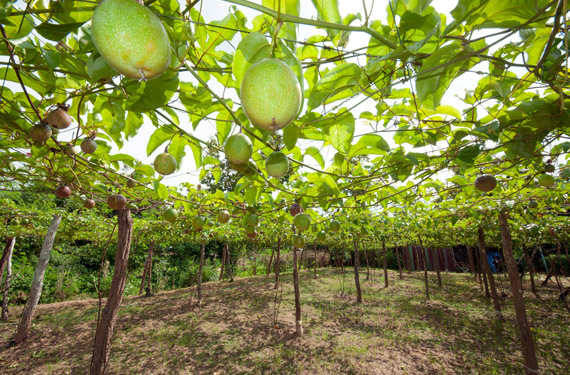
Two jobs deserve your attention before the first vine goes into the ground: site preparation and trellising. Passion fruit is a climbing vine. Without a strong support structure, the crop sprawls, disease spreads faster, spraying becomes difficult and yields fall. The trellis is not an optional extra you add later. It is part of the establishment cost you budget for from day one, alongside the seedlings.
This guide walks through the crop from the buying decision to the first harvest and beyond. You will find the price and spacing maths, the agronomy, the pest and disease picture, a framework for estimating costs and revenue, and a checklist of questions to ask any nursery before you pay.
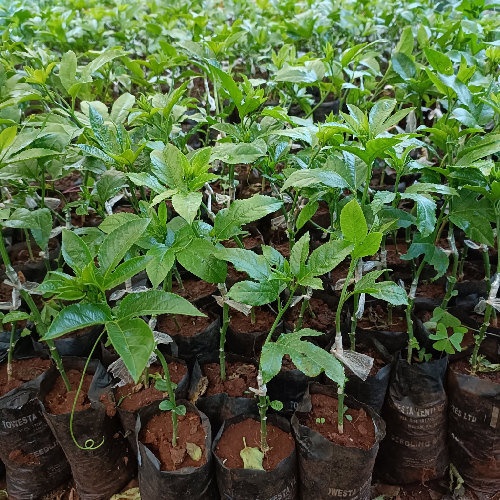
Grafted Purple Passion Fruit Seedlings in Kenya at Fruit Africa Veriplant nursery
What grafted purple passion fruit seedlings actually are
A grafted seedling is two plants joined into one. The lower part, the rootstock, supplies the root system. The upper part, the scion, is a cutting or bud taken from a purple passion fruit plant of the variety you want to grow. The nursery joins the two, holds them together while the tissues fuse at the graft union, then raises the young plant until the union is strong enough for field life.
This differs from a seed-grown plant, where a single seedling grows from a passion fruit seed and carries whatever traits that seed inherited. Seed-grown purple passion fruit varies more from plant to plant, and the roots are whatever the seed produced, with no selection for soil-borne disease tolerance or vigour.
Cuttings are a third route. A cutting taken from a parent vine roots on its own and grows true to that parent, but it carries the parent’s own root type rather than a selected rootstock. Cuttings have a place, yet they are not the same as grafted material and should not be sold as such.
The distinction matters because the word grafted gets stretched in the market. Not every nursery-raised passion fruit plant is grafted. Some sellers raise seedlings from seed, grow them in the same polybags, and the untrained eye sees little difference on the bench. A genuine grafted seedling shows a visible union, usually a slight change in stem thickness or a small scar or collar where scion meets rootstock. If a seller cannot show you that union or explain the grafting, treat the plant as seed-grown until proven otherwise.
Why growers choose grafted planting material
The main reason is the root system. Passion fruit fields in warm, wet or heavily cropped soils face root and collar problems that shorten the productive life of a vine. A rootstock selected for tougher root behaviour gives the plant a better chance against certain soil-borne pressures than an ordinary seedling root. That is the practical argument for grafting.
Be careful with how far you push this claim. The advantage a rootstock delivers depends on which rootstock the nursery used and how well matched it is to your soil and disease situation. A rootstock that resists one soil problem does not resist every problem. Grafting is not a vaccine against all field diseases, and it does not remove the need for good drainage, clean planting material and sensible crop management. Where a nursery states a specific rootstock advantage, ask which rootstock delivers it. If the answer is vague, treat the claimed benefit as unconfirmed.
The second reason growers graft is variety control. When the scion comes from a known purple passion fruit plant, you know the fruit type you are planting. That predictability helps when you are planning for a market that wants purple fruit of a consistent appearance.
What grafting will not do is guarantee a bigger harvest on its own. Yield on a passion fruit farm rests on many things at once: the quality of the planting material, whether the rootstock and scion are compatible and healthy, your site conditions, soil fertility, water supply, disease pressure in the area, the trellis, pruning, pollination, pest control, your own management and how carefully the fruit is harvested and handled. A grafted seedling improves your starting position. The rest of the result you earn in the field.
Grafted seedlings compared with ordinary seedlings
A short comparison helps here because the difference decides how you spend money and what risks you carry.
| Feature | Grafted seedling | Seed-grown seedling |
|---|---|---|
| Root system | Selected rootstock, chosen for root behaviour | Whatever the seed produced |
| Variety of fruit | Known scion variety | Varies between plants |
| Soil-borne disease tolerance | Depends on rootstock, often better | No selection, generally weaker |
| Uniformity across the field | More uniform | More variable |
| Unit price | Higher | Lower |
| Visible union | Present, inspectable | None |
A seed-grown seedling costs less at purchase. The saving looks attractive on a spreadsheet, but the field is where the difference shows. Variable plants ripen unevenly, some carry weaker roots, and a field that fails early wastes the money you spent on poles, wire, manure and labour. Grafted material carries a higher seedling price and a stronger foundation. Weigh the two against the full establishment cost, not against the seedling price alone.
Purple passion fruit characteristics
Passiflora edulis is a vigorous perennial climber. Left unchecked, a single vine throws long shoots in every direction and tangles into a dense mass. Managed on a trellis with regular pruning, the same vigour becomes a productive, workable canopy.
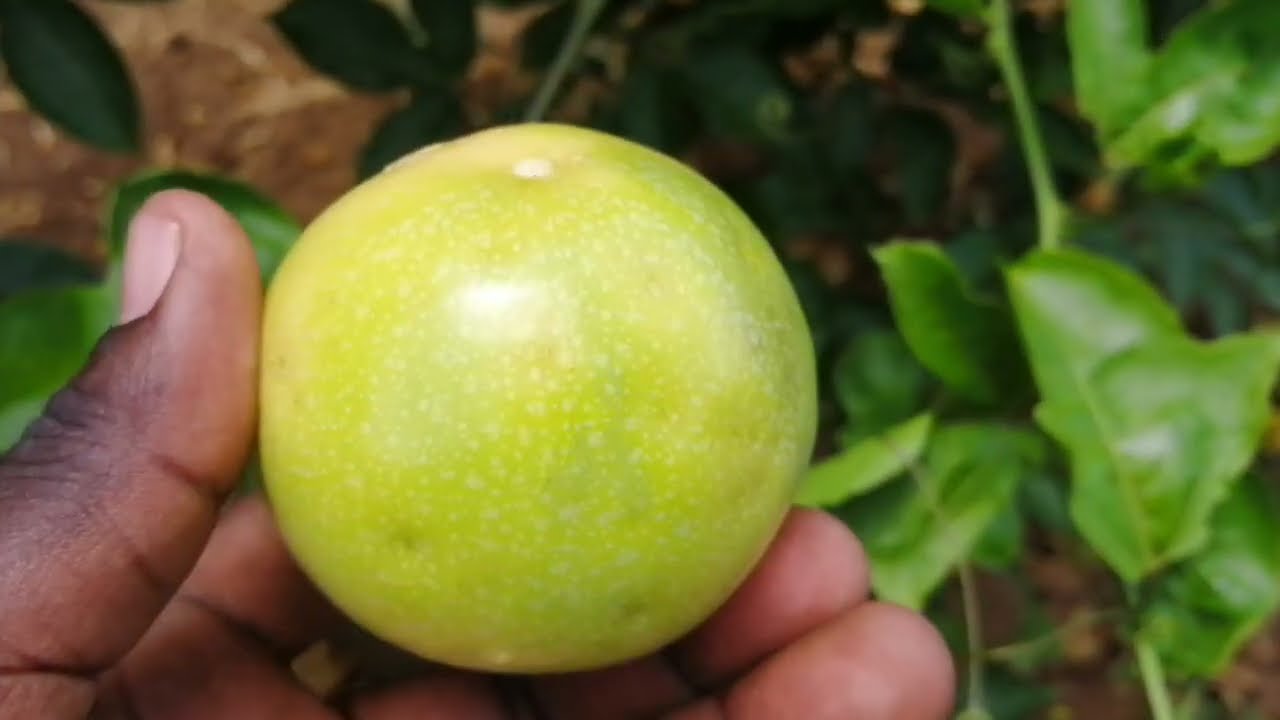
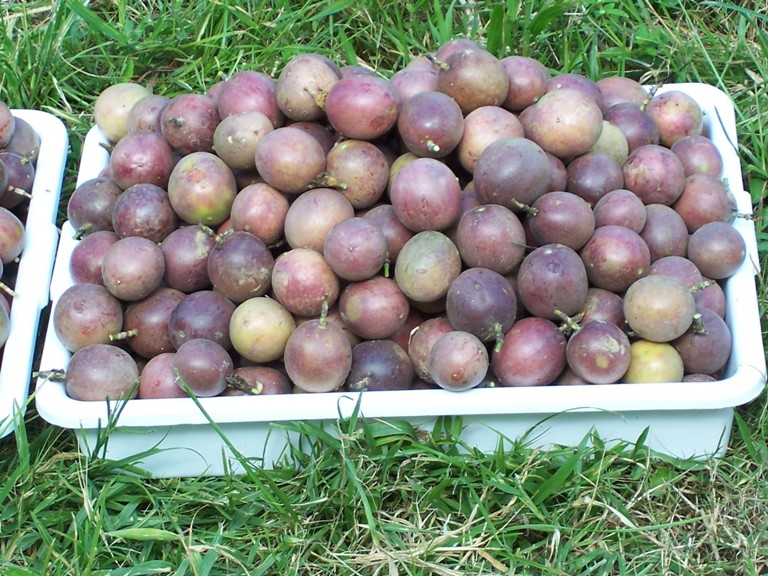
The purple fruit is round to slightly oval, smaller than the yellow type, with a smooth skin that turns from green to deep purple as it ripens. As the fruit matures further, the skin wrinkles, which many buyers read as a sign of ripeness and sweetness. The pulp is aromatic, with an orange to yellow colour and a good balance of sweetness and acidity that fresh-market buyers in Kenya prefer.
Purple passion fruit generally suits cooler, higher-altitude conditions better than the yellow type, which tends to tolerate lower, warmer areas. This is one of the clearest practical reasons to keep the two separate when you plan. Planting purple fruit in the wrong climate band leads to poor set, small fruit and disappointing yields, regardless of how good the seedling was.
Growing requirements in Kenya
Kenya does not offer one climate. Altitude, temperature, rainfall and soil change sharply over short distances, and purple passion fruit responds to all of them. A site that suits the crop in one county fails a short drive away because the altitude drops or the soil turns waterlogged. Assess your own site rather than assuming the crop performs everywhere.
Altitude and temperature
Purple passion fruit favours the medium to higher-altitude zones, broadly the mid-altitude highlands where days are warm and nights are cool. Very hot, low-lying areas push the crop towards the yellow type. Frost-prone spots and very cold high ground slow growth and hurt fruit set. Aim for a site with warm days, moderate nights and no frost.
Temperature drives both vine growth and flowering. Extended cold checks the plant. Extreme heat stresses it and reduces fruit quality. Moderate, stable warmth gives the best combination of vine health and steady fruiting.
Rainfall and water
The crop needs a reliable water supply spread across the year rather than a single heavy season followed by a long dry spell. Well-distributed rainfall supports continuous flushing and fruiting. Long dry periods without irrigation stress the vines, drop flowers and shrink fruit.
Where rainfall is uneven, plan for irrigation. Passion fruit does not tolerate drought well during flowering and fruit fill, and it does not tolerate waterlogging at any stage. The target is steady moisture in a free-draining soil, never standing water around the roots.
Soil and drainage
Deep, well-drained soils with good organic matter suit the crop. A medium-textured loam that holds moisture yet drains freely is close to ideal. Heavy clay that holds water and shallow soils that dry out quickly both cause problems.
Drainage deserves special weight. Passion fruit roots and collars rot in wet, poorly drained ground, and grafting onto a tougher rootstock reduces but does not remove this risk. If your site has a drainage weakness, fix it before planting through raised beds, ridging or drainage channels. Do not rely on the rootstock to survive standing water.
A slightly acidic to near-neutral soil pH suits the crop. Strongly acidic or strongly alkaline soils lock up nutrients and hold back growth.
Soil testing before you plant
A soil test taken before planting tells you the pH, the nutrient status and any correction the soil needs. Spending on a test early saves guesswork later. The results guide your lime decision, your manure and fertiliser plan and any structural work the drainage needs. Sample several points across the block, mix them and submit a representative sample to a recognised soil laboratory. Base your amendment plan on the report rather than on a blanket recommendation.
Preparing the land
Clear the block of perennial weeds, old crop debris and any diseased plant material from a previous passion fruit crop. Land that carried passion fruit before, especially a crop lost to soil disease, carries risk for the next planting. Where a previous crop failed to disease, take advice before replanting the same ground.
Open the soil through ploughing and harrowing so roots establish freely. On sloping land, plan the rows to reduce erosion and manage water movement. Where drainage is marginal, form ridges or raised planting rows so the collar of each plant sits above any water that pools after heavy rain.
Planting holes and soil amendments
Dig planting holes ahead of the rains so the soil settles before you plant. Separate the topsoil from the subsoil as you dig. Mix well-rotted manure into the topsoil and return that enriched soil to the hole. Well-decomposed manure improves soil structure, feeds soil life and supplies nutrients as the young plant establishes. Fresh, un-rotted manure burns roots and introduces weed seeds, so use manure that has broken down properly.
The exact quantity of manure per hole depends on your soil test and the fertility of your ground, so treat any single figure with caution and follow the advice your soil report and local agronomist give. Where the test shows a nutrient shortfall or a pH problem, correct it at this stage while the hole is open, because reaching the root zone later is harder.
Planting season
Time planting to the onset of reliable rains so the young vines establish with natural moisture behind them. Where you irrigate, you have more freedom on timing, but even then the start of a wet period reduces early water stress and helps the plants settle. Avoid planting into the peak of a dry spell without irrigation in place.
Planting grafted seedlings
Handle grafted seedlings gently. The graft union is the plant’s weak point until it fully knits, so avoid knocking or bending the stem at the join during transport and planting.
Set the plant at the correct depth. The graft union must sit above the soil line, never buried. Planting too deep invites the scion to root above the union, which defeats the purpose of grafting and exposes the plant to the collar problems the rootstock was chosen to resist. Firm the soil gently around the roots to remove air pockets without compacting the ground hard.
Water each plant in at planting. The first watering settles the soil around the roots and reduces transplant shock. Keep the young plants moist through the establishment weeks, watching for waterlogging in wet weather.
Mulch around the base once the plant is in. A layer of organic mulch conserves soil moisture, moderates soil temperature and suppresses weeds near the vine. Keep the mulch a short distance clear of the stem so the collar stays dry and airy.
Spacing and layout
Plant at 2 metres between plants within the row and 3 metres between rows. This layout gives each vine room for its canopy, keeps rows far enough apart for you to move through with a knapsack sprayer, and allows air to move through the field, which lowers disease pressure.
Row orientation matters where sunlight and slope allow a choice. Running rows so the canopy catches good light through the day helps fruiting, and on a slope the rows also serve water management. Fit the layout to your site rather than forcing a single orientation onto every block.
Plant population and seedling numbers
Here is the maths that turns spacing into an order.
- One acre is about 4,047 square metres.
- At 2 m × 3 m, each plant occupies about 6 square metres.
- 4,047 ÷ 6 is about 674 plants per acre in theory.
That 674 figure is the theoretical ceiling for a perfectly rectangular acre with no wasted space. Real farms lose ground to boundaries, headlands, access paths, drainage channels and a service area for handling fruit and inputs. After those deductions, many growers plant somewhere in the region of 600 to 650 vines per acre, then keep a small reserve of seedlings for replacing any that fail early.
The table below shows theoretical populations and seedling cost at KSh 100 per seedling for common plot sizes. Treat the plant counts as theoretical maximums, and expect your practical order to run a little lower after you deduct paths and service areas.
| Plot size | Approx. area (sq m) | Theoretical plants at 6 sq m each | Seedling cost at KSh 100 each |
|---|---|---|---|
| Quarter acre | 1,012 | about 168 | about KSh 16,800 |
| Half acre | 2,024 | about 337 | about KSh 33,700 |
| One acre | 4,047 | about 674 | about KSh 67,400 |
| Two acres | 8,094 | about 1,349 | about KSh 134,900 |
If you order a round 1,000 seedlings, the seedling cost works out at 1,000 × KSh 100, which is KSh 100,000. A thousand seedlings suits roughly one and a half acres at this spacing, with a margin for replacements. Match the order to your measured, usable planting area rather than to the theoretical ceiling, and add a modest reserve on top for gapping up.
Building the trellis
Passion fruit fruits on a support structure. A well-built trellis holds the canopy off the ground, spreads the fruiting wood to the light, keeps fruit clean and lets you spray, prune and harvest without fighting a tangle.
Posts
Set strong posts down the rows to carry the weight of a mature, fruiting canopy through wind and rain. A loaded vine is heavy, and a trellis that sags or collapses in the second year costs far more to fix than to build well the first time. Use durable posts, treated where necessary against rot and termites, and set the end and corner posts more firmly than the line posts because they carry the tension of the wires. Space the posts along the row at a distance the wire supports without sagging between them.
Wire and trellis height
Run galvanised wire along the tops of the posts to carry the vines. The canopy sits at a working height that lets a person of average height reach the fruit and prune the vines without a ladder, and high enough to keep the trailing growth and fruit clear of the ground. A common working height sits at roughly shoulder to head level for an adult. Set the exact height to suit the people who will work the farm.
Tension the wire properly and keep it tight as the canopy loads up. Slack wire drops the canopy towards the ground, which brings the fruit into contact with soil splash and raises disease risk.
Training and pruning
Train each young vine up a single main stem to the top wire, removing side shoots below the wire so the plant puts energy into reaching the trellis. A support string or stake from the ground to the wire guides the stem upward in the early weeks.
Once the leader reaches the top wire, pinch out the growing tip to encourage lateral shoots along the wire. These laterals carry the fruiting wood, and training them along the wire in each direction builds the productive canopy.
Pruning is ongoing work, not a one-off event. Remove dead, diseased and tangled wood, thin out crowded growth to let light and air into the canopy, and cut back excessive vigour so the plant fruits rather than running to leaf. An open, well-lit canopy sets more fruit, dries faster after rain and suffers less disease than a dense mass. Keep pruning tools clean, and disinfect them between plants when you are cutting out diseased wood so you do not spread infection down the row.
Water management
Passion fruit wants steady moisture without waterlogging. During establishment, keep the root zone moist so the young plants settle. Through flowering and fruit development, water stress drops flowers and shrinks fruit, so a reliable supply through these stages protects your yield.
Where rainfall is uneven, drip irrigation delivers water efficiently to the root zone and keeps the foliage dry, which lowers leaf disease pressure compared with overhead watering. Match the irrigation schedule to the weather, the soil’s water-holding capacity and the plant’s stage of growth rather than watering on a fixed calendar regardless of conditions. In wet spells, cut back and check that water drains away from the collars.
Feeding the crop
Passion fruit is a heavy, continuous producer once it comes into bearing, and continuous fruiting draws steadily on soil nutrients. A feeding plan built on your soil test keeps the vines productive without waste.
Early growth leans on nutrients that build the vine and its root system. As the plant moves into flowering and fruiting, the balance shifts towards the nutrients that support fruit set and fill. Well-rotted manure worked in at planting and topped up through the crop’s life feeds the soil and improves its structure alongside any mineral fertiliser you apply.
Avoid pushing the crop with heavy nitrogen once it is bearing, because excess nitrogen drives leafy growth at the expense of fruit and thickens the canopy in a way that favours disease. Follow the rates your soil report and a local agronomist recommend rather than a blanket figure, because the right amount depends on your soil’s starting fertility and the crop’s stage.
Weed control
Keep the base of each vine and the strip along the row clear of weeds, especially while the plants are young and competing for water and nutrients. Weeds also harbour pests and, in some cases, disease.
Mulch along the rows suppresses weeds while conserving moisture, and it is a low-risk method near the stems. Shallow hand weeding or careful mechanical weeding between rows keeps the alleys clean without disturbing the passion fruit roots, which run close to the surface. Where you use a herbicide, keep it off the vines and follow the registered product label and local regulations. Root damage from careless deep cultivation opens the door to soil-borne disease, so weed shallowly near the plants.
Pollination and fruit set
Fruit set depends on pollination, and pollination is a common weak point on passion fruit farms. Purple passion fruit flowers are structured so that pollinators, particularly larger bees such as carpenter bees, move pollen effectively. Honeybees contribute less because of the flower’s size and shape.
Anything that reduces pollinator activity reduces fruit set. Heavy or poorly timed pesticide spraying kills pollinators and cuts your harvest, which is one more reason to spray carefully and only when needed. A healthy population of pollinators around the farm supports set, so protecting nesting sites and avoiding blanket insecticide use near flowering both help. Where natural pollination is poor and the block is small, some growers hand-pollinate to lift set, though this is labour-intensive and suits only limited areas.
Pests
Passion fruit attracts a range of pests, and the mix varies with location and season. Watch for the following groups and scout the crop regularly so you catch problems early.
- Aphids, which suck sap, weaken shoots and spread viruses.
- Mites, which cause leaf stippling and stress in dry conditions.
- Thrips, which damage flowers and young fruit.
- Fruit flies, which sting fruit and cause it to drop or rot.
- Mealybugs and scale insects, which colonise stems and drain the plant.
- Nematodes in the soil, which damage roots, particularly on land that carried susceptible crops before.
Manage pests through integrated pest management rather than routine calendar spraying. Scout the crop, identify the pest correctly, and act when numbers cross a level that threatens the crop. Field hygiene, removal of fallen and infested fruit, encouragement of natural enemies and careful timing all reduce the need for chemicals. Where chemical control is warranted, choose a product registered for the pest on passion fruit, follow the label rate and pre-harvest interval, and observe local regulations. Do not use unregistered products or off-label rates, and protect pollinators by avoiding sprays during flowering where possible.
Diseases
Disease is the biggest threat to a passion fruit field’s productive life, and several of the worst problems attack the roots and collar where you cannot see them until the vine wilts. This is where planting clean, healthy grafted material and managing drainage pays off.
Watch for these categories:
- Fusarium wilt and collar rot, soil-borne problems that block the vine’s water transport or rot the collar, leading to sudden wilting and death of otherwise mature vines. Drainage, clean planting material and a suitable rootstock reduce the risk, though no rootstock removes it entirely.
- Root rots in waterlogged soils, which is why drainage sits so high on the priority list.
- Brown spot and other fungal leaf and fruit spots, which damage leaves, stems and fruit and spread faster in dense, wet canopies.
- Viral diseases, particularly the woodiness and mosaic viruses spread by aphids and by infected planting material, which distort leaves and fruit and shorten the productive life of the vine. There is no cure once a vine is infected, so prevention through clean material and aphid control is the only defence.
- Bacterial problems that spot leaves and fruit under wet conditions.
Preventing disease
Prevention beats cure on passion fruit, because several of the important diseases have no chemical remedy once they take hold. The pillars of prevention are clean planting material, good drainage, an open and well-pruned canopy that dries quickly, control of the insects that spread viruses, field hygiene that removes diseased material from the block, and clean tools that do not carry infection from plant to plant. Where a fungicide is warranted, use a registered product at the label rate and follow the pre-harvest interval and local regulations. Rotate away from land that lost a previous passion fruit crop to soil disease unless you have addressed the cause.
Recognising unhealthy seedlings
A field starts with the seedling, so learn to read the plant on the nursery bench. A healthy grafted seedling shows firm, green, unblemished leaves with no yellowing, spotting, curling or distortion. The stem stands upright and firm. The graft union is clean and well knitted, with no cracking, oozing or dieback above or below the join. When you tip the plant from its bag, the roots are white to cream, well spread through the medium and free of dark, rotten or knotted sections. Knots or galls on the roots point to nematode damage and are a reason to reject the plant.
Reject any seedling with wilting that watering does not fix, with leaf mottling or mosaic patterns that suggest virus, with a weak or poorly formed union, or with roots that smell of rot or show dark decay. A cheap but diseased seedling is the most expensive plant you will ever buy, because it costs you the trellis, the labour and the season around it.
Choosing quality grafted seedlings
Buying well is a skill, and a short inspection at the nursery protects the whole investment that follows. Work through the following before you pay.
- Confirm the type. You are buying purple passion fruit, Passiflora edulis, not the yellow type or another species. Ask the seller to state the type plainly.
- Confirm the graft. Ask to see the union and ask the seller to explain the grafting. A genuine grafted seedling shows an inspectable join. If none is visible, treat the plant as seed-grown.
- Ask about the scion variety and the rootstock. A nursery that grafts deliberately knows what it grafted onto what. Where a rootstock is named, note it. Where the seller is vague, treat any rootstock benefit as unconfirmed rather than assuming it.
- Check the roots. White, well-spread, healthy roots with no rot and no knots.
- Check the union quality. Clean, well-healed, firm, with healthy growth above and below.
- Check the scion. Firm stem, healthy green leaves, no distortion or spotting.
- Check the rootstock portion. Sound stem below the union, no lesions or rot at the collar.
- Look for disease. No mottling, no wilting, no spotting, no oozing.
- Ask about true-to-type material. The scion should come from a known purple passion fruit source so the fruit matches what you plan to sell.
Seedling age and size
Ask for a seedling that is well established with a healed graft union and enough root development to survive transplanting, rather than a plant chosen on age alone. A plant with a firm, knitted union and a good root ball transplants better than an older plant that has become pot-bound or a very young plant whose union has not fully healed. Judge readiness by the state of the union and the roots more than by a stated number of weeks, because growing conditions change how fast a seedling develops.
Hardening, transport and planting after delivery
Seedlings raised under nursery shade need hardening before they meet full field conditions. Hardening exposes the plants gradually to more sun and less frequent watering so they toughen up and survive the shift to the field. A plant moved straight from soft nursery conditions into open sun without hardening suffers heavy shock. Ask whether the seedlings have been hardened before you collect them.
During transport, protect the plants from wind, heat and physical damage, and guard the graft union against knocks. Keep the seedlings upright and shaded, and move them promptly so they do not dry out or overheat in transit.
Plant as soon as possible after delivery. Seedlings held too long in their bags after transport lose condition, dry out or become stressed. Prepare the holes before the seedlings arrive so you plant on the day of delivery or very soon after, water them in and mulch them without delay.
Flowering, fruiting and first harvest
After planting, the vine spends its early months building the frame, reaching the trellis and filling out the canopy. Flowering and the first fruit follow once the plant is established and the canopy is developed, and the exact timing shifts with variety, altitude, temperature, water and how well the crop is managed. Rather than fixing on a single number of months, watch the plant. A well-managed vine that has reached the wire, filled its laterals and set flowers is on track. Cold, water stress, poor nutrition or heavy disease pushes the first harvest later.
Flowers open, get pollinated, and develop into fruit over the following weeks. Fruit swells, colours from green to purple, and reaches harvest maturity as the skin darkens. Once a field comes into bearing, purple passion fruit produces over an extended period rather than in a single flush, so harvesting becomes a regular, repeated job rather than a one-off event.
Harvesting
Harvest purple passion fruit at the right maturity for your market. For the fresh market, fruit picked as the skin turns fully purple, or allowed to drop naturally when dead-ripe, carries the best eating quality. Fruit destined for a market some distance away is often picked slightly earlier so it travels without over-ripening on the road.
Pick regularly, because a bearing field produces continuously and fruit left too long over-ripens, wrinkles beyond what buyers want or falls and spoils. Handle the fruit gently to avoid bruising, which shortens shelf life and downgrades the fruit.
Post-harvest handling, sorting and grading
After picking, keep the fruit cool and out of direct sun. Passion fruit loses quality quickly in heat. Sort out damaged, diseased and undersized fruit, and grade the rest by size and appearance so you present a consistent product to the buyer. Clean, well-graded, undamaged fruit fetches a better price and builds a reputation with buyers who return. Pack the fruit in containers that protect it from crushing during transport.
Selling purple passion fruit
Plan your market before you plant, not after the first harvest arrives. A field in full bearing produces steadily, and a grower without a buyer arranged sells into whatever price the day offers. Several channels exist in Kenya for fresh purple passion fruit.
- Farmgate sales, where buyers or brokers collect from the farm. Convenient, but often at a lower price because the buyer carries the transport and risk.
- Direct sales to consumers, at markets or through local networks, which returns more per fruit but takes time and effort.
- Traders and brokers who aggregate fruit and move it to larger markets.
- Retailers, including grocers and shops that buy graded fruit consistently.
- Hotels and restaurants, which want reliable supply of good-quality fruit and often pay well for consistency.
- Processors who buy fruit for juice and pulp, usually at lower prices but in volume and with less strict appearance grading.
Each channel pays differently and demands a different grade and volume. Understanding what your local channels want, and at what price, before you plant shapes how much you plant and how you grade. Talk to buyers early and confirm what they pay and what they expect.
Estimating yield
Yield per acre for purple passion fruit varies widely between farms, and any single figure quoted without conditions misleads more than it helps. The honest position is that your yield depends on the factors listed throughout this guide working together. A farm with strong planting material, good site conditions, reliable water, a solid trellis, disciplined pruning, good pollination and tight pest and disease control produces far more than a neglected field on a marginal site.
Rather than trusting a headline yield number, build your own estimate from what you observe. Count the marketable fruit a representative sample of your vines produces over a period, scale that up across your plant population, and adjust for the fruit lost to grading. That approach grounds your projection in your own field rather than in a figure copied from an advert.
Factors that move yield
- Planting material quality and graft health.
- Site suitability, altitude and climate.
- Soil fertility and drainage.
- Water supply through flowering and fruiting.
- Trellis quality and canopy management.
- Pollination.
- Pest and disease pressure and how well you manage it.
- Pruning discipline and harvesting practice.
Farm establishment costs
Budget for the whole establishment, not the seedlings alone. The seedling price is the one figure fixed here at KSh 100 per seedling. Every other cost depends on your suppliers, your location and your choices, so this guide gives you a framework to build your own budget rather than invented figures.
The seedling cost is straightforward:
Number of seedlings × KSh 100 = seedling cost.
For a practical one-acre planting of around 674 vines at the theoretical maximum, the seedling cost is about KSh 67,400. Order a round 700 to allow for replacements and the cost is KSh 70,000. Order 1,000 seedlings, enough for roughly one and a half acres with a margin, and the cost is KSh 100,000.
Beyond the seedlings, budget for the following. Gather local prices for each before you commit, because these vary and none of them are supplied here.
- Trellis materials: posts, galvanised wire, tensioning hardware and the labour to erect the structure. On a per-acre basis this is often one of the largest establishment costs, so price it carefully before you plant.
- Land preparation: clearing, ploughing, harrowing, hole digging and any drainage work.
- Soil amendments: manure, lime if the soil test calls for it, and basal fertiliser.
- Irrigation: the system, its installation and the water supply, where you irrigate.
- Crop protection: pesticides and fungicides used through integrated management, and the equipment to apply them.
- Fertiliser through the crop’s life.
- Labour: planting, training, pruning, weeding, spraying, irrigating and harvesting.
- Transport of inputs and of fruit to market.
Assemble these into a simple establishment budget using your own quotes. The seedling line is the only figure you have a fixed price for. Treat every other line as a quote you must obtain locally.
Revenue and margin, without exaggeration
Revenue is not profit, and treating the two as the same misleads your planning. Work through the layers.
Gross revenue comes from the fruit you sell:
Marketable yield × farmgate price = gross revenue.
Or, counting by fruit:
Number of marketable fruits × average selling price per fruit = gross sales.
To estimate gross revenue you need two things this guide cannot supply: your realistic marketable yield and the current price in your market. Yield you estimate from your own field or from a defensible local benchmark. Price you obtain from your local market before you build any projection, because passion fruit prices move with season and location, and a figure invented on paper is worthless for planning. Find out what your intended buyers pay now, and check how the price moves across the year.
From gross revenue, subtract production costs to reach gross margin:
Gross revenue − production costs = gross margin.
Production costs include the running costs of the crop: fertiliser, crop protection, water, labour and harvesting. Gross margin is what remains before you account for the establishment costs you spread over the life of the field.
Net profit sits below gross margin, after you account for the establishment costs written down over the years the field produces, plus any finance costs, land costs and overheads. A field that produces for several years spreads its establishment cost over those seasons, which is why the productive lifespan of the field matters to the sums.
Build your projection with clearly labelled assumptions, and test it against a poor season as well as a good one. A realistic plan survives a bad year. An optimistic plan built on the best possible yield and the highest possible price collapses the first time the weather or the market turns.
How long a field stays productive
A well-established, well-managed purple passion fruit field produces for a number of seasons before yield and fruit quality decline enough to warrant replanting. The exact productive lifespan varies with disease pressure, site conditions and management, and disease is usually what ends a field’s life rather than age alone. A field hit early by soil-borne wilt or virus fails long before a clean, well-drained, well-managed field. Plan on replanting eventually, and factor the field’s productive years into how you spread the establishment cost.
Common mistakes to avoid
Several errors turn up again and again on passion fruit farms, and most are avoidable.
- Skimping on the trellis. A weak structure fails under a loaded canopy and costs more to rebuild than to build properly once.
- Planting into poorly drained ground. Wet soil rots roots and collars, and no rootstock fully saves a vine standing in water.
- Buying on price alone. A cheap, diseased or seed-grown plant sold as grafted wastes the whole season’s investment around it.
- Planting the graft union below the soil line, which lets the scion root and defeats the grafting.
- Neglecting pruning, which produces a dense, disease-prone canopy that runs to leaf instead of fruit.
- Blanket pesticide spraying that kills pollinators and cuts fruit set.
- No market plan, so a full harvest meets no arranged buyer.
- Ignoring the soil test and guessing at amendments.
When to replace weak vines and when to replant
Replace individual weak or dead vines early in the field’s life while the gaps are easy to fill and the replacements have time to catch up with the block. A single failed plant among healthy neighbours is a gapping-up job, not a reason to touch the rest of the field.
Whole-field replanting makes sense when yield and fruit quality across the block decline to the point where the running costs no longer justify the returns, or when disease has spread widely enough that saving individual vines is uneconomic. Where soil disease caused the decline, address the cause and consider rotating to different ground before replanting the same block with passion fruit.
Where to buy grafted purple passion fruit seedlings in Kenya
Buy from a nursery that grafts deliberately, states the type and variety plainly, and lets you inspect the planting material before you pay. Fruit Africa Veriplant supplies grafted purple passion fruit seedlings at KSh 100 per seedling and handles orders through the contacts below.
- Phone: 0714 994 444
- WhatsApp: https://wa.link/di12my
- Email: sales@fruitafrica.org
- Contact page: https://fruitafrica.org/contact-us/
- Request for quotation: https://fruitafrica.org/request-for-quotation/
Whichever nursery you use, apply the inspection checklist from this guide. A reputable supplier welcomes inspection and answers questions about the scion, the rootstock, the grafting and the nursery management without hesitation.
Questions to ask before you order
Put these to any nursery before you commit, and note the answers.
- Is the seedling purple passion fruit, Passiflora edulis, and not the yellow type?
- Is the plant genuinely grafted, and where is the union?
- What scion variety is grafted, and what rootstock is used?
- Are the seedlings raised from healthy, disease-free material?
- Have the seedlings been hardened for field conditions?
- What is the state of the roots, and are they free of rot and knots?
- How are the seedlings handled and transported to my farm?
- What condition should I expect the plants to arrive in, and how soon should I plant them?
- How many seedlings match my measured planting area at 2 m × 3 m?
- What are the delivery arrangements, and what is the total cost at KSh 100 per seedling for my order?
Frequently asked questions
How much are grafted purple passion fruit seedlings in Kenya?
Fruit Africa Veriplant sells grafted purple passion fruit seedlings at KSh 100 per seedling. Your total depends on how many you order, which follows from your usable planting area at 2 m × 3 m spacing. Remember to budget for the trellis, land preparation, soil amendments, water, crop protection and labour on top of the seedlings, because those costs together usually exceed the seedling bill.
How many grafted purple passion fruit seedlings do I need for one acre?
At 2 m × 3 m, each plant takes about 6 square metres, and an acre of about 4,047 square metres holds roughly 674 plants in theory. After deducting boundaries, paths, drainage and a service area, most growers plant closer to 600 to 650 vines per acre and keep a few spare seedlings for replacements. Measure your actual usable area rather than ordering to the theoretical ceiling.
What is the spacing for purple passion fruit?
Plant at 2 metres between plants and 3 metres between rows. This gives each vine room for its canopy, keeps the rows wide enough to move through with a sprayer, and allows air movement that lowers disease pressure.
How much does 1,000 grafted passion fruit seedlings cost?
At KSh 100 per seedling, 1,000 seedlings cost KSh 100,000. A thousand seedlings suits roughly one and a half acres at 2 m × 3 m, with a margin for replacements.
What is the difference between grafted and ordinary passion fruit seedlings?
A grafted seedling joins a chosen purple passion fruit scion onto a selected rootstock, giving a known fruiting variety on a root system chosen for its behaviour, often for better tolerance of certain soil-borne problems. An ordinary seed-grown seedling grows from seed with variable traits and whatever roots the seed produced. Grafted plants cost more and offer a stronger, more predictable foundation, though the field result still depends on your management.
When should I plant purple passion fruit in Kenya?
Plant at the start of reliable rains so the young vines establish with natural moisture, or at a time of your choosing where you irrigate. Avoid planting into a dry spell without irrigation in place.
How long does purple passion fruit take to start producing?
The vine first builds its frame, reaches the trellis and fills the canopy, then flowers and fruits once established. The exact timing shifts with variety, altitude, temperature, water and management, so watch the plant rather than fixing on a set number of months. Cold, water stress, poor nutrition and disease all push the first harvest later.
Does passion fruit need a trellis?
Yes. Passion fruit is a climbing vine that fruits on a support structure. A strong trellis holds the canopy off the ground, keeps fruit clean, and lets you prune, spray and harvest. Build it before or at planting, because it is part of the establishment cost, not an afterthought.
What type of soil is suitable for purple passion fruit?
Deep, well-drained soils with good organic matter and a slightly acidic to near-neutral pH suit the crop. Drainage is the priority, because roots and collars rot in waterlogged ground. Test your soil before planting and correct any pH or nutrient problem while the planting holes are open.
How often should passion fruit be watered?
Keep the root zone steadily moist without waterlogging, especially through flowering and fruit development when water stress drops flowers and shrinks fruit. Match watering to the weather, the soil and the plant’s stage rather than a fixed calendar. Drip irrigation delivers water efficiently and keeps foliage dry, which lowers leaf disease.
What diseases affect purple passion fruit?
The serious threats include fusarium wilt and collar rot, root rots in wet soils, fungal leaf and fruit spots such as brown spot, viral diseases like woodiness and mosaic spread by aphids and infected material, and bacterial spots. Several have no cure once established, so prevention through clean planting material, good drainage, an open canopy, aphid control and field hygiene matters more than treatment.
How do I identify healthy grafted passion fruit seedlings?
Look for firm green leaves with no spotting or distortion, an upright firm stem, a clean well-healed graft union with the join above the soil line, and white, well-spread roots free of rot and knots. Reject any plant with wilting, leaf mottling that suggests virus, a weak union, or rotten or knotted roots.
Are grafted seedlings a guarantee of higher yields?
No. Grafting improves your starting position through a stronger root system and a known variety, but yield rests on planting material quality, rootstock and scion compatibility, site conditions, soil fertility, water, disease pressure, trellising, pruning, pollination, pest control, your management and harvesting. Grafting helps. It does not replace good farming.
What is the difference between purple and yellow passion fruit?
Purple passion fruit, Passiflora edulis, produces the smaller dark purple fruit favoured by the Kenyan fresh market and generally suits cooler, higher-altitude areas. Yellow passion fruit produces a larger yellow fruit and tolerates lower, warmer areas better. Match the type to your altitude and your market, and confirm you are buying the purple type when you order.
Where can I buy grafted purple passion fruit seedlings in Kenya?
Fruit Africa Veriplant supplies grafted purple passion fruit seedlings at KSh 100 per seedling. Reach them on 0714 994 444, by WhatsApp at https://wa.link/di12my, by email at sales@fruitafrica.org, through the contact page at https://fruitafrica.org/contact-us/, or by requesting a quotation at https://fruitafrica.org/request-for-quotation/. Inspect the planting material and ask the buying questions in this guide before you pay.
Before you place an order, measure your usable planting area, confirm your site suits purple passion fruit at your altitude, sort out drainage and your trellis plan, and gather local prices for the inputs this guide could not fix. Then order seedlings to match your measured area at 2 m × 3 m, with a small reserve for replacements, and inspect every plant against the checklist before it leaves for your farm.