
Description
- Grafted purple passion fruit seedlings in Kenya at KSh 100 each from Fruit Africa Veriplant. Learn spacing, planting, trellising, yield and farm costs.
Grafted Purple Passion Fruit Seedlings in Kenya: Price, Spacing, Planting and Farming Guide
Fruit Africa Veriplant sells grafted purple passion fruit seedlings at KSh 100 each. The recommended spacing is 2 metres between plants and 3 metres between rows, which gives each plant about 6 square metres of ground. At that spacing, one acre holds roughly 674 plants in theory, though the practical number you order is usually lower once you allow for paths, boundaries, and access points.
Purple passion fruit is Passiflora edulis, the species grown for fresh fruit and juice in Kenya. The grafted seedling you buy is not the same as a seed-grown plant. A grafted seedling carries a chosen fruiting variety joined to a rootstock, and the rootstock is selected for root strength and tolerance of soil problems. The point of grafting is to give the vine a stronger root system and better field survival than a seed-grown plant would give you on the same site.
Before you buy, confirm the passion fruit type, the grafting status, the health of the graft union, and the condition of the roots. These checks matter more than the price per seedling, because a weak plant costs you a full season. Site preparation and trellising also decide how the crop performs. Passion fruit is a vine, not a tree, and it needs a trellis from day one.
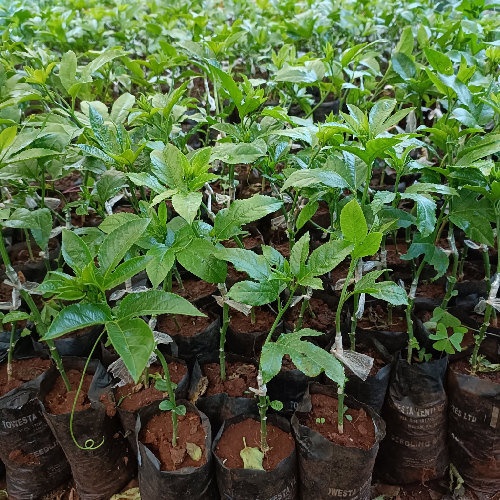
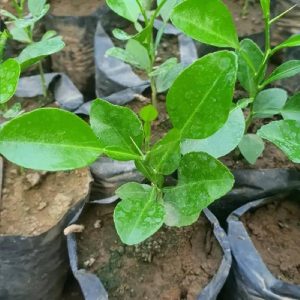
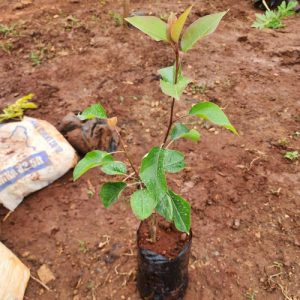
Grafted purple passion fruit seedlings at Fruit Africa Veriplant nursery
What Are Grafted Purple Passion Fruit Seedlings?
A grafted purple passion fruit seedling is a young vine made by joining two plants. The top part, called the scion, comes from a selected purple passion fruit variety that produces the fruit you want to sell. The bottom part, called the rootstock, comes from a plant selected for root vigour and soil tolerance. The two are joined at a graft union, and the vine grows from that union.
Grafting in passion fruit is not the same as grafting a mango or an avocado. Passion fruit is a fast-growing vine with a relatively short commercial life, so the rootstock choice is about soil performance and root health rather than tree size and canopy shape. Different rootstocks carry different strengths and weaknesses. Some rootstocks tolerate certain soil-borne problems better than others. Some grow faster. Some suit heavier soils. Ask the nursery what rootstock sits under the scion before you buy, and treat any claim about rootstock performance as something to verify rather than assume.
Purple passion fruit is a different species from yellow passion fruit. Purple passion fruit, Passiflora edulis, produces the round purple fruit sold fresh and processed in Kenya. Yellow passion fruit, Passiflora edulis flavicarpa, produces a larger, more acidic fruit and often serves as a rootstock for purple varieties because of its vigour and soil tolerance. Do not confuse the two when you buy, because the fruit type you plant determines the market you sell into.
Seed-grown plants also exist in the market. A seed-grown purple passion fruit plant carries genetic material from a mother plant and a pollen parent, so it does not always match the fruit quality of the mother. A grafted plant carries the exact scion of a known variety, so the fruit matches the parent vine. Grafting does not guarantee high yield. Farm performance depends on planting material quality, rootstock and scion compatibility, site conditions, soil fertility, water availability, disease pressure, trellising, pruning, pollination, pest management, farmer skill, and harvesting practices.
How Passion Fruit Grafting Works in Practice
Grafting a passion fruit vine starts with a rootstock raised from seed. The rootstock is grown in a nursery bag until the stem reaches pencil thickness. At that stage, the nursery takes a scion from a selected mother vine and joins the two.
Several grafting methods work with passion fruit. The most common method used by commercial nurseries is cleft grafting, where the rootstock is cut clean across and a wedge-shaped scion is inserted into a slit at the top of the rootstock. The union is wrapped with grafting tape and kept under shade while the join heals. Some nurseries use side grafting or approach grafting, and each method produces a different looking graft union.
You do not need to know the grafting technique to buy a good seedling. You need to know what a healthy graft union looks like. A healthy union is fully healed, with no gap, no crack, and no oozing wound. The scion and rootstock sit flush, and the join is firm when you press it gently. A union that looks fresh, wet, or separated has not healed, and the vine will fail in the field.
The graft union also tells you where to plant. The union must sit above the soil surface at planting. If soil covers the union, the scion can send its own roots into the ground, and the rootstock loses its effect. Keep the union at least 10 to 15 centimetres above the soil line, and check it after heavy rain to make sure soil has not piled around the stem.
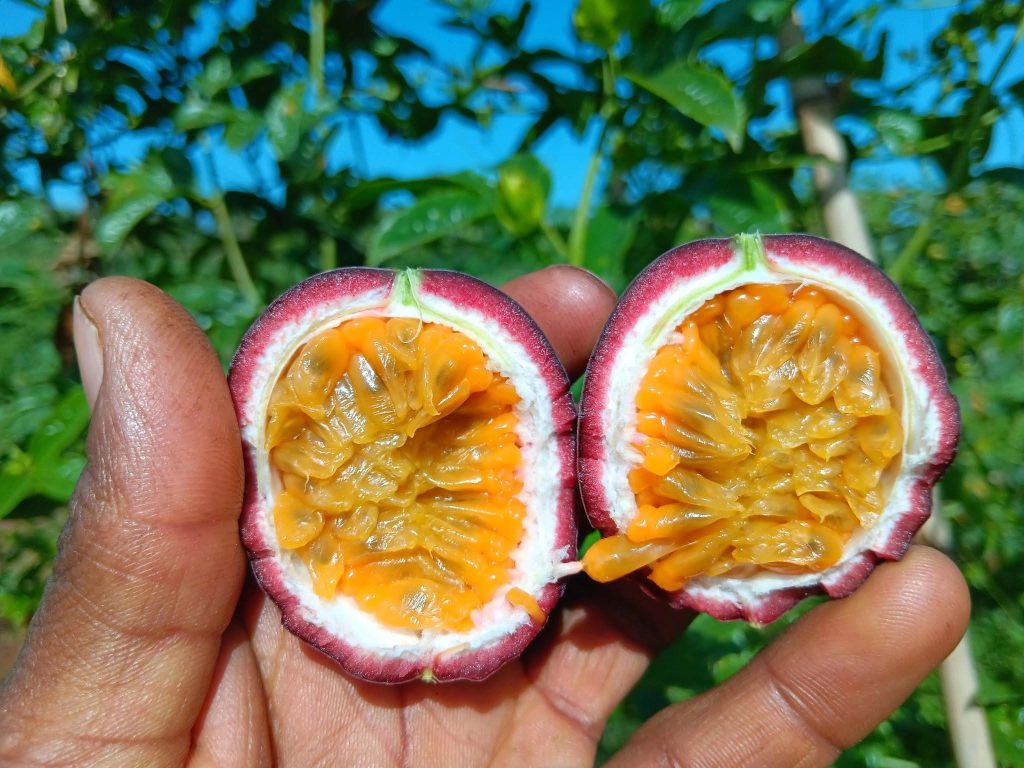
Purple Passion Fruit
Purple Passion Fruit Characteristics
Purple passion fruit produces a round to oval fruit with a deep purple skin when ripe. The skin wrinkles slightly as the fruit matures, which is normal and not a sign of spoilage. Inside, the fruit holds yellow-orange pulp with black seeds. The flavour is sweet and aromatic, which suits fresh consumption and juice processing.
The vine grows as a climbing plant. It produces tendrils that grip the trellis wire, and it grows fast under good conditions. Left untrained, the vine becomes a tangled mass that produces few fruits and many disease problems. Trained on a trellis with regular pruning, the vine produces fruit along new growth for several seasons.
Purple passion fruit vines have a limited commercial life. Many Kenyan fields produce well for two to three years and then decline, often because of disease buildup and old wood. Some farmers replant after two seasons, while others push to three or four years with careful management. Plan for replacement rather than expecting a field to last a decade.
Grafted Seedlings Versus Ordinary Seedlings
The market offers three types of purple passion fruit planting material. Grafted seedlings, seed-grown seedlings, and cuttings. Each has strengths and weaknesses, and each suits a different situation.
Grafted seedlings carry a chosen variety on a chosen rootstock. The fruit matches the parent vine, and the root system comes from a selected rootstock. The cost per plant is higher than seed-grown material, and availability depends on the nursery.
Seed-grown seedlings cost less per plant and are easy to produce in large numbers. Fruit quality varies from plant to plant because the pollen parent is unknown. Root systems vary too. Some seed-grown plants perform well, and some do not.
Cuttings produce plants identical to the mother vine, and the root system comes from the cutting itself. Cuttings root easily in passion fruit, and they carry the same fruit type as the mother plant. The root system of a cutting is not selected for soil tolerance the way a rootstock is, so cutting-raised plants behave differently from grafted plants.
For a commercial farmer who wants uniform fruit and stronger roots, grafted seedlings offer the most predictable start. For a small farmer testing the crop on a small plot, seed-grown material may be enough. Match the planting material to your goal.
Purple Passion Fruit Growing Requirements in Kenya
Purple passion fruit suits warm, frost-free areas with well-distributed rainfall. Altitude affects temperature, and temperature affects flowering. In Kenya, passion fruit grows well from about 1,200 to 1,800 metres above sea level in areas with reliable moisture. Some farms outside that range produce fruit with careful management, and some farms inside the range fail for other reasons, so treat the altitude figure as a starting point rather than a fixed rule.
Temperature affects flowering more than any other climate factor. Purple passion fruit flowers poorly in cold conditions and suffers in extreme heat. Daytime temperatures between 20 and 30 degrees Celsius suit the crop. Night temperatures below 10 degrees slow growth and reduce fruit set.
Rainfall of about 900 to 1,500 millimetres per year, well distributed, supports the crop. A dry spell longer than three weeks during flowering and fruit development cuts yield. Irrigation covers the gap in areas with unreliable rain.
Soil matters as much as climate. Purple passion fruit needs deep, well-drained soil with good organic matter. The ideal pH range runs from 5.5 to 6.5. Waterlogged soil kills the vine, because passion fruit roots do not tolerate standing water. Test your soil before planting, because corrections like lime take weeks to react.
Temperature Effects Through the Season
The flowering cycle responds to temperature in a way that Kenyan farmers notice through the year. Cool mornings and warm afternoons give the best fruit set. Extended hot spells above 32 degrees reduce pollen viability and cause flower drop. Cold spells below 12 degrees slow flowering and delay fruit development.
If your farm sits at the cooler end of the suitable range, plant on a slope facing the sun to warm the vines earlier in the day. If your farm sits at the warmer end, plant on a slope facing away from the afternoon sun to reduce heat stress.
Rainfall Distribution and Irrigation Backup
Rainfall distribution matters more than the annual total. A farm that receives 1,400 millimetres across nine months of steady rain performs better than one that receives the same total in three months of heavy storms and nine months of dry weather.
Plan irrigation for the gap between rainy seasons. Drip irrigation delivers water to the root zone without wetting the leaves, which reduces disease pressure. A drip system sized for one acre costs money upfront, but it reduces yield loss from dry spells and gives you more control over vine growth.
Where Purple Passion Fruit Performs Well in Kenya
Purple passion fruit grows in many parts of Kenya, and the crop has a longer history in some counties than others. The central highlands, including parts of Kiambu, Murang’a, Nyeri, and Kirinyaga, support the crop where altitude and rainfall suit. The Rift Valley counties of Nakuru, Kericho, and Bomet also grow passion fruit. Western Kenya, including Kakamega, Bungoma, and Kisii, produces the crop in suitable pockets. Parts of the eastern highlands, including Embu, Meru, and Tharaka Nithi, also grow purple passion fruit.
Suitability depends on local altitude, temperature, rainfall, soil, water availability, and disease pressure. Do not assume your farm suits the crop just because a neighbouring county grows it. Check your own conditions first, and plant a small trial block if you are unsure.
Matching the Variety to the Site
Different purple passion fruit selections perform differently across sites. A selection that fruits well in the cooler central highlands may flower poorly in the warmer lowland areas. Ask your nursery which selection suits your altitude band, and confirm how the vines performed at similar farms before you commit.
Disease Pressure Varies by Site
Fusarium wilt and Phytophthora root rot hit hardest where the soil stays wet and where passion fruit has grown before. If your site has a history of passion fruit, grafted plants on a tolerant rootstock give you a better chance than seed-grown plants. Crop rotation before replanting reduces disease pressure further.
Land Preparation
Prepare your land two to three months before your seedlings arrive. Rushing this stage costs you a full season, because a vine planted into poorly prepared ground takes longer to establish and produces less in the first year.
Clear the site of weeds, bushes, and old stumps. Do not burn the cut material on the plot, because fire kills soil life. Stack the material away from the planting area, and use it later as mulch after it dries.
Plough to loosen the topsoil, then harrow to break clods and level the surface. If your soil is compacted, consider subsoiling to break the hardpan. A hardpan layer traps water above it and blocks root growth below it, which is the worst combination for passion fruit.
Test the soil before planting. Send a sample to a laboratory for pH, organic matter, and basic nutrients. If the pH falls below 5.5, apply lime at the rate the soil test recommends, and work it into the topsoil at least one month before planting.
Mark your rows and planting points before you dig. At 2 metres between plants and 3 metres between rows, you peg a grid across the field. Straight rows make trellis construction, pruning, and harvest easier.
Correcting Drainage Before Planting
Drainage failures kill passion fruit faster than drought. If your site collects water after heavy rain, fix it before you plant. Options include open drains along the lowest part of the field, raised beds, and subsurface drainage using perforated pipes buried below the root zone.
A simple test tells you whether drainage is a problem. Dig a hole 60 centimetres deep, fill it with water, and watch how long the water takes to drain away. If the water still sits in the hole after 24 hours, drainage is poor, and you need to correct it before planting.
Preparing Sloping Land
On sloping land, plant along the contour rather than up and down the slope. Contour rows slow runoff, hold moisture, and reduce soil erosion. Dig a small basin on the uphill side of each planting hole to capture runoff. On steep slopes, consider building contour bunds or terraces.
How to Prepare Planting Holes
Dig each planting hole 45 to 60 centimetres wide and 45 to 60 centimetres deep. Keep topsoil and subsoil in separate heaps. Mix the topsoil with 10 to 20 kilograms of well-rotted manure or compost, and add 100 to 150 grams of a phosphorus-rich fertiliser if your soil test shows phosphorus shortage. Mix thoroughly so no concentrated lumps remain.
Do not fill the hole with raw manure. Fresh manure burns young roots. Let the prepared hole rest for one to two weeks before planting so the soil settles and the manure begins to break down.
Hole Spacing and Layout
At 2 metres between plants and 3 metres between rows, you plant in a grid. Mark every planting point with a peg, and use a string line to keep the rows straight. Straight rows make trellis construction easier, because you can run wire along a consistent line rather than weaving around irregular spacing.
If your field has an odd shape, keep the spacing consistent within each block and adjust the boundary rows to fit the shape. Do not shrink the spacing inside the block, because crowded vines compete for light and air and produce poorly.
How to Plant Grafted Purple Passion Fruit Seedlings
Plant at the start of the rainy season, in March to May or October to November, when soil moisture supports the young vine without irrigation. If you have irrigation, you have more flexibility with timing.
Water the seedling in its bag an hour before planting. Remove the bag carefully by cutting it away rather than pulling the plant by the stem. Keep the root ball intact.
Place the seedling in the hole with the graft union sitting clearly above the soil line. Burying the graft union allows the scion to root, which defeats the purpose of grafting. Keep the union about 10 to 15 centimetres above the soil surface.
Fill around the root ball with the amended topsoil, and press gently to remove air pockets. Water thoroughly with 10 to 15 litres per plant.
Spread mulch in a ring around the vine, keeping the mulch a few centimetres away from the stem. Mulch holds moisture, suppresses weeds, and feeds soil life. Drive a stake beside each vine to support the young plant and to guide it toward the trellis wire.
Planting Depth Matters More Than It Looks
Planting too deep is the most common planting mistake. When soil covers the graft union, the scion sends roots into the ground, the rootstock loses its effect, and the plant behaves like a seed-grown vine. When soil covers the stem above the union, the stem rots.
Planting too shallow is also a mistake. When the root ball sits partly above the soil surface, roots dry out and the vine wilts. Aim for the top of the root ball level with the surrounding soil, and the graft union 10 to 15 centimetres above that.
Watering In After Planting
The first watering settles the soil around the roots and removes air pockets. Give each vine 10 to 15 litres slowly, so the water soaks in rather than running off. If your soil is sandy, water in two stages with a short gap, because sandy soil drains fast. If your soil is heavy, water slowly and check that no puddle forms at the base of the stem.
Spacing and Number of Seedlings Per Acre
Fruit Africa Veriplant recommends 2 metres between plants and 3 metres between rows for grafted purple passion fruit. Each plant occupies about 6 square metres at this spacing.
One acre equals approximately 4,047 square metres. Divide 4,047 by 6 and you get about 674 plants per acre in theory. The practical number you order is usually lower, because boundaries, paths, access points, drainage channels, and service areas take up space.
| Farm Size | Theoretical Plants | Practical Planning Range |
|---|---|---|
| 1 acre | 674 | 600 to 650 |
| 2 acres | 1,348 | 1,200 to 1,300 |
| 5 acres | 3,370 | 3,000 to 3,250 |
Order 5 percent extra for gap filling. Replacement plants keep the field uniform and help you maintain a steady harvest.
Why Spacing Affects Yield More Than Plant Count
More plants per acre does not always mean more fruit. Passion fruit needs airflow and light to produce well. Crowded vines shade each other, reduce airflow, and encourage disease. A field with 600 plants spaced correctly can outproduce a field with 800 plants crowded together.
The 2 m by 3 m spacing gives each vine room to grow along the trellis and enough air movement to reduce fungal problems. Follow it unless you have a specific reason to adjust, and if you adjust, adjust for airflow rather than for plant count.
Different Farm Shapes and How to Adjust
A long narrow field works well with rows running lengthwise. A square field works well with rows running east to west, so morning and afternoon sun reach both sides of the trellis. A field with an awkward shape may need a small compromise on spacing at the boundaries, but keep the interior grid consistent.
Seedling Cost at KSh 100 Per Seedling
Seedling cost comes from multiplying the number of plants by KSh 100. Use the practical planning range rather than the theoretical maximum when you budget.
| Farm Size | Practical Plants | Seedling Cost at KSh 100 |
|---|---|---|
| 1 acre | 620 | KSh 62,000 |
| 2 acres | 1,240 | KSh 124,000 |
| 5 acres | 3,100 | KSh 310,000 |
| 1,000 seedlings | 1,000 | KSh 100,000 |
The seedling price covers only the plant. You still need to budget for land preparation, planting holes, manure, fertiliser, trellis posts, trellis wire, labour, irrigation, mulch, and pest management. Get quotes for each item from local suppliers before you commit.
How the Seedling Cost Compares to the Total Budget
Seedlings make up a large share of the first-year budget on a passion fruit farm, but they are not the only cost. Trellis material often costs more than the seedlings themselves, because you need posts, wire, and labour to build a structure that carries the fruit load. Land preparation, manure, and planting labour add more. Plan your budget with all categories in view rather than focusing on the seedling price alone.
Buying in Bulk Versus Buying in Batches
Buying all your seedlings at once gives you a uniform block that flowers and fruits on the same cycle. Buying in batches staggers your harvest but complicates trellis construction and field management. For a commercial block, buy all seedlings from one batch, and order 5 percent extra for replacements.
Passion Fruit Trellis Design
The trellis is not optional. A passion fruit vine needs support from the moment it leaves the nursery bag, because the vine grows along the ground and produces poorly if it cannot climb.
A standard trellis uses wooden or concrete posts driven into the ground at 6 to 8 metres along each row. Posts sit at least 2 metres above ground level. Between posts, run a top wire and one or two lower wires. The top wire carries the main vine canopy, and the lower wires support young growth and fruit load.
Post spacing at 6 metres along a 3 metre row spacing gives one post per 18 square metres. On one acre, that works out to about 220 posts. Post cost depends on the material. Wooden posts cost less than concrete posts, but they rot faster. Concrete posts last longer and cost more.
Wire tension matters. Slack wire sags under fruit load and breaks vines. Tighten the wire at installation and check it after the first season.
Trellis height affects airflow and light. Keep the top wire at about 1.8 to 2 metres above the ground. Higher trellises increase airflow under the canopy but make pruning and harvest harder.
Post Material and Post Depth
Wooden posts work well if you treat them against termites and rot. Use a preservative that does not leach into the soil around the vine. Concrete posts cost more upfront, but they last many seasons and do not need treatment.
Drive each post at least 60 centimetres into the ground. On soft soils, go deeper. The post must hold steady when the vine carries a heavy fruit load and when wind pushes against the trellis.
Wire Gauge and Tensioning
Use a wire gauge that carries the weight of a mature vine without stretching. Too thin a wire stretches under fruit load and sags, which damages vines and pulls the trellis out of shape. Too thick a wire costs more than you need.
Run the top wire along the top of the posts and secure it with staples or wire clips. Run a second wire about 60 centimetres below the top wire, and a third wire about 120 centimetres below the top wire if your trellis is tall. The lower wires support young shoots and fruit that hang below the top canopy.
Tension the wire with a wire strainer at the end of each row. A well-tensioned wire stays level through the season.
End Posts and Anchors
End posts carry the pull of the wire across the whole row. Set end posts deeper than intermediate posts, and brace them against the pull. A common approach is a diagonal brace from the top of the end post to a short anchor post set in the ground a metre away.
If the end post is not braced, the wire tension pulls it inward, and the whole row slackens over the season.
Row Orientation and Light
Rows running east to west give each vine sunlight on both sides through the day. Rows running north to south give strong sunlight on one side in the morning and on the other side in the afternoon. Either works, but east to west rows generally give more even light across the canopy, which supports better fruit set.
Training Vines onto the Trellis
Training begins from day one. Tie the young vine to the stake with soft ties that do not cut the stem. Guide the vine toward the top wire as it grows. Once the vine reaches the top wire, pinch the growing tip to encourage branching. Let two side branches develop along the wire, one in each direction. These branches become the main fruiting arms of the vine.
Remove any shoots that grow below the top wire. The vine should carry its growth above the trellis, not along the ground. Remove tendrils that wrap around the wire in a mess, because they make pruning difficult later.
Early Training Rhythm
During the first three months, check the vine every week. Tie new growth to the stake, remove side shoots below the top wire, and guide the main stem upward. Small adjustments each week prevent the vine from developing a shape that is hard to correct later.
What to Do When a Vine Reaches the Wire
When the main stem reaches the top wire, cut the tip. This forces the vine to branch. Choose two strong side branches, one running each way along the wire, and tie them in place. Remove all other branches at this stage, so the vine puts its energy into the two main arms.
Pruning and Canopy Management
Pruning shapes the vine for production and keeps the canopy open for airflow. Passion fruit produces fruit on new growth, so the aim is to keep fresh growth coming while removing old wood that stops producing.
After each major harvest, cut back the fruiting branches to about 30 centimetres from the main arm. This encourages new shoots that become the next harvest cycle. Remove dead, damaged, and crossing branches. Thin the canopy so light reaches the inner branches and air moves through the vine.
Do not prune heavily during flowering or fruit development. Heavy pruning during those stages removes flowers and young fruit, which costs you yield. Schedule major pruning after harvest and light pruning between cycles.
Renewal Pruning Between Cycles
Passion fruit vines produce on fresh growth, and old wood stops bearing after a few cycles. When the main arms begin to look woody and produce fewer flowers, cut them back hard and let new shoots grow from the base. This renewal pruning extends the productive life of the vine.
Managing the Canopy Above the Wire
Keep the canopy above the top wire rather than letting vines drape over the sides. Vines that hang below the wire produce fruit close to the ground, where fruit rot and pests do more damage. Lift low branches back onto the wire, and remove branches that hang below the lower wire.
Water Management
Purple passion fruit needs consistent moisture, and it does not tolerate waterlogged soil. Young vines need watering two to three times a week during dry spells. Mature vines need watering every five to seven days during dry spells. Drip irrigation delivers water to the root zone without wetting the leaves, which reduces disease pressure.
Signs of water stress include wilting in the afternoon, yellowing lower leaves, and slow new growth. Signs of overwatering include yellowing leaves across the plant, root rot, and vine collapse. Check soil moisture before you irrigate. If the soil stays moist a few centimetres below the surface, the vine has enough water.
Reading Soil Moisture Without a Meter
Push a finger or a small stick into the soil a few centimetres from the stem. If the soil sticks to your finger and feels cool, moisture is adequate. If the soil crumbles and feels warm, the vine needs water. Check two or three points in the field, because moisture varies with soil texture and slope.
Drip System Sizing and Layout
A drip system for one acre uses a tank or pump, a filter, a main line, and lateral lines with two emitters per vine. Run lateral lines along each row, and place emitters on opposite sides of the vine so water spreads across the root zone.
Flush the filter weekly and check emitters for blockage every month. A blocked emitter starves the vine slowly, and the damage shows up weeks later as poor growth and poor fruit set.
Fertilizer and Nutrition
Fertiliser should follow the vine’s growth stage and soil test results. Young vines need balanced nutrition to build root and leaf. Fruiting vines need more potassium for fruit development.
Apply well-rotted manure at 10 to 20 kilograms per vine per year, spread in a ring around the stem and kept away from direct contact. Supplement with a balanced NPK fertiliser, split across two or three applications during the growing season. Where your soil test shows low potassium, use a potassium-rich blend.
Read the leaves for signs of shortage. Yellowing between the veins points to magnesium shortage. Yellowing across whole leaves points to nitrogen shortage. Purple or reddish leaf edges point to phosphorus shortage. Take a photograph of the symptom and send the photograph to your agronomist before you apply any product.
Split Applications and Timing
Passion fruit responds best to small, frequent feeds rather than large, infrequent ones. Split your annual fertiliser into two or three applications through the growing season. Apply the first at the start of the rains, the second at the start of flowering, and the third as the first fruit fills.
Avoid applying fertiliser during drought unless you can water it in. Dry fertiliser on dry soil stays put and burns roots when rain finally arrives.
Organic Matter and the Long-Term Soil
Organic matter builds slowly but matters over the life of the field. Add compost or well-rotted manure every year, and let mulch break down into the soil. After two seasons, the soil holds more water and feeds the vines more steadily than a field that relies on fertiliser alone.
Weed Management
Weeds compete with young vines for water and nutrients. Keep a clean ring of about 60 centimetres radius around each vine, and slash the rest of the field. Plan four weeding rounds per year, and avoid deep hoeing near the vine because passion fruit roots grow shallow.
Mulch reduces weed pressure and holds soil moisture. Use dry grass, straw, or similar material, and keep mulch a few centimetres away from the stem.
Managing Weeds in the Trellis Row
Weeds in the trellis row are the hardest to remove because the wire and posts limit hoe access. Hand-pull the weeds closest to the vine, and use a slasher for the rest. Do not apply herbicide in the vine ring, because passion fruit roots grow shallow and easily absorb herbicide.
Pollination and Fruit Set
Purple passion fruit sets fruit through self-pollination and cross-pollination. Bees and other insects carry pollen between flowers and improve fruit set. Wind helps to a lesser extent.
If your farm has few pollinators, plant flowering plants near the field to attract bees, and avoid spraying insecticides during flowering. Poor fruit set often comes from low pollinator activity, high temperature stress, or water stress during flowering.
Encouraging Pollinators on the Farm
Leave a strip of flowering plants along one edge of the field. Sunflower, coriander, and basil all attract bees. Avoid mowing the flowering strip until the crop finishes flowering. If your neighbour sprays heavily, keep your own flowering strip further from the field.
Hand Pollination When Needed
If fruit set is poor and pollinator activity is low, hand pollination gives good results on small blocks. Pick a fresh flower from one vine in the morning, brush the anthers against the stigma of a flower on a different vine, and repeat across the block. Hand pollination is slow, but it lifts fruit set on farms where pollinator numbers have dropped.
Pests Affecting Passion Fruit
Several pests attack purple passion fruit in Kenya. Scout the crop every week, because early action costs less than late action.
Aphids cluster on new shoots and the undersides of leaves. They suck sap and transmit viral diseases. Control relies on monitoring, encouraging natural predators, and applying registered products when populations build.
Mealybugs feed on stems and leaves and produce honeydew that attracts ants. Ant control is part of mealybug management, because ants protect the mealybugs from predators.
Fruit flies attack ripening fruit and lay eggs inside the skin. Larvae feed on the pulp and spoil the fruit. Management relies on orchard sanitation, prompt removal of fallen fruit, and pheromone-based traps.
Mites cause stippling and leaf bronzing during dry spells. Monitor leaf undersides, and apply registered miticides when needed.
For any pesticide use, follow the product label and local regulations. Respect pre-harvest intervals. Use protective equipment. Do not mix products that the label does not allow.
Scouting Rhythm and What to Look For
Walk the field once a week along a fixed route, and check a set number of vines per row. Look at the underside of young leaves, the growing tips, the flowers, and the fruit. Record what you find, so you can track whether a pest population is building or falling.
Encouraging Natural Predators
Ladybirds, lacewings, and predatory mites feed on aphids and mites. Reduce broad-spectrum insecticide use, because these products kill predators along with pests. When a pesticide is needed, use a selective product where one is registered for the pest and the crop.
Diseases Affecting Passion Fruit
Diseases cause more losses in Kenyan passion fruit than pests do. The main problems sit in the soil, on the leaves, and in the vascular system.
Fusarium wilt causes sudden wilting and vine collapse. It attacks through the roots and blocks water movement inside the plant. Prevention relies on grafting onto tolerant rootstock, good drainage, and crop rotation. Once the disease establishes in the field, the vine dies and cannot be cured.
Phytophthora root rot develops in waterlogged soils. The vine wilts, leaves yellow, and roots turn brown and soft. Drainage is the main prevention.
Brown spot causes dark lesions on leaves and fruit. It spreads in wet conditions and reduces marketable yield. Pruning for airflow and applying registered fungicides when the disease appears both help.
Woodiness virus shows up as mottled leaves, distorted fruit, and reduced fruit size. Aphids transmit the virus, so aphid control matters for virus management. Remove and destroy infected vines to prevent spread.
For any chemical control, use only products registered for passion fruit, follow the label, and respect pre-harvest intervals. Integrated pest and disease management, combining cultural, biological, and chemical methods, gives better results than spraying alone.
Field Hygiene as the First Defence
Remove and destroy infected vines as soon as you identify them. Do not leave infected material in the field or on the compost heap, because the disease spreads from plant debris. Disinfect pruning tools between vines with a household bleach solution or a registered disinfectant.
Rotating Away from Old Passion Fruit Ground
Do not replant passion fruit into ground that grew passion fruit within the last two seasons. The soil carries Fusarium and Phytophthora that attack young vines. Grow a cereal or a legume for one or two seasons before replanting, or plant a new block on fresh ground.
Flowering and Fruit Development
Purple passion fruit vines begin flowering six to eight months after planting under good conditions. Some vines flower earlier, and some later, depending on the variety, the site, the planting material, and how well you manage water and nutrition.
The first flowers may produce few fruits. The vine is still building its canopy. Meaningful fruiting starts when the vine covers the trellis and produces enough leaves to support a crop. This usually happens at nine to twelve months after planting.
Fruit develops over about 60 to 80 days from pollination. Harvest begins once the fruit changes colour and the skin starts to wrinkle.
Flowering Cycles Through the Year
A healthy vine flowers in waves through the year, with a strong flush during the warm season and a smaller flush during cooler months. Manage each flush by keeping water steady, avoiding heavy pruning, and reducing insecticide sprays during the flowering window.
Fruit Development and What Affects Fruit Size
Fruit size depends on pollination, water during fruit fill, potassium availability, and the number of fruit the vine carries. A vine carrying a heavy load produces smaller fruit than one carrying a moderate load. If your market pays for size, thin the fruit slightly after the first set, so the remaining fruit grow larger.
First Harvest Expectations
The first harvest usually comes nine to twelve months after planting. The crop builds over the next two years. Most Kenyan fields reach their best production in the second and third year, and then decline because of disease buildup and old wood.
Do not expect a heavy first harvest. The first pickings are small. Record each harvest round in a notebook, because the records help you plan for the next cycle and for replacement.
Recording Each Harvest
Write down the date, the number of fruit picked, the total weight, and any quality problems you noticed. After four or five harvests, the records show which part of the year gives the best yield, which vines produce poorly, and which inputs made a difference.
Harvesting
Harvest purple passion fruit when the skin turns deep purple and begins to wrinkle. Do not harvest green fruit, because green fruit does not ripen well off the vine. Use hand pickers or clippers, and handle the fruit carefully to avoid bruising.
Collect fruit into shallow containers rather than deep sacks, because deep sacks crush fruit at the bottom. Sort fruit after harvest. Remove damaged or diseased fruit before you deliver to the buyer.
Picking Rhythm Through the Week
Purple passion fruit does not ripen all at once. A vine may carry fruit at different stages, so pick every two or three days through the harvest window. Daily picking during the peak flush keeps ripe fruit from falling to the ground and spoiling.
Post-Harvest Handling, Sorting and Grading
Buyers pay more for uniform fruit. Sort by size and colour before you pack. Remove fruit with bruises, spots, or signs of insect damage. Grade into at least two sizes, because mixed sizes fetch less at the market.
Pack fruit in ventilated crates rather than sealed plastic bags. Ventilation reduces sweating and slows spoilage. Store fruit in a cool, shaded place before transport. Deliver to the buyer within two to three days of harvest.
Packing for Different Buyers
Supermarkets and premium retailers often want fruit packed in specific crate sizes with specific grades. Processors accept mixed grades but pay based on pulp weight. Ask each buyer what packing they want, and pack separately for each buyer rather than sending mixed crates.
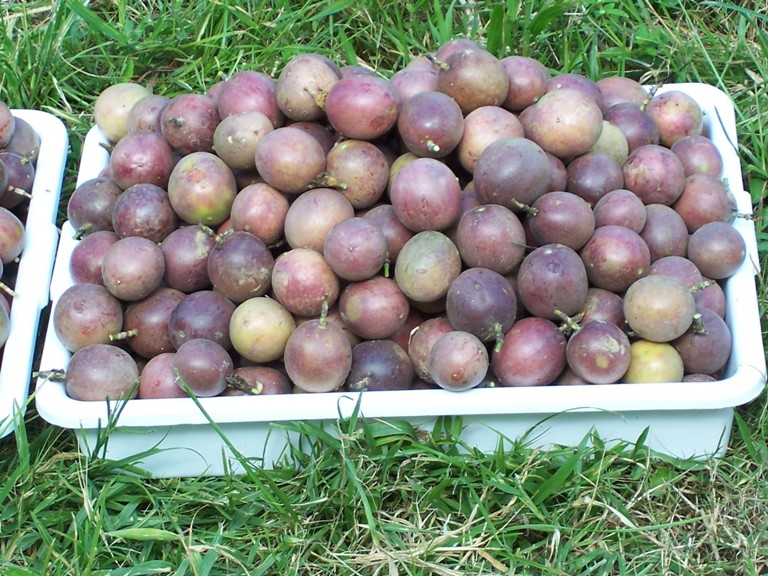
Harvested passion fruits
Selling Purple Passion Fruit
Passion fruit has several market channels in Kenya, and each pays differently.
Farm-gate buyers collect from your farm. They pay less than direct buyers, but they save you transport.
Traders buy at wholesale markets and move fruit to urban centres. Prices differ between markets and seasons.
Retailers, supermarkets, and greengrocers buy graded fruit in consistent volumes. They demand uniform size and appearance.
Hotels, restaurants, and juice bars buy fresh fruit for menu use. They often pay a premium for quality.
Processors buy fruit for pulp and juice. They absorb large volumes but pay based on pulp yield and fruit quality.
Identify your market before you plant a large block. Visit the buyers, ask about their requirements, and confirm the current price. Prices change through the year, so plan for a range rather than a single figure.
Buying Agreements and Consistent Supply
A buyer who receives consistent volume and quality becomes a repeat buyer. If a supermarket or hotel agrees to buy from you, keep the volume and grade steady through the season. A written agreement stating weekly volume, grade, and price protects both sides.
Yield Estimation
Yield varies widely between farms. Variety, plant population, vine age, water, nutrition, pruning, pollination, pest control, and disease pressure all affect the crop. Kenyan commercial passion fruit yield data is limited, so use planning scenarios rather than promised figures.
| Scenario | Fruits per Plant | Plants per Acre | Fruits per Acre |
|---|---|---|---|
| Conservative | 100 | 620 | 62,000 |
| Middle | 200 | 620 | 124,000 |
| Higher management | 300 | 620 | 186,000 |
These are planning scenarios, not guarantees. Actual results depend on your site and management.
Weight Versus Fruit Count
Buyers often buy by weight rather than by fruit count. A purple passion fruit weighs about 60 to 100 grams, depending on variety and management. Convert your fruit count into weight when you plan revenue, because the price per kilogram is what most buyers quote.
Marketable Yield Versus Total Yield
Not every fruit that grows on the vine reaches the buyer. Bruising, pest damage, and disease reduce marketable yield. Plan with marketable yield rather than total yield, and aim to keep losses below 10 percent through careful harvest, sorting, and packing.
Revenue Calculations
Revenue comes from multiplying marketable yield by the price per fruit or per kilogram. Use your own market price when you run the numbers.
Number of marketable fruits × average selling price = gross sales.
Marketable yield in kilograms × farm-gate price per kilogram = gross revenue.
Gross revenue is not profit. Deduct production costs to reach gross margin, and deduct all other costs to reach net profit. Keep the two separate when you plan.
Working Through a Simple Example
Assume 620 plants and a middle scenario of 200 marketable fruits per plant. That gives 124,000 fruits. If your buyer pays KSh 10 per fruit, gross revenue comes to KSh 1,240,000. If your buyer pays by weight and each fruit averages 80 grams, the crop weighs 9,920 kilograms. At KSh 120 per kilogram, gross revenue comes to KSh 1,190,400. Replace these figures with your own buyer price before you plan.
Farm Establishment Costs
Seedling cost is easy to calculate from the KSh 100 price. Other costs depend on your location, the material you use, and the labour you hire. Get quotes for each item before you commit.
| Cost Category | Notes |
|---|---|
| Seedlings | Number of plants × KSh 100 |
| Land preparation | Ploughing, harrowing, drainage work |
| Planting holes | Labour for digging and filling |
| Manure and compost | Based on soil test and local rates |
| Planting fertiliser | Based on soil test |
| Trellis posts | One post per 18 square metres |
| Trellis wire | Top wire and lower wires |
| Labour | Planting, training, weeding, pruning |
| Irrigation | System installation if needed |
| Mulch | Materials and labour |
| Pest and disease management | Monitoring and inputs |
| Harvesting | Labour and containers |
| Transport | Farm to buyer |
Trellis Costs Often Lead the Budget
Trellis material is usually the largest single cost after seedlings. Posts, wire, and labour to build the trellis can exceed the seedling bill on a one-acre block. Plan the trellis first, because the vine needs it from day one, and a weak trellis costs more to replace than to build properly at the start.
Labour Costs Through the Season
Passion fruit needs labour at planting, training, weeding, pruning, spraying, and harvest. Labour demand peaks during harvest, when you may need daily pickers. Plan for extra labour during the harvest window, and agree on pay per day or per kilogram with your workers before the season starts.
Common Mistakes Farmers Make
- Planting seed-grown plants and expecting grafted performance.
- Burying the graft union at planting.
- Planting before the trellis is ready.
- Skipping soil testing and guessing at fertiliser.
- Letting weeds grow around young vines.
- Pruning heavily during flowering.
- Spraying insecticides during peak flowering and reducing pollinators.
- Selling ungraded fruit to buyers who pay for grade.
- Ignoring disease symptoms until the vine collapses.
- Planting the same field to passion fruit year after year without a break.
When to Replace Weak Vines and Replant
Replace weak vines as soon as you notice them. A vine that wilts and stays wilted, shows vascular browning, or produces poorly across two seasons costs you space and inputs. Remove the vine, destroy the plant material, and plant a fresh grafted seedling in the gap.
Replant the whole field when yields drop across most vines, usually after two to three seasons in areas with high disease pressure. Prepare the new field with a break crop or a fallow period before you replant, because passion fruit does poorly when planted into old passion fruit ground without a break.
Deciding on the Replant
Walk the field and count the vines that are producing well. If fewer than six in ten vines carry a good crop, the field is due for replanting. If seven or more in ten vines produce well, keep the field for another cycle and remove the weak vines.
How to Identify Healthy Grafted Seedlings
A healthy grafted purple passion fruit seedling has several clear signs. Check each one before you pay.
The graft union looks clean and fully healed. There is no gap, crack, or oozing wound at the join.
The scion carries fresh green leaves with no yellowing, spotting, or insect damage. The shoot is firm and upright.
The rootstock is firm and well developed. The root ball holds together when you slide the seedling from its bag, and roots look pale and healthy rather than brown or mushy.
The bag carries a label with the variety name, the batch number, and the sowing date. A nursery that cannot label its plants cannot guarantee what you are buying.
What to Check at the Nursery
Visit the nursery if you can. Ask to see the mother plants, the rootstock block, and the seedlings for sale. Confirm the passion fruit type, the variety, and the rootstock used. Ask how the nursery selects its mother plants and how it hardens seedlings before dispatch. Ask about replacement policy for plants that die in transit. Ask for the current price in writing.
Buy only from a registered nursery with clear records. Ask about plant health documents before you move seedlings across counties. Fruit Africa Veriplant answers these questions on the phone, so call 0714994444 and ask for the batch details.
Transporting Seedlings and Planting Immediately
Load seedlings upright and pack them tight enough to stop movement. Cover the load to block wind, and drive at a steady pace on rough roads. Travel during the cooler hours of the morning if the road is long. Unload on arrival, water each bag, and plant within twenty-four to forty-eight hours. Seedlings held longer than a week in bags develop coiled roots and lose vigour.
Where to Buy Grafted Purple Passion Fruit Seedlings in Kenya
Fruit Africa Veriplant supplies grafted purple passion fruit seedlings at KSh 100 each. The company serves farmers across Kenya through nurseries and delivery arrangements that you confirm before ordering.
Call 0714994444 or write to sales@fruitafrica.org with your county, your farm size, your water source, and the number of seedlings you need. The team confirms variety, graft details, price, and delivery options for your area.
Fruit Africa Veriplant
Phone: 0714 994 444
WhatsApp: https://wa.link/di12my
Email: sales@fruitafrica.org
Contact Us: https://fruitafrica.org/contact-us/
Request for Quotation: https://fruitafrica.org/request-for-quotation/
Questions Farmers Should Ask Before Ordering
- What passion fruit type is this, and is it purple passion fruit?
- Is the seedling grafted, and what rootstock sits under the scion?
- What variety is the scion, and where do the mother plants come from?
- What is the seedling age, and how was the seedling hardened?
- What does the graft union look like on a sample from this batch?
- What plant health documents come with the batch?
- What is the replacement policy for plants that die in transit?
- What is the price per seedling in writing?
- What is the delivery arrangement to my county?
Frequently Asked Questions About Grafted Purple Passion Fruit Seedlings
1. How much are grafted purple passion fruit seedlings in Kenya?
Fruit Africa Veriplant sells grafted purple passion fruit seedlings at KSh 100 each. Confirm the current price before ordering because nursery prices and availability change with batch.
2. How many grafted purple passion fruit seedlings do I need for one acre?
At 2 metres by 3 metres spacing, one acre holds about 674 plants in theory. Most farmers order 600 to 650 plants once they allow for paths, boundaries, and access points. Order 5 percent extra for gap filling.
3. What is the spacing for purple passion fruit?
Fruit Africa Veriplant recommends 2 metres between plants and 3 metres between rows. Each plant occupies about 6 square metres at this spacing.
4. How much does 1,000 grafted passion fruit seedlings cost?
At KSh 100 per seedling, 1,000 seedlings cost KSh 100,000. The figure covers seedlings only. Budget separately for land preparation, trellis, labour, manure, fertiliser, and irrigation.
5. What is the difference between grafted and ordinary passion fruit seedlings?
A grafted seedling carries a chosen fruiting variety joined to a chosen rootstock. An ordinary seed-grown seedling carries genetic material from two parents, so fruit quality and root strength vary. Grafted plants give more predictable fruit and often survive better on difficult soils.
6. When should I plant purple passion fruit in Kenya?
Plant at the start of the rains in March to May or October to November. With irrigation, you have more flexibility with timing.
7. How long does purple passion fruit take to start producing?
Vines begin flowering six to eight months after planting under good conditions. The first meaningful harvest usually arrives nine to twelve months after planting.
8. Does passion fruit need a trellis?
Yes. Passion fruit is a vine and needs a trellis from day one. A vine left on the ground produces poorly and suffers more disease. Build the trellis before the seedlings arrive.
9. What type of soil is suitable for purple passion fruit?
Deep, well-drained soil with good organic matter and a pH between 5.5 and 6.5. Waterlogged soil kills the vine, so fix drainage before planting.
10. How often should passion fruit be watered?
Young vines need water two to three times a week during dry spells. Mature vines need water every five to seven days during dry spells. Check soil moisture before you irrigate.
11. What diseases affect purple passion fruit?
Fusarium wilt, Phytophthora root rot, brown spot, and woodiness virus are the main problems in Kenya. Grafting onto tolerant rootstock, good drainage, and prompt removal of infected vines all help.
12. How do I identify healthy grafted passion fruit seedlings?
Look for a clean graft union, healthy green leaves, firm roots, and a labelled bag with variety, batch number, and sowing date. Reject plants with yellowing leaves, brown roots, or an unhealed graft union.
13. Can I plant grafted passion fruit without a trellis?
No. A passion fruit vine without a trellis grows along the ground, produces poorly, and suffers more disease. Build the trellis before you plant, because the vine needs support from the first week in the field.
14. How long does a passion fruit field stay productive?
Most Kenyan fields produce well for two to three seasons. Some farmers push to four seasons with careful management. Plan for replacement after the second or third harvest, and prepare a new block on fresh ground.
15. Where can I buy grafted purple passion fruit seedlings in Kenya?
Fruit Africa Veriplant supplies grafted purple passion fruit seedlings at KSh 100 each. Call 0714994444 or email sales@fruitafrica.org for current availability and delivery.
Final Guidance Before You Buy
Buying grafted purple passion fruit seedlings is the first decision in a multi-season crop. Confirm the passion fruit type, the graft status, the rootstock, the variety, the graft union condition, and the root health before you pay. Match the plant count to your practical field area rather than the theoretical maximum.
Build the trellis before the seedlings arrive, because a vine with nowhere to climb falls to the ground and produces poorly. Test the soil before planting. Fix drainage before you dig. Prepare holes in advance so the seedlings go into rested, amended soil rather than fresh ground.
Plan for a field life of two to three productive seasons, not a decade. Keep records of every harvest round, every input, and every disease symptom. The records tell you when to replant and what to change. They also help you talk to buyers with confidence.
Fruit Africa Veriplant supplies grafted purple passion fruit seedlings at KSh 100 each. Contact the team to confirm current availability, variety, and delivery arrangements for your county.
Fruit Africa Veriplant
Phone: 0714 994 444
WhatsApp: https://wa.link/di12my
Email: sales@fruitafrica.org
Contact Us: https://fruitafrica.org/contact-us/
Request for Quotation: https://fruitafrica.org/request-for-quotation/


Reviews
There are no reviews yet.