Learn how low chill apple varieties in Kenya, such as Anna and Wambugu, make apple farming in Kenya possible, even when growing apples in warm areas.
Low Chill Apple Varieties Kenya: Apple Farming in Warm Areas
For decades, commercial apple production (Malus domestica) was considered impossible in warm, tropical, and sub-tropical regions. Standard temperate cultivars (such as Red Delicious, Fuji, or Granny Smith) require between 800 and 1,200 “chill hours” below 70C to break physiological dormancy. Without this cold period, traditional apple trees exhibit delayed foliation, irregular bloom patterns, poor fruit set, and eventual dieback.
The introduction of low-chill apple varieties – requiring as few as 150 to 400 chilling hours alongside artificial dormancy-breaking techniques (such as chemical and manual defoliation) has completely transformed apple cultivation across Kenya. Farms in Laikipia, Nyeri, Uasin Gishu, Machakos, Kajiado, and the Western Highlands are now harvesting premium apples 2 to 3 times per year.
| Agricultural Parameter | Low-Chill Specifications for Warm Climate Success |
| Average Seedling Price | KSh 600 to KSh 1,000 per KEPHIS-certified grafted seedling |
| Leading Commercial Varieties | Wambugu Apple, Anna, Dorsett Golden (Pollinizer), Golden Delicious |
| Chilling Requirement | 150 to 400 chill hours (or artificial defoliation under equatorial conditions) |
| Optimal Elevation Range | 1,200 m to 2,300 m above sea level (ASL) |
| Ideal Temperature Profile | 150C to 280C daytime; cool night drops 100C – 150C accelerate color and sugars |
| Target Soil Specifications | Deep sandy loam or clay loam; pH 5.5 to 6.8; zero tolerance for standing water |
| Recommended Tree Densities | Standard: 3m x 3m = 450-500 trees/acre; High-Density: 1m x 3m =1,200-1,300 trees/acre |
| First Commercial Yield | 9 to 12 months (first bloom); peak commercial yield at Year 3 to 4 |
| Annual Yield Potential | 20 to 40 Tonnes per acre at mature capacity |
| Average Farmgate Price | KSh 20 to KSh 40 per fruit (KSh 200 to KSh 400 per kg) |
Can Apples Really Grow in Kenya?
Ask most people where apples grow and they will name cold places such as Europe, North America or New Zealand. Ask them about apple farming in Kenya and many will say it cannot work, because Kenya has no winter. That belief is partly right. Most apple varieties do need a cold period every year. But some do not need much of it, and a few can fruit in places that never see a real frost.
Plant breeders in Israel, the United States and other countries spent decades building low chill apple varieties for warm regions. The Anna apple was bred in Israel in the 1950s for exactly this purpose. In Kenya, a farmer named Peter Wambugu Kago from Nyeri grafted and selected a local apple that research officers later approved and named after him. And on the island of Java in Indonesia, close to the equator, farmers grow millions of apple trees where there is no winter at all.
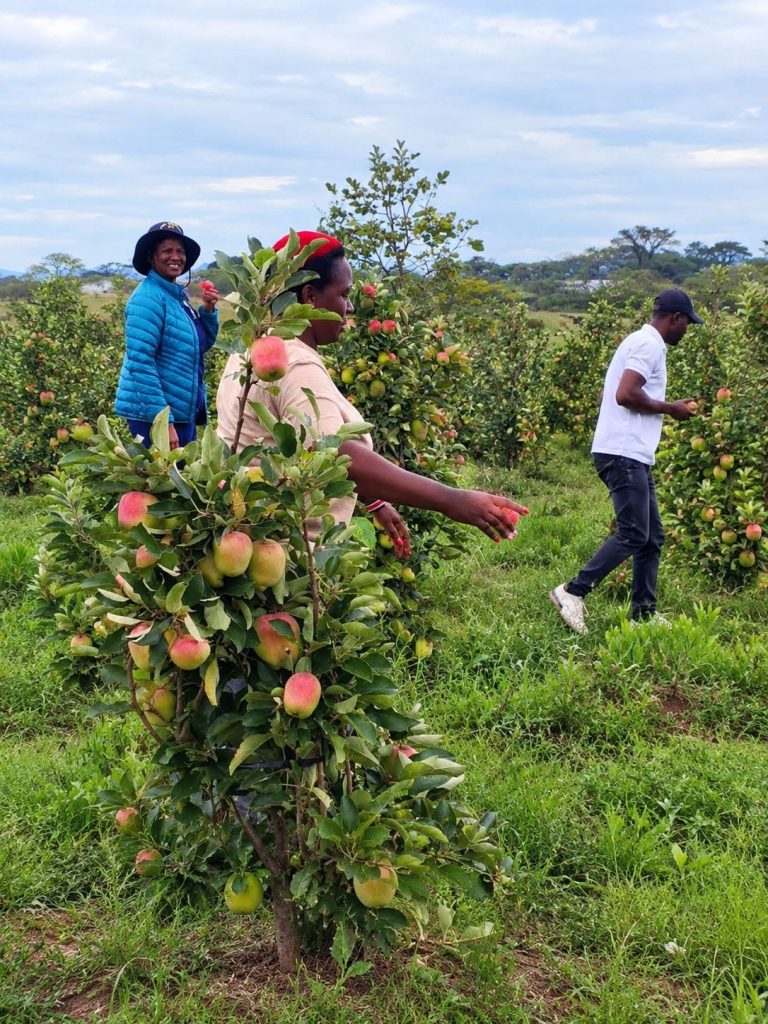
This guide explains the science. You will learn what dormancy is, how cold is measured, why night temperatures matter more than most farmers think, and why a hot afternoon can cancel some of the benefit of a cold night. You will also learn how low chill apple varieties in Kenya such as Anna, Dorsett Golden, Ein Shemer and Wambugu cope with mild conditions, and what a farmer can do when growing apples in warm areas of Kenya.
Where published numbers differ, we say so. Chill requirements in particular are measured in different ways by different sources, and for some Kenyan varieties no formal figure has been published at all.
Quick facts
| Question | Short answer |
|---|---|
| How much cold does a regular apple need? | About 500 to 1,000 chill hours a year |
| How much does a low chill apple need? | About 100 to 300 chill hours, depending on the variety and the source |
| Is frost needed? | No. Chill is counted from cool temperatures, not freezing ones |
| Which cool temperatures count? | Mostly 0 to about 10 degrees Celsius, with 6 to 7 degrees working best |
| Why do nights matter? | In Kenya, most of the cool hours happen at night, especially at altitude |
| Why does daytime heat matter? | Warm hours can cancel part of the chill gained overnight |
| Which varieties are used in warm areas? | Anna, Dorsett Golden, Ein Shemer, Tropic Sweet and the Wambugu apple |
| Can trees be helped to flower? | Yes, with pruning, defoliation, water control and in some cases chemicals |
Why People Believe Apples Need a Cold Climate
The apple was first domesticated from wild trees growing in the mountains of Central Asia. Those trees live through long, cold winters. To survive, they stop growing in autumn, drop their leaves and shut down their buds until the cold has passed. The shutdown protects the tree. If buds opened during a warm spell in January, the first hard freeze would kill them.
Over thousands of years, growers moved apples to Europe and North America, where winters are cold and reliable. The popular varieties we know today, such as Red Delicious, Golden Delicious, Gala, Fuji and Granny Smith, were selected in those conditions. They carry the same built-in safety switch. The buds will not open until the tree has felt enough cold. Because of this, a standard apple tree planted in a warm climate usually grows poorly. It leafs out late, flowers weakly and gives little fruit.
The mistake is in the next step. People assume that because standard apples need a long winter, all apples do. In fact, the cold requirement is a trait that varies from variety to variety, just like fruit colour or size. It can be bred down. Low chill apple varieties have been selected to need far less cold, and some of them have been tested for decades in places such as Israel, Florida, southern California, Arizona, Brazil and the Philippines.
Dormancy: What Is Happening Inside the Bud
To understand low chill apples, you need to understand dormancy. It is not one single state. Scientists describe three kinds.
Paradormancy
Paradormancy is a block that comes from another part of the same tree. A growing shoot tip, for example, can stop the buds below it from opening. Pruning the tip removes the block and the lower buds wake up. Farmers use this effect every time they prune.
Endodormancy
Endodormancy is the deep rest. The block is inside the bud itself. Even if you give the tree warmth, water and sunlight, the bud will not open. The only way out is to expose the bud to enough cool temperatures over enough time. This is the stage where chill hours are counted. Once the bud has received its dose, the block is lifted.
In autumn, shorter days and cooler nights send the signal to begin this rest. Growth hormones in the shoot tips fall and inhibitors such as abscisic acid, often called ABA, rise. The tree stops extending its shoots, forms a terminal bud and later drops its leaves.
Ecodormancy
Ecodormancy comes after the chill requirement has been met. The bud is now able to open, but the weather is still too cold or too dry. As soon as warmth arrives, the bud swells and bursts. The speed of bud burst then depends on how much warm weather the tree receives, often measured in growing degree hours.
The key point is the order. First the tree needs cool temperatures to finish endodormancy. Then it needs warm temperatures to open the buds. In a temperate climate the two come in sequence, one in winter and one in spring. In a tropical climate they overlap and are mixed together, which is why timing becomes a problem.
What happens when chill is not enough
If a tree does not get enough chill, endodormancy is not fully released. You will see the signs in spring: buds that open late and unevenly, weak and sparse flowers, flowers that open before the leaves do, long gaps with bare wood, small leaves, poor fruit set and a light crop. In a few years the tree can become weak. These symptoms are often blamed on pests or soil, so farmers in warm areas should learn to recognise them as a chill problem.
How Chill Is Measured
There is no single way to count chill. Three methods are in common use, and the figures they give are not interchangeable.
| Method | How it counts | Main strength | Main weakness |
|---|---|---|---|
| Chilling hours (Weinberger) | Each hour between 0 and 7.2 degrees Celsius (32 to 45 degrees Fahrenheit) counts as one | Simple, and most variety figures are given this way | Ignores the effect of warm hours |
| Utah model | Gives each hour a weight. About 2.5 to 9 degrees counts fully, milder temperatures count half, and hours above about 16 degrees subtract | Includes the effect of heat cancelling chill | Developed for peaches in a cold climate, and less reliable in mild winters |
| Dynamic model | Counts chill portions in two steps, so a portion is only locked in after cold has built up a certain amount | Studies in several warm regions found it predicts bloom better | Needs hourly temperature data and software |
When a nursery says that Anna needs about 200 to 300 hours of chill, it almost always means the simple chilling hours model. A farmer who uses a data logger and the Dynamic model will get a different number for the same site. This is one reason for the wide ranges you find online.
The Dynamic model is worth understanding because it matches what happens in warm places. In this model, cold temperatures first build up an unstable compound inside the bud. If enough builds up, the compound turns into a permanent chill portion that heat can no longer remove. If warm weather arrives before that happens, the compound breaks down and the progress is lost. The model finds the most effective temperature to be close to 6 degrees Celsius, with a weaker effect at milder temperatures.
Nighttime Drops versus Daytime Heat
This is the part that decides whether apples can grow on a particular farm in Kenya.
Kenya sits on the equator. It has no winter in the sense of a long, cold season. What it does have is altitude. Air cools by about 6.5 degrees Celsius for every 1,000 metres you climb. A farm at 2,000 metres is on average about 6.5 degrees cooler than one at 1,000 metres. Cooling is strongest at night, when the ground loses heat quickly under clear skies. So in the Kenyan highlands, the cold hours are mostly night hours, and the warm hours are mostly day hours.
That means the daily temperature swing is what a Kenyan apple tree feels. A tree in the highlands at a typical cool-season site may get a night with eight hours near 6 degrees, followed by a day that warms to the low or mid twenties. The night adds chill. The afternoon takes some of it back.
A simple worked example
The table below uses made-up hourly numbers to show how the counting works. It is an illustration, not a measurement from a real farm.
| Part of the day | Hours | Temperature | Chilling hours model | Utah model |
|---|---|---|---|---|
| Night | 8 | About 6 degrees | +8 | +8 |
| Early morning | 3 | About 10 to 12 degrees | 0 | +1.5 |
| Late morning | 6 | About 13 to 15 degrees | 0 | 0 |
| Early afternoon | 4 | About 16 to 18 degrees | 0 | -2 |
| Afternoon | 3 | Above 18 degrees | 0 | -3 |
| Total for 24 hours | 24 | 8 | 4.5 |
The simple model gives 8 chill hours for this day. The Utah model gives only 4.5, because the warm afternoon cancels part of what the night earned. The Dynamic model would also reduce the gain, but in a different way, depending on how much of the night chill had already been locked in before the temperature rose.
The lesson for a farmer is that a cool night alone is not enough. The shape of the whole day matters.
What this means in the field
A few practical points follow from the science.
First, cloud and mist help. In the cool months of June to August, many highland areas are cloudy and damp, and daytime highs are lower. There is less afternoon cancellation, so the same night temperature gives more net chill.
Second, aspect and slope matter. Cold air is heavy and flows downhill at night. A low spot or the foot of a slope collects cold air and may have more chill hours than the ridge above it. The same low spot is also at higher risk of frost at flowering, so there is a trade-off.
Third, chill in Kenya is spread out. A cold country gets one solid block of winter. A Kenyan highland site gets cool nights spread over many months, with warm spells in between. This is a weaker and less clear signal, and it is the main reason that a low chill variety is needed.
Fourth, warmth after chill sets the date of bloom. Once endodormancy is over, warm days speed up bud development. In a warm place, a tree that has just enough chill will open its buds quickly and may do so unevenly. The result can be a stretched flowering period, which is hard on pollination and harvest planning.
How Low Chill Apple Varieties Work
A low chill variety does not break the biological rules. It simply has a smaller threshold for endodormancy. Breeders create such varieties by crossing standard apples with parents that came from mild climates or that show unusual behaviour, then testing the seedlings in warm places and keeping the ones that flower and fruit.
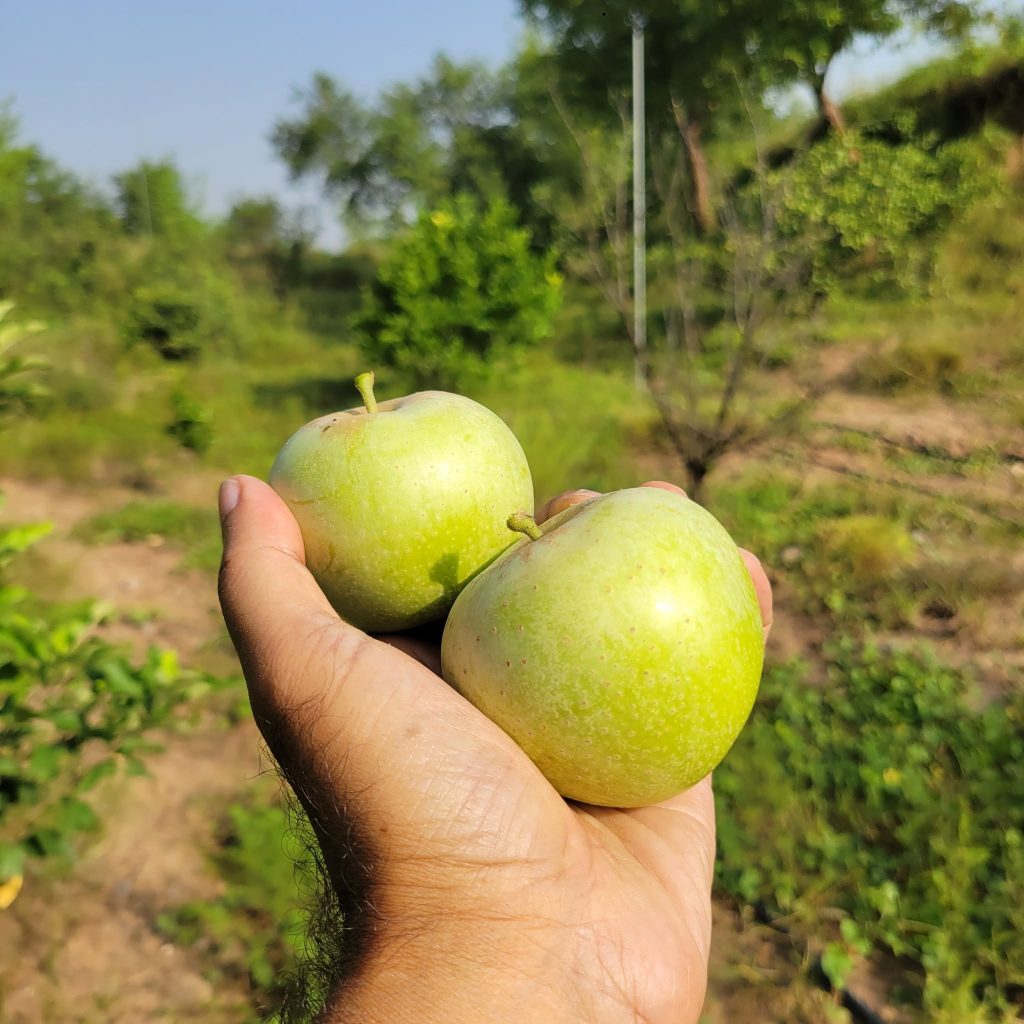
The Anna apple is the best known example. It was bred by Abba Stein at the Ein Shemer kibbutz in Israel, and released in 1959. Its parents are Golden Delicious and a variety called Red Hadassiya. The aim was to produce a Golden Delicious style apple that could be grown in places with mild winters.
The low chill trait does not come alone. Several side effects appear again and again in low chill varieties.
- They tend to bloom early in the season, because they come out of dormancy early.
- Their flower buds are therefore at greater risk from late frost where frost occurs.
- They often ripen early, with a short harvest window.
- The fruit is often smaller or softer than the best fruit from high chill varieties, and it may not store as long.
These are not flaws to hide. They are the cost of being adapted to a warm climate, and a farmer should plan for them.
The Main Low Chill Apple Varieties for Kenya
The table gives a summary. Chill figures are ranges from published sources and nursery information, and they differ between sources.
| Variety | Origin | Reported chill requirement | Notes |
|---|---|---|---|
| Anna | Israel, 1959 | About 200 to 300 hours | Golden Delicious style, very early, widely planted in warm regions |
| Dorsett Golden | The Bahamas | About 100 to 250 hours | Golden skin, small to medium fruit, a good partner for Anna |
| Ein Shemer | Israel | About 100 to 300 hours | Yellow fruit, early, a good pollinizer for Anna |
| Tropic Sweet | Florida | About 150 hours | Newer low chill variety |
| Beverly Hills | United States | About 300 hours | Pale yellow fruit, bursts buds poorly in some tropical trials |
| Wambugu | Nyeri, Kenya | No published figure | Reported to flower and fruit in warm conditions |
Anna
Anna is the most widely planted low chill apple in Florida and is common in warm parts of California and Arizona. It gives a sweet, crisp, lightly tart fruit with a red blush. It ripens very early in the season. Sources disagree on whether it sets a full crop alone, so it is safer to plant a second variety nearby. In a tropical trial in the Philippines at 1,500 metres, Anna responded well to defoliation, which is the leaf removal method used to force a new growth cycle.
Dorsett Golden
Dorsett Golden came from the Bahamas. It has golden skin with a light blush and a flavour close to Golden Delicious. The fruit is slightly smaller and firmer than Anna. Anna and Dorsett Golden flower at about the same early time, which makes them natural partners. Like Anna, it responded well to defoliation in the Philippine trial.
Ein Shemer
Ein Shemer is an Israeli variety with yellow, round fruit and a crisp, slightly tart taste. It is among the lowest in chill need, with figures as low as 100 hours in some extension guides. It is a good pollen source for Anna. Florida researchers rate it as a second choice for their conditions because it ripens later in the summer, when rain and disease pressure are higher.
The Wambugu apple
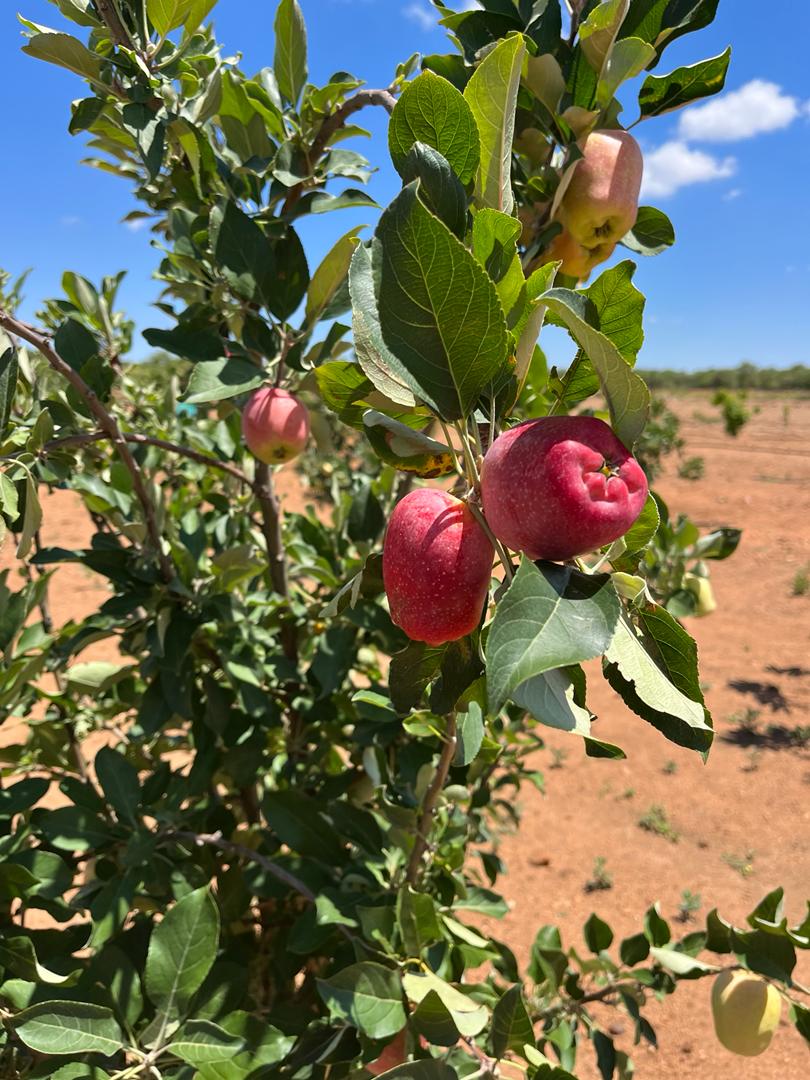
The Wambugu apple deserves its own explanation because it is a Kenyan story. According to Kenyan press reports, Peter Wambugu Kago found apple trees, planted them on his father’s farm in Nyeri and grafted them with an Israeli variety that was already growing there. The reports do not name the Israeli variety. The Kenya Agricultural and Livestock Research Organization, then known as KARI, studied the trees and named the apple after him. The Kenya Plant Health Inspectorate Service has also been reported to have approved it.
Farmers and promoters say that the Wambugu apple flowers and fruits in warm conditions and can give more than one crop a year. Reports of how many crops differ, with some saying two and others three, and claims for the time to first fruit also vary. The parentage has not been published, and we have not found a peer-reviewed chill figure for it. Treat the variety as a promising local selection that is still under observation, and ask any nursery for field records from sites like yours. Buy only from a nursery that can show the source of its scions and its KEPHIS papers.
Pollination and Bloom Timing
Apples set the most fruit when pollen comes from a different, compatible variety. Some low chill varieties are said to be self-fertile, but crops are usually better with a partner.
The best partners flower at the same time. Anna, Dorsett Golden and Ein Shemer pollinate each other well, and extension services in Florida and Arizona recommend planting two of them together. A common layout is one pollinizer row to every three or four rows of the main variety, or one pollinizer tree to every eight or ten main trees spread through the block. Add bees. Place two to three hives per acre when the first flowers open, and do not spray insecticide during bloom.
In a warm climate where flowering can stretch over weeks, a mix of two or three low chill varieties also helps. If one is late, another may still be open.
Growing Apples in Warm Areas of Kenya: The Tools That Work
In a warm area the tree never gets a clear winter. It receives mild nights, warm days and occasional rain, all through the year. If you plant a low chill variety and do nothing else, the tree may grow but flower in an untidy way. Growers in tropical countries have worked out ways to give the tree a clear cycle of its own.
The Indonesian system
The best documented example is in East Java, Indonesia. Research reports from the 1980s describe commercial apple orchards near the town of Batu, at about 8 degrees south of the equator and at 800 to 1,200 metres above sea level. No winter chilling occurs there. Even so, farmers grew more than two million apple trees by the time those reports were written.
The method is simple to describe. Soon after the harvest, workers strip the leaves from the trees by hand. This is done within about a month of picking. The flower buds have already formed on the tree by that time. Removing the leaves removes the source of growth inhibitors and triggers a new growth cycle. Buds burst within three to four weeks, the trees flower, and the fruit matures in four to five months. The trees are then stripped again after harvest, which gives two crops a year. Because the stripping date decides the bloom date, a farmer can stagger blocks to spread harvests across the year.
Why does this work without chill? The tree is pushed into a new cycle before the deep rest has had time to set in. It never enters endodormancy, so it never has to be released from it. Researchers who studied the practice found no chilling requirement showing up under those conditions.
Other tools used around the world
Reviews of tropical and subtropical fruit growing list several other tools, and they can be used alone or together.
Bending and pruning is the first. Long shoots are tied down close to horizontal, which slows their growth and encourages flower buds. Some growers prune twice a year to control the timing of growth.
Controlled water stress is the second. In places with a dry season, growers cut irrigation for a period, then resume. The return of water helps trigger bud break. This is used in parts of Brazil and could suit Kenya’s drier months.
Close spacing with growth control is the third. In lowland trials in the Philippines, researchers used a spacing of 3 m by 1 m, together with growth restriction, defoliation and branch bending. The results at warm lowland sites came close to those at a cooler highland site, but flowering was sparse in some cases.
Rest-breaking chemicals are the fourth. Various sprays have been tested to push buds open after defoliation, including potassium nitrate, thiourea and hydrogen cyanamide. Results were mixed. In the lowland Philippine trials the sprays had only a slight effect. Many of these products are hazardous and are regulated, so use only products registered in Kenya, follow the label exactly, and take advice from your county extension officer or the Pest Control Products Board before you use any of them.
Variety choice is the fifth, and it remains the most reliable tool. In the Philippine trials at 1,500 metres, Anna and Dorsett Golden responded well to defoliation, while Beverly Hills and Gordon burst poorly. The same treatment can give very different results with different varieties.
The trade-offs
Forcing a tree to crop twice a year has costs. Researchers in Indonesia reported fruit set problems when flowers opened during the wet season. Flowering should therefore be planned for drier weeks. Repeated cropping also draws heavily on the tree, so it needs steady feeding, good water supply and fruit thinning. Hand defoliation takes a lot of labour. An orchard run this way needs a calendar and a manager who follows it.
The claims you may see that a Kenyan apple variety gives two or three harvests a year fit this picture. A tree that grows all year round in a mild climate will flower again and again. Whether those harvests are large, good in quality and kind to the tree depends on the management behind them.
Which Altitude Suits Low Chill Apples in Kenya?
The table below is a working guide drawn from research reports and field accounts. It is not a rule. Local conditions vary from one slope to the next, so confirm with a small trial before you plant a large area.
| Altitude | Typical conditions | What to expect |
|---|---|---|
| Above 2,200 m | Cold nights, frost possible | Frost at flowering is the main risk, especially for early-blooming low chill varieties. Higher chill varieties may also be worth testing. |
| 1,500 m to 2,200 m | Cool nights through much of the year | The most promising range for low chill varieties. Many Kenyan apple farms sit here, in counties such as Nyeri, Nyandarua, Kiambu, Nakuru and Meru. |
| 1,000 m to 1,500 m | Milder nights | Possible with low chill varieties and active management such as defoliation and water control. Start with a trial block. |
| 700 m to 1,000 m | Warm nights | Marginal. Needs Indonesian-style management. Reports from semi-arid areas exist, but detailed field records are hard to find. |
| Below 700 m | Hot nights, and humid at the coast | Not advised for commercial planting without proof from a local trial. |
Two cautions apply. The Indonesian orchards are at 800 to 1,200 metres, but the climate there is very humid and wet for much of the year, which is different from many parts of Kenya. And close to the equator the seasons are short, so an apple tree can be in flower during rain even when you did not plan for it.
How to Test Your Own Site
Online lists of chill hours by county are rough at best. The most useful information is the temperature record from your own farm, which you can collect with a small amount of effort.
Start with a simple temperature data logger that records every hour, and place it in a shaded, ventilated box at tree height in the orchard. Run it for a full year. If a weather station is nearby, ask whether it has an hourly record for the last few years. Then count chill using the chilling hours model and, if you can, the Dynamic model. Free tools and spreadsheets exist for both.
At the same time, plant a trial block of 20 to 30 trees made up of two or three low chill varieties. Record the date of bud swell, first flower, full bloom and petal fall, how many flowers set fruit, the date of harvest, and the yield and quality of the fruit. Two seasons of records will tell you more than any website.
Orchard Basics for Low Chill Apples
Choosing a variety is only a first step. The rest of the orchard follows the usual rules for good apple growing, with some changes for warm conditions.
Soil and site
Apples prefer deep, well-drained loam with a pH of about 6.0 to 7.0. Heavy soil that stays wet will rot the roots. Take a soil sample to a laboratory before you plant and correct acidity with lime well ahead of planting. In areas where frost happens, choose a gentle slope where cold air can drain away, and avoid the bottom of a valley where it collects.
Rootstock and spacing
Apples are always grafted. A tree grown from an apple seed does not come true to its parent, and it can take many years to fruit. A grafted tree has a scion, which is the variety you want, joined to a rootstock, which controls the size of the tree and its roots. Dwarfing rootstocks such as M9 produce small trees that fruit early and can be planted close together, but they need a support post or wire. Semi-dwarfing rootstocks produce a larger tree that stands better on its own. Spacing depends on the rootstock and training system, from about 3 m by 1 m for supported dwarf trees to 4 m by 4 m or more for vigorous ones. Ask your nursery which rootstock your variety is on and what spacing it advises.
Planting
Dig a hole about 60 cm wide and deep, keeping topsoil and subsoil apart. Mix the topsoil with well-decomposed farmyard manure and a little phosphate. Plant at the start of the rains and keep the graft union a hand’s width above the soil. A buried union lets the scion root and cancels the effect of a dwarfing rootstock. Stake the tree, water it well and mulch around it, keeping the mulch clear of the stem.
Water, feeding and training
Drip irrigation gives steady moisture and suits the water-control methods described above. Feed according to the soil test, with extra attention to potassium and calcium, since low calcium can cause bitter pit in the fruit. Train young trees to a central leader or a slender spindle shape, so that light reaches the whole canopy. Thin the fruit in heavy years. A tree left to carry too much fruit gives small apples and may skip the next year.
Pests, Diseases and Other Risks
Warm and humid conditions favour some pests and diseases, so a low chill orchard needs regular scouting.
Apple scab and powdery mildew are the main fungal diseases. Scab thrives in wet, humid weather. Good airflow through open pruning, clean orchards and well-timed protective sprays help keep it down. Codling moth, fruit flies, woolly apple aphid and red spider mites are the common insects and mites. Walk the orchard every week, check leaves, shoots and fruit, and spray only when you find a problem. Choose products that are registered for apples in Kenya.
Frost at flowering is a risk for any early-blooming variety. Florida researchers note that frost injury to flower buds is common on low chill apples for exactly this reason. Plant on slopes and not in frost pockets, delay pruning until late in the cool season, and watch the forecast during bloom.
Rain during flowering lowers fruit set. Plan your bloom dates for drier weeks where you can control them.
The last risk is the plant itself. Fruit of low chill varieties can be smaller or softer than the fruit of high chill apples, and may keep for a shorter time. Plan your selling and storage around that, and sell the fruit soon after harvest.
How to Buy Apple Seedlings Without Being Misled
The apple trade in Kenya has some of the same problems as other fruit crops. Unlabelled trees are sold as apple, and some seedlings are grown from seed and will not match the variety on the sign. Use the following checks.
Ask for the exact variety name, such as Anna, Dorsett Golden or Wambugu, and the rootstock. Ask for the KEPHIS inspection papers and a receipt that lists the variety. Look for a healed graft union on the lower stem. Ask where the scion wood came from and whether the nursery has field records from sites at a similar altitude to yours. For the Wambugu apple, ask for proof that the scions come from an approved source, because the variety is described as patented and approved by Kenyan research and plant health authorities.
Be wary of anyone who claims a single variety will fruit anywhere in Kenya, from the coast to the highest slopes. No variety does that.
What Can You Expect in Yield and Income?
Kenyan websites give a wide range of yield claims. Some quote 10 to 20 kg per tree a year, and others quote 50 kg or more, with acre yields running from a few tonnes to many tonnes. The ranges are too wide to plan a budget on, and they rarely say which variety, spacing or altitude they refer to.
A better approach is to use your own trial results. Start with a small block, record yields for two or three seasons, and sell the fruit through your real market, whether that is a supermarket, a produce market or a direct buyer. Then use those numbers to plan a larger planting. Build the budget with the same care you would give any orchard, including seedlings, drip irrigation, labour, spraying and the cost of waiting for the first harvest.
Frequently Asked Questions About Apple Farming in Kenya
Can apples grow in Kenya?
Yes. Apples grow in Kenya, mainly in highland and mid-altitude areas where nights are cool. Low chill varieties such as Anna and Dorsett Golden, and the locally selected Wambugu apple, are used because they need much less cold than standard apples. Results depend on altitude, variety and management, so test a small block first.
What are low chill apple varieties?
Low chill apple varieties are apples bred or selected to need far less cold weather to release dormancy. A standard apple needs about 500 to 1,000 chill hours, while low chill types such as Anna, Dorsett Golden and Ein Shemer are reported to need about 100 to 300 hours.
How many chill hours does an apple tree need?
It depends on the variety. Standard apples such as Fuji, Gala and Red Delicious need roughly 500 to 1,000 hours between 0 and 7.2 degrees Celsius. Low chill varieties need about 100 to 300 hours. Figures differ between sources and between counting methods.
Do apples need frost to fruit?
No. Apples need cool temperatures, not freezing ones. Chill is counted from hours at about 0 to 10 degrees Celsius, with the strongest effect near 6 degrees. Frost is not required, and frost at flowering can damage the early blossoms of low chill varieties.
Which low chill apple varieties are best for Kenya?
Anna, Dorsett Golden and Ein Shemer are the best documented low chill varieties, and the Wambugu apple is a Kenyan selection reported to fruit in warm conditions. Plant Anna with Dorsett Golden or Ein Shemer for pollination, and ask the nursery for field records from sites like yours.
What is the Wambugu apple?
The Wambugu apple is a Kenyan variety developed by Peter Wambugu Kago in Nyeri, who grafted trees with an Israeli variety. KARI, now KALRO, studied and named it, and it has been reported as approved by KEPHIS. Its parentage and chill requirement have not been published, so ask for field records.
Can I grow apples in warm areas of Kenya?
It may be possible below 1,500 metres with low chill varieties and active management, such as defoliation after harvest, water control and shoot bending, as used in Indonesia. Results become less certain as altitude falls, and below about 700 metres commercial planting is not advised without a local trial.
What altitude is best for apple farming in Kenya?
The most promising range for low chill varieties is about 1,500 to 2,200 metres, where nights stay cool through much of the year. Above that, frost at flowering is the main risk. Below it, you need more management. Treat this as a guide and confirm it on your own site.
How do I make apple trees flower without a cold winter?
Choose a low chill variety first. Then use management to set a cycle: remove leaves by hand soon after harvest, bend long shoots, control irrigation and prune at set times. Some growers also use registered rest-breaking sprays, with care. Plan flowering for drier weeks to protect fruit set.
How long before a grafted apple tree bears fruit?
Grafted trees on dwarfing rootstocks often give a first small crop in the second or third year. Some Kenyan reports claim fruit within the first year, but plan for a meaningful crop from year two or three, and full production later. Record your own yields.
Summary: Apples Do Not Need Winter, They Need the Right Signal
Apple farming in Kenya is not a matter of luck. Apples need a period of cool temperatures to release their buds from dormancy, but the amount differs widely between varieties. Standard apples need 500 to 1,000 chill hours. Low chill apple varieties such as Anna, Dorsett Golden and Ein Shemer need roughly 100 to 300, and the Kenyan Wambugu apple is reported to flower and fruit in warm conditions.
In Kenya the cool signal comes mainly from cold nights at altitude, and a warm afternoon can cancel part of it. That is why the shape of the daily temperature curve matters as much as the lowest night temperature. Where the signal is weak, growers in tropical countries use defoliation, shoot bending, water control and careful pruning to give the tree a clear cycle.
If you want to grow apples in a warm area, start with a variety that fits, record the temperatures on your own farm, plant a small trial block, and buy grafted trees only from a nursery that can show its papers. Scale up when your own records show that the trees flower, set fruit and sell.
Ask About Grafted Low Chill Apple Seedlings
For availability of grafted low chill apple seedlings, with variety names, rootstock details and KEPHIS-inspected planting stock, contact Fruit Africa Veriplant.
- Head Office Location: Ruiru, Kiambu County, Kenya
- Nursery Distribution Bases: Murang’a, Nairobi, and Embu
- Phone Direct: +254 714 994 444
- WhatsApp Assistance: Message us on WhatsApp
- Official Email: sales@fruitafrica.org
- Official Website: www.fruitafrica.org
- Request a Quote: fruitafrica.org/request-for-quotation/