

Description
Certified Grafted Hass Avocado Seedlings in Kenya: Complete Guide to Planting, Spacing, Yield and Profitability
Avocado farming in Kenya is one of the most profitable agricultural ventures today. The Hass variety leads the export market and is in high demand across Europe, the Middle East, China, and North America. Kenyan farmers are increasingly turning to this crop because it offers strong returns and a reliable market. The fruit is often called “green gold” for good reason.
Fruit Africa Nurseries is a trusted source of high-quality certified grafted Hass avocado seedlings in Kenya. With locations in Murang’a, Nairobi, and Embu, the nursery serves farmers across the country. They offer KEPHIS-certified seedlings that are properly grafted, well-hardened, and ready for transplanting. Contact Fruit Africa Nurseries at +254714994444 or sales@fruitafrica.org for genuine, high-quality seedlings.
What Are Hass Avocados?
Hass avocados are a variety of avocado known for their dark, pebbly skin that turns black when ripe. They have a creamy texture and rich flavour that consumers love. The fruit has a high oil content, which gives it a superior taste compared to other varieties. This high oil content is the main reason Hass avocados are preferred for export.
The Hass variety originated in California and has spread worldwide. It is now the most grown avocado variety globally. In Kenya, Hass avocados thrive in the highlands and have become the backbone of the country’s avocado export industry. The fruit has a long shelf life and a tough skin that protects it during shipping, making it ideal for international markets.
Hass avocados are also versatile in the kitchen. They are used in guacamole, salads, sandwiches, smoothies, and even desserts. Their creamy texture makes them a favourite for health-conscious consumers. The fruit is rich in healthy monounsaturated fats, which help reduce bad cholesterol and support heart health. They are also a good source of vitamins C, E, K, and B-complex, as well as potassium, magnesium, and folate.
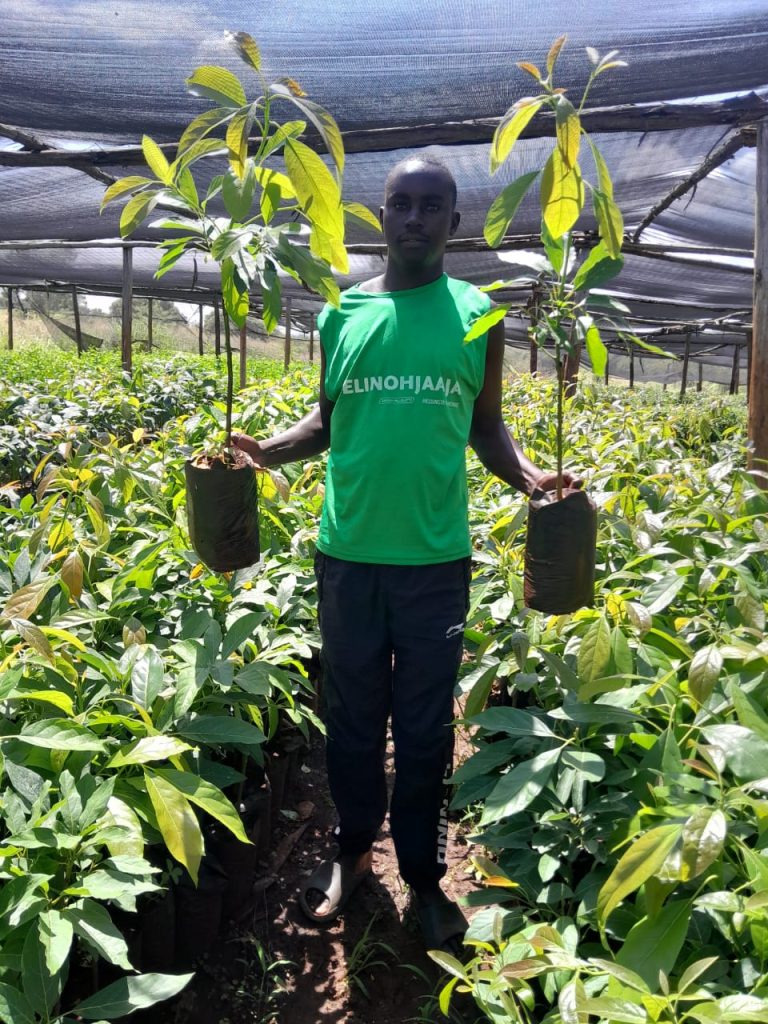
Hass Avocado Seedlings from Fruit Africa
Why Choose Certified Grafted Hass Avocado Seedlings from Fruit Africa Nurseries?
Certified grafted Hass avocado seedlings offer several advantages over seedlings grown from seeds. Grafted trees start bearing fruit much faster, typically within 2.5 to 3 years. Seed-grown trees take 8 to 10 years to produce. That is a big difference.
Fruit Africa Nurseries provides high-quality certified grafted Hass avocado seedlings. Each seedling is grafted from elite mother trees onto superior rootstock, giving the tree disease resistance, early maturity, and high production capacity. The seedlings are certified and hardened, ready to transplant. They have a high survival rate and give farmers confidence in their investment.
At Fruit Africa Nurseries, they value farmers and their success. That is why they offer affordable pricing for superior quality seedlings. The company provides KEPHIS-certified seedlings that are free from diseases and pests. The seedlings are propagated using advanced techniques that ensure uniformity and high performance. Farmers who buy from Fruit Africa Nurseries get access to technical support and advice on planting and management.
Hass Avocado Characteristics
Appearance
Hass avocados are medium to large in size. They have a distinctive dark green skin that turns almost black when fully ripe. The skin is thick and pebbly, which protects the fruit during shipping. The flesh is pale green to yellow, creamy, and buttery. The fruit is oval to pear-shaped and weighs between 150 and 250 grams on average.
Flavour and Texture
Hass avocados have a rich, nutty flavour with a creamy texture. The high oil content gives them a smooth mouthfeel that makes them perfect for guacamole, salads, and sandwiches. They are also great eaten on their own with a little salt. The flavour is often described as buttery and slightly nutty, with a satisfying richness that other varieties lack.
Nutrition
Hass avocados are packed with nutrients. They are rich in healthy monounsaturated fats, vitamins, and minerals. They contain vitamins C, E, K, and B-complex vitamins, as well as potassium, magnesium, and folate. The healthy fats help reduce cholesterol and support heart health. Avocados are also a good source of dietary fibre, which aids digestion and helps maintain a healthy weight.
Shelf Life
Hass avocados have an excellent shelf life compared to other varieties. They can be stored for several weeks under cool conditions. The thick skin protects the fruit from damage and slows down ripening. This makes them ideal for export to distant markets. The fruit can be kept in cold storage at 4 to 7 degrees Celsius for up to 6 weeks without losing quality.

Avocado Varieties Available in Kenya
Hass
Hass is the most important export variety in Kenya. It is the number one choice for export to Europe, the Middle East, and China. Hass avocados are known for their high oil content, creamy texture, and excellent shelf life. The fruit matures on the tree and keeps well after harvest. The skins change from green to black as they ripen. Hass avocados have a rich, nutty flavour and are preferred by consumers worldwide.
Fuerte
Fuerte avocados have a thinner, lighter green skin that remains green even when ripe. The flesh is creamy and has a milder flavour than Hass. Fuerte is also exported but is not as dominant in the export market as Hass. It is a good variety for local markets and comes from the same mother plants as the Hass variety. Fuerte trees are slightly less productive than Hass but produce high-quality fruit.
Others
Other avocado varieties grown in Kenya include Puebla, Pinkerton, and Nabal. These varieties are grown in smaller quantities and are mainly sold in local markets. However, Hass remains the most important variety for export. Pinkerton is known for its pear-shaped fruit and good oil content. Nabal produces large, round fruit with a good flavour. Puebla is an early-maturing variety that is popular in some regions.
Ecological Requirements for Hass Avocados
Climate Requirements
Hass avocados need a subtropical to tropical climate. They do best in areas with moderate temperatures between 15 and 25 degrees Celsius. The trees are sensitive to frost and strong winds. They need protection from cold temperatures, especially when young. Extreme heat can cause sunburn on the fruit and reduce yields.
Altitude
The ideal altitude for Hass avocados is between 1,500 and 2,100 metres above sea level. At these altitudes, the trees produce the best quality fruit with high oil content. Higher altitudes with cooler temperatures may slow growth and delay maturity. Lower altitudes may produce fruit with lower oil content, which is less desirable for export.
Temperature
Hass avocados need temperatures between 15 and 25 degrees Celsius. They can tolerate short periods of higher temperatures but do not do well in extreme heat. Cold temperatures below 10 degrees Celsius can damage the flowers and reduce fruit set. The trees are sensitive to frost, especially when they are young or in flower.
Rainfall and Water
Hass avocados need 1,000 to 1,500 millimetres of rainfall per year. The rainfall should be well distributed throughout the year. In areas with lower rainfall, irrigation is needed. The trees do not tolerate waterlogging and need well-drained soils. Water stress during flowering and fruit development reduces yields and fruit quality.
Soils
Hass avocados do best in deep, well-drained soils. The soil should be fertile and rich in organic matter. The pH should be between 5.5 and 6.5. Heavy clay soils should be avoided because they hold water and can cause root rot. Sandy loam soils are ideal because they provide good drainage and allow the roots to breathe.

Medium Sizes Hass Avocado Seedlings at Fruit Africa
Best Counties for Hass Avocado Farming in Kenya
Central Highlands
The Central Highlands are the leading avocado-growing region in Kenya. Counties like Kiambu, Murang’a, Nyeri, Kirinyaga, and Embu have ideal conditions for Hass avocados. The altitude, temperatures, and rainfall are suitable for high-quality production. The proximity to Nairobi makes it easy to access markets and services.
Rift Valley
Parts of the Rift Valley are also suitable for avocado farming. Nakuru, Laikipia, and parts of Kericho have good conditions. The cooler temperatures help produce high-quality fruit. These areas are close to Nairobi, which makes it easy to access markets and services. The soils in these areas are generally fertile and well-drained.
Eastern Kenya
Parts of Eastern Kenya, including Meru and parts of Machakos, are suitable for avocado farming. The altitude and climate are favourable. These areas are close to major markets. The soils are generally good, although irrigation may be needed in some areas.
Western Kenya
Parts of Western Kenya are suitable for avocado farming. Kakamega, Bungoma, and Kisii have good conditions. The high rainfall and fertile soils support good production. These areas have good access to markets and services.
Coastal Region
Some parts of the coastal region are suitable for avocado farming. The temperatures are warm, and the soils are generally good. However, farmers need to manage diseases and pests carefully. The coastal region has good access to export markets through the port of Mombasa.
Planting Material
Certified Seedlings
Use certified grafted seedlings from reputable nurseries. Fruit Africa Nurseries offers KEPHIS-certified seedlings that are disease-free and true to type. The seedlings are propagated from elite mother trees and are hardened before sale. Certified seedlings give farmers confidence that they are planting the right variety and that the trees will perform well.
Grafting
Hass avocados are propagated through grafting. The rootstock is usually from local avocado varieties that are resistant to root rot. The scion is from mature Hass trees that are known to be high-producing and disease-free. Grafting ensures that the new trees have the same characteristics as the mother tree.
Seedling Quality
Good seedlings should be at least 2 to 3 feet tall. They should be free from disease and insect damage. The graft union should be well healed and strong. The plants should be hardened and ready for planting. Farmers should inspect seedlings carefully before buying to ensure they are healthy.
Seedling Care
Seedlings should be watered regularly before planting. They should be protected from strong sun and wind. The nursery should provide seedlings that are well-rooted and ready for transplanting. Farmers should handle seedlings carefully to avoid damaging the roots.
Avocado Spacing
Importance of Proper Spacing
Proper spacing is important for maximum production and reducing disease pressure. Correct spacing gives each tree enough room to grow and produce well. Good air circulation reduces the spread of fungal diseases. It also makes management tasks like pruning and harvesting easier.
Recommended Spacing
The recommended spacing for Hass avocados is 7 metres by 7 metres or 5 metres by 7 metres. At 7 by 7 metres, approximately 85 trees fit per acre. At 5 by 7 metres, approximately 125 trees fit per acre. The choice of spacing depends on soil fertility, rainfall, and management intensity. More fertile soils and higher rainfall allow closer spacing.
Dense Planting
Some farmers plant at higher densities of up to 250 trees per acre. This is done to maximize production in the early years. However, the trees need to be thinned as they grow to prevent overcrowding and reduce disease pressure. Dense planting requires more intensive management and higher inputs.
Spacing Table
| Spacing | Trees per Acre | Suitability |
|---|---|---|
| 7m x 7m | 85 | Low fertility, low rainfall |
| 5m x 7m | 125 | Moderate fertility, moderate rainfall |
| 5m x 5m | 175 | High fertility, high rainfall |
| 4m x 5m | 200 | High fertility, irrigation |
Planting Hass Avocado Seedlings
When to Plant
The best time to plant is at the start of the rainy season. This allows the trees to establish before the dry season. In areas with irrigation, planting can be done year-round. The ideal time is March to April and October to November. Planting during the rainy season reduces the need for irrigation and gives the trees a good start.
Preparing the Land
Clear the land of weeds and debris. Plough and harrow to break up the soil. Remove any rocks and roots that could interfere with planting. Prepare the field for planting. The land should be well-drained and free from waterlogging. If the land is sloping, consider terracing to prevent soil erosion.
Hole Preparation
Dig holes that are 2 feet by 2 feet by 2 feet. Separate the topsoil from the subsoil. Mix the topsoil with 20 kilograms of well-decomposed manure. Add 200 grams of DAP or TSP fertilizer. Mix everything well and put it back into the hole. The hole should be large enough to accommodate the root ball without bending or crowding the roots.
Planting
Cut the plastic bag holding the seedling carefully. Ensure the root ball does not break. Plant the seedling at the same depth as it was in the nursery. The graft union should be above the ground. Firm the soil around the roots. Water immediately after planting. Mulch around the tree to conserve moisture.
Mulching
Mulching is essential for avocado production. It conserves soil moisture and suppresses weeds. It also provides nutrients as it decomposes. Apply dry grass or other organic mulch around the tree. Keep the mulch away from the trunk to prevent rot. Mulching also helps maintain a stable soil temperature and improves soil structure.
Watering
Water the seedlings regularly during the establishment phase. Once established, water weekly during dry periods. Provide 20 to 40 litres of water per tree per week. Drip irrigation is the most efficient system for avocados. It delivers water directly to the root zone and reduces water waste.
Avocado Management Practices
Weed Management
Avocado orchards should be kept weed-free. Weeds compete for water and nutrients. They also harbour pests and diseases. Mulching and mechanical weeding are the most effective control methods. Chemical herbicides can be used, but they should be applied carefully to avoid damaging the trees.
Pruning and Training
Avocado trees need pruning to maintain shape and promote growth. Prune to remove diseased and damaged branches. Prune to improve light penetration and air circulation. Prune to control height and encourage flowering. Young trees are trained to a single stem. Remove any competing leaders.
Nutrition and Fertilization
Avocados need a balanced supply of nutrients. A general recommendation is 0.6 kilograms of nitrogen per tree per year for young trees, increasing to 1.0 to 1.5 kilograms for mature trees. Phosphorus and potassium are also important. Conduct soil and leaf analysis for accurate fertilizer recommendations.
Apply manure annually around the base of the tree. Use compost as a top dressing. Apply fertilizer in split applications during the rainy seasons. The most critical periods for nutrition are flowering and fruit development. Potassium is especially important for fruit quality and oil content.
Irrigation
Avocados need consistent water during flowering, fruit set, and fruit development. Water stress during these periods reduces yields. Drip irrigation is recommended for efficient water use. Use rainwater collection and storage to supplement irrigation. The trees should not be allowed to dry out completely, but they also should not be waterlogged.
Mulching
Mulching is essential for avocado production. It conserves soil moisture and suppresses weeds. It also provides nutrients as it decomposes. Apply dry grass or other organic mulch around the tree. Keep the mulch away from the trunk to prevent rot. Mulching also helps maintain a stable soil temperature and improves soil structure.
Pests and Diseases
Common Pests
Avocado lace bug is a major pest. It causes yellowing and leaf drop. Control with insecticides and natural predators. Thrips attack flowers and young fruit. They cause scarring that reduces fruit quality. Use insecticides and biological control. Fruit flies lay eggs in the fruit. The larvae cause fruit damage and rot. Use bait traps, insecticides, and good orchard sanitation. Scale insects feed on leaves and stems. They produce honeydew that encourages sooty mould. Control with insecticides and natural predators.
Common Diseases
Root rot is caused by Phytophthora fungi. It is one of the most destructive diseases of avocados. Use resistant rootstocks and improve drainage. Scab affects fruit, causing rough, corky lesions. It reduces fruit quality and marketability. Control with fungicides. Anthracnose is a fungal disease that causes fruit rot. Control with fungicides and good orchard hygiene. Cercospora spot is a fungal disease that causes leaf spots and fruit lesions. Control with fungicides.
Avocado Maturity and Harvest
Maturity Timeline
Grafted Hass avocado trees start bearing fruit in 2.5 to 3 years. Production increases gradually and reaches its peak at 6 to 10 years. A mature tree produces 200 to 400 fruits per year, weighing 80 to 150 kilograms.
Flowering
Avocado trees flower in spring. The flowers are perfect and self-pollinate. However, cross-pollination improves fruit set. Bees help in pollination. The flowers are small and greenish-yellow. They appear in clusters at the ends of the branches.
Fruit Development
After pollination, the fruit develops over several months. The fruit matures and increases in size and oil content. Hass avocados mature in 6 to 12 months, depending on the climatic conditions. The fruit grows slowly and accumulates oil and dry matter.
Harvesting
Avocados mature on the tree but do not ripen until they are picked. Harvest when the fruit reaches the required dry matter content. The minimum dry matter content for export is 24 percent. Use a clipper to cut the stem, leaving a short stalk attached to the fruit.
Maturity Indicators
Oil content is the most important indicator of maturity. A minimum of 24 percent dry matter is required for export. Fruit colour changes from green to black as the fruit ripens. The fruit becomes softer and easier to feel. Farmers can also test the fruit by cutting it open and checking the colour and texture.
Profitability of Avocado Farming
Revenue per Tree
A mature Hass tree produces 200 to 400 fruits per year. At a farm gate price of Ksh8 to Ksh15 per fruit, each tree earns Ksh1,600 to Ksh6,000 per year.
Revenue per Acre
At 85 trees per acre (7m by 7m spacing), an acre produces 17,000 to 34,000 fruits per year. At Ksh8 to Ksh15 per fruit, gross revenue is Ksh136,000 to Ksh510,000 per acre per year. At 125 trees per acre (5m by 7m spacing), an acre produces 25,000 to 50,000 fruits per year. At Ksh8 to Ksh15 per fruit, gross revenue is Ksh200,000 to Ksh750,000 per acre per year.
Cost of Starting Avocado Farming
| Item | Estimated Cost (KES) |
|---|---|
| Seedlings (85-125 at Ksh300 each) | 25,500 – 37,500 |
| Land Preparation | 20,000 – 40,000 |
| Manure and Compost | 20,000 – 30,000 |
| Planting Labour | 10,000 – 20,000 |
| Irrigation Equipment (if needed) | 30,000 – 50,000 |
| Total | 105,500 – 177,500 |
Where to Buy Certified Grafted Hass Avocado Seedlings
Fruit Africa Nurseries is a trusted source of high-quality certified grafted Hass avocado seedlings in Kenya. With locations in Murang’a, Nairobi, and Embu, the nursery serves farmers across the country. The company offers KEPHIS-certified seedlings that are properly grafted. The seedlings are well-hardened and ready for transplanting. They have superior quality and exceptional productivity.
At Fruit Africa Nurseries, they value farmers and their success. That is why they offer affordable pricing for quality seedlings. Contact Fruit Africa Nurseries at +254714994444 or sales@fruitafrica.org to place your order or get more information about their products and services.
Frequently Asked Questions
What is a Hass avocado? Hass avocado is a variety known for its dark, pebbly skin that turns black when ripe. It has a creamy texture and rich flavour.
How much do certified grafted Hass avocado seedlings cost? Fruit Africa Nurseries offers quality seedlings at affordable prices. Contact them for current pricing.
How many trees fit on one acre? At 7m by 7m spacing, approximately 85 trees fit per acre. At 5m by 7m spacing, approximately 125 trees fit per acre.
How long does it take for Hass avocados to mature? Grafted trees start bearing fruit in 2.5 to 3 years. Full production is reached in 6 to 10 years.
How much can I earn from one acre? A well-managed acre can produce Ksh136,000 to Ksh750,000 annually depending on spacing and management.
What is the best soil for avocados? Avocados need deep, well-drained soils with pH between 5.5 and 6.5.
Can avocados grow in dry areas? Yes, with irrigation. Avocados need consistent moisture for good yields.
What is the spacing for Hass avocados? The recommended spacing is 7m by 7m or 5m by 7m.
How do I control pests on avocados? Monitor your orchard regularly. Use cultural controls and apply insecticides when necessary.
How do I control diseases on avocados? Use resistant rootstocks. Practice good drainage. Apply fungicides when necessary.
When is the best time to plant avocados? The best time is at the start of the rainy season. In areas with irrigation, planting can be done year-round.
What is the minimum dry matter content for export? The minimum dry matter content for Hass avocados is 24 percent.
How do I know when avocados are ready to harvest? Avocados are ready when they reach 24 percent dry matter. The skin changes colour as the fruit ripens.
Can I export avocados from Kenya? Yes. Kenya exports avocados to Europe, the Middle East, China, and North America.
What are the main export markets for Kenyan avocados? The main export markets are the United Kingdom, France, the Netherlands, the United Arab Emirates, Saudi Arabia, China, and India.
Final Checklist
- Select the right location with suitable soil and climate conditions.
- Buy certified grafted Hass avocado seedlings from Fruit Africa Nurseries.
- Prepare the land with proper planting holes and organic matter.
- Plant at the start of the rainy season.
- Space correctly (7m by 7m or 5m by 7m).
- Water regularly during the establishment phase.
- Apply fertilizer and manure based on soil analysis.
- Control weeds through mulching.
- Prune annually to maintain tree shape.
- Monitor for pests and diseases regularly.
- Harvest when the fruit reaches 24% dry matter.
- Market your avocados to exporters, processors, or local buyers.




Reviews
There are no reviews yet.