
High density avocado farming in Kenya explained for Hass: spacing per acre, tree height limits, light angles and a pruning calendar for mature trees.
High Density Avocado Farming in Kenya: 6 Essential Pruning and Spacing Rules
High density avocado farming in Kenya means planting more Hass trees on each acre than the standard 7 by 7 metre layout, which holds about 83 trees per acre. A tighter layout puts more trees to work sooner. The same layout fills the canopy sooner, and a crowded canopy shades the lower branches, pushes fruit to the treetops and raises the cost of every task from pruning to picking.
Most guides give one spacing, such as 5 by 5 metres or 6 by 6 metres, and stop there. A spacing tells you how many trees to buy. The spacing does not tell you how tall the trees stand in year six, how much sun reaches the lower branches in the morning or when to cut the regrowth. This guide covers those questions, because they decide whether a dense orchard earns more than a standard one.
A range of 160 to 250 trees per acre equals about 395 to 618 trees per hectare. Published research on Hass at these densities is thin, and this guide says so wherever the evidence stops. A field trial in Antioquia, Colombia, compared six planting densities of Hass in a tropical region. The abstract reports the highest yields at 333 and 400 trees per hectare, which equal 135 and 162 trees per acre, and lower yield per tree as density rose. The top of the 160 to 250 range therefore belongs to growers with strong pruning skills, and not to every farm.
We grow grafted Hass avocado seedlings at our nurseries in Murang’a, Nairobi and Embu, and our agronomy team in Ruiru advises growers on layouts.
High Density Avocado Farming in Kenya: 6 Essential Pruning and Spacing Rules
The 6 Rules of High Density Avocado Farming at a Glance
| Rule | Action | Why the rule matters |
| 1 | Match the density to your pruning skill, labour and equipment | Hass is a vigorous tree, and a tight layout only works when someone prunes the trees on time |
| 2 | Set the row width and row direction for light | Row width controls how long each hedge shades the next one |
| 3 | Hold tree height at 80 percent of row width | Taller trees shade the lower canopy and push fruit upward |
| 4 | Train young trees to a narrow, open frame | The shape you set in years one to three decides the pruning work for twenty years |
| 5 | Prune mature trees on a fixed yearly cycle | Planned cuts keep light in the canopy, while late rescue cuts cost crop |
| 6 | Thin before the trees crowd, and measure light every season | Delayed thinning is the usual reason a dense orchard declines |
What Counts as High Density for Hass Avocado in Kenya
The label high density has no single definition, and published sources draw the line in different places. A grower who plants 5 by 5 metres is running a high density orchard by one source and a medium density orchard by another. Read the numbers before you read the label.
| Source | Density bands | Trees per acre |
| KALRO guide on climate smart practices | Hass at 7 by 7 metres, 204 trees per hectare | 83 |
| Seeka grower deck, Avocado Growing Systems and Pruning | Low density at 10 by 10 metres or wider, medium density at the traditional 7 by 7 metres, high density at less than 7 by 7 metres | Low: 40 or fewer. Medium: 83. High: above 83 |
| Wolstenholme and Sheard (2012), cited by Mitchell (2019) in a Nuffield report | High density at 500 to 1,000 trees per hectare, ultra high density above 1,000 trees per hectare | High: 202 to 405. Ultra high: above 405 |
The Seeka deck and the Nuffield report agree on one point. Density alone does not define the system. A high density orchard also needs a hedgerow or narrow tree shape, a fixed height limit and a pruning programme. The Nuffield report calls high density systems complex and management intensive, and says current varieties and rootstocks suit them poorly.
In this guide, higher density means 112 to 253 trees per acre, which covers layouts from 6 by 6 metres to 4 by 4 metres. The range includes the 160 to 250 trees per acre in the title, and the range also includes the 5 by 5 metre layout which many Kenyan farms already use.
What Kenyan sources say about density
KALRO gives 7 by 7 metres for Hass and adds spacing depends on variety, soil type and climatic conditions. A FreshPlaza report from October 2023 describes 7 by 7 metres as the standard, with 5 by 5 and 6 by 6 metres for small holdings, and warns tighter spacing means a lot of pruning work later. The report cites tuko.co.ke as the source and names no grower or researcher.
The same report quotes 140 trees per acre for 5 by 5 metres and 120 trees per acre for 6 by 6 metres. Plain geometry gives 162 and 112. An acre holds 4,047 square metres, and each 5 by 5 metre tree takes 25 square metres. The published counts differ from the geometry, so calculate your own count from your own land plan.
Hass Avocado Spacing Per Acre in Kenya: Trees for Each Layout
Write the row width first and the distance between trees in the row second. Divide 4,047 square metres by the area each tree takes to get the gross count per acre. Divide 10,000 by the same area to get the count per hectare. The table adds the tallest tree height allowed by the 80 percent rule from Rule 3, based on the row width.
| Spacing, row width first | Trees per hectare | Trees per acre | Height limit at 80 percent of row width |
| 8 by 8 metres | 156 | 63 | 6.4 metres |
| 7 by 7 metres (KALRO) | 204 | 83 | 5.6 metres |
| 6 by 6 metres | 278 | 112 | 4.8 metres |
| 7 by 4 metres | 357 | 145 | 5.6 metres |
| 5 by 5 metres | 400 | 162 | 4.0 metres |
| 6 by 4 metres | 417 | 169 | 4.8 metres |
| 7 by 3 metres | 476 | 193 | 5.6 metres |
| 5 by 4 metres | 500 | 202 | 4.0 metres |
| 6 by 3 metres | 556 | 225 | 4.8 metres |
| 4 by 4 metres | 625 | 253 | 3.2 metres |
| 5 by 3 metres | 667 | 270 | 4.0 metres |
These are gross counts. Roads, drains, headlands, tree-free strips along fences and the space for a packing point all lower the count of trees you plant. Mark these on your farm map first and count the planted area only.
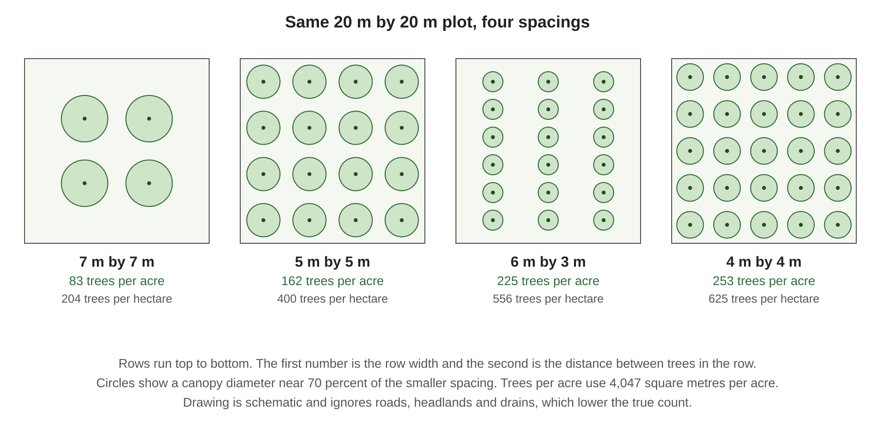
Figure 1. The same 20 metre square planted at four spacings. Our drawing, schematic, with gross counts which ignore roads and drains.
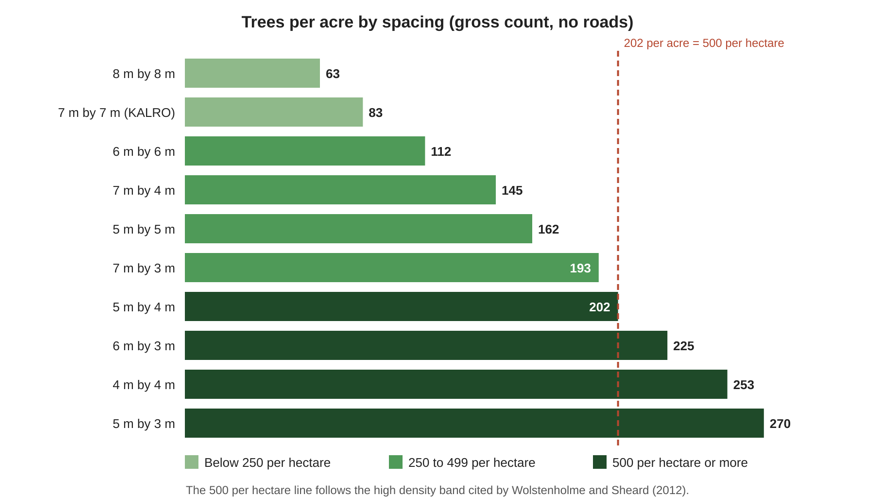
Figure 2. Trees per acre by spacing. The dashed line marks 500 trees per hectare, the start of the high density band in Wolstenholme and Sheard (2012). Our chart.
Why the row width matters more than the tree spacing in the row
The row width sets how far each hedge casts a shadow across the aisle, and the shadow decides how much of the neighbouring row sits in sun. The distance between trees in the row sets how fast neighbours join into one continuous hedge. A 6 by 3 metre layout and a 4 by 4 metre layout hold a similar number of trees per acre, yet the 6 metre row leaves a wider aisle for light and machines. Choose the row width for light and access first. Then choose the in-row distance to match the number of trees your crew prunes each year.
A Worked Example: Planning One Acre at 5 by 5 Metres
A worked example makes the rules concrete. We use one acre planted at 5 by 5 metres, the layout growers ask us about most often. A square acre measures about 63.6 metres on each side. Twelve rows 5 metres apart need 60 metres, and twelve trees 5 metres apart fill each row, so the block holds 144 trees. The gross count from the area is 162. The working count is lower because the edges carry a drain and a turning strip for the crew and the vehicle.
The rows run north to south. The height limit is 4 metres, and the crew cuts to about 3.0 to 3.3 metres. Before planting, we mark the temporary trees on the farm map. The temporary trees are every second tree on the diagonal, and the permanent trees stand about 7.1 metres apart on the diagonal. The permanent count of 72 sits close to the KALRO standard of 83 trees per acre.
| Item | Number or rule | How we reach the figure |
| Planted trees | 144 | 12 rows with 12 trees in each row |
| Temporary trees | 72 | Every second tree on the diagonal |
| Permanent trees | 72 | The remaining trees, about 7.1 metres apart on the diagonal |
| Height limit | 4.0 metres | 80 percent of the 5 metre row width |
| Cutting height | 3.0 to 3.3 metres | Leaves room for the regrowth |
| Aisle between canopy bases | 2 metres | 5 metre row minus a 3 metre canopy base |
| Pruning days per round | 7.2 | 144 trees divided by an assumed 20 trees a day |
| Pruning days per year with two rounds | 14.4 | 7.2 days times 2 |
The rate of 20 trees a day is an assumption for the example and not a measured rate. Replace the figure with the rate your own crew reaches. A crew which prunes 10 trees a day needs twice the days. At 7 by 7 metres, the same acre holds about 83 trees gross, and the same assumed rate gives 4.1 days per round. At 4 by 4 metres, the acre holds 253 trees gross, and the same rate gives 12.7 days per round. The pruning bill rises with the tree count, and the table shows the rise before you buy a single seedling.
Kenyan Growing Conditions Which Shape Your Layout
KALRO lists Hass for altitudes from 800 to 2,100 metres above sea level and describes the variety as suited to cooler locations. KALRO also gives peak flowering in October and peak harvest from June to September. These months describe a typical season. Your trees keep their own dates, so copy the method from this guide and measure the dates on your own trees.
Rain and the pruning year
The KALRO guide on climate smart practices gives an ideal rainfall of at least 1,000 millimetres, well distributed. Kenya’s long and short rains therefore shape the pruning year. Spann advises against pruning when the canopy is wet, because wet conditions release fungal spores into fresh wounds. Plan cuts for dry days, and keep the crew out of the block during heavy rain.
A FreshPlaza report from 2022 quotes Jack Njoroge of Avodemia saying excessive rain during flowering causes flowers to drop and lowers production. Flowering in October and November overlaps the start of the short rains in many districts. We advise finishing the pruning before flowering starts, for the sake of the flowers and for the sake of dry working conditions.
Slopes in Murang’a, Embu and Kiambu
Many avocado orchards in Murang’a, Embu and Kiambu sit on slopes. Slopes need contour rows, cut-off drains and raised mounds where drainage is poor, as our guide on avocado root rot explains. Dense layouts leave less room between rows for water to move, so draw the drains first and fit the trees around them. Spann states the 80 percent height rule does not apply where rows do not run north to south or where the hillside does not face due south. On a steep slope we suggest a lower height limit on the sides which shade the rows below, so light still reaches the lower trees.
What the Research Says About Yield at Different Densities
No single trial answers the question for Kenyan Hass at 160 to 250 trees per acre. The useful studies come from Colombia, California, South Africa and Australia, and each differs from your farm in climate, variety or management. Read the findings as pointers and check each one against the caveat beside the finding.
The Colombian trial: a tropical test of Hass density
A paper in Pesquisa Agropecuária Brasileira reports a randomised block trial in Antioquia, Colombia. Researchers compared six densities of Hass, from 204 to 816 trees per hectare, on nine-year-old trees over five harvest seasons. The densities were 204, 278, 333, 400, 625 and 816 trees per hectare.
The abstract states the highest fruit yield came at 333 and 400 trees per hectare. Yield per tree and the number of fruit per tree fell as density rose. Fruit quality followed the same pattern, because the 333 and 400 densities gave the highest pulp proportion and the lowest seed proportion. These densities equal 135 and 162 trees per acre. The 625 and 816 densities equal 253 and 330 trees per acre, and neither gave the highest yield.
The trial supports the lower half of the range in the title. The trial gives no support for 250 trees per acre as a yield target, though the abstract does not say how the growers pruned the dense plots.
The California canopy volume comparison
Tim Spann, Research Program Director at the California Avocado Commission, argued in 2019 trees per acre does not set yield potential. Canopy volume does, because fruit depends on light reaching leaves throughout the tree. His table compared canopy volume per acre at six layouts and found the traditional 20 by 20 foot spacing, with 109 trees per acre, still held more canopy volume than any denser layout.
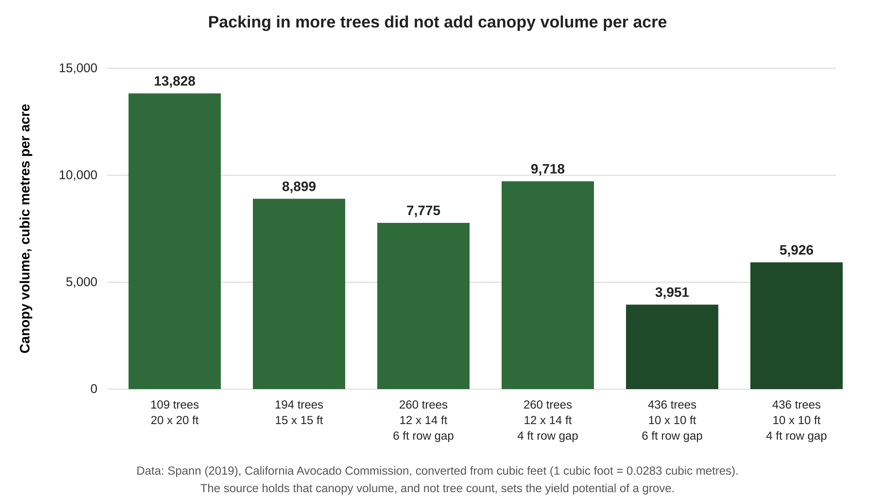
Figure 3. Canopy volume per acre for six layouts, from Spann (2019), converted to cubic metres. The widest layout holds the most canopy volume. Our chart.
The figure also shows what a gap between rows does. A 12 by 14 foot layout with a 4 foot row gap held 9,718 cubic metres per acre as converted in Figure 3, against 7,775 with a 6 foot gap. Leaving less aisle meant more canopy volume and a narrower aisle for light. Spann concluded dense groves yield more only with the right variety, early pruning and good management, and a poorly managed grove produces poorly at any tree count.
The Pine Tree Ranch trial in California
Spann reported a trial of Hass on Toro Canyon rootstock at eight spacings, with 145 to 435 trees per acre. The trial sat at Santa Paula and was planted in June 2014. Plots measured 0.15 to 0.44 acres. The four tightest spacings gave the highest average yield per acre and the highest cumulative yield through 2020. At 10 by 10 feet, the densest layout, yield averaged 10,758 pounds per acre over the first four harvests, which is about 12 tonnes per hectare.
The same report records the cost of waiting. The team did not prune from 2014 through 2018, and pruning began in spring 2019 after harvest. The tightest spacings lost most interior and lower leaves and were, in the author’s words, essentially sticks. Yields fell sharply in 2020. Spann expected the 10 by 10 layout to plateau at about 5,000 to 6,000 pounds per acre under annual pruning, and he questioned whether the layout holds up over a grove life of 25 years or more. He also noted the trial held only four years of data from a single site.
Ultra high density Reed in California
Whiley and Tony describe an ultra high density Reed planting by Reuben Hofshi at 2.25 by 2.25 metres. The planting reached 6.5, 26.0, 65 and 81.7 tonnes per hectare in years three to six. Reed has a natural central leader, and Hofshi kept tree height low enough to hand harvest all fruit from the ground. This is not Hass, the density is far above 250 trees per acre and the management was intensive, so the yields show what a different tree achieves under heavy control, and not what Hass gives in Kenya.
Australian orchards between 333 and 476 trees per hectare
A Horticulture Innovation Australia report on canopy management, project AV04008, surveyed commercial orchards. Densities ran from about 115 trees per hectare at 11 by 8 metres to 476 trees per hectare at 7 by 3 metres. The highest Hass yield in the report was 28.5 tonnes per hectare per year, from the 476 tree orchard which used mechanical and selective pruning. Another orchard at 333 trees per hectare reported 25.8 tonnes per hectare per year with annual pruning of terminals and branches. The report names insufficient light as the main problem in overcrowded orchards, and says higher densities generally needed more intensive management.
| Study | Variety and place | Density | Finding | Limit for Kenyan growers |
| Colombian density trial | Hass, Antioquia | 204 to 816 per hectare | Highest yield and best fruit quality at 333 and 400 per hectare | Pruning method not stated in the abstract |
| Spann (2019) | California layouts | 109 to 436 per acre | Widest layout held the most canopy volume per acre | Canopy volume is a model, not a yield measurement |
| Spann (2020) | Hass, Santa Paula | 145 to 435 per acre | Tightest layouts led early, then lost lower canopy without pruning | Single site, four years, small plots |
| Whiley and Tony (2002) | Reed, California | About 1,973 per hectare | 81.7 tonnes per hectare in year six | Different variety, intensive control |
| AV04008 report | Hass, Australia | 115 to 476 per hectare | Best yield 28.5 tonnes per hectare at 476 per hectare with hedging | Survey of orchards, not a controlled trial |
What the evidence means for 160 to 250 trees per acre
Three points hold across the studies. Dense plantings crop early, because more trees fill the space sooner. Dense plantings lose this advantage once shade builds, and the loss shows first in the lower and inner canopy. Pruning on a fixed schedule, started early, separates the dense orchards which keep cropping from those which do not.
For Hass in Kenya, the Colombian result and the Australian surveys point to roughly 135 to 190 trees per acre as the range with the best support. Layouts from 200 to 250 trees per acre belong to experienced growers who accept a trial block, and the next rules show why.
Rule 1: Match the Density to Your Pruning Capacity
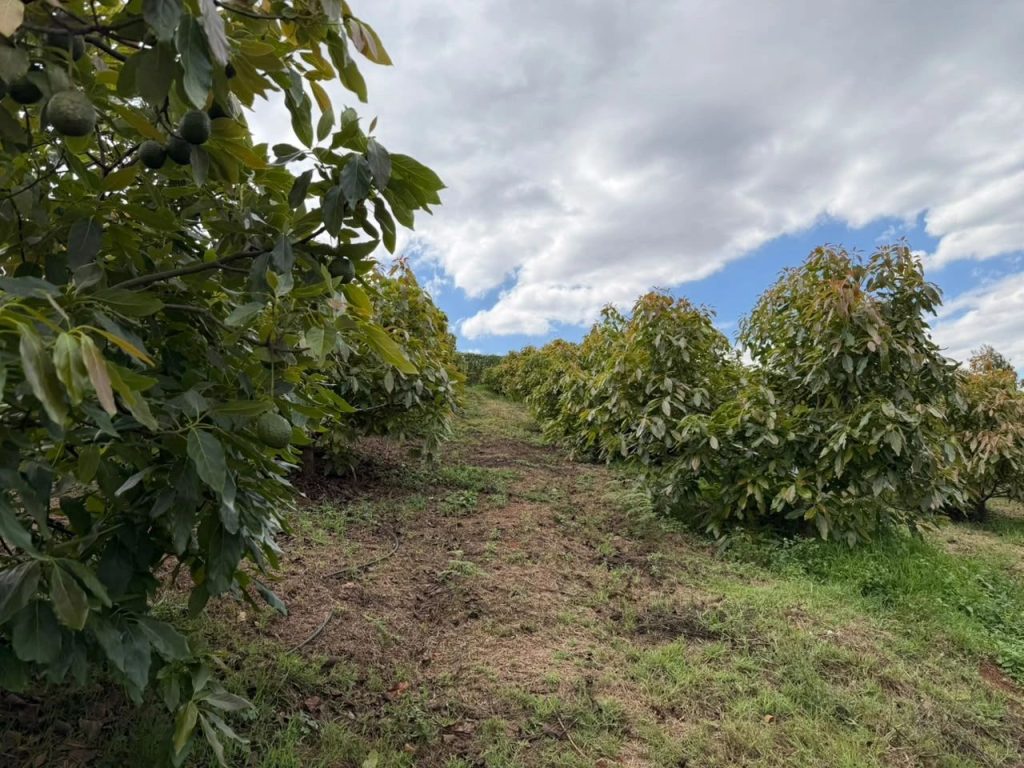
Hass is a large, vigorous tree. A Seeka grower deck states Hass grows 0.5 to 1 metre or more per year, forms a dome shape when given room and warns Hass is sometimes too vigorous for high density systems. Spann calls standard Hass at 10 by 10 feet a pruning nightmare, and notes growers at high density often choose narrow, upright types such as Lamb Hass, Gem or Reed. Ask your nursery which compact selections the nursery holds, and check each with KEPHIS before you order, since not every selection is available in Kenya.
Pruning work grows with tree count. A 5 by 5 metre block holds about twice the trees of a 7 by 7 metre block, so each pruning round takes about twice the labour. The Seeka deck advises at least four prunings a year in high density systems, and Spann says pruning is sometimes needed twice a year at high density. The Pine Tree Ranch report priced pruning at 4.88 dollars per tree in California, a figure which does not carry over to Kenya but shows the cost is real and recurs every year.
A capacity test before you choose the layout
We suggest a simple test. Count the trees your crew prunes well in one working day, with the tools you have. Divide the number of trees in your planned block by this count. The answer is the number of working days one pruning round needs. Multiply by the number of rounds you plan each year, then compare the total with the days you truly have free. If the total exceeds the free days, choose a wider layout. This test is our own planning rule and not a published standard.
Soil and water set the other limit. Dense trees compete for water and nutrients, and a healthy root system matters more at high density, since the Nuffield report stresses Phytophthora cinnamomi management is critical. Read our guide on avocado root rot and drainage before you plant a dense block on clay.
Rule 2: Set Row Direction and Row Width for Light
Kenya’s central highland avocado districts lie within about one and a half degrees of the equator. Nairobi sits near 1.3 degrees south, Ruiru near 1.1, Murang’a near 0.7 and Embu near 0.5. The sun there climbs almost straight overhead at noon and crosses the sky from east to west on every day of the year. This changes the advice you read in California or Australia, where the sun stays low in the southern or northern sky.
Why north to south rows suit equatorial sun
When rows run north to south, the sun crosses the rows at a right angle. In the morning the sun lights the east face of each hedge, around noon the sun lights the top, and in the afternoon the sun lights the west face. Both faces of every hedge get direct sun on every day. When rows run east to west, the hedge faces point toward the north and south, away from a sun which moves east to west, and each tree shades the neighbouring tree along the row in the early morning and late afternoon.
The Nuffield report cites work on apples by Middleton (2007) which found north to south orientation raises light interception by 15 to 20 percent. The work was done on apples at a temperate latitude, so treat the figure as a sign of direction and not as a value for Kenyan Hass.
When slope decides the row direction
Many Kenyan orchards sit on slopes in Murang’a, Embu and Kiambu, and slopes need contour rows for erosion control and drainage. Spann states the 80 percent height rule does not apply where rows do not run north to south or where the hillside does not face due south. On a slope, plant along the contour first. We suggest a height limit below 80 percent of the row width on the shaded sides, and a wider row.
Choose a row width in this order
Start from the machines and people who will work the aisle. A tractor sprayer, a pruning platform and a picking crew each need space. The Nuffield report uses 3 metres as a serviceable aisle in an Australian example. Add the width of one canopy base to the aisle, and you reach the row width. A 3 metre aisle and a 3 metre canopy base give a 6 metre row. A 2 metre aisle gives the 5 metre row in Figure 4, which suits hand pruning and small equipment and leaves no room for a wide platform.
Light Interception Angles: The Geometry Behind the 80 Percent Rule
Near the equator at the equinox, the sun’s height above the horizon equals 90 degrees minus 15 degrees for each hour from solar noon. A hedge casts a shadow whose length equals the hedge height divided by the tangent of the sun height. For rows which run north to south, the shadow across the aisle depends only on the hour, and the equation gives the same result in every month of the year.
| Hours from solar noon | Sun height above horizon | Shadow length per metre of tree height | Shadow of a 4 metre hedge |
| 1 hour | 75 degrees | 0.27 metres | 1.1 metres |
| 2 hours | 60 degrees | 0.58 metres | 2.3 metres |
| 3 hours | 45 degrees | 1.00 metres | 4.0 metres |
| 4 hours | 30 degrees | 1.73 metres | 6.9 metres |
| 5 hours | 15 degrees | 3.73 metres | 14.9 metres |
At three hours from noon, the shadow of a 4 metre hedge reaches 4 metres across the ground. In a 5 metre row, the shadow ends inside the canopy base of the next row. At four hours from noon, the shadow reaches 6.9 metres and passes the centre line of the next hedge. Late in the afternoon and early in the morning, every hedgerow shades the next one, and the question is how many hours of the day stay clear.
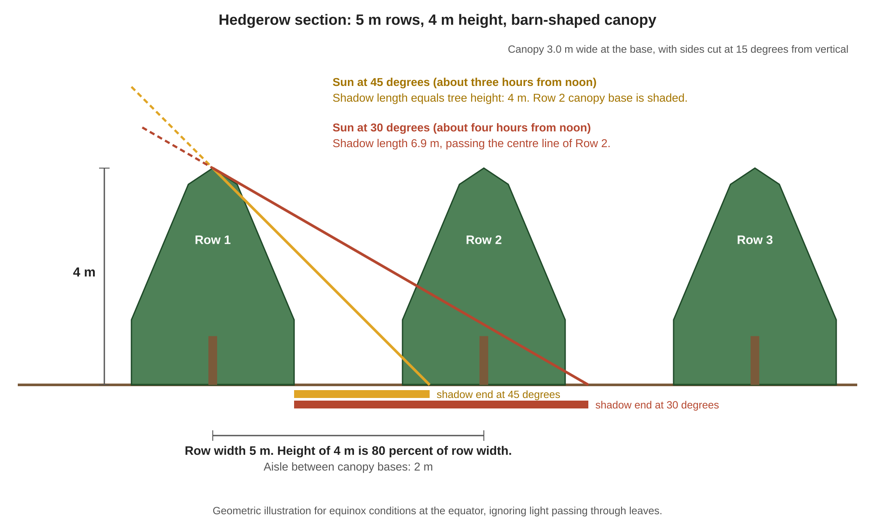
Figure 4. A hedgerow cross-section for 5 metre rows and 4 metre height, with the shadow at two sun heights. Our drawing, a geometric illustration which ignores light passing through leaves.
Taller hedges lose sun hours quickly. Figure 5 plots the number of hours the sun clears the neighbouring hedge and strikes the centre line of the next row at ground level, for a range of height to row width ratios.
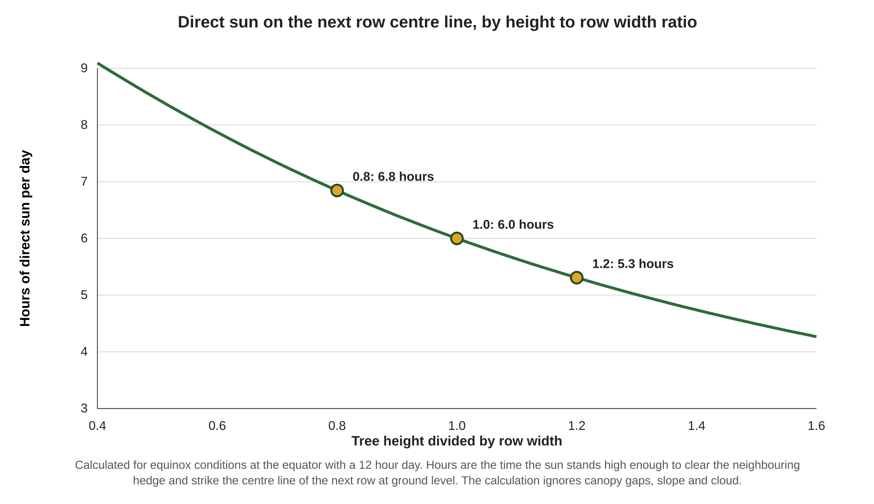
Figure 5. Direct sun hours on the next row centre line against the ratio of tree height to row width, calculated for the equator. Our chart.
At a ratio of 0.8, the next row centre line receives direct sun for about 6.8 hours a day. At 1.0 the figure drops to 6.0 hours, and at 1.2 to 5.3 hours. A hedge 20 percent taller than the row width therefore removes about one and a half hours of direct sun from the base of the neighbouring hedge, compared with a hedge at 80 percent. This is a calculation and not a field measurement. Cloud, slope, gaps in the canopy and the tilt of the cut sides change the real numbers.
How deep light reaches inside a canopy
Row width controls light between hedges. Canopy depth controls light inside each hedge. The Nuffield report cites a 2004 thesis by Hadari which found light penetrates an avocado canopy to a maximum of about 1 metre, so a tree wider than about 2 metres holds a dark core. The Seeka deck links shape to productive canopy and lists about 20 percent for a dome, 56 percent for a hedgerow and 91 percent for a cylinder. The deck names no author for these numbers, so read them as an industry estimate.
Spann describes the fix in practical terms. Narrow the tree and open the centre so light enters, and look for leaf cover through the canopy. The 3 metre base in Figure 4 is wider than the 2 metre depth Hadari suggests. The sloped sides help, and selective thinning of interior branches helps more.
Rule 3: Hold Tree Height at 80 Percent of Row Width
Spann gives a rule of thumb for hedgerow avocado: tree height stays at or below 80 percent of the row spacing. For rows 20 feet apart, the maximum height is 16 feet. The rule keeps light reaching the orchard floor and the lower canopy. The same article states the rule does not hold on slopes where rows fail to run north to south or the hillside faces away from due south, as covered under Rule 2.
In metres, the limit is 4.0 metres for 5 metre rows, 4.8 metres for 6 metre rows and 5.6 metres for 7 metre rows. The 5 by 5 metre layout, the one most Kenyan growers pick for small holdings, therefore needs a hedge no taller than 4 metres. A Hass tree left alone climbs well beyond this height.
Cut below the limit, since the tree regrows
Spann notes holding a 16 foot height means cutting to about 12 or 13 feet, so the regrowth reaches 16 feet by the next pruning. The same proportion applies in metres. To hold a 4 metre hedge, cut to about 3.0 to 3.3 metres. A crew which cuts exactly at the limit finds the trees above the limit by the next pruning round.
Why height pays in other ways
Height also decides harvest cost and safety. Spann suggests a height of not more than about 15 feet, or 4.6 metres, for ladder-free harvest with picking poles. Hofshi kept his ultra high density Reed trees low enough to hand harvest all fruit from the ground. In Florida, after Hurricane Andrew in 1991, trees topped to about 5 metres or less suffered less damage than taller trees. Trees on exposed Kenyan ridges face wind, so the Florida result is worth noting.
Australian growers in the AV04008 report cut trees down to similar heights. Orchards in the report brought trees from 7 to 8 metres down to 5 to 6 metres, from 9 metres down to 6 metres, and to 4.6 metres in one barn-shaped hedgerow.
Cutting a tall tree down in stages
KALRO warns Hass is highly susceptible to sunburn and advises against severe pruning, except to reduce tree size after many years of growth. Heavy cuts expose bark and branches which grew in shade. We suggest two steps for a block which has already grown too tall. First, lower the height over more than one season and open the centre first. Second, whitewash newly exposed branches. Spann recommends a 50:50 mix of thinned interior latex paint and water, or kaolin clay for organic orchards, on branches exposed by pruning late in the season.
Mark the height limit on a pole. Paint metre bands on a 6 metre pole and carry the pole through the block at pruning time. A crew with a clear mark makes cuts at the same height tree after tree, and the hedge stays level.
Rule 4: Train Young Trees to a Narrow, Open Frame
The shape you set in the first three years decides the pruning work for the next twenty. A tree with a straight central stem and well spaced side branches is far easier to hold at 4 metres than a tree with four equal trunks. Training costs little when the tree is small, and the same job costs a crew weeks once the tree is large.
What KALRO and the research advise for young Hass
The KALRO guide advises pinching the growing tips of young plants at the top bud at a height of 1 to 1.5 metres, to promote a more compact tree. The guide also advises removing lower branches which interfere with irrigation or field hygiene, and removing internal branches and dead twigs. Spann advises pruning young trees for structure after the first year in the ground.
Research from other countries adds three ideas. Hofshi recommended training a central leader in the nursery, and Reed and Lamb Hass keep a natural central leader which lets light into the lower canopy. An overseas Hass trial which Spann describes removes proleptic side shoots, keeps upright sylleptic shoots to form a pyramid and removes water shoots. Dr P. Stassen of the Institute for Tropical and Subtropical Crops in South Africa researched intensive central leader training of Hass, and Whiley and Tony saw no sign the South African industry had adopted the results. The methods are therefore worth a trial block and not a whole farm.
| Stage | Training task | Basis |
| At planting | Choose seedlings with a straight stem and a healthy graft union, and keep the union above the soil | Our suggestion |
| First year after planting | Keep the lower stem clear of branches which touch the ground or block drippers, and remove dead twigs | KALRO |
| Year two, at 1 to 1.5 metres | Pinch the top bud to promote a compact tree, and select an upright leader with spaced side branches | KALRO, and the central leader work above |
| Years two and three | Remove water shoots and crossing or inward branches, and keep side branches below the height limit | Overseas trial described by Spann |
| Before the first heavy crop | Set the width: narrow the base and slope the sides toward the top | AV04008 hedgerow example |
Skirt the tree to keep the lower trunk clear
Spann describes skirt pruning as removing lower branches from the ground up to about knee height. In Kenyan orchards, skirting keeps branches off the soil, which also helps hygiene when Phytophthora is present, as KALRO advises in the field hygiene notes. Skirting also gives space for drip lines and workers.
Questions to ask your nursery before you order
Ask how the nursery shapes seedlings in the bag, whether the grafted stem grows straight and whether the nursery tops young plants. Ask which rootstock carries the Hass graft, and read our guide on root rot to see why the choice matters. A straight, healthy seedling saves pruning days for years. Our nurseries in Murang’a, Nairobi and Embu supply grafted Hass seedlings, and our team answers these questions before you pay.
Water, Mulch and Nutrition in a Dense Block
Dense trees draw on the same soil volume sooner than trees at standard spacing. We know of no Kenyan trial data on the extra water and nutrients a dense Hass block needs, so this section sets out the published advice we trust and the habits we recommend to growers.
Water the root zone, and measure the soil
The KALRO guide on climate smart practices notes avocado roots are relatively shallow, so supplementary irrigation needs to be frequent and light, with no more than 50 litres a week for young trees according to the guide. We advise placing drippers inside the root zone of the young tree and away from the trunk, and keeping them off the graft union. University of California extension calls appropriate irrigation the single most critical practice for preventing Phytophthora root rot, and the same advice applies to a dense block, where more trees share one irrigation line.
Irrigate by soil moisture and not by habit. A New Zealand orchard guide gives 50 kilopascals as the tensiometer trigger on clay soils. The number comes from New Zealand, so confirm the trigger for your own soil with an agronomist. After a heavy cut, the tree carries less leaf, and we advise checking the soil moisture before the next irrigation cycle.
Mulch and organic matter
University of California extension advises at least 4 to 6 inches, about 10 to 15 centimetres, of coarse organic mulch under the canopy, kept clear of the trunk. KALRO advises maintaining high soil organic matter with well-decomposed manure. We recommend chipping clean prunings and spreading them under the canopy as mulch. Remove diseased wood from the block, because Spann advises taking cankered branches and other diseased material out of the grove.
Soil and leaf sampling
Spann notes growers of dense groves often add a more intensive fertility programme. A New Zealand guide suggests soil samples taken to a depth of 15 centimetres, halfway between the trunk and the canopy edge, with leaf samples taken at the same time. We advise sampling each block every year and keeping the results beside the pruning record. Fertiliser rates depend on the soil and leaf results, so this guide gives none.
Rule 5: Pruning Mature Avocado Trees on a Fixed Yearly Cycle
Pruning mature avocado trees has one purpose in a dense orchard: keep the height, the width and the light inside the canopy within limits. Spann points out no physiological requirement for pruning exists, and trees fruit without pruning. At high density the trees fill their space and the crop moves to the treetops, so pruning becomes a requirement of the system you chose.
Thinning cuts and heading cuts
Spann separates two kinds of cut. A thinning cut removes a branch back to the point where the branch starts, and reduces size and opens the canopy. A heading cut shortens a branch, and stimulates vigorous new growth below the cut. In a dense orchard, heading cuts feed the regrowth you are trying to control. Use thinning cuts for most of the work.
Make structural cuts first. Spann advises fixing crossing limbs, narrow forks and badly placed branches before any other cut. He also notes a couple of larger cuts cost less time than many small cuts. For branches thicker than 1 inch, about 2.5 centimetres, use the three-cut method. Make a first cut on the underside a short way out from the final cut position. Make a second cut from above, slightly further out, to drop the branch. Make a third cut close to the branch collar. The first cut stops the bark tearing down the trunk as the branch falls.
Hedging by machine or cutting selectively by hand
Mechanical hedging shapes the sides and top quickly. The AV04008 report records Sites 2, 3, 4 and 7 formed hedgerows this way, often with selective pruning to open the centres and keep access for platforms. One orchard cut the sides at 15 degrees from vertical and the top at 60 degrees from vertical, and lowered the trees to 4.6 metres. Another orchard took 45 percent off each side with mechanical and selective pruning, and yields dropped sharply in the first year afterward. The same orchard recorded the report’s highest Hass yield, 28.5 tonnes per hectare per year.
The report’s conclusion on method is clear. Selective limb removal suits cooler regions, while mechanical and selective pruning suits warmer areas with an earlier harvest. Many Kenyan Hass districts are cool highlands where fruit stays on the tree for months, so We suggest selective cutting by hand as the starting point. Mechanical hedging needs a tractor, a hedger and flat or terraced rows. Check whether your block offers these before you plan around the method.
Avoid staghorning
Staghorning means cutting the main limbs back to stubs. The AV04008 report records yields of 0, 1.1, 7.8 and 10.1 tonnes per hectare in the first four years after staghorning at one site. Four seasons of income are lost. Planned yearly cuts keep the canopy under control and avoid the rescue cut.
Cut one side at a time
Whiley and Tony describe two methods which keep a fruiting face on every tree. At Allesbeste in South Africa, André Ernst cuts the canopy back to within 2 metres of the trunk on one side immediately following harvest, and cuts the second side the following year. At Westfalia Estates, crews prune alternate sides in consecutive years so every tree keeps at least one productive fruiting face. Ernst reported 15 to 20 tonnes per hectare on pruned Hass planted at 5 by 7 metres, and he claims the strategy lessens alternate bearing. These are grower reports from a field study and not trial results.
A California Avocado Commission trial rotates the cut in a four year cycle. The trial cuts the south-west side in year one, the north-east side in year two and the top in year three, and repeats the cycle in year four. About two-thirds of the fruiting wood remains each year. The same trial tests a second method which prunes all sides and the top each year after harvest at 7 to 8 feet. Spann reports no results from the comparison.
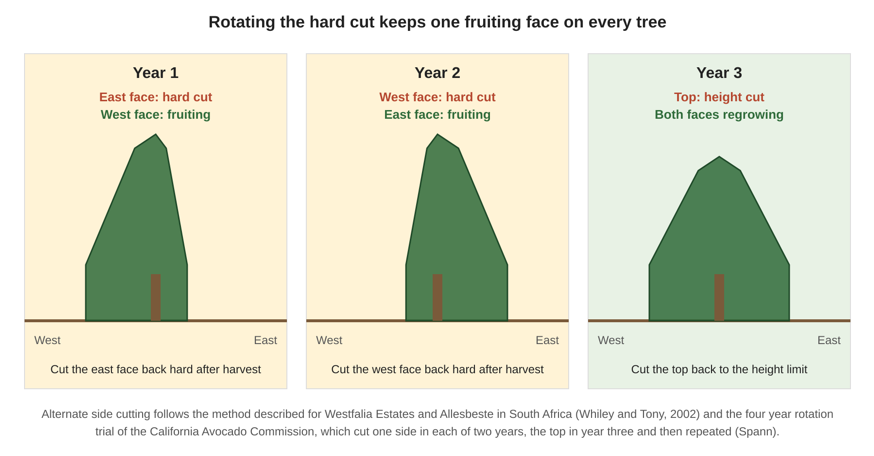
Figure 6. Alternate side pruning over three years, following the South African methods and the California rotation trial. Our drawing.
Clean tools and dry canopies
Spann advises sanitising tools after each tree with a spray of 25 percent household bleach or 70 percent ethanol, and removing diseased material such as cankered branches from the grove. He warns disinfecting tools does not stop avocado sunblotch viroid, and infected trees must be removed. He also advises against pruning when the canopy is wet, because wet conditions release fungal spores into fresh wounds. KALRO adds a clean pruning saw avoids spreading disease.
Summer Pruning Schedules for Kenyan Hass Orchards
South African growers use the phrase summer pruning for a lighter second cut made in the growing season, after the main cut. Westfalia Estates does light hand pruning after harvest in winter, and a second prune in early summer to establish the next season’s fruiting platform. Ernst does summer pruning in December and January. Mitchell, in the Nuffield report, found every pruning system he reviewed uses two cuts: a primary cut after harvest and a follow-up to remove vigorous regrowth.
Kenya has no summer in the temperate sense, so the useful question is where the two cuts fit in the crop calendar. KALRO lists peak flowering for Hass in October and peak harvest from June to September, with fruit maturing 8 to 9 months after blossoming. A FreshPlaza report from 2022 quotes Jack Njoroge of Avodemia saying flowering runs through October and November, and a short dry spell triggers the flowering. A tree therefore carries a crop for most of the year, and the window between the last pick and the next flowering is short.
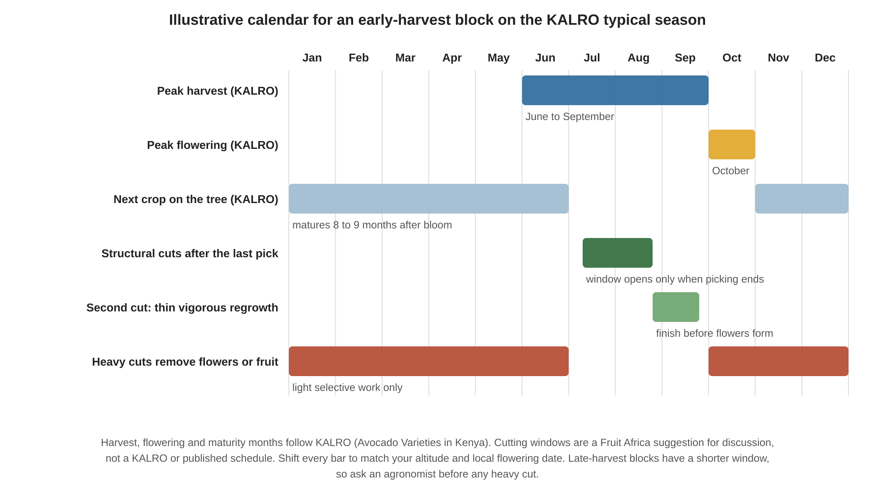
Figure 7. An illustrative calendar for an early-harvest block, based on KALRO season months. The cutting windows are our suggestion for discussion, and not a published schedule.
Why the timing of cuts matters
Timing follows how the avocado tree flowers. Flowers form on growth from the previous season, and Spann states new growth must mature before the next flowering. The Seeka deck states pruning before flower initiation stimulates more growth in the same year, while pruning after flower initiation removes flowers and stimulates growth the following spring. The AV04008 report adds in central Queensland growers prune Hass between June and August, before flowering, and in cooler regions with two crops growers prune in an off year to limit fruit loss.
Apply the same logic to your block. A cut in the weeks before and during flowering costs flowers. A cut while a heavy crop hangs costs fruit, and exposes fruit to sunburn. The safe window opens when the last fruit leaves the block and closes well before flowers form.
| Task | When | Aim | Basis |
| Structural cut | Right after the last pick from the block | Lower the tallest limbs to the height limit, open the centre and set the width | Nuffield report, Westfalia, Allesbeste |
| Second cut | After vigorous regrowth appears, and early enough for the shoots to harden before flowering | Thin the strongest shoots and keep the hedge shape | Nuffield report, Westfalia early summer prune |
| Light maintenance | Through the year, on dry days | Remove dead wood, water shoots and low branches | KALRO, Spann |
| No heavy cuts | Before and during flowering, and while a heavy crop hangs | Protect flowers, fruit set and fruit | Seeka deck, Spann, AV04008 |
| Whitewash new exposure | After any heavy cut | Prevent sunburn on exposed branches | Spann, KALRO |
The dates in Figure 7 suit an early-harvest block picked in June and July. A late-harvest block picked into September has almost no window. Ask an agronomist before you make a heavy cut in such a block. Spann notes many growers prune after the harvest of a heavy crop in an off year to limit fruit loss, and cuts after about mid-May in California risk delaying flowering by a year. Stagger the harvest across blocks so one block is always free for pruning, and never harvest immature fruit to open a pruning window. Early picking breaks the dry matter rules which protect Kenya’s export market.
Growth regulators are a separate decision
South African growers spray uniconazole or paclobutrazol products on regrowth. Ernst sprays regrowth at 50 to 100 millimetres, using 0.25 percent twice about two weeks apart, and Westfalia sprays at about 100 millimetres. The AV04008 report found these products reduced shoot growth and raised flowering in staghorned Hass, though results were mostly not statistically significant. Spann notes they are not currently permitted on avocado in California, and the Nuffield report records New Zealand high density orchards still struggled with excessive growth at elevated rates. Check the registration status with the Pest Control Products Board and the buyer’s residue rules before you use any growth regulator. This guide gives no rates, because the label and a local agronomist set them.
A Year-by-Year Plan From Planting to Year Ten
This is our suggested plan for a 5 by 5 metre block with temporary trees. The plan blends the KALRO training advice, the published records quoted above and our own judgement. Change the plan as your trial results arrive.
| Stage | Main tasks | Basis |
| Before planting | Dig profile pits, mark drains and mounds, set the row direction and map the temporary trees | Our suggestion, and our root rot guide |
| Year 1 | Keep irrigation light and frequent, keep the lower stem clear and remove dead twigs | KALRO |
| Year 2 | Pinch the top bud at 1 to 1.5 metres, choose an upright leader and remove water shoots | KALRO, and Spann on structure after the first year |
| Year 3 | Make light structural cuts, set the width and the height mark and start the record sheet for each block | Our suggestion. Pine Tree Ranch harvested the first crop in year three, and KALRO states bearing starts after 3 to 5 years |
| Year 4 | Run the first full cycle: structural cut after the last pick and a second cut on the regrowth | Nuffield report, Seeka deck on four prunings a year |
| Year 5 | Cut one side hard, review light and decide which temporary trees go | Pine Tree Ranch began pruning in year five and found the tight plots crowded |
| Year 6 or 7 | Remove the temporary trees, or cut them back to a small frame where the block stays dense | Spann’s untested proposal to thin around year six, and the Seeka deck on year seven |
| Years 7 to 10 | Keep the yearly cycle, hold the height limit and review the record sheet each season | Our suggestion |
The plan aims at a standard density by year seven. A grower who keeps the block dense must accept a heavier and more frequent pruning load. Spann doubted a 10 by 10 foot Hass layout stays sustainable over 25 years or more, and we know of no long term Hass trial at 250 trees per acre in Kenya. Ask us about your block before you commit to the dense option for the whole life of the orchard.
Pruning Crew Briefing and Checklist
A dense orchard fails when the crew cuts without a standard. A ten minute briefing at the start of each pruning day keeps the cuts consistent. Show the crew one finished tree and one unfinished tree, agree on the height mark and agree on which side takes the hard cut this year. The table lists the steps we want every crew to follow.
| Step | What the crew does | Basis |
| 1 | Start only on a dry day with a dry canopy | Spann |
| 2 | Check the block’s flowering date before the first cut | Seeka deck, Spann |
| 3 | Set the height pole, painted in metre bands, at the end of each row | Our suggestion |
| 4 | Spray tools with 70 percent ethanol or 25 percent household bleach after each tree | Spann |
| 5 | Make structural cuts first, and remove crossing limbs and narrow forks | Spann |
| 6 | Prefer thinning cuts, and prefer a few larger cuts to many small cuts | Spann |
| 7 | Use the three-cut method on branches thicker than 2.5 centimetres | Spann |
| 8 | Cut only the side marked for this year to the hard cut | Westfalia and Allesbeste methods |
| 9 | Whitewash newly exposed branches after heavy cuts | Spann, KALRO |
| 10 | Remove diseased wood from the block, and chip clean prunings for mulch | Spann, our suggestion |
| 11 | Record the trees cut, the hours worked and the height of the final cut | Our suggestion |
Safety belongs in the briefing too. Keep pole saws away from power lines, avoid ladders on wet slopes and give each worker eye protection. These are standard safety rules, and they cost nothing.
Rule 6: Thin Before the Trees Crowd, and Measure Light Every Season
Every dense orchard reaches a year when the trees fill the space. Growers who plan the thinning at planting handle this year well. Growers who delay thinning lose the lower canopy, then the crop, then years of income while the trees recover. The Seeka deck says growers often delay thinning, and the delay reduces the benefit.
What the records show about thinning
The Seeka deck recommends thinning medium density plantings in year seven after planting, to reduce crowding and shading. The deck warns a thin made too early wastes trees, because the fruit value has not yet paid back the establishment cost. A California report on Fuerte describes a grove which became crowded after year 14. Yields stayed low in years 15 to 19, and thinning to 54 trees per acre led to the grove’s highest production in year 22. The report gives no yield figures.
At Pine Tree Ranch, Spann’s team did not prune from 2014 through 2018 and began pruning in spring 2019. The team later used diagonal thinning, which removes every other tree, and the grove ended at a 20 by 14 foot offset spacing. Spann suggests a hybrid plan for future plantings which thins around year six and removes the whole grove around year twelve. He labels the plan a proposal and not a tested result. In Australia, one orchard in the AV04008 report removed every second row and reduced the planting from 555 to 278 trees per hectare.
Plan the thinning at planting
Diagonal thinning removes every second tree in a square layout. The trees left stand on a wider spacing than the original grid, and the arithmetic is simple. Each remaining tree takes twice the area.
| Planting layout | Trees per acre at planting | Trees per acre after diagonal thinning | Distance between remaining trees |
| 4 by 4 metres | 253 | 126 | 5.7 metres on the diagonal |
| 5 by 5 metres | 162 | 81 | 7.1 metres on the diagonal |
| 6 by 3 metres | 225 | 112 | 6.7 metres between thinned positions |
A 5 by 5 metre block thinned on the diagonal ends near the KALRO standard of 83 trees per acre. This is a useful fact for a grower who wants early cropping from a dense block and a standard orchard later. Decide before you plant which trees stay. Mark the permanent trees on the farm map, and tell your crew the other trees are temporary. A crew which treats every tree as permanent will not cut any.
Signs the block needs thinning
| Sign | What you see | Action |
| Canopies meet across the aisle | Branches from two rows touch at head height | Cut back the sides, and mark the temporary trees for removal |
| Bare lower branches | Leaves absent below the middle of the tree and branches without foliage | Thin the canopy and plan removal of the temporary trees |
| Fruit only at the treetop | Crop sits in the top third of the hedge | Lower the height, open the centre and thin the neighbours |
| Falling fruit size | Fruit from shaded branches stays small | Increase light through thinning and compare the dry matter of fruit from lit and shaded branches |
| Pruning work rising each year | The crew needs more days for the same block | Review the tree count against the crew capacity |
Whiley and Tony recorded the same pattern in Florida and California. Many orchards had poorly lit side canopies, and fruiting had retreated to the tops of the trees. Spann notes poor light penetration kills interior and lower branches and pushes fruit to the canopy exterior. Some shade protects fruit from sunburn, but excess shade lowers fruit set and fruit size.
Measure light and keep records
Spann’s 2025 article gives no measured light values for avocado, and offers a practical test instead. Look for leaf cover through the canopy, and where the interior is bare, make strategic cuts to admit light. Add three simple checks of your own. Photograph the same hedge from the same spot each season. Walk each block after harvest and note where the lowest leaves sit. Count the fruit on one lower branch and one upper branch of the same tree. These checks are our suggestions, and they cost nothing.
Keep a record sheet for every block. Note the planting date, the layout, each pruning date, the labour days used, the height at the cut, the yield and the fruit size. Spann points to citrus research in which pruning at the same time every year stabilised yields after a few seasons, and suggests avocados respond in the same way, though no avocado trials exist yet. Your own records become the trial.
Fruit Quality, Dry Matter and Harvest in a Hedgerow
A dense hedgerow still has to deliver fruit which passes the maturity rules. The Horticultural Crops Directorate recommends 24 percent dry matter for Hass, and the UNECE standard FFV-42 sets a minimum of 21 percent for Hass. Our guide on avocado dry matter testing in Kenya explains the two numbers and the test method. Pruning does not change the rules, so plan the harvest and the pruning together.
Never pick early to open a pruning window
The pruning window opens when the last fruit leaves the block. Pressure to open the window early leads some growers to pick fruit before the fruit reaches the required dry matter. Early picking breaks the rules, and the practice damages the market for every Kenyan grower. Stagger the harvest across blocks so one block is free for pruning, and let each block reach the dry matter target before the pickers enter.
Compare fruit from lit and shaded positions
Spann notes some shade protects fruit from sunburn, but excess shade lowers fruit set and fruit size. We suggest a simple comparison each season. Tag five fruit from the sunlit outer canopy and five from a shaded inner position on the same tree, and record the size at harvest. KALRO describes Hass fruit as medium sized, from 150 to 300 grams. A growing gap between lit and shaded fruit tells you the canopy needs more thinning. We have no published data on the link between canopy shade and dry matter in Kenya. Keep the dry matter results for each block beside your pruning record, and look for a pattern across seasons.
Harvest from the ground where possible
Spann suggests a height of not more than about 15 feet, or 4.6 metres, for ladder-free harvest with picking poles. Hofshi kept his Reed trees low enough to hand harvest all fruit from the ground. A 4 metre hedge in a 5 metre row brings the whole crop within reach of pickers using poles, and the crew works with fewer ladders on slopes. Check the aisle width against the crates and carts you use, and keep the aisle clear of regrowth at harvest time.
Common Mistakes in Dense Avocado Blocks
Waiting for the canopy to close before the first cut
The Pine Tree Ranch team did not prune from 2014 through 2018, and the tightest spacings lost most of their lower leaves. Spann noted the trial possibly lost yield through late pruning. Start the cutting plan in year two and the first full cycle in year four.
Using heading cuts to control height
A heading cut stimulates vigorous regrowth below the cut, according to Spann. A crew which tops every tree at the same height gets a flush of upright shoots and a dense, dark crown. Use thinning cuts and open the centre.
Waiting for a rescue cut
Staghorning is the cut which leaves main limbs as stubs. One orchard in the AV04008 report recorded yields of 0, 1.1, 7.8 and 10.1 tonnes per hectare in the four years after staghorning. Annual cuts avoid the rescue.
Cutting near flowering
Heavy cuts near flowering remove the flowers, as the Seeka deck explains. Mark the flowering date for each block, and move the last cut well before the date.
Planting along the slope
Rows which run up and down a slope carry water and soil downhill, and the shaded sides stay shaded. Plant along the contour, and add drains before the trees.
Treating every tree as permanent
A crew which sees every tree as permanent refuses to remove any. Map the temporary trees at planting, and brief the crew and the owner on the removal year.
Skipping tool sanitation and records
Spann advises sanitising tools after each tree. A crew without a spray bottle spreads disease from tree to tree. A farm without records has no way to tell which cut helped, so keep the sheet for every block.
Risks of High Density Avocado Farming in Kenya
The Nuffield report lists the main risks of high density avocado systems, and the other sources agree with most of them. Read the list before you commit a large block.
| Risk | What the sources say | What to do |
| Disease pressure | The Nuffield report states healthy trees are essential, and Phytophthora cinnamomi management is critical | Buy clean seedlings, drain the site and plant on mounds where needed |
| Vigorous regrowth | Hass is vigorous, and New Zealand high density orchards struggled with excessive growth even at elevated growth regulator rates | Plan two cuts a year, and start training in year one |
| Girdling needs | Growers in other countries use girdling in dense groves, which is labour intensive, relies on subjective decisions and weakens branches | Avoid girdling unless an agronomist trains your crew |
| Yield dips after hard cuts | AV04008 records sharp first year drops after heavy cuts, and Pine Tree yields fell in 2020 after the first pruning | Cut every year in small steps, and avoid one rescue cut |
| No dwarfing rootstock | Spann notes apples and cherries reach about 1,200 trees per acre because size-controlling rootstocks and trellises exist, and avocados lack both | Control size with cuts and not with the root system |
| Short evidence | The Pine Tree trial holds four years of data from a single site, and Spann says long term high density Hass data is lacking | Run a trial block before you plant the whole farm |
Drainage needs a separate plan in a dense block. Raised mounds at 4 metre spacing leave narrow gaps for water, so mark the drains and mounds on the farm plan before you mark tree positions.
The Economics of High Density Avocado Farming in Kenya
More trees per acre means more seedlings, more irrigation points, more pruning days and more fruit to pick. The extra income arrives sooner, and the extra costs arrive every year. Compare the two with your own numbers. This guide gives no Kenyan price figures, since seedling, labour and fruit prices change by region and season.
Start with the seedling count. A 5 by 5 metre block holds 79 more trees per acre than a 7 by 7 metre block, and a 4 by 4 metre block holds 170 more. Every extra tree needs a hole, a mound where drainage requires one, a seedling and irrigation. Spann’s California costing put 70 dollars on each planted tree, including planting labour, staking, whitewash and above-ground irrigation, and 4.88 dollars on pruning each tree each year. The figures belong to California, and the structure of the costing carries over.
| Item | How to calculate | Your figure |
| Extra seedlings | Trees at the dense layout minus trees at 7 by 7 metres, times the seedling price | Fill in |
| Extra planting cost | Extra trees times the cost of the hole, mound, stake and drip point | Fill in |
| Yearly pruning cost | Pruning days per round, times rounds per year, times the daily wage | Fill in |
| Extra picking cost | Expected kilograms of fruit times the picking cost per kilogram | Fill in |
| Early income gain | Expected fruit in years three to six from the dense layout minus the standard layout, times your price | Fill in |
| Cost of thinning | Trees removed times the removal cost, less any income those trees gave before removal | Fill in |
Spann reached a cautious conclusion on his own numbers. Closer spacing produced higher early yields and returns, and he questioned whether the 10 by 10 foot layout holds up as a grove of 25 years or more. He also warned the figures are not a net return, because not all expenses were tracked. Treat early income as real, and plan the thinning as a cost from day one.
Choosing Grafted Hass Seedlings for a Dense Block
A dense block rewards uniform trees. A block of seedlings with mixed vigour forces your crew to prune each tree one by one, and the strong trees shade the weak ones. Buy all the seedlings for one block from one batch where possible, and ask the nursery for the batch record.
Check the graft union, the straightness of the stem and the root ball on arrival, using the inspection steps in our root rot guide. Ask which rootstock carries the graft, how the nursery shapes the young plant and whether the plants are topped. Ask for a few spare seedlings above your planting count, so you replace losses with plants of the same batch.
We raise grafted Hass seedlings at our nurseries in Murang’a, Nairobi and Embu. Our agronomy team helps you work out a layout, a thinning plan and a seedling order for your land. You are welcome to visit www.fruitafrica.org or use the contact details at the end of this guide.
Frequently Asked Questions on Hass Spacing and Pruning
What is the best Hass avocado spacing per acre in Kenya?
KALRO gives 7 by 7 metres, which equals 83 trees per acre. Many small farms plant 5 by 5 metres, which equals 162 trees per acre. The Colombian density trial found the highest yields at 135 and 162 trees per acre, and the AV04008 report found high yields at 135 and 193 trees per acre. The best spacing is the one your crew keeps pruned on time.
Does a Hass orchard work at 250 trees per acre?
A 4 by 4 metre layout gives 253 trees per acre. Evidence for Hass at this density is thin. The Colombian trial found lower yield per tree at 625 trees per hectare, which equals 253 per acre, than at 400. The height limit under the 80 percent rule is 3.2 metres, and the Seeka deck advises at least four prunings a year at high density. Treat 250 trees per acre as a trial block for experienced growers, with a plan to thin to about 126 trees per acre.
How many Hass trees fit in an acre at 5 by 5 metres?
An acre holds 4,047 square metres, and each tree takes 25 square metres, so the gross count is 162 trees. Roads, drains and headlands lower the count of planted trees.
Which row direction suits avocado in Kenya?
Kenya lies on the equator, and north to south rows give both faces of each hedge direct sun during the day. On slopes, plant along the contour first, and lower the height limit on the shaded sides.
What height limit applies to a high density avocado hedge?
Spann advises a height of no more than 80 percent of the row width. The rule gives 4.0 metres at 5 metre rows and 4.8 metres at 6 metre rows. Cut to about 3.0 to 3.3 metres at 5 metre rows so the regrowth stays under the limit.
When do you prune mature avocado trees in Kenya?
Make the structural cut right after the last pick from the block, and make a lighter second cut after vigorous regrowth appears, early enough for the shoots to harden before flowering. KALRO lists peak flowering in October and peak harvest from June to September, so the window is short. Treat the calendar in this guide as a suggestion and confirm the dates for your altitude with an agronomist.
How much do you cut from a mature tree in one season?
No published value fits every orchard. The AV04008 report records one orchard with a 45 percent cut on each side and a sharp yield drop in the first year, and another orchard which pruned part of the terminals and branches each year and recorded 25.8 tonnes per hectare per year. Spann advises making a few larger thinning cuts and not many small ones. Start on a few rows, record the result and extend the method when the result is good.
Does pruning reduce avocado yield?
Hard cuts reduce yield in the following season, and the record shows this at Pine Tree Ranch and in the AV04008 orchards. Regular, planned pruning keeps the canopy productive, and Spann notes crowded trees lose their lower canopy and their crop moves to the top.
Which rootstock suits a dense Hass block?
No published data names one rootstock for dense Hass in Kenya. The Nuffield report notes current varieties and rootstocks suit high density poorly. Choose for drainage and Phytophthora tolerance first, and read our guide on avocado root rot treatment in Kenya before you decide.
How soon does a dense Hass block start to bear?
KALRO states bearing starts after 3 to 5 years. The Pine Tree Ranch trial in California, planted in June 2014, recorded the first harvests in 2017, which is year three. The Reed planting by Hofshi reached 6.5 tonnes per hectare in year three. Treat these as California and Reed records, and keep your own record for Kenya.
What do I do with trees which already stand too tall?
Lower the height over more than one season, and open the centre first. KALRO advises against severe pruning because Hass is highly susceptible to sunburn. Whitewash the branches exposed by each cut, and ask us before you cut a tall block hard.
Do I need a machine to prune a dense block?
No. The AV04008 report concludes selective limb removal suits cooler regions, and many Kenyan Hass districts are cool highlands. Hand saws, loppers and pole pruners suit small blocks. Mechanical hedging needs a tractor, a hedger and rows wide and flat enough for the machine.
How do I protect pruning wounds?
Spann advises sanitising tools, avoiding pruning in wet weather and whitewashing branches which the cut exposes to the sun. KALRO advises covering the cuts of top working with a copper-based fungicide. Ask an agronomist about wound care for ordinary pruning cuts in your area.
Is a growth regulator required for a dense block?
We know of no Kenyan source which requires a growth regulator for Hass. South African growers use uniconazole and paclobutrazol products, and the Nuffield report records New Zealand high density orchards still struggled with excessive growth. Check the registration with the Pest Control Products Board and the residue rules of your buyer before you use any product.
How many seedlings do I order for a block?
Work from the planted area and not from the gross count. Multiply the number of rows by the number of trees in each row, and treat the temporary trees as part of the total. Add a few spare seedlings from the same batch for gap filling. Send us the farm plan, and our team checks the count with you.
Plan the Canopy Before You Plant the First Tree
High density avocado farming in Kenya rewards the grower who plans the whole life of the orchard on the day of planting. The layout sets the first crop. The row width sets the light. The height limit keeps the lower canopy alive. Training sets the frame, and the yearly cuts hold the frame in place. Thinning returns the orchard to a standard density when the trees fill the space.
The evidence supports about 135 to 190 trees per acre for Hass, and supports layouts to 250 trees per acre only for growers who prune hard and on time. Draw your layout on paper, choose your temporary trees, mark your height limit on a pole and book your pruning days before you order seedlings. Our agronomy team is ready to help you build the plan for your own land.
Glossary of Terms in This Guide
| Term | Meaning |
| Hedgerow | A continuous wall of trees in a row, shaped to a set height and width |
| Row width | The distance between two rows, measured from one trunk line to the next |
| Height limit | The tallest height allowed for the hedge, set at 80 percent of the row width |
| Thinning cut | A cut which removes a whole branch back to the point where the branch starts |
| Heading cut | A cut which shortens a branch and stimulates new growth below the cut |
| Skirting | Removing the lowest branches, up to about knee height |
| Central leader | A single upright main stem with side branches spaced along the stem |
| Staghorning | Cutting the main limbs back to stubs to reduce tree size |
| Diagonal thinning | Removing every second tree in a square layout, so the remaining trees stand on a wider diagonal grid |
| Canopy volume | The space filled by leaves and branches, which holds the light-capturing leaf area |
| Flush | A burst of new shoots and leaves after rain, irrigation or a cut |
| Solar noon | The moment the sun stands highest in the sky, near 12:30 in central Kenya |
Sources Used in This Guide
KALRO and NAVCDP, Climate Smart Agronomic Practices for Avocado
KALRO and NAVCDP, Avocado Varieties in Kenya
FreshPlaza, Hass avocado growers are looking at the density of their orchards in Kenya, 12 October 2023
FreshPlaza, Kenyan avocado trees are flowering, we are preparing next year’s season, 11 November 2022
Pesquisa Agropecuária Brasileira, Yield and fruit quality of avocado grown at different planting densities in Colombia
Tim Spann, California Avocado Commission, High Density Groves: Fact or Fiction, 2019
Tim Spann, California Avocado Commission, Optimize Productivity by Pruning for Maximum Light, 2019
Tim Spann, California Avocado Commission, The Economics of High Density Avocado Groves, 2020
California Avocado Commission, High Density Avocado Production
Tim Spann, California Avocado Commission, Pruning Avocado Trees: Science, Art or Mysticism, 2025
Horticulture Innovation Australia, Avocado canopy management strategies, project AV04008
Whiley and Tony, field report on avocado orchard management in South Africa, Florida and California, 2002
Seeka, Avocado Growing Systems and Pruning, grower roadshow slides
Dudley Mitchell, Nuffield Australia, High Density Avocado Production: Constructing an Integrated Management Model
Contact Our Agronomy Team Today
Head Office Location: Ruiru, Kiambu County, Kenya
Nursery Distribution Hubs: Murang’a, Nairobi and Embu
Phone Direct: +254 714 994 444
WhatsApp Assistance: Message us on WhatsApp
Official Email: sales@fruitafrica.org
Official Website: www.fruitafrica.org
Request a Quotation: fruitafrica.org/request-for-quotation/