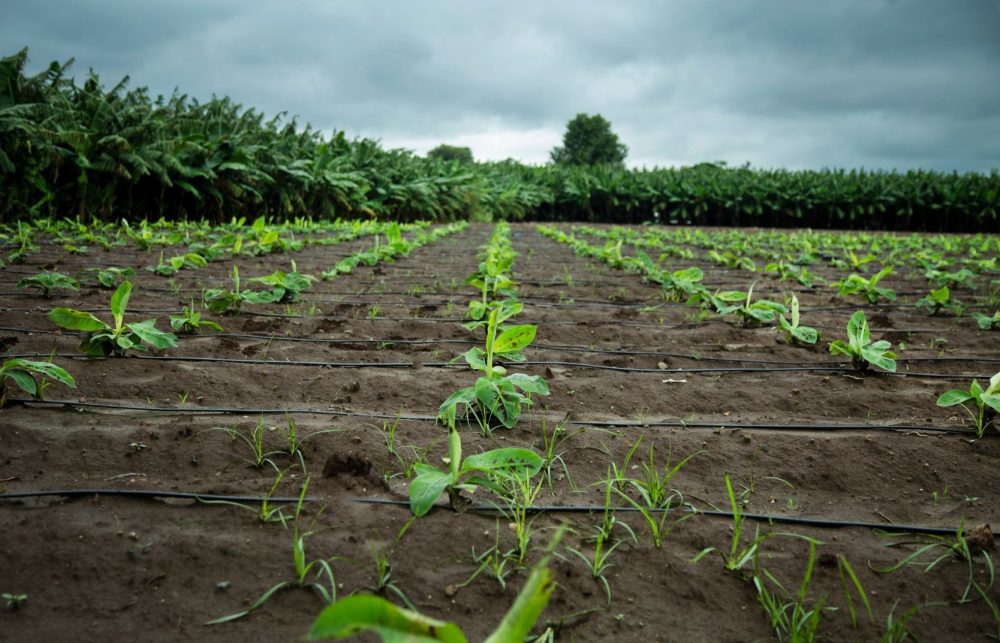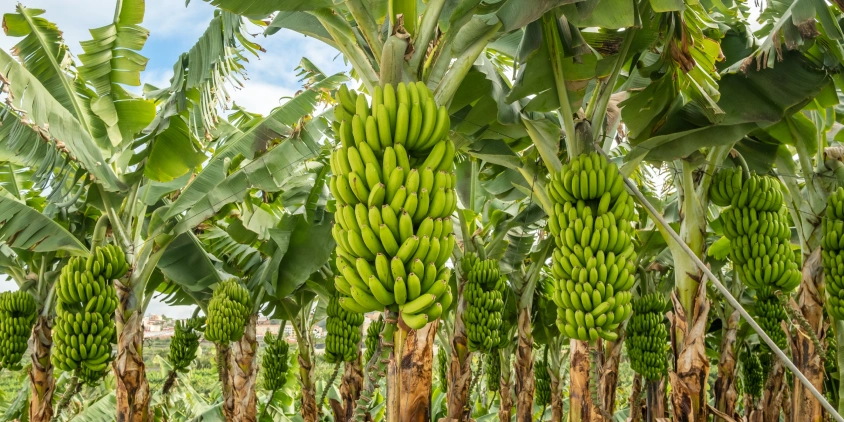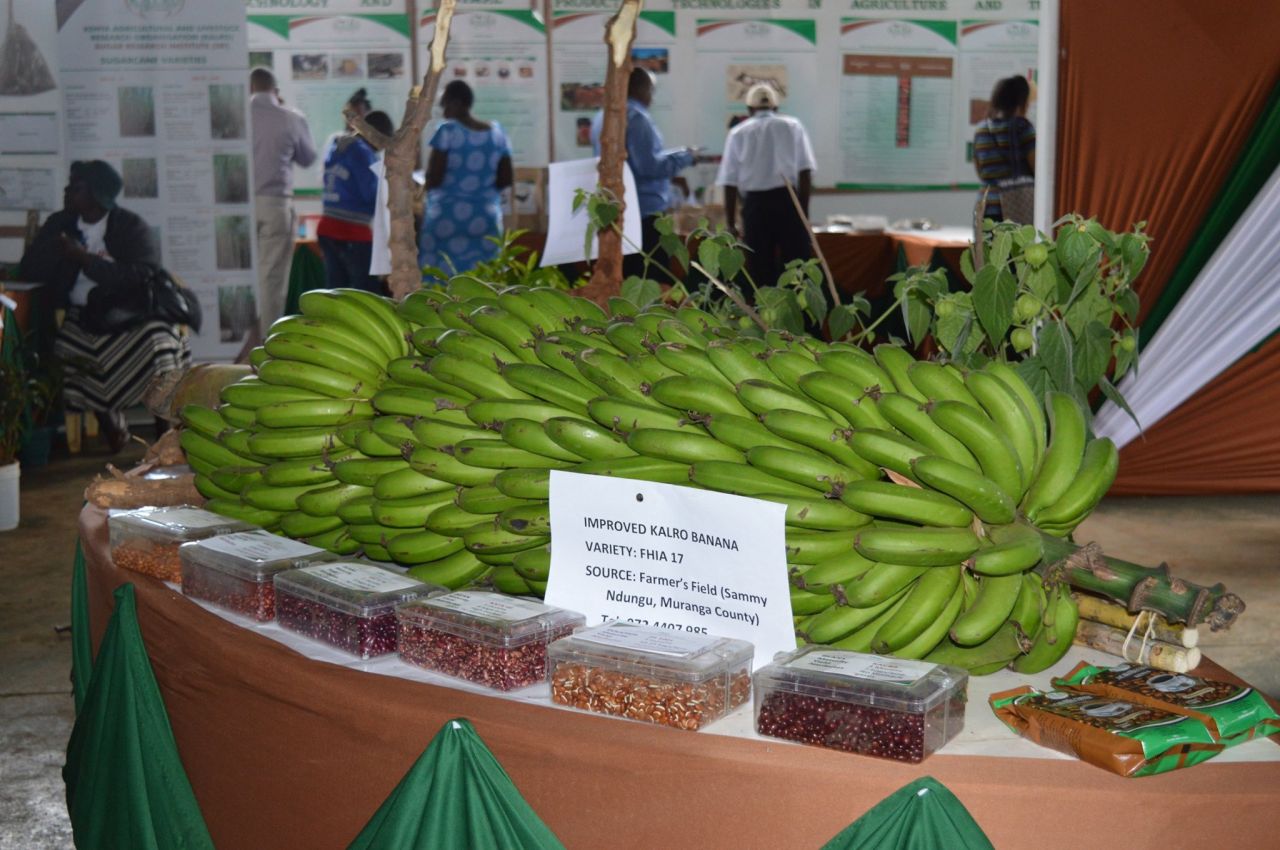

Follow this banana de-suckering guide for Kenya. Learn how to select followers, manage banana mats, remove male buds and support heavy bunches.
Banana De-Suckering Guide: The 3-Plant Mat System, Male Bud Removal and Propping for Bigger Bunches in Kenya
By John Matemo, Director, Fruit Africa Veriplant
Walk through banana shambas in many counties and you see the same thing. One mat carries seven or eight stems of different ages, all pushing up together. The pseudostems lean on each other, the leaves shade the plant carrying the bunch, and the bunch ends up thin and late. The farmer bought clean seedlings, planted well and watered, and still the harvest disappoints. The problem is in the mat, and the mat is the part of a banana farm you control every month of the year.
We manage every mat so the plants on the mat stand at different stages of growth, and every extra sucker comes off. We call this the 3-plant mat system. The mother plant carries the bunch. The follower is half grown and takes over when the mother is cut. The grand-follower is a young sucker coming up behind the follower. Every other sucker is removed. We start farmers at three plants, and the right number moves with the variety, the spacing, the water and how closely the block is managed.
Three is a starting point and the number is not fixed. At close spacing two plants per mat is enough. At wider spacing, with reliable water and a worker who walks every mat on schedule, four or five plants at different stages work well. What stays the same on every farm is the principle of plants of different ages on one mat and no crowding.
The mat is one part of the work. A good crop also needs a heavy-bunch variety, water, feed, a male bud removed at the right stage and a prop under the bunch before the stem leans. We cover each of these in turn, and we say where the evidence is clear and where the evidence is thin.
A word on bunch weight before we start. The variety sets the upper limit. Grand Naine is rated at 30 to 45 kg a bunch and FHIA-17 at 35 to 50 kg, so 40 kg sits near the top of the first range and in the middle of the second. Trials in other countries often recorded lighter bunches, and we report those figures too.
Good mat management protects the weight your variety is capable of and removes the losses from crowding, shade, wind and thrips. Management does not add weight the variety lacks. We treat 40 kg as a target for a well-run block of a heavy variety, and any promise of 40 kg from a method alone as a sales line.
We are Fruit Africa Veriplant. We grow fruit seedlings in our nurseries and serve farmers through our nurseries in Murang’a, Nairobi and Embu, with our head office in Ruiru, Kiambu County. Most of the banana questions we hear after planting are mat questions, and this article answers them.
What Is a Banana Mat and Why Remove Extra Suckers?
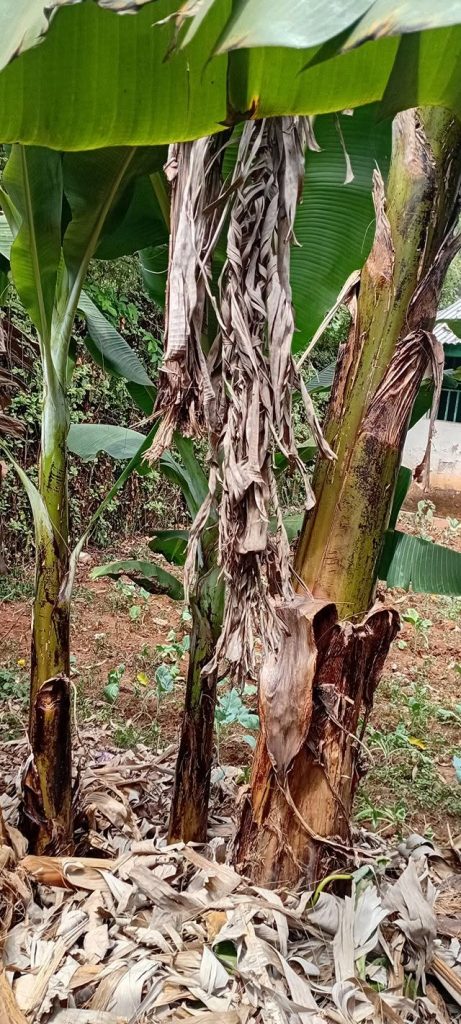
A banana plant is not a tree. What looks like a trunk is a pseudostem, made of tightly packed leaf sheaths, and the pseudostem grows from an underground stem called the corm. The corm sends up new shoots from the sides, and these shoots are the suckers. The corm together with the stems growing from the corm is the mat, which many Kenyan farmers call a stool.
A mother plant of East African highland banana throws two to ten suckers in one cycle. If you leave them alone, all of them grow, and a single seedling becomes a crowded clump spreading outward from the planting hole.
Suckers are not all equal. Sword suckers and maiden suckers are the most reliable and productive planting material. A sword sucker is a narrow-leaved, cone-shaped shoot, often 0.5 to 1 metre long, with a thick base. Sword suckers rate above water suckers, the weaker shoots with broad leaves from an early stage. Peepers are the smallest suckers, cone-shaped and weighing 200 to 300 g. We remove suckers at about 30 cm, long before leaf shape shows the difference, so at 30 cm you judge a sucker by position and vigour.
Position matters because every sucker kept grows into a plant needing light, water and feed from the same soil as the mother. A follower rising against the mother’s pseudostem takes her light and tangles roots with hers. A follower on the outer edge of the mat, pointing away from the mother, shades nobody.
Fewer stems also means easier work. A mat of three plants is simple to walk around, prop, inspect for pests and harvest. A mat of seven stems hides pests, blocks the path to the bunch and slows every job. The time saved on a thinned mat repays the 45-day walk.
The Three-Plant Banana Mat System Explained
We keep three plants on each stool, one bearing, one half grown and one sprouting. Farmers call them the mother, the follower and the grand-follower, and we use those names.
| Plant on the mat | Stage | Job on the mat | What you do |
|---|---|---|---|
| Mother | Bearing a bunch or heading for flowering | Fills the bunch you will sell | Remove the male bud, prop the bunch, cover the bunch, harvest and cut the stem at ground level |
| Follower | Half grown | Takes over as the next mother | Keep one follower aligned outward, remove every sucker beside the follower |
| Grand-follower | Young sucker, kept after you chose the follower | Becomes the follower when the follower becomes the mother | Keep one, peg the rest |
At any time the mat has three plants at three ages. When the mother is harvested and cut, the follower becomes the new mother, the grand-follower becomes the follower, and a new sucker is chosen as the grand-follower. The mat is never empty and never goes past three plants.
Staggering is the main reason for the system. Three plants of the same age on one mat flower together, flood the market for a month and leave you without bunches for months afterwards. Three plants of different ages produce a bunch at regular intervals. Highland bananas in south-western Uganda take 650 to 738 days from the emergence of a sucker to harvest of the bunch. If the three plants on a mat are evenly spaced across the cycle, one bunch ripens on the mat about every seven to eight months. Your own cycle depends on variety, altitude and water, but the principle is the same.
Three is where we start, though some growers go higher. A mat of five stems at different stages is workable in a vigorous variety on wide spacing, and farmers at close spacing do well on two or three. We start farmers at three because more plants mean more shade, more competition for the same roots and more work, and a mat of five stems leaves each stem a smaller share of the soil. At the closest spacing we drop to two. We move toward four or five only where the spacing is wide, the variety is vigorous, water is reliable and someone walks every mat on schedule.
The first year is different from the later cycles because a tissue culture seedling arrives alone. The section on the first year of the mat sets out the sequence.
Banana Spacing and the Number of Suckers to Keep per Mat
How many plants a mat carries depends partly on how far apart the mats stand. Short varieties suit 3 by 3 metres, medium varieties 3 by 4 and tall varieties 4 by 4, which is 444, 333 and 250 mats an acre. Grand Naine, Giant Cavendish, Valery and Ng’ombe are planted at 444 seedlings an acre, and FHIA-17 and FHIA-23 at 333.
A 2025 survey of farmers in Taveta County shows how spacing and plants per mat go together in practice. At 2 by 2 metres, which is 1,000 plants an acre, farmers kept about two plants per stool. At 3 by 3 metres they kept about three, at 4 by 3 metres about three and a half and at 4 by 4 metres about three. Close spacing works mainly for short varieties such as Dwarf Cavendish, and Grand Nain was the variety grown most at high densities. The survey puts the sensible range at 2 to 3 plants per stool at the closest spacing, 3 to 5 at the wider ones and 2 to 3 for dwarf varieties.
Bunch weight per plant and output per acre are two different measures, and spacing affects them differently. Bunch weight per plant tends to rise as spacing widens. Output per acre is bunch weight multiplied by the number of bunches harvested, so a close spacing puts more mats on the acre with lighter bunches and a wide spacing puts fewer mats on the acre with heavier bunches. Yield at 2 by 2 metres differed significantly from yield at the wider spacings in the Taveta survey. A farmer chasing the heaviest single bunch and a farmer chasing the most fruit from an acre will choose different spacings.
Water and labour change with spacing too. Nearly all the farmers on the closest spacing irrigated, against about two thirds at 3 by 3 metres, and fewer of them propped. A tall variety at close spacing needs more water and more props.
Our advice is to choose the spacing from the height of the variety and the water you have, and then match the plants per mat to the spacing. At 2 by 2 metres we keep two plants, a mother and a follower, and pick the grand-follower late. At 3 by 3 and 3 by 4 metres we keep three. At 4 by 4 metres we also keep three, and we add a fourth or fifth plant only where water is reliable, the variety is vigorous and a worker walks every mat on schedule. Crowding a tall, heavy variety at close spacing in the hope of a bigger harvest lowers the bunch weight and raises the cost of props.
How Too Many Suckers Affect Banana Bunch Size
Banana plants on one mat share one root zone. Each extra stem draws water, potassium and light away from the stem carrying your bunch, and the loss shows in the bunches.
The clearest evidence is a trial on Grand Nain in Puerto Rico, run on a research station from 1983 to 1987. Plots where the follower was chosen soon after planting and the other suckers pruned produced the highest yield, and the authors credit this mainly to about 20 percent more bunches harvested, not to heavier bunches. Bunch weight stayed close to equal across the three better treatments. Letting every sucker grow until half the plants flowered cut total yield by about 9 percent against early selection.
Pruning every sucker from planting and choosing a follower only when half the plants flowered cut yield by about 14 percent and lowered bunch weight as well. Bunches in these trials weighed about 20 kg.
Many farmers think a crowded mat loses mainly through lighter bunches. This trial shows most of the loss came from fewer bunches and from the delay in choosing a follower, with a smaller effect on the weight of a single bunch. Bunch weight does fall as plant density rises. Either way, a mat managed from the first months produces more bunches, and a neglected mat produces fewer and later ones.
Farmers in Taveta show the distance between advice and practice. Most de-sucker, but they do the job every two to three months and not every one to two months, and propping is far less common than de-suckering.
A crowded mat is easy to recognise. The follower stands as tall as the mother or taller, the pseudostems lean, the leaves of two or three plants overlap above the bunch, the newest suckers are thin and pale, and the mat looks wider each season. A mat like this has waited too long, and the recovery section below explains what to do.
How Banana Bunch Weight Is Built: Hands, Fingers and Finger Size
A bunch of bananas is built from three things multiplied together: the number of hands, the number of fingers and the weight of each finger. Knowing which one a job affects tells you what to expect from the job.
FHIA-17 carries 170 to 220 fingers in 10 to 12 hands, with each finger weighing 170 to 260 g. Multiplying the extremes puts the bunch between about 29 kg and about 57 kg. FHIA states 35 to 50 kg, a figure inside the range, so a 40 kg bunch needs both a good number of fingers and well-filled fingers.
Hands and fingers are set early, in the months before the plant flowers. In Ugandan work on highland bananas, hands per bunch ran from 8.1 to 9.2 across the four quarters of emergence, with no significant difference. Fingers per bunch ran from 109 to 140 depending on when the sucker emerged, and bunch weight followed the finger count. The season a plant grows in shapes the number of fingers, and nothing done at flowering adds fingers.
Finger size fills in the weeks after the bunch emerges, and most of the jobs at flowering act on this stage. A Queensland trial recorded heavier bunches through longer fingers after male bud removal, and recorded shorter fingers when fewer than nine or ten leaves stayed on the plant. Sealed covers lengthened fingers along the whole bunch, while open covers did so mainly near the stalk end. A West African trial recorded no fall in fruit filling days after bud removal in any genotype.
The work therefore divides in two. The mat system, a clean start, and water and feed before flowering set the number of fingers. The male bud, the leaves, the prop and the cover protect finger size after the bunch emerges. A farmer who does only the second set of jobs on a crowded mat is protecting a small bunch. The variety matters for the same reason, because the variety sets how many hands and fingers a bunch carries and management protects what is already set.
Banana De-Suckering Guide: Timing, Tools and Technique
De-suckering means removing the suckers you do not need. The job repeats every few weeks, so the farmers who do the job well treat the work as routine, in the same way as weeding.
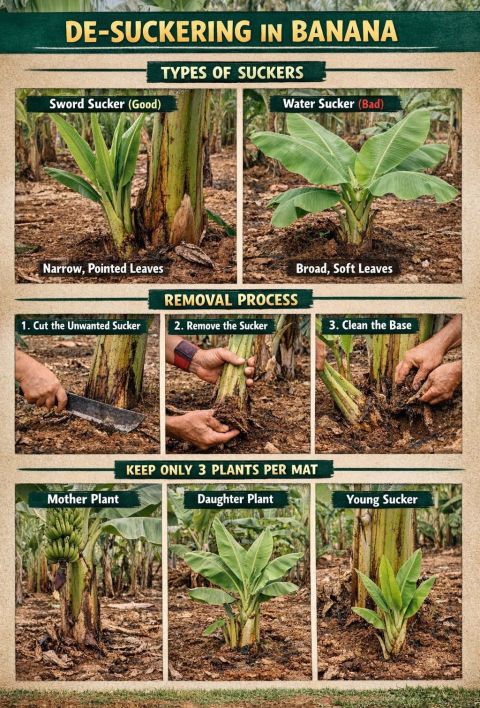
Banana De-Suckering
When to start and how often
The routine starts two months after planting and repeats every 45 days until the plant flowers. Some advisers recommend a visit every month to two months, and we hold to 45 days as the routine. Suckers grow at different speeds with the season, the variety and the water, so the regular walk matters more than the calendar date.
A sucker removed at 30 cm costs the mat little because the sucker has barely started drawing on the corm, while a sucker removed at 2 metres has already taken months of food from the mat. We advise marking the 45-day visit on a calendar at planting. A farmer with five acres and a hired hand does not rely on memory, and the regular walk also catches pests and sick plants early.
Cutting the sucker and killing the growing point
The sucker is cut at ground level with a clean, sharp tool and the growing point is then destroyed. There are two ways. A sharpened peg is pushed into the growing part of the surplus sucker so the sucker does not sprout again. The other way is to gouge a small cavity in the centre of the cut sucker with a knife and pour in 2 ml of paraffin to kill the growing point. Both methods do the same job. A sucker cut at ground level without either treatment grows back within weeks, and the work is repeated for nothing.
The tools needed are a sharp spade or panga, a knife, a few wooden pegs, a bottle of disinfectant, a forked stick for the male buds and a notebook. Cut suckers are chopped into small pieces and laid away from the corm. Harvested stems are treated the same way, because small pieces dry and rot faster, and weevils lay eggs on fresh suckers.
Keeping tools clean
Banana bacterial wilt spreads on cutting tools. The bacteria stay alive on a blade for up to a week after the blade touches diseased tissue, and other work reports longer, so we treat every blade as contaminated until the blade is disinfected. Heating the blade over a fire and dipping the blade in household bleach both work, and in laboratory tests sodium hypochlorite at 3.5 percent eliminated all the bacteria. The blade is cleaned between mats, and work moves from the healthy block toward any block with a sick plant. Where the disease has appeared nearby, we cut back on the use of tools for de-suckering and de-leafing until no sick plants are seen.
Suckers as planting material
Surplus suckers serve as planting material, and 1 to 3 suitable suckers per mat is the usual number, depending on the variety. Careless or excessive removal weakens the support of the mat and leads to toppling, so the sucker harvest is a separate job from the 45-day routine.
We advise against taking planting material from your own mats unless the mat is healthy and you know where the mat came from. A sucker from a mat with nematodes or a hidden infection carries the problem into the new block. Where farmers do use their own suckers, hot water treatment is the safe practice.
All the roots are trimmed, about 1 cm is pared from the corm until clean white tissue shows, and the corm is immersed in water at 50 to 55 degrees Celsius for 20 minutes, or dipped in boiling water for 30 seconds when no thermometer is available. Suckers are not left in the field overnight, because weevils lay eggs on them. For new ground, seedlings from a source with a batch record are the safer start.
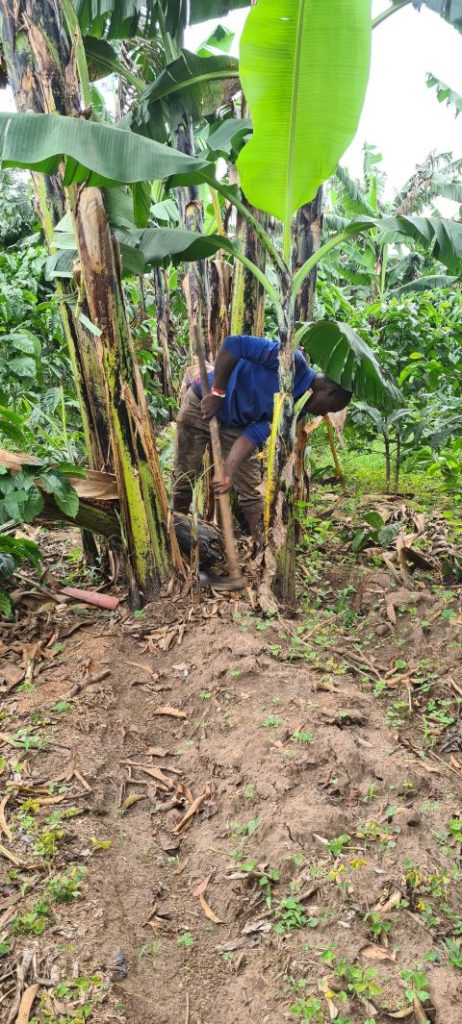
A farmer De-Suckering bananas
Choosing the follower
Four tests decide the follower. The sucker stands on the outside of the mat, pointing away from the mother. The base is thick and the leaves are narrow and upright. The sucker sits far enough from the mother to leave room for both, and lines up with the direction of the rows so the spacing holds across cycles. Every other sucker is cut.
Research from several countries shows when the choice is best made.
| Study | Plants and place | What the study found |
|---|---|---|
| Irizarry and colleagues, 1992 | Grand Nain, Puerto Rico | Choosing a vigorous follower soon after planting produced the highest yield. Delaying selection until half the plants flowered cut yield by 9 to 14 percent |
| Eckstein and colleagues, 2000 | Tissue culture bananas | Choosing the follower at 6 months produced 7 percent more yield over two cycles than choosing at 11 months |
| Lima and colleagues, 2021 | Prata and Nanica, Brazil | Removing the first follower and growing the next one delayed harvest by 32 days in Prata and 41 days in Nanica, with no loss in bunch weight. The authors warn against repeating the method on the same mat |
| Birabwa and colleagues, 2010 | Highland banana, Uganda | The quarter of the year in which a sucker emerged changed the cycle length and bunch weight, so season affects which follower you keep |
From these results we advise choosing the first follower early, once a vigorous, well-placed sucker has developed. The tissue culture trial made the choice at six months, and we use six months as a planning marker and not as a fixed date for every farm. The grand-follower is chosen once the follower is established, usually as the mother nears flowering, and one pattern is kept across the block so every mat settles into a steady cycle.
The Brazilian work also shows a way to move a harvest date. Removing the first follower and growing the next one pushed the harvest back by about a month with no loss in bunch weight, so a farmer whose mats are about to ripen in the same week moves one of them back. The next follower comes up shorter, so we use the method once on a mat needing to move.
The Ugandan work looked at timing from the market side. Bunches from suckers emerging between December and February weighed 15.7 kg, against 20.7 kg for suckers emerging between September and November. The lighter bunches still fetched up to 50 percent more per kilogram than bunches from suckers emerging between June and August, and the higher price offset the lower weight. A heavier bunch is not always the better bunch, so know your market calendar before choosing which sucker to keep.
Recovering a crowded mat
A crowded mat is brought back by deciding the three plants to keep before cutting anything. These are the mother carrying the bunch, the best-placed half-grown follower and one young sucker on the outside as the grand-follower. Every other plant is cut at ground level and the growing point destroyed. The cut stems are mulched well away from the corm and the mat is watered deeply the same week. The follower takes a few weeks to respond, and the better bunch comes in the next cycle and not on the mother already carrying fruit.
Dry and wet seasons
Many farmers de-sucker in the dry season and skip the job in the wet season, but suckers keep growing in the wet months. We keep the 45-day walk in every season and use the dry season for the heavy clean-up of a neglected mat, when the soil is firm and cut stems dry out.
Banana Sucker Management During the First Year
A tissue culture seedling arrives as a single plant of uniform age, and a block planted on the same day tends to flower within a few weeks. The uniformity helps with spraying and harvest planning but works against a staggered mat, so the first year is where the stagger is built.
The seedling is planted as the mother plant of the mat. From two months after planting, each unwanted sucker is removed as the sucker emerges, cut at about 30 cm with the growing point destroyed. The first follower is chosen when a vigorous, well-positioned sucker has developed on the outside of the mat. The tissue culture trial made this choice at six months and produced 7 percent more yield over two cycles than choosing at eleven months, and the Puerto Rico trial on Grand Nain pointed the same way. Six months comes from one trial, and variety, altitude and water move the date. The grand-follower is chosen once the first follower is established.
The block itself is staggered by planting in sections a month or two apart. Within a block, selected mats are moved back by about a month using the follower method from Brazil, and farmers note which mats were moved.
Planting also decides how well the mat holds. The seedling we plant is about 30 cm tall with at least five healthy leaves. The hole is 60 by 60 by 60 cm, or 90 by 90 by 90 cm in dry areas, with the topsoil and the subsoil kept in separate heaps. The topsoil is mixed with 2 to 3 debes of well-decomposed manure and 200 g of triple super phosphate, returned to the hole first with the subsoil on top, and the hole is left to settle for at least two weeks before transplanting.
The seedling goes in 30 cm deep for anchorage and the hole is mulched heavily. Properly produced tissue culture seedlings reduce the risk of carrying pests and diseases in the planting material, and mat management then protects the start the farmer paid for.
How to Manage Banana Ratoon Cycles for Regular Harvests
A ratoon is the crop following the first one on the same mat. The plant crop is the seedling planted, the first ratoon is the follower and the second ratoon is the grand-follower. Each plant on the mat is in a different cycle, and managing those cycles is the work.
Staggering brings three benefits. Bunches ripen on a spread of dates, so supply is steady. Harvesting, propping and de-suckering are done on a few mats at a time, so labour is spread across the month. And the mat stays healthier because the follower has a head start on the grand-follower, and the grand-follower stays out of the mother’s light.
As an illustration, take 444 mats at 3 by 3 metres. If each mat produces one bunch every eight months, the block yields about 55 bunches a month, or about 13 a week. This is a planning figure built on one assumption, and your own cycle depends on variety, altitude, water and feed. A farmer with a weekly order from a hotel or a supermarket plans around a figure like this, and a farmer whose mats all flower together has no such plan.
Harvesting starts 9 to 18 months after planting and full production comes in two to three years. The first year is the wait, and from the second year the staggered mat produces a bunch every few months.
The table below sets out one mat from planting to the second harvest. The timings are planning ranges, and altitude and variety move them.
| Stage | Job on the mat | Reason |
|---|---|---|
| Planting | Transplant a seedling about 30 cm tall with at least five healthy leaves, plant 30 cm deep and mulch heavily | Deep planting anchors the mat and mulch holds moisture |
| From month 2 | Remove unwanted suckers when they reach about 30 cm, and repeat every 45 days | Small suckers cost the corm little |
| Around month 6 | Choose the follower once a vigorous, well-placed sucker has developed, keeping one outward-pointing sucker and cutting the rest | Early selection produced the best yields in trials |
| Before flowering | Choose the grand-follower once the follower is established, and keep the count at the number you set for your spacing | Keeps three ages on the mat |
| Flowering | Check the stem is straight and the soil is firm, and keep green leaves on the mother | Green leaves fill the bunch |
| After the last hand sets | Remove the male bud, then prop and cover the bunch | Protects the fruit from disease, thrips and wind |
| Harvest | Cut the bunch at maturity, then cut the mother at ground level and chop the stem | Clears light and space for the follower |
| After harvest | The follower becomes the mother, the grand-follower becomes the follower, and you select a new grand-follower | The mat never goes empty |
Male Bud Removal on Bananas: Reasons, Timing and Results
At the tip of the stem, beyond the last hand, a purple bud hangs on a long stalk. Farmers call the bud the male bud, the bell or the banana heart. After the female flowers, which become the fingers, have finished forming, the plant keeps pushing out male flowers from this bud. The bud sets no fruit. Removing the bud is the second job in the title, and the evidence is stronger on some points than on others.
Why farmers remove the male bud
Disease is the first reason. Insects visiting the male bud carry the bacterium of banana bacterial wilt from plant to plant, and removing the bud is one of the main control measures. Taking the bud off removes the landing place. We use a forked stick for the work so no blade is carried through the block, which also protects against Panama disease.
Thrips are the second reason, and removing the bud as soon as the fruits have formed is the standard practice for keeping them down.
Bunch weight is the third reason, and here the results differ with variety and growing conditions. Research in North Queensland recorded heavier bunches through longer fingers after male bud removal, and the dry weight figures suggest the bud competes with the bunch for the products of photosynthesis. Kenyan training materials claim earlier bunch filling and bunches up to 7.5 percent heavier. We treat these as possible gains and not as promises, for the reasons in the next section.
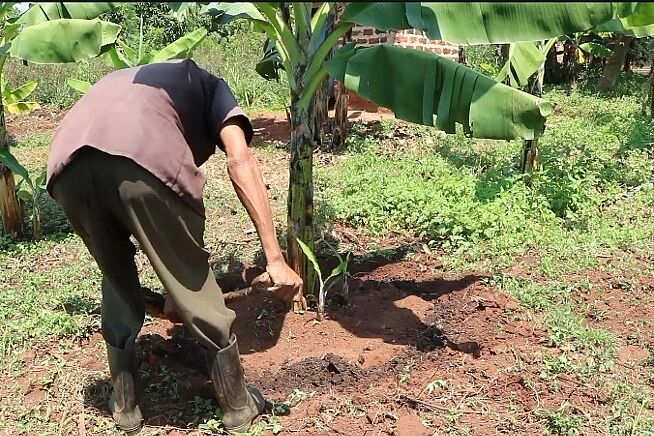
Banana De-Suckering Guide: The 3-Plant Mat System, Male Bud Removal and Propping for Bigger 40Kg Bunches in Kenya
What the research does not show
A trial in the humid forest zone of West Africa tested male bud removal on nine genotypes. These were plantain landraces, plantain hybrids, the cooking hybrid FHIA 3 and the cooking banana Cardaba. Buds were removed one week after the last hand emerged. Only FHIA 3 produced significantly heavier bunches, fruit filling days did not fall in any genotype, and the authors recorded little or no yield benefit for plantains.
Put together, the two trials show male bud removal raising bunch weight in the Australian work and in one hybrid in the West African work, and making no difference in the other genotypes. The disease and thrips reasons stand whatever happens to weight. For a Cavendish dessert banana, a Kenyan farmer has good reason to remove the bud. For a plantain or a local cooking type, the weight gain is uncertain and the disease reasons still apply.
When and how the bud comes off
The bud comes off once all the female flowers have opened, the last hand has emerged and the fingers have set. Our practice is between one and two weeks after the last hand emerges. Going earlier carries a cost, because removing the bud too early stunts the lower hands or makes the fingers curve upward, which reduces bunch size. Leaving the bud on for weeks keeps the landing place for insects and keeps the bud drawing on the plant.
A forked stick is held under the stalk, below the bud, and the bud is snapped off a short distance after the last hand. We use the forked stick on every plant in turn, whether or not the plant looks diseased, which avoids cross-infection. The bud and the dry flower remains are taken away from the mat and buried or discarded. A bare panga is never used on a block where bacterial wilt has been reported nearby, and any blade is disinfected after each plant.
Green Leaves and Whole Bunches
Only old, hanging, dry leaves and leaves killed by black Sigatoka are removed. Every other green leaf stays on the plant, and every hand stays on the bunch. Removing green leaves reduces the leaf area feeding the bunch and lowers the final bunch weight, and diseased leaves are burned to cut the disease load. In the Queensland trials, bunches lost weight when fewer than ten leaves remained at flowering, because the fingers grew shorter, and the recommendation there is to keep at least nine or ten leaves from flowering to harvest. Kenyan training materials allow seven leaves per pseudostem. The figures differ by a few leaves, so we keep more green leaves and not fewer.
Some farmers cut off the last hand or two to push weight into the larger fingers. The Queensland trial tested bunch trimming and recorded lower bunch weight and no increase in the share of extra-large fruit.
Propping Banana Bunches
A 40 kg bunch hangs at the top of a stem three metres tall, and a gust or a heavy rain pushes against the stem until the stool goes over with the roots out of the ground. The loss comes when the fruit is nearly ready, after a year or more of work and cost.
The standard support is a V-shaped or forked pole placed under the bunch, taking care not to injure the fruit. A strong peg with string tied to the stem is another option. Cultivars with the largest bunches face the greatest risk from wind. Grand Nain, Williams, Valery, Giant Cavendish and the FHIA series need props, while Chinese Dwarf, the short Cavendish type, needs none.
Many farmers skip the job. In Taveta the share of farmers propping ran from a third at the closest spacing to nearly eight in ten at 3 by 3 metres, and propping is done mostly on tall and medium varieties. A prop costs a pole and a few minutes, and a fallen stem costs a bunch.
The prop goes in while the bunch is still light, in the weeks after the male bud comes off, and not when the stem has already started to lean. The base of the pole is pushed firmly into the soil, the fork rests under the bunch stalk and the pole stays clear of the fingers. Props are checked after every heavy rain and rotted ones replaced.
Props are one of four protections against toppling. Deep planting is the first, with seedlings set 30 cm deep and mulched heavily for anchorage. A sound root system is the second. The banana weevil borer causes yellowing, withering and easy toppling, and moles are another cause of falling stools, so a stem falling on a calm day calls for digging around the base to look for the cause. Shelter is the third, since strong winds tear leaves and cause lodging, and windbreaks help. Shorter stems are the fourth, since a dwarf type such as Chinese Dwarf needs no prop.
Covering Banana Bunches Against Thrips
A special polybag over the bunch protects the fruit from thrips and other insects. Covers have a long record on commercial farms, and the research is clear on how to use them.
A trial on Williams bananas in North Queensland compared covers left open at the base with covers sealed at the base. Open covers shortened the time from emergence to harvest by 5 to 11 days and did not raise bunch weight. Sealed covers raised bunch weight by up to 9 percent and lengthened fingers, but delayed harvest by up to 16 days and caused severe maturity bronzing, with some fruit abnormalities and spotting. The authors rule out sealing and recommend open covers applied early.
We follow this advice. The cover goes on early, soon after the male bud is removed, with the base left open so air moves through. A clean open-ended cover is used each time and removed at harvest. A cover helps deliver clean, unmarked fruit, and dessert buyers who reject thrips marks pay for the extra effort.
Protecting the Mat From Weevils, Nematodes, Sigatoka and Wilt
A well-managed mat still needs protection from four problems, and each one links back to a job in this article.
The banana weevil borer is a brown-black weevil with a hard, curved shell, and the grubs tunnel into the corm. Infested leaves yellow, wither and die early, and the plants blow over easily. Clean planting material, either tissue culture or hot water treated suckers, is the first control. Suckers and other planting material are not left in the field overnight. After harvest, stems are cut at ground level, the cut surface is covered with soil and the stems are chopped into small pieces. Pseudostem trapping and strict field hygiene help keep weevil numbers down.
Nematodes cause the heaviest losses, above 70 percent of the crop in bad cases. They leave lesions and tunnels in the corm, and the root damage topples plants. The controls are clean planting material, Tithonia and Mexican marigold as green manure, and farmyard or poultry manure. This is another reason to start the mat from a seedling with a batch record.
Black Sigatoka starts as narrow, reddish-brown streaks on the underside of the leaves and spreads into dark spots with yellow margins and grey centres. Yield loss reaches 50 percent or more, and the fruit ripens prematurely. The cultural controls are removal of affected leaves, adequate spacing and good drainage, which is one more reason to keep a mat to a sensible number of plants. FHIA 17, 18 and 25 resist the disease, along with some Cavendish types such as Williams and Grand Nain. Some farmers use Sigatoka leaves as mulch, which spreads the disease, so diseased leaves are burned and not used as mulch.
Banana bacterial wilt affects every banana variety, and losses reach 100 percent in affected stands. Premature or uneven ripening of the bunch is among the signs. A plant showing these signs is left alone, tools are kept away, the bunch is not cut, and the plant is reported to the county agricultural officer. A mat kept to a sensible number of plants is easier to inspect, because every stem is seen on every visit.
Why Bunches Stay Small Despite Good Management
A poor bunch leaves clues on the plant and in the mat, and each clue points to a job in this article.
A late bunch with thin fingers on a mat of five or six stems points to crowding. The follower stands as tall as the mother, the leaves overlap and the corm feeds too many plants. The mat is cut back in stages to the number of plants set for the spacing, as the recovery section explains, and the improvement shows in the next cycle.
Short, thin fingers on a mat with a clean, tidy shape point to leaf loss or water stress. Count the green leaves on the mother at flowering, because the Queensland trial recorded shorter fingers when fewer than ten remained, and water the mat well through the flowering period.
Silvery patches on the fingers, turning brown and cracking, are thrips marks, and the answer is to remove the male bud on time and cover the bunch early. Bronzed, dull fruit under a plastic cover points to a sealed cover, which the Queensland trial linked to severe maturity bronzing.
A bunch ripening in patches on the plant, or ripening too early, deserves a call to your agricultural officer. Premature or uneven ripening is a symptom of bacterial wilt, so the bunch is left alone, tools are kept away from the plant and advice comes before any cutting.
A stem falling on a calm day points to a problem below the ground. The banana weevil borer and moles cause stools to topple, so dig around the base, look for tunnels in the corm and check whether soil is mounded around the stool. A stem leaning in a gust, with a healthy base, needs a prop and a closer look at the planting depth.
Small bunches year after year on healthy, well-managed mats usually mean the variety does not carry heavy bunches. Check the variety against the rated weights and the FHIA figures before blaming the management.
Harvest and the Next Ratoon
Harvest is also the point where the follower takes over, and the way the old mother is cleared sets up the next cycle.
Judging maturity
A mature bunch shows clear signs. The fingers become rounder, while early fruit is angular in cross-section. The peel moves from deep green to light green or yellow, and the flesh shifts from creamy white toward orange-yellow. Farmers judge maturity by the roundness of the fingers and a lighter green colour, and seldom count days from flowering. Dessert bananas for distant markets are harvested when the fruit is 75 to 90 percent mature, with the fingers about three-quarters round. The stage is matched to the distance the bunch has to travel, so a bunch bound for a market two days away is cut earlier than a bunch sold at the farm gate.
Cutting and handling the bunch
On tall varieties the pseudostem is cut halfway first so the bunch comes down without hitting the ground. A second person takes the weight of the bunch on a padded shoulder or a clean sack as the bunch falls. Bunches are handled gently to avoid bruising, because farmers usually transport whole bunches and the fruit takes knocks on the way. The bunch is weighed before the bunch goes to the buyer so the record is complete. Where farmers sell by the hand, the hands are removed from the bunch and packed in reusable plastic containers. Fruit with thrips marks, rust damage or heavy latex staining is set aside, because buyers reject such fruit.
Setting up the next mother
The old mother is cut at ground level straight away. The stem is chopped into small pieces to deter weevils, the cut surface is covered with soil, and the pieces are laid as mulch away from the corm and clear of the new mother’s base.
Next comes a look at the follower. A good follower stands straight, carries healthy leaves and sits where you want the next bunch. The prop moves to the follower before the follower flowers, if the old prop is sound. A new grand-follower is chosen from the best-placed sucker, and everything else is cut and the growing points destroyed. The mat is watered well after the cut.
The weight, the harvest date and the mat number go in the notebook. Over a year these notes show which mats produce the heaviest bunches and which mats need a closer look.
How to Get Big Banana Bunches in Kenya Beyond the Mat
The mat sets the number of plants and the timing. The weight of each bunch depends on six more things, and a farmer who fixes the mat and ignores the rest still harvests a thin bunch.
Variety potential and farm performance
Bunch weight starts with the plant you buy. Grand Naine is rated at 30 to 45 kg, and Williams, Giant Cavendish and Dwarf Cavendish at about 30 kg. FHIA-17 is rated at 35 to 50 kg, and the FHIA hybrids are quoted at about 50 kg. These figures are the potential of each variety under good conditions, and the weight on your farm depends on how close you come to the potential. No amount of de-suckering turns a 30 kg variety into a 45 kg variety, and a poor mat holds a good variety well under the rated weights. Our guide to the best banana varieties in Kenya sets out each variety against the market the variety serves.
Realistic weights
Field trials report lower figures than leaflets. The Puerto Rico trial on Grand Nain recorded bunches of about 20 kg. A trial on tissue culture Grand Naine at Coimbatore in India, with a full four-stage nutrient programme, recorded 32.15 kg as the best bunch weight. Mean bunch weights for FHIA-17 across field trials in several countries ran from 21.5 to 53.4 kg. The average Kenyan yield is about 6 tonnes an acre, and good management reaches 20. A bunch of 40 kg is possible, and reaching 40 kg takes the right variety, a clean start, a managed mat, water and feed, all together.
A clean start
Properly produced tissue culture seedlings reduce the risk of carrying pests and diseases into your field on the planting material. A mat starting from a seedling with a batch record starts without the nematodes and hidden infections carried by suckers from old stools. Farmers still have to manage the soil, the tools and the neighbours after planting.
Climate and soil
Bananas grow from sea level to 1,800 metres, with Chinese Dwarf growing up to 2,100 metres. The crop needs 1,000 to 2,000 mm of rain a year, well spread, and a temperature of 20 to 30 degrees Celsius with about 27 degrees as the best. The best soil is a deep, friable loam rich in organic matter and well drained, with a pH of 6.0 to 7.5. A waterlogged soil invites root rot, and a thin soil holds little feed or water. Check your site against these figures before choosing the number of plants for the mat, because a poor site does not carry a large mat.
Water
Bananas need at least 1,000 mm of rain a year, and water is critical at flowering. In drier areas we recommend 40 to 60 litres per plant a week, split into two applications of 20 litres. Many farmers overwater, so we advise irrigating when the crop needs water and not as a routine, to avoid dampness and root rot. A mat of three plants draws more water than a mat of one, so a block growing a single plant happily in the first year needs a closer look at the water supply once the mat fills out.
Feed and mulch
Banana needs more potassium than nitrogen or phosphorus for high yield and quality. A trial on tissue culture Grand Naine in India recorded the highest bunch weight where the full fertiliser dose was split over four stages of growth.
We recommend 2 to 4 debes of decomposed farmyard manure per stem per year before the rains, spread around the canopy edge and worked in carefully. For top-dressing we recommend 200 g of calcium ammonium nitrate per stool a year, or 250 g of a banana fertiliser of 10:3:20 plus trace elements every six months, in a band 60 cm from the plant. Manure, compost or tithonia leaves every six months also work. Check these rates against a soil test or an officer’s advice for your own farm, because the rates are general and your soil is particular.
Mulch heavily. A heavy mulch cover suppresses weeds, holds moisture and adds humus, and banana roots are shallow, so weed with care. Some farmers intercrop young bananas with legumes or African indigenous vegetables.
What an extra 10 kg is worth
The figures in this section are a historical illustration and not a price guide. A 2021 report in The Standard quoted farm-gate prices of about KSh 8 to 10 per kg. A July 2024 report in The Star from Kirinyaga quoted KSh 16 per kg for green bananas and 30 kg as the average bunch weight. Prices move by county, by season and by buyer, and some buyers pay by the bunch.
Take the range of KSh 8 to 16 per kg to see the scale. An extra 10 kg adds KSh 80 to 160 to every bunch. If an acre of 444 mats produces about 13 bunches a week, which is the planning illustration set out earlier, the acre produces about 670 bunches a year, and the extra 10 kg adds about KSh 54,000 to 107,000 a year in revenue. Revenue is not profit. The extra weight sometimes needs more water, fertiliser, labour and crop protection, so subtract those costs before judging whether a job pays for itself. Check today’s price with your own buyer before working out the figures for your farm.
One Mat Over Two Years: A Worked Illustration
This illustration is built from the facts in this article, and the farm in the story is not real.
A farmer in a mid-altitude county plants a Grand Naine seedling in a prepared hole at the start of the long rains. The seedling is about 30 cm tall with six healthy leaves. The farmer plants the seedling 30 cm deep and mulches the hole.
At two months the farmer begins the 45-day walk. Suckers appear, and the farmer cuts each one at about 30 cm and pegs the growing point. Around six months a vigorous sucker stands on the outside of the mat, pointing along the row, and the farmer keeps the sucker as the follower. Everything else comes off.
By the end of the first year the mother is tall and the follower stands about a metre high. The farmer chooses a young sucker on the far side of the mother as the grand-follower. The mat now holds three plants at three ages. The farmer keeps cutting every other sucker and checks the cutting tool for dirt each time.
In the second year the mother flowers. The bunch forms, the last hand opens, and one to two weeks later the farmer snaps off the male bud with a forked stick. The farmer fits a prop, slips a clean open-ended cover over the bunch and leaves the green leaves alone. The farmer waters the mat well through flowering.
Weeks later the farmer cuts the bunch at maturity, with the pseudostem cut halfway so the bunch lands gently. The farmer then cuts the mother at ground level and chops the stem. The follower, now half grown and strong, becomes the new mother, and the grand-follower becomes the follower. A new sucker becomes the grand-follower, and the cycle repeats with no empty year between.
Banana Farming Management Tips and Common Mat Mistakes
The routine for every visit
Short, regular jobs keep a mat in order better than occasional big ones. We advise walking each block every 45 days with a clean tool and a notebook, and recording which mats are tight, which followers are well placed and which props need replacing. Marking the mats where a follower has been chosen keeps the pattern clear across the block.
Clean tools matter more on a banana farm than on most crops. A bottle of bleach or disinfectant goes with the worker, and the blade is wiped between mats. Male buds come off with a forked stick, healthy blocks are cut and pruned first, and any block with a suspect plant comes last. Suckers, tools and cut stems never move from a block with a sick plant into a healthy block, and a plant showing the signs of bacterial wilt is removed, buried or destroyed, and reported to the county agricultural officer.
The routine for every season
The heavy jobs follow the rains. Farmyard manure goes on before the rains at 2 to 4 debes per stem a year, and the top-dressing follows the schedule in the feed section. Every prop is checked after a heavy rain. In a dry spell, the mats close to flowering are watered first, because water is critical at the flowering stage. The dry season is the time for the heavy clean-up of any mat fallen behind.
Teaching workers the rule
Every worker needs to know the rule in plain words. The mother carries the bunch, the follower stands next, the grand-follower comes last, and every other sucker comes off. A hired worker cutting the follower by mistake costs the owner a bunch, so each worker is shown the plants on a real mat, and a strip of coloured cloth tied on the follower once chosen marks the plant. The first block is walked together before the worker works alone.
Keeping records of bunch weights
The first twenty bunches of the season are weighed, and then a handful every month. The variety, the planting date, the date of male bud removal and the weight at harvest all go in the notebook. Within a year these notes show which blocks do well and which mats need attention, and they show whether a change in routine works.
Common mistakes
The commonest mistake is waiting. Farmers plant the seedlings, watch the first suckers come and decide to choose the follower later, when the plant needs the space. By then the mat has five stems and every stem has drawn on the corm for months. The Puerto Rico trial shows what waiting costs, and the cost is yield.
A second mistake is cutting suckers without destroying the growing point. The sucker returns in weeks, and the farmer cuts the same sucker again and again. A peg in the growing point ends the job in one visit.
Other errors come with the bunch. Some farmers remove the male bud too early and stunt the lower hands, and others leave the bud on and lose the benefit. Some trim hands off the bunch, or strip healthy leaves to tidy the plant, and both practices lowered bunch weight in the Queensland trials. Others fit a sealed cover and wonder why the fruit bronzes. A last group skips the prop and meets a fallen stem in the first storm.
A final error is copying a neighbour. The neighbour grows a variety with smaller bunches, keeps five stems for reasons of cash flow or sells by the bunch to a trader who does not care about weight. The mat has to match your own variety, your own spacing and your own buyer.
Where Fruit Africa Veriplant Fits In
A well-managed mat starts with a good seedling. We do not run a tissue culture laboratory. We buy laboratory plantlets from KEPHIS-certified laboratories, harden them in our nurseries and supply the seedlings to farmers across Kenya through our hubs in Murang’a, Nairobi and Embu. For every order we record the laboratory, the variety and the batch, and we issue an invoice. Our tissue culture banana guide explains how the plantlets are produced and hardened.
Send us your county, your altitude, your water source, your buyer, the number of acres and your planting date. Our agronomy team uses these details to suggest a variety and a spacing, to advise on the number of plants to keep per mat and to work out the number of seedlings. Tell us which varieties you want, and we confirm which ones we hold and which we place on order. We do not promise a fixed bunch weight, a fixed yield or a fixed price, because bunch weight depends on the variety and on how you manage the mat. Use the quotation link below, and we quote the price per plant in writing.
Frequently Asked Questions About the Banana De-Suckering Guide
What is the 3-plant banana mat system?
The system keeps three plants on each banana mat at three ages: the mother carrying the bunch, a half-grown follower and a young grand-follower. Every other sucker is cut. When the mother is harvested, the follower becomes the new mother and the grand-follower becomes the follower.
How many suckers do you leave on a banana mat?
We start at three plants in total, counting the mother, and the number moves with the spacing. Two to three plants suit the closest spacing, and three to five suit wider spacings with reliable water and close management. Fewer plants suit close spacing and dry sites.
When do you start de-suckering bananas?
De-suckering starts two months after planting and repeats every 45 days until flowering. Suckers are cut while they are about 30 cm tall.
How do you de-sucker a banana plant?
The unwanted sucker is cut at ground level with a clean, sharp tool, and the growing point is then destroyed with a peg, or with a knife cavity and 2 ml of paraffin. The tool is disinfected between mats because bacterial wilt travels on blades. The follower is a vigorous sucker on the outside of the mat, pointing along the row.
When do you choose the banana follower?
The follower is chosen once a vigorous, well-placed sucker has developed. A tissue culture trial made the choice at six months and recorded 7 percent more yield over two cycles than choosing at eleven months. Six months is a planning marker, and variety and altitude move the date.
When do you remove the male bud?
The male bud comes off after all the female flowers have opened and the last hand has emerged, which is one to two weeks after the last hand shows in our practice. A forked stick snaps off the bud so no blade is carried through the block.
Does removing the male bud increase bunch weight?
Sometimes. A trial in North Queensland recorded heavier bunches through longer fingers. A West African trial on nine genotypes recorded a significant gain only in the hybrid FHIA 3. The disease and thrips reasons for removal apply whatever happens to weight.
Do you remove the male bud on plantains and cooking bananas?
The weight gain is uncertain, because the West African trial recorded little or no yield benefit for plantains. The disease reasons still apply, so a forked stick and early removal still protect the block from bacterial wilt where the disease is a risk.
How do you prop a banana bunch?
A V-shaped pole goes under the bunch with the base pushed firmly into the soil and the fork clear of the fingers. The prop goes in while the bunch is still light. Grand Nain, Williams, Valery, Giant Cavendish and the FHIA series are among the varieties needing props.
Does covering the bunch increase weight?
Not reliably. A trial on Williams bananas recorded open covers shortening the time to harvest by 5 to 11 days with no rise in bunch weight. Sealed covers raised weight by up to 9 percent but delayed harvest and caused severe maturity bronzing, so the authors advise against sealing.
Which banana varieties produce 40 kg bunches?
Grand Naine is rated at 30 to 45 kg, and FHIA reports 35 to 50 kg for FHIA-17. Field trials in other countries often recorded lighter bunches, so 40 kg is a target for a well-run block and not a promise.
How do you get big banana bunches in Kenya?
Choose a heavy-bunch variety, plant a clean seedling and keep the right number of plants on each mat. Water the crop through flowering, feed with a potassium-rich programme, keep healthy leaves on the mother and remove the male bud once the last hand has formed. Prop the bunch and protect the fruit from thrips. No single step does the job alone.
Final Advice for Farmers
A banana mat repays steady attention. We advise keeping plants at different ages, starting from three, cutting every other sucker at about 30 cm and destroying the growing point of each sucker cut. The follower is chosen once a vigorous sucker stands well placed, around six months after planting in the trial we cite, and the grand-follower comes once the follower is established. The male bud comes off when the last hand has formed, the prop goes in before the stem leans, and the green leaves stay on the mother.
The research is clear on the main points and mixed on others. Early follower selection raised yield in the Puerto Rico and tissue culture trials. Male bud removal raised bunch weight in Cavendish-type bananas and did little in most plantain types. Open covers helped and sealed covers hurt. Recommendations on plants per mat run from three to five, so adjust the number to your spacing and your management. Taking the best of each finding produces a routine costing a few hours each month.
Start with one block. Walk the block with a clean tool, count the plants on each mat and cut the extras. Weigh the first bunches and write the weights down. Then send us your county, your altitude, your water source and your buyer, and our agronomy team will help you choose the variety and the spacing for traceable tissue culture banana seedlings.
Sources and References
- Ministry of Agriculture, Livestock and Fisheries, banana production training materials for model farmer groups, 2016: https://www.jica.go.jp/project/english/kenya/015/materials/c8h0vm0000f7o8cj-att/materials_18.pdf and https://www.jica.go.jp/project/english/kenya/015/materials/c8h0vm0000f7o8cj-att/materials_03.pdf
- Wasilwa L.W. and colleagues, Evaluation of farmer practices in high density banana production, agronomic aspects in Taveta County Kenya, IJRSI, July 2025: https://rsisinternational.org/journals/ijrsi/articles/evaluation-of-farmer-practices-in-high-density-banana-production-agronomic-aspects-in-taveta-county-kenya/
- KALRO, Inventory of technologies, innovations and management practices for the banana value chain, National Agricultural Value Chain Development Project, 2024: https://navcdp.kalro.org/docs/tot_timps/Banana%20TIMPS.pdf
- Irizarry H., Rivera E. and Rodríguez J.A., Bunch and sucker management for profitable yields and high-quality fruit in bananas, Journal of Agriculture of the University of Puerto Rico 76(3-4), 1992: https://core.ac.uk/download/268236749.pdf
- Eckstein K., Fraser C. and Robinson J.C., Sectoral and conventional sucker selection technique using tissue culture banana plants, Acta Horticulturae 540, 2000: https://ishs.org/ishs-article/540_30/
- Lima J.D. and colleagues, Sucker pruning management to change the harvest date in banana, Comunicata Scientiae 12, 2021: https://core.ac.uk/download/525080484.pdf
- Birabwa R., van Asten P.J.A., Alou I.N. and Taulya G., Got matooke for Christmas, Acta Horticulturae 879, 2010 (IITA and Makerere University): https://biblio.iita.org/documents/S10ArtBirabwaGotNothomNodev.pdf-33cb32bca6860c486c27c72076672084.pdf
- Daniells J.W., Lisle A.T. and Bryde N.J., Effect of bunch trimming and leaf removal at flowering on maturity bronzing, yield and other aspects of fruit quality of bananas in North Queensland, Australian Journal of Experimental Agriculture 34(2), 1994: https://publish.csiro.au/AN/EA9940259
- Daniells J.W., Lisle A.T. and O’Farrell P.J., Effect of bunch-covering methods on maturity bronzing, yield and fruit quality of bananas in North Queensland, Australian Journal of Experimental Agriculture 32, 1992: https://era.dpi.qld.gov.au/id/eprint/14815/1/Effect%20of%20bunch-covering%20methods%20on%20maturity.pdf
- Okoro J., Vuylsteke D. and Ortiz R., Effect of male bud removal on the yield of Musa genotypes in a humid forest zone of West Africa, IITA Research Repository: https://biblio1.iita.org/handle/20.500.12478/3657
- Blomme G., Ocimati W., Tinzaara W., Karamura E., Beed F., Nakato V. and Tripathi L., Controlling banana Xanthomonas wilt in East and Central Africa, European Journal of Plant Pathology 139, 2014 (Bioversity International and IITA): https://www.africamuseum.be/publication_docs/blomme2014.pdf
- FAO, banana propagation chapter, Plant Production and Protection Paper 195, as hosted by growables.org: https://growables.org/information/TropicalFruit/BananaPropagationFAO.htm
- Balamohan T.N., Auxilia J. and Sudha R., Standardization of stage-wise requirement of nutrients in banana cv. Grande Naine (AAA), Journal of Horticultural Sciences 10(2), 2015: https://core.ac.uk/download/357743227.pdf
- KALRO, Selected commercial banana dessert varieties, pamphlet: https://kalro.org/navcdp/docs/banana/SELECTED%20COMMERCIAL%20BANANA%20DESSERT%20VARIETIES%20Pamphlet.pdf
- Fundación Hondureña de Investigación Agrícola (FHIA), FHIA-17 fact sheet: https://fhia.org.hn/wp-content/uploads/2025/01/fhia-17.pdf
- ProMusa, FHIA-17 cultivar profile: https://www.promusa.org/FHIA-17
- The Standard, New banana export market excites farmers, 2021: https://www.standardmedia.co.ke/farmkenya/article/2001412668/new-banana-export-market-excites-farmers
- The Star, Marketing group helps banana farmers fetch better prices, July 2024: https://www.the-star.co.ke/counties/central/2024-07-19-marketing-group-helps-banana-farmers-fetch-better-prices
- Fruit Africa Veriplant: https://www.fruitafrica.org
Contact Our Agronomy Team Today
- Head Office Location: Ruiru, Kiambu County, Kenya
- Nursery Distribution Hubs: Murang’a, Nairobi and Embu
- Phone Direct: +254 714 994 444
- WhatsApp Assistance: Message us on WhatsApp
- Official Email: sales@fruitafrica.org
- Official Website: www.fruitafrica.org
- Request a Quotation: fruitafrica.org/request-for-quotation/