
Banana farming profit per acre in Kenya for 3 by 3, 2.5 by 2.5 and 2 by 2 metre spacing. See the start-up cost, the water needed and the yearly margin.
Banana Spacing per Acre in Kenya: 3 by 3 Metres Against Close Spacing
By John Matemo, Director, Fruit Africa Veriplant
Most people will tell you an acre of bananas takes 444 plants. This is the number for 3 by 3 metres, and the number is right. But 444 only tells you the spacing. Before you plant, you also need to know what the acre costs, how much water the acre drinks in a dry month, how many bunches you will cut each week and how much money is left after you pay for everything. All of these change when the spacing changes.
We worked out three spacings for one acre. The first is 3 by 3 metres with 444 mats. The second is 2.5 by 2.5 metres with 640 mats. The third is 2 by 2 metres with 1,000 mats. For each one we worked out the cost of starting, the water, the fertiliser, the harvest and the money left every year after running costs.
Our advice is simple. Plant your first acre at 3 by 3 metres, because this spacing earns the most for every shilling you put in. Move to 2.5 by 2.5 metres on your next acre if your water is reliable and your buyer pays well. Plant 2 by 2 metres only if you have plenty of cash, plenty of water, a short variety and a buyer paying KSh 30 a kilo or more. The rest of this article shows you why.
When we say gross margin, we mean the money from selling your bananas minus the money you spend running the acre in a year. We leave out land rent, your own labour, loan interest, tax, a pack house and a vehicle. Fertiliser and labour cost different amounts in different places, so ask for today’s price before you buy. Use our bunch weights and prices to plan, then replace them with your own after your first harvests.
We are Fruit Africa Veriplant. We grow fruit seedlings in our nurseries and serve farmers through our nurseries in Murang’a, Nairobi and Embu, with our head office in Ruiru, Kiambu County. How you manage each mat matters as much as the spacing, and our banana de-suckering guide covers this part in full.
Banana Farming Profit per Acre in Kenya Depends on More Than Plant Count
Many farming guides use one spacing, one bunch weight and one price, then multiply them. Farmers Trend Limited’s banana profit guide, for example, uses 450 plants at 3 by 3 metres, a 35 kg bunch and a farm-gate price of KSh 15 to KSh 25 a kilo. The same guide mentions about 650 plants at 2.5 by 2.5 metres for farms with excellent management and fertile soil. Multiply 650 plants by the same bunch weight and the same price and you seem to earn 45 percent more money. You do not.
When you plant closer, four things change. You buy more seedlings, dig more holes, carry more manure and lay more drip pipe. You need more water. Bunches get lighter because the plants share the same soil and light. And each mat carries fewer plants, so each mat produces fewer bunches in a year. The fruit from your acre goes up slowly while your costs go up fast. Work out both before you choose a spacing.
Price is the second thing. A broker at the farm gate pays about KSh 16 a kilo. In a shop, Cavendish sells for KSh 60 to KSh 100 a kilo. If you sell to the broker, you keep the first price. If you take clean, graded bananas every week to a hotel, a ripener or a supermarket, you keep more of the second. Close spacing pays only when your price is high enough to cover the extra cost.
Banana Spacing per Acre in Kenya: Plants, Mats and Stems
Farmers mix up three numbers, so we start by settling them. A mat, also called a stool, is the corm and all the stems growing from the corm. One mat is one planting hole, and when we write plants per acre in a spacing table we mean mats. Plants per mat is the number of stems you keep on one mat, which is the mother, the follower and the grand-follower. Stems per acre is mats multiplied by plants per mat.
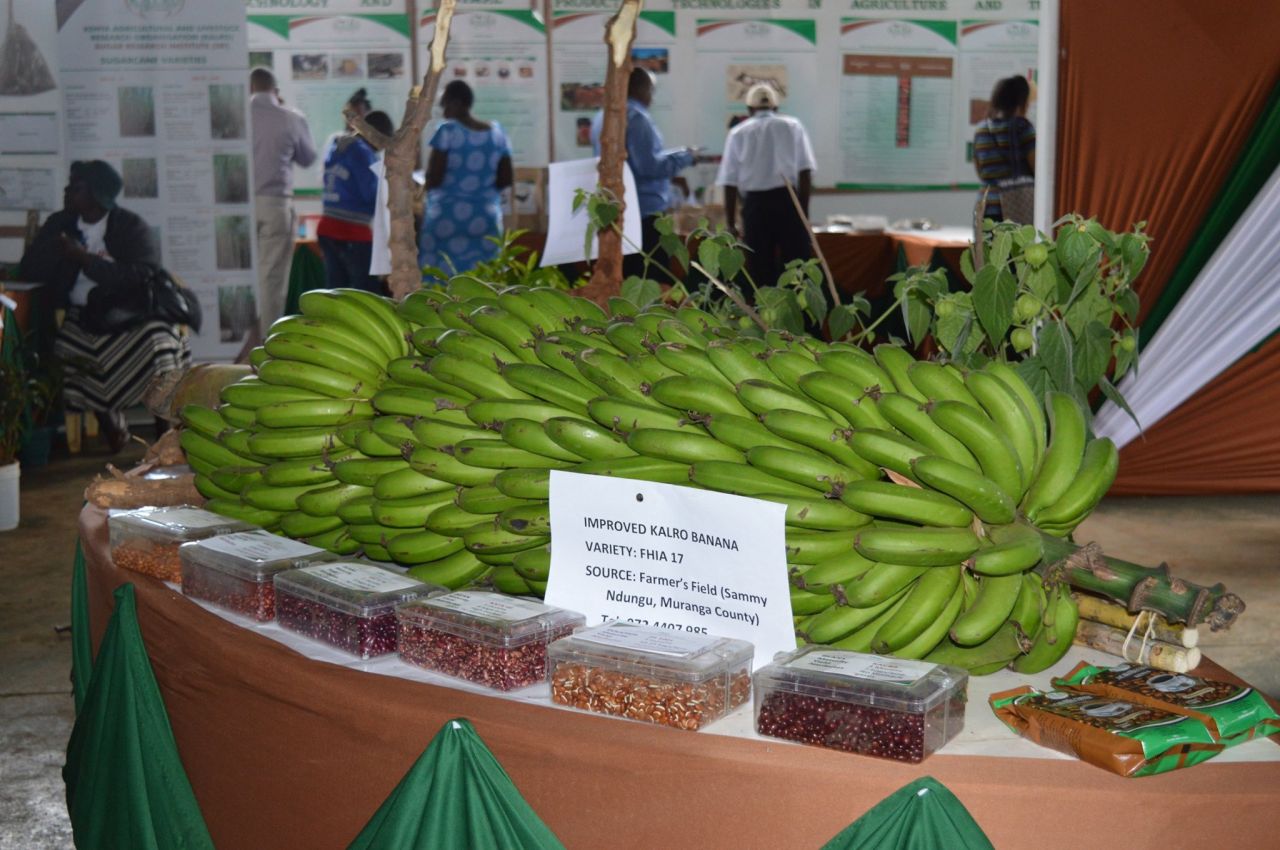
An acre of 4,000 square metres holds 444 mats at 3 by 3 metres, 333 at 3 by 4, 250 at 4 by 4, 640 at 2.5 by 2.5 and 1,000 at 2 by 2. In Kenya, short varieties go at 3 by 3 metres, medium varieties at 3 by 4 and tall varieties at 4 by 4. Grand Naine, Giant Cavendish, Valery and Ng’ombe are planted at 444 seedlings an acre, and FHIA-17 and FHIA-23 at 333.
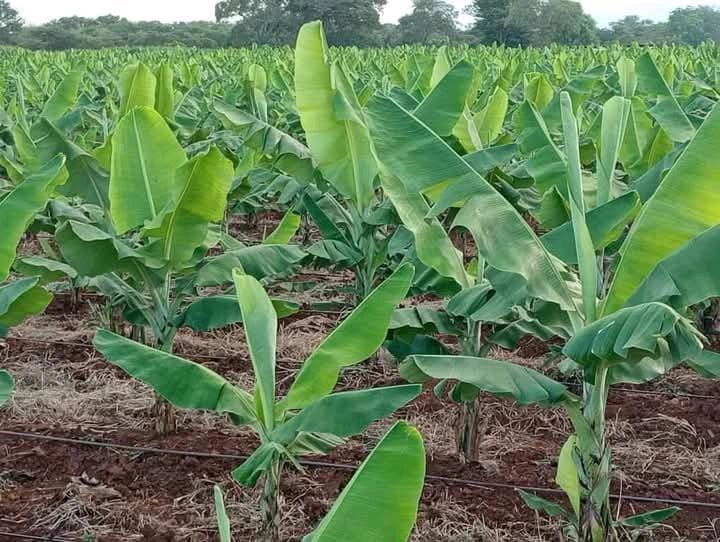
How many plants you keep on a mat depends on the spacing. At 3 by 3 metres we keep three, so the acre has 1,332 stems of three different ages. At 2.5 by 2.5 metres we keep two or three, so the acre has about 1,600 stems. At 2 by 2 metres we keep two, so the acre has 2,000 stems. Going from 444 to 1,000 mats more than doubles the mats, but the stems rise by only half. This explains most of the numbers later in the article.
Banana Spacing per Acre in Kenya: Plants, Mats and Stems
Close spacing works best on short varieties such as Dwarf Cavendish. In Taveta County, where farmers have tried close spacing more than anywhere else in Kenya, Grand Nain is the variety grown most at high densities. In India, trials with about 670 hills an acre and three suckers on each hill produced higher yields than normal spacing at every centre reporting results. The gains ran from 4 percent to 79 percent, depending on the place and the fertiliser dose.
What Farmers in Taveta Do at Each Spacing
A 2025 survey of Taveta farmers shows what close spacing looks like on real farms. At 2 by 2 metres the farmers kept about two plants on each mat, and at 3 by 3 metres they kept about three. Nearly all the farmers at 2 by 2 irrigated, against about two thirds at 3 by 3. Only about a third of the 2 by 2 farmers propped their bunches, against nearly eight in ten at 3 by 3. They sold at about KSh 17 a kilo through cooperatives and about KSh 15 through brokers.
Their costs are worth comparing with ours. In the first year they spent about KSh 202,500 an acre at 3 by 3 metres and about KSh 356,000 at 2 by 2. After this they spent about KSh 176,600 and KSh 228,600 a year. Our running cost at 3 by 3 metres is KSh 181,675, close to what they spent. Ours at 2 by 2 metres is KSh 340,440, higher, because we count props, hired labour and water in full.
The survey authors say 2 by 2 metres earned the best margin. Their reported yields at 2 by 2 are far above the yields we plan on, and we do not plan an investment on the best year anyone reported.
Cost of Starting a Banana Farm in Kenya: One Acre at Three Spacings
Here is where the money goes in the first year. Most of the cost depends on the number of mats, so the three spacings are far apart.
| Item per acre, in KSh | 3 by 3 m | 2.5 by 2.5 m | 2 by 2 m |
|---|---|---|---|
| Mats (planting holes) | 444 | 640 | 1,000 |
| Tissue culture seedlings at KSh 150 | 66,600 | 96,000 | 150,000 |
| Digging holes and planting labour | 31,080 | 44,800 | 70,000 |
| Manure at planting, 10 kg a hole | 35,520 | 51,200 | 80,000 |
| DAP at planting | 7,104 | 10,240 | 16,000 |
| Soil test and ploughing | 6,500 | 6,500 | 6,500 |
| Drip irrigation system | 64,400 | 84,000 | 120,000 |
| Setup total | 211,204 | 292,740 | 442,500 |
| Running costs to month nine | 136,256 | 179,664 | 255,330 |
| Cash needed before the first bunch | 347,460 | 472,404 | 697,830 |
We price seedlings at KSh 150 each, the same price the national banana value chain analysis and the Taveta survey use. Shops quote tissue culture plantlets between KSh 100 and KSh 200, so ask for a written quote before you fix your budget. Digging a hole costs KSh 50 and planting costs KSh 20. Manure is 10 kg a hole at KSh 8 a kilo. DAP is about 230 g a hole at KSh 70 a kilo. A soil and water test costs about KSh 3,000 and ploughing about KSh 3,500.
Drip for fruit trees starts at about KSh 45,000 an acre, according to a Kenyan farming feature. For bananas we plan KSh 64,400 at 3 by 3 metres, KSh 84,000 at 2.5 by 2.5 and KSh 120,000 at 2 by 2, because closer rows need more pipe and more drippers. The cost covers the main line, filter, laterals, one dripper for each mat and the fittings.
A tissue culture banana takes nine to fifteen months to produce the first bunch. You buy manure, feed, labour and water for all those months before any money comes in. This is why the table adds nine months of running costs, and why the last line is the cash you need before the first bunch.
Cost per mat is almost the same at every spacing. The cost is KSh 476 at 3 by 3 metres, KSh 457 at 2.5 by 2.5 and KSh 443 at 2 by 2. What changes is the total. A 2 by 2 acre needs twice the cash of a 3 by 3 acre, and the cash is tied up for the same nine to fifteen months. The table leaves out land, fencing, the water source, a pack house and transport. A borehole or a pan with a pump and tanks costs extra, and on many farms the water source is the biggest cost of all.
Water Needs for Each Spacing
Most banana areas in Kenya need irrigation in the dry months. Bananas need at least 1,000 mm of well-spread rain a year, and they need water most at flowering. In drier areas we recommend 40 to 60 litres per plant a week, and we plan on 50 litres.
Water is counted per plant, so the stems on each mat decide your water bill. At 3 by 3 metres the acre has 1,332 stems and needs about 66,600 litres a week in a dry spell, or about 9,500 litres a day. At 2.5 by 2.5 metres the acre needs about 80,000 litres a week, or 11,400 a day. At 2 by 2 metres the acre needs about 100,000 litres a week, or 14,300 a day. A 10,000-litre tank covers about one day of a 3 by 3 acre in a dry spell.
Check your water before you choose your spacing. If your source supplies less than 100,000 litres a week in a dry spell, do not plant 2 by 2 metres. Nearly every Taveta farmer at 2 by 2 irrigates.
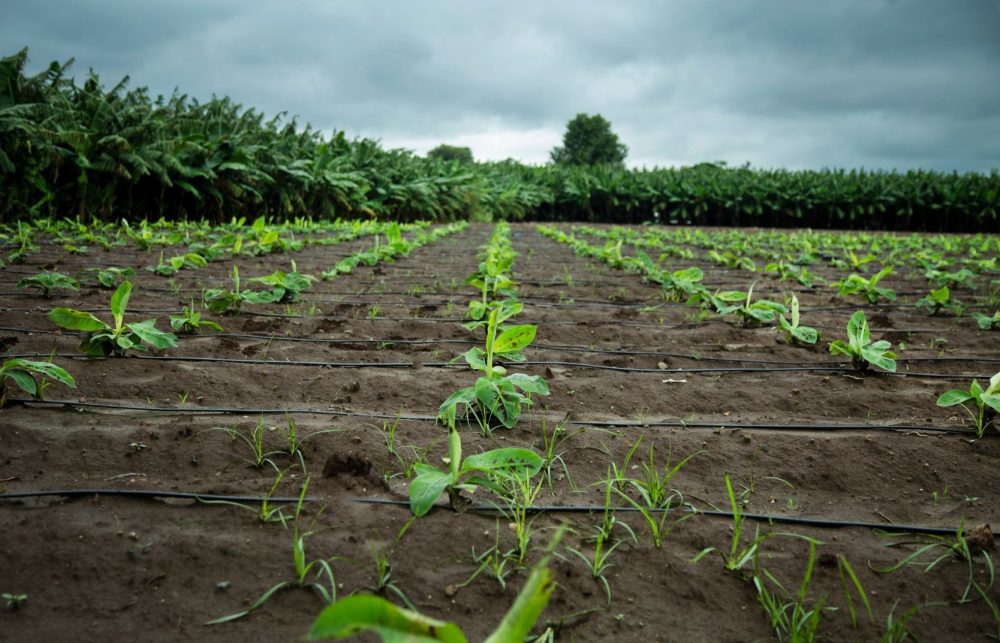
Use drip. Water goes to the roots of each mat and little is wasted between the rows. Run one lateral along each row with one or two drippers at each mat. At 3 by 3 metres the laterals are 3 metres apart. At 2 by 2 metres they are 2 metres apart, so you buy half as much pipe again, more drippers and a bigger pump and filter.
Pumping costs depend on how you lift the water. We plan KSh 12 for every cubic metre, covering fuel or power and pump repairs, and we plan on irrigating about 60 percent of the year. This comes to about 2,078 cubic metres and KSh 24,935 a year at 3 by 3 metres. At 2.5 by 2.5 metres the figures are about 2,496 cubic metres and KSh 29,952. At 2 by 2 metres they are about 3,120 cubic metres and KSh 37,440. Gravity-fed systems cost less to run and diesel pumps cost more.
Many farmers overwater. Irrigate when the crop needs water and not by routine, because waterlogged soil rots roots and wastes pumping money. Mulch heavily. Mulch holds moisture and keeps weeds down, so you water less.
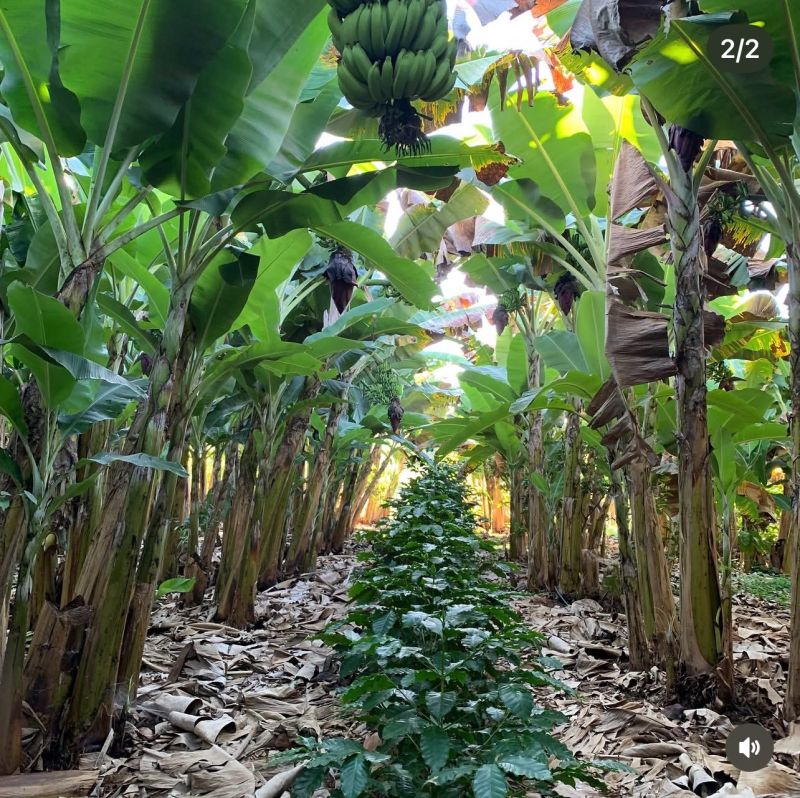
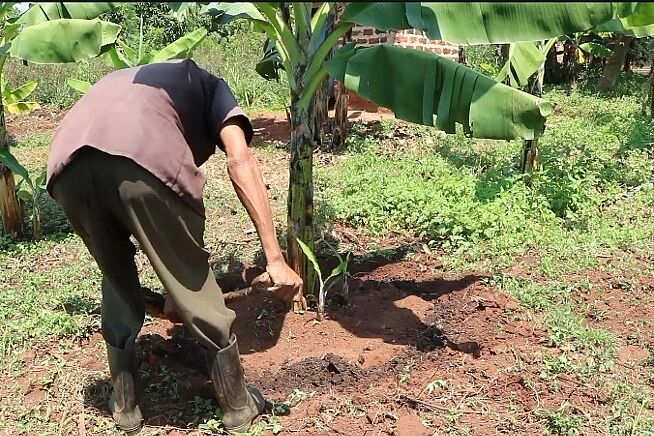
A banana farm
A Potassium-Heavy Feeding Schedule for Every Spacing
Bananas need more potassium than nitrogen or phosphorus. Potassium fills the bunch and improves the fruit. In an Indian trial on tissue culture Grand Naine, the heaviest bunches came where the fertiliser was split over four growth stages and not applied in one or two rounds.
Here is the schedule we recommend for every spacing, worked per mat. At planting, mix 10 kg of well-rotted manure and about 230 g of DAP with the topsoil in the hole.
One month after planting, start top-dressing. Then feed every ten weeks, five rounds in the year. In every round apply 100 g of muriate of potash. In the first four rounds also apply 100 g of calcium ammonium nitrate. Stop nitrogen after round four, and in round five, near flowering on the mother plant, apply potash only.
In one year each mat receives 500 g of muriate of potash, about 300 g of potassium oxide, and 400 g of calcium ammonium nitrate, about 110 g of nitrogen. Add another 10 kg of manure each year before the rains.
Spread the fertiliser in a band about 60 cm from the plant, or around the mat, and never against the stem. This dose is heavier than the 200 g of calcium ammonium nitrate a stool a year, or 250 g of 10:3:20 every six months, found in common training materials. Test your soil first, since soils differ in potassium and acidity, and add lime where the pH is low.
Use the same dose per mat at every spacing. At 2 by 2 metres each plant has less soil to feed from, so close spacing needs feeding on time even more. Muriate of potash at KSh 60 a kilo costs KSh 13,320 an acre at 3 by 3 metres, KSh 19,200 at 2.5 by 2.5 and KSh 30,000 at 2 by 2. Calcium ammonium nitrate at KSh 75 a kilo costs about the same again. Potassium is only 7 to 9 percent of your running cost, so do not cut the dose to save money.
The Indian trials show why. Their gains over normal spacing ran from 4 percent to 79 percent depending on the place and the fertiliser dose. Close spacing paid where feeding and water were enough and paid less where they were not. If you plant close and skimp on feed, you pay for the extra plants and lose the extra bunches.
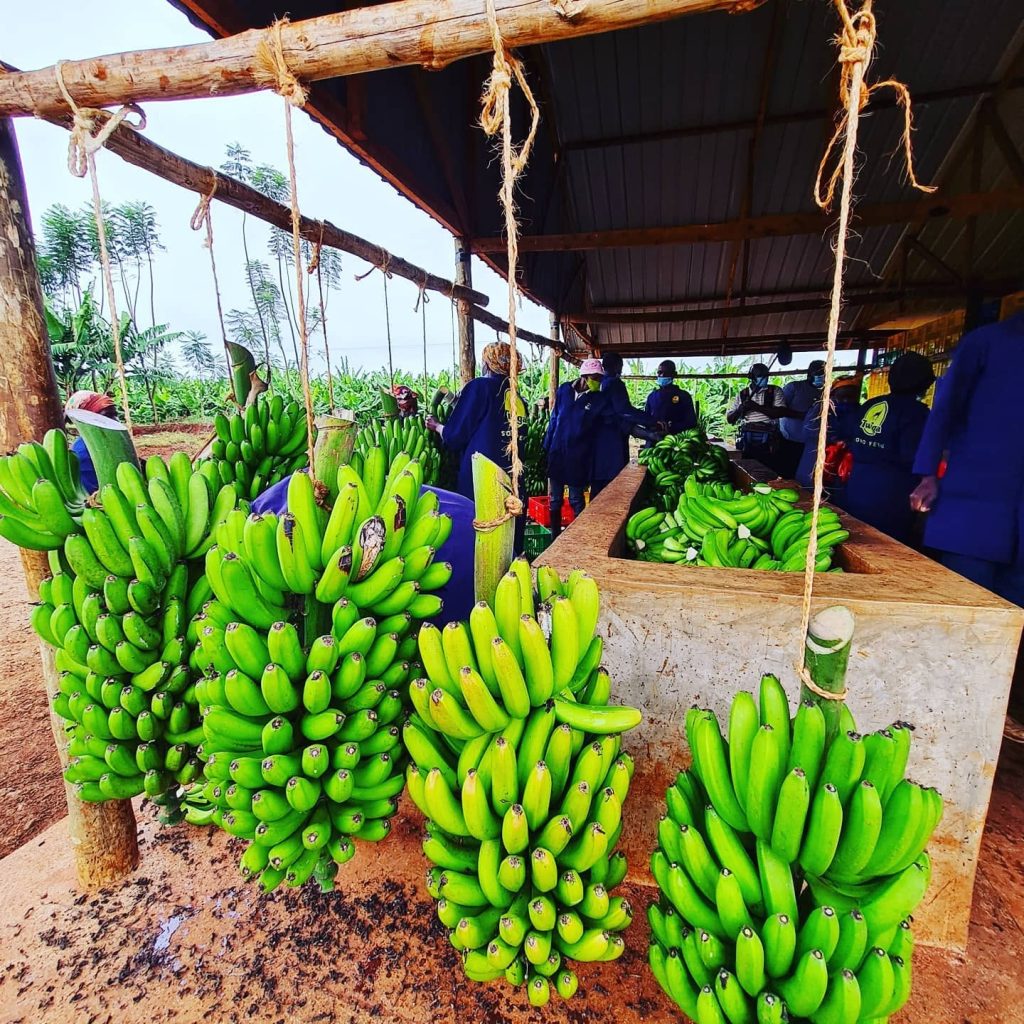
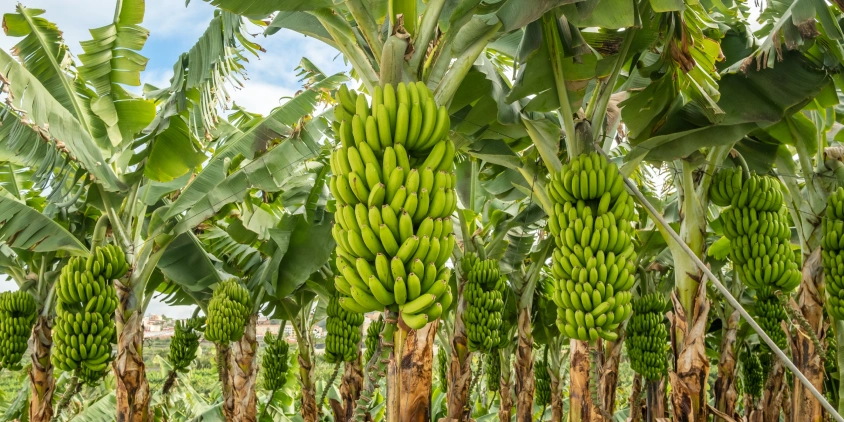
Bananas at a market
How Many Bunches and How Many Kilos From One Acre
To find the bunches from an acre, multiply bunches per mat by the number of mats. Each plant needs time to go from sucker to harvested bunch. We plan on 24 months for each plant, close to the 650 to 738 days recorded for highland bananas in Uganda. Guides often quote tissue culture Cavendish as faster, with ratoons six to nine months apart, so 24 months is a careful plan. On a 24-month cycle, three plants on a mat produce 1.5 bunches a year, two and a half plants produce 1.25 and two plants produce 1.0. Close spacing puts more mats on the acre but fewer plants on each mat.
Bunch weight comes next. Grand Naine is rated at 30 to 45 kg a bunch, and bunches get lighter as plants come closer together. We plan on 35 kg at 3 by 3 metres, 32 kg at 2.5 by 2.5 and 28 kg at 2 by 2. All three weights are inside the rated range. We use the lowest weight for 2 by 2 because the plants share light and feed even when you follow the feeding schedule.
| Planning figures per acre, steady year | 3 by 3 m | 2.5 by 2.5 m | 2 by 2 m |
|---|---|---|---|
| Mats per acre | 444 | 640 | 1,000 |
| Plants kept per mat | 3 | 2 to 3 | 2 |
| Bunches per mat per year | 1.5 | 1.25 | 1.0 |
| Bunches per acre per year | 666 | 800 | 1,000 |
| Bunches a week | 13 | 15 | 19 |
| Planning bunch weight, kg | 35 | 32 | 28 |
| Fruit per acre per year, kg | 23,310 | 25,600 | 28,000 |
| Revenue at KSh 20 per kg | 466,200 | 512,000 | 560,000 |
| Running costs per acre | 181,675 | 239,552 | 340,440 |
| Gross margin at KSh 20 per kg | 284,525 | 272,448 | 219,560 |
| Running cost per kg of fruit | 7.79 | 9.36 | 12.16 |
| Gross margin per mat | 641 | 426 | 220 |
Going from 444 to 1,000 mats raises the fruit from your acre by 20 percent, from about 23 tonnes to 28 tonnes. Running cost goes up by 87 percent. This is why the margin drops as the plants come closer.
Is 23 tonnes an acre realistic at 3 by 3 metres? Common training materials put the average Kenyan yield at about 6 tonnes an acre and good management at about 20. The national banana value chain project plans for 31 to 36 tonnes a year from the second to the fifth year on 440 plants an acre. We plan below the project figure because a dry season, a pest outbreak or a late choice of follower cuts the yield.
Weekly bunches matter when you sell. A 3 by 3 acre with mats at different ages produces about 13 bunches a week, a 2.5 by 2.5 acre about 15 and a 2 by 2 acre about 19. A buyer who wants a fixed load every week needs you to stagger your mats. Plant the whole block on one day and you cut all the bunches in one month, then none for months. Our banana de-suckering guide explains how to stagger the plants on every mat.
Where the Running Cost Goes
At 3 by 3 metres, manure costs KSh 35,520, potash KSh 13,320, nitrogen KSh 13,320, pest and disease control KSh 6,660, props KSh 33,300, hired labour KSh 34,640, harvest labour KSh 19,980 and irrigation water KSh 24,935. The total is KSh 181,675.
At 2.5 by 2.5 metres the same lines cost KSh 51,200, KSh 19,200, KSh 19,200, KSh 9,600, KSh 40,000, KSh 46,400, KSh 24,000 and KSh 29,952, a total of KSh 239,552.
At 2 by 2 metres they cost KSh 80,000, KSh 30,000, KSh 30,000, KSh 15,000, KSh 50,000, KSh 68,000, KSh 30,000 and KSh 37,440, a total of KSh 340,440.
Manure and feed rise with the number of mats, so each costs 2.25 times as much at 2 by 2 metres as at 3 by 3. Hired labour almost doubles. Props, harvest labour and water follow the bunches and stems, so they rise by 50 percent. Costs tied to the number of holes grow fastest, and this is why close spacing loses margin even when you cut more fruit.
Check three lines against your own farm before you commit. For manure we plan 10 kg a mat a year at KSh 8 a kilo. If you keep cattle or goats, you spend far less. If you buy manure delivered, you pay more. For props we plan one pole at KSh 50 for every bunch, and poles you reuse across cycles cost less. For pest and disease we plan KSh 15 a mat, which is low if your farm has nematodes or black Sigatoka, so keep a reserve for nematicide and fungicide.
Farm-Gate Price and Urban Price
Farm-gate prices for Cavendish in Kenya are close to each other. A 2026 market estimate puts the farm-gate price near KSh 16 a kilo. Taveta farmers sold at about KSh 17 through cooperatives and about KSh 15 through brokers. The national banana value chain analysis uses KSh 18 to KSh 24 a kilo. A July 2024 report from Kirinyaga quoted KSh 16 a kilo with an average bunch of 30 kg, and a 2021 report quoted KSh 8 to KSh 10. Prices have climbed since 2021 but are still low, and you will see different prices in different counties, seasons and buyers.
In the shops the price is far higher. A 2026 retail guide quotes Cavendish at KSh 60 to KSh 100 a kilo and apple bananas at KSh 100 to KSh 200. The difference pays for harvesting, transport, ripening, losses and the shop’s margin. You keep a share of the difference only if you do part of this work yourself.
A 35 kg bunch at KSh 16 a kilo brings KSh 560 at the gate. The same bunch at KSh 35 a kilo brings KSh 1,225. We use KSh 35 a kilo as the price for fruit you deliver yourself to a hotel, a ripener or a supermarket buyer. This is our planning figure, between the farm-gate and the shop price, and no buyer has quoted this price to us. Agree the price, the grade, the pack and the payment terms with your buyer in writing before you build a plan on KSh 35.
Selling direct costs more than selling at the gate. We plan KSh 6 a kilo for transport, crates and handling, and we expect to lose 5 percent of the fruit to bruising and rejects. At KSh 35 a kilo you keep about KSh 27 a kilo after those costs. Urban buyers also expect clean, unmarked fruit, a regular schedule and harvest at the right maturity. Follow the follower selection, male bud removal, propping and covering routines in our banana de-suckering guide and you will meet these demands.
Yearly Margin per Acre at Each Spacing
The table shows the gross margin of one acre in a steady year at four selling prices. The table also shows the break-even price and your cash position over the first three years. The break-even price is the lowest price at which you cover running costs plus the drip system spread over five years.
| Per acre, in KSh | 3 by 3 m | 2.5 by 2.5 m | 2 by 2 m |
|---|---|---|---|
| Gross margin at KSh 15 per kg (low farm-gate) | 167,975 | 144,448 | 79,560 |
| Gross margin at KSh 20 per kg (mid farm-gate) | 284,525 | 272,448 | 219,560 |
| Gross margin at KSh 25 per kg (high farm-gate) | 401,075 | 400,448 | 359,560 |
| Gross margin at KSh 35 per kg, direct sale after KSh 6 per kg costs and 5 percent loss | 453,522 | 458,048 | 422,560 |
| Break-even price per kg | 8.3 | 10.0 | 13.0 |
| Cash position after year 1 at KSh 20 per kg | -241,308 | -332,519 | -507,874 |
| Cash position after year 2 at KSh 20 per kg | -13,688 | -114,561 | -332,226 |
| Cash position after year 3 at KSh 20 per kg | 270,837 | 157,887 | -112,666 |
For the cash positions we assume 0.4 bunches a mat in the first year, 80 percent of full output in the second year and full output from the third year, with all setup costs in the first year.
At a farm-gate price of KSh 15 to KSh 20, 3 by 3 metres earns the most. At KSh 20 this spacing earns KSh 284,525 an acre, against KSh 272,448 at 2.5 by 2.5 and KSh 219,560 at 2 by 2. At about KSh 25 a kilo the first two earn about KSh 401,000 each and 2 by 2 earns KSh 359,560. At the direct-sale price of KSh 35, all three earn within 8 percent of each other, from KSh 422,560 to KSh 458,048.
Do not look at total margin alone, because the cash you put in differs a great deal. Divide the yearly margin at KSh 20 by the cash needed before the first bunch. A 3 by 3 acre earns about KSh 82 a year for every KSh 100 you put in. A 2.5 by 2.5 acre earns about KSh 58 and a 2 by 2 acre about KSh 32. At the direct-sale price the numbers rise to KSh 130, KSh 97 and KSh 61. Close spacing earns less for every shilling you risk, even when the total margin looks similar.
Payback follows the same order. A 3 by 3 acre returns your start-up cash a little after two years. A 2.5 by 2.5 acre returns the cash about five months into the third year. A 2 by 2 acre is still behind at the end of year three and returns the cash about six months into the fourth year. At KSh 15 a kilo, 2 by 2 takes much longer, and a poor season or a late first harvest adds more months.
All three spacings make money above their break-even prices of about KSh 8, KSh 10 and KSh 13 a kilo. A price of KSh 15 to KSh 17 covers all three, but at 2 by 2 you clear break-even by only KSh 2 to KSh 4. When the price falls, close spacing suffers first.
When 2 by 2 Metres Beats 3 by 3 Metres
Two things must happen together. The first is bunch weight above about 31 kg. At KSh 20 a kilo, a 2 by 2 acre matches a 3 by 3 acre with 35 kg bunches once the bunches on the 2 by 2 acre reach 31 kg. If the 2 by 2 plants hold 35 kg, the acre earns KSh 359,560 against KSh 284,525. If bunches fall to 24 kg, the margin drops to KSh 139,560. Every 5 kg of bunch weight is worth about KSh 100,000 an acre at 2 by 2 metres and about KSh 66,600 at 3 by 3, so close spacing rewards heavy bunches more and punishes light bunches more.
The second is price. Every KSh 5 a kilo adds KSh 116,550 an acre at 3 by 3 metres and KSh 140,000 at 2 by 2. Close spacing gains more from a higher price, and this is why 2 by 2 looks best at the direct-sale price. If you sell at the gate to a broker, the extra plants add little. If you hold a written contract at KSh 30 a kilo or more, your position is different.
Which Spacing to Choose
Decide using three facts about your farm, in this order: your water, your cash and your buyer.
Start with water. A 3 by 3 acre needs about 66,600 litres a week in a dry spell, and a 2 by 2 acre needs about 100,000. If your source is a seasonal stream, a shallow well or rain alone, plant at 3 by 3 metres or wider and irrigate only to carry the crop through the dry months. Close spacing needs enough moisture and fertility, and a farm without reliable water has neither.
Next, count your cash. A 3 by 3 acre needs about KSh 347,000 before the first bunch and a 2 by 2 acre needs about KSh 698,000. If you hold the first sum and borrow the rest, interest reduces your margin and 2 by 2 looks worse than the table shows. Many farmers do better planting two acres at 3 by 3 metres than one acre at 2 by 2. The two acres cost about the same as one close-spaced acre and earn much more at farm-gate prices.
Last, look at your buyer. If you sell to brokers at the gate, choose 3 by 3 metres. If you hold a standing order from a hotel, a ripener or a supermarket at KSh 30 to KSh 35 a kilo, you have a case for 2.5 by 2.5 metres. Try 2 by 2 on a short variety with drip, full feeding and a manager who walks every mat each month.
For most farmers the answer is 3 by 3 metres on the first acre, and 2.5 by 2.5 metres on the second once your water, your buyer and your skill with the mat are proven. Keep tall, heavy varieties at 3 by 3 or wider. The number of plants per mat is the same as in our banana de-suckering guide: three at 3 by 3, two to three at 2.5 by 2.5 and two at 2 by 2.
Plant in Sections to Spread the Cost
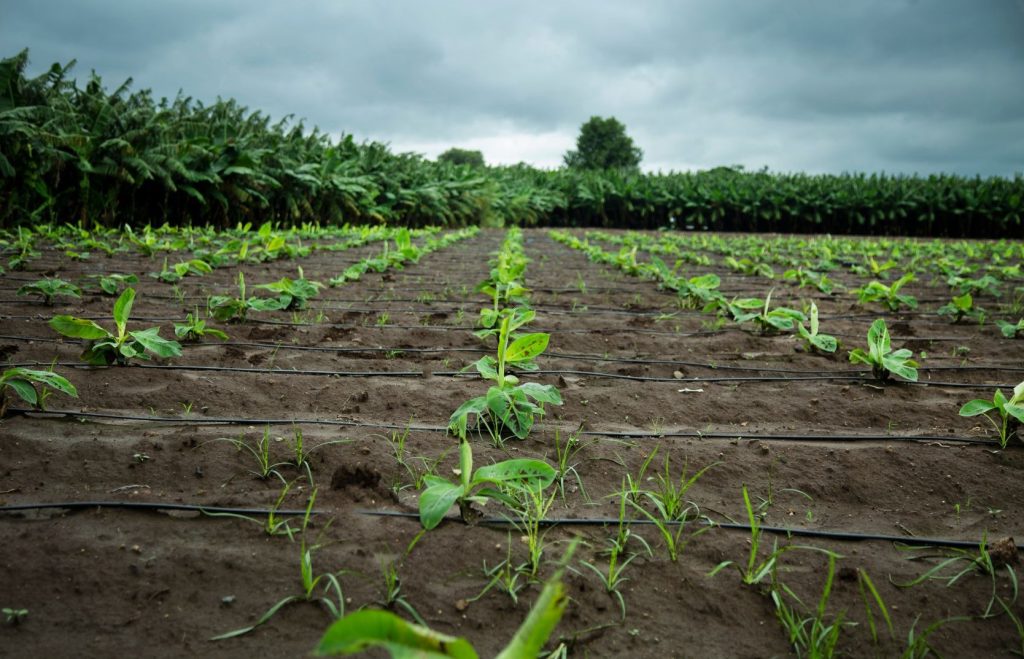
You do not have to plant the whole acre in one week. Plant in sections one or two months apart. The cost of seedlings, holes and manure spreads over several months, and the first harvests come at different times, so your bunches reach the buyer steadily and not all at once. Lay the drip system for the whole acre at the start, or section by section if your main line and filter are sized for the full acre.
If you are new to bananas, start with half an acre. A half acre at 3 by 3 metres has 222 mats and needs about KSh 190,000 before the first bunch. This is a little more than half the full-acre figure because the soil test, the ploughing and part of the irrigation system do not halve. The half acre teaches you your own bunch weights, your own water bill and your buyer’s habits. These three facts will tell you whether the next acre goes in at 3 by 3, 2.5 by 2.5 or wider.
Planting More Than One Acre
The figures in this article multiply with the acreage, but your limits do not. Ten acres at 3 by 3 metres produce about 6,660 bunches a year, about 128 a week, or about 4.5 tonnes of fruit a week at 35 kg a bunch. At this size you need a vehicle or a firm transport arrangement, a place to cut and pack, a team for the weekly harvest and a buyer who takes 4 to 5 tonnes every week. The same ten acres need about 666,000 litres of water a week in a dry spell. Your source must be a borehole, a large pan or a river with a legal abstraction right, and one tank will not do.
Cash grows too. Ten acres need about KSh 3.5 million before the first bunch. At this size, sort out the water first, the buyer second and the seedlings third. A signed purchase agreement for your weekly volume protects your margin better than any choice of spacing.
Risks Which Rise With Close Spacing
Close spacing brings five risks, and each one shows up in the numbers.
Seedling quality comes first. At 1,000 seedlings an acre, KSh 150,000 goes into the ground before your first sale, against KSh 66,600 at 444. A bad batch with nematodes or hidden disease costs you more, and nematodes cause losses above 70 percent of the crop in bad cases. Buy properly produced tissue culture seedlings with a batch record, so you trace any problem back to the source.
Black Sigatoka is next. The disease costs you 50 percent of the yield or more when you leave the disease uncontrolled. Cut off affected leaves, keep adequate spacing and drain the field well. A tight block loses part of the spacing protection. FHIA 17, 18 and 25 resist Sigatoka, and Williams and Grand Nain have some tolerance.
Bacterial wilt comes third. In affected stands losses reach 100 percent, and the disease spreads on cutting tools and through the male bud. A 2 by 2 acre has 2,000 stems against 1,332 at 3 by 3, so every inspection round covers half as many stems again. Use a forked stick for male buds, clean your blades between mats and report any plant with uneven ripening to the county agricultural officer. These steps protect every spacing, and they matter more as stems multiply.
Wind is the fourth risk. Tall and medium varieties need props, and the Taveta farmers at close spacing propped less often than those at 3 by 3, which is dangerous with a tall variety. We plan one prop at KSh 50 for every bunch. A mat falling on the day of harvest costs far more than a prop.
Labour is the fifth. Harvest, props, de-suckering, feeding rounds and weekly bunch handling all grow with the mats. At 19 bunches a week, a 2 by 2 acre needs a trained team every week. A 3 by 3 acre at 13 bunches a week is manageable with one or two workers and a supervisor.
Managing the Mats at Each Spacing
Spacing sets the number of plants you keep on each mat, and the rest of the routine follows. At 3 by 3 metres keep the mother, the follower and the grand-follower. At 2.5 by 2.5 metres keep two or three plants and choose the grand-follower late. At 2 by 2 metres keep two, the mother and the follower, and cut every other sucker at about 30 cm.
Walk the mats every 45 days at every spacing. The work in each visit grows with the number of mats, and at 1,000 mats an acre you need more workers or more days. Skip de-suckering at close spacing and you pay sooner, because the follower and the grand-follower shade the mother within months and bunches fall below the weights in this article. Male bud removal, open covers, props and green leaves follow the same rules at every spacing. Our banana de-suckering guide explains each step.
xr:d:DAFau1AsDx8:197,j:2447696227,t:23041012
Where Fruit Africa Veriplant Fits In
A good acre starts with a good seedling. We do not run a tissue culture laboratory. We buy laboratory plantlets from KEPHIS-certified laboratories, harden them in our nurseries and supply the seedlings to farmers across Kenya through our hubs in Murang’a, Nairobi and Embu. For every order we record the laboratory, the variety and the batch, and we issue an invoice. Our tissue culture banana guide explains how the plantlets are produced and hardened.
Send us your county, your altitude, your water source, your buyer, your acreage and your planting date. Our agronomy team will suggest a variety and a spacing, advise on the plants to keep per mat and work out the number of seedlings and the drip layout. Tell us which varieties you want, and we will confirm which ones we hold and which we place on order. We do not promise a fixed bunch weight, yield or price, because the result depends on the variety, the water, the feeding and how you manage the mat. Use the quotation link below and we will quote the price per plant in writing.
Frequently Asked Questions About Banana Farming Profit per Acre in Kenya
What is the best banana spacing per acre in Kenya?
For most farmers the best spacing is 3 by 3 metres, which means 444 mats. This spacing earns the most for every shilling you invest at farm-gate prices. Farms with reliable water, a direct buyer and strong management have a case for 2.5 by 2.5 metres, and 2 by 2 metres suits short varieties under drip irrigation.
How many banana plants per acre at 3 by 3 metres?
An acre of 4,000 square metres holds 444 mats at 3 by 3 metres. Each mat carries three plants at three ages, so the acre has about 1,332 stems. Some guides round the number to 450.
Does 2 by 2 metre spacing work for bananas in Kenya?
The spacing works where the variety is short, water is certain, feeding is full and the price is high. Farmers in Taveta County grow bananas at 2 by 2 metres and nearly all of them irrigate. Our figures show a 2 by 2 acre earning less than a 3 by 3 acre at farm-gate prices, and winning only if bunches stay above about 31 kg and the price is high.
What is the cost of starting a banana farm in Kenya per acre?
Setting up an acre at 3 by 3 metres costs about KSh 211,000, and you need about KSh 347,000 before the first bunch once nine months of running costs are added. At 2 by 2 metres setup costs about KSh 442,500 and you need about KSh 698,000. Land, the water source and transport cost extra.
How much does a tissue culture banana seedling cost?
Planning figures use KSh 150 a seedling, and hardened ready to plant tissue culture banana seedlings at Fruit Africa Veriplant nursery at between 250-500Ksh depending on many factors like, size, age and variety. The price depends on the variety, the quantity and the laboratory. Ask us for a written quote for your order.
How much water does an acre of bananas need?
Plan on 50 litres per plant a week in a dry spell. A 3 by 3 acre with 1,332 stems needs about 66,600 litres a week, and a 2 by 2 acre with 2,000 stems needs about 100,000 litres a week.
How much potassium do bananas need?
Apply 500 g of muriate of potash to each mat a year in five rounds of 100 g, about 300 g of potassium oxide. Add 400 g of calcium ammonium nitrate in the first four rounds. Confirm the rates with a soil test for your farm.
What is banana farming profit per acre in Kenya?
At 3 by 3 metres the gross margin is about KSh 285,000 a year at KSh 20 a kilo and about KSh 454,000 a year at a direct-sale price of KSh 35. These figures leave out land rent, your own labour and interest, and they change with bunch weight and price.
What is the farm-gate price of bananas in Kenya?
Recent figures run from about KSh 15 to KSh 24 a kilo, with a 2026 estimate near KSh 16. Retail guides quote KSh 60 to KSh 100 a kilo for Cavendish. Prices differ by county, season and buyer.
How long before a banana farm pays back?
A 3 by 3 acre returns the start-up cash a little after two years at KSh 20 a kilo. A 2 by 2 acre takes about three and a half years. A lower price or a lighter bunch adds months.
Which banana varieties suit close spacing?
Short varieties such as Dwarf Cavendish suit close spacing. Grand Nain is grown at high densities in Taveta. Tall varieties and heavy hybrids such as the FHIA series do better at 3 by 3 metres or wider.
How many suckers do you keep per mat at close spacing?
Keep two plants at 2 by 2 metres, two to three at 2.5 by 2.5 and three at 3 by 3. Our banana de-suckering guide explains how to choose the follower and the grand-follower.
Final Advice for Farmers
Four numbers decide your spacing: the cash you have, the water you have, the bunch weight you reach and the price you secure. For most farmers, 3 by 3 metres wins. At 3 by 3 you spend about KSh 347,000 before the first bunch, earn about KSh 285,000 a year at KSh 20 a kilo and get your cash back a little after two years. Use 2.5 by 2.5 metres as your second step when your water is proven and you have a direct buyer. Keep 2 by 2 metres for the farmer who has the cash, the water, a short variety and a contract above KSh 30 a kilo.
Whatever spacing you choose, the same habits earn the margin. Feed with more potassium than nitrogen in every round and keep to the schedule. Irrigate when the crop needs water. Keep the right number of plants on every mat, remove the male bud on time, cover the bunch early and prop the bunch. Weigh your first bunches and write down the weights, because your own figures will replace ours the day you harvest.
Before you buy seedlings, write down three numbers: the litres of water you supply each week, the cash you hold and the price your buyer has promised in writing. Send them to us with your county, your altitude and your planting date. Our agronomy team will help you choose the variety, the spacing and the number of traceable tissue culture banana seedlings for your acre.
Sources and References
- Ministry of Agriculture, Livestock and Fisheries, banana production training materials for model farmer groups, 2016: https://www.jica.go.jp/project/english/kenya/015/materials/c8h0vm0000f7o8cj-att/materials_18.pdf and https://www.jica.go.jp/project/english/kenya/015/materials/c8h0vm0000f7o8cj-att/materials_03.pdf
- Wasilwa L.W. and colleagues, Evaluation of farmer practices in high density banana production, agronomic aspects in Taveta County Kenya, IJRSI, July 2025: https://rsisinternational.org/journals/ijrsi/articles/evaluation-of-farmer-practices-in-high-density-banana-production-agronomic-aspects-in-taveta-county-kenya/
- Ndungu and colleagues, High density banana production in Taveta County Kenya, an economic assessment of farmer practices, IJRISS, July 2025: https://rsisinternational.org/journals/ijriss/articles/high-density-banana-production-in-taveta-county-kenya-an-economic-assessment-of-farmer-practices/
- KALRO and National Agricultural Value Chain Development Project, Gross margin analysis for a banana enterprise, brochure, 2024: https://www.kalro.org/navcdp/docs/banana/GROSS%20MARGIN%20ANALYSIS%20FOR%20A%20BANANA%20ENTERPRISE%20%20Brochure.pdf
- KALRO, Inventory of technologies, innovations and management practices for the banana value chain, National Agricultural Value Chain Development Project, 2024: https://navcdp.kalro.org/docs/tot_timps/Banana%20TIMPS.pdf
- Debnath S. and colleagues, Studies on high density planting and nutrient requirement of banana in different states of India, Journal of Horticultural Sciences 16(2), 2021: https://doaj.org/article/b4a5dc01d9bf43dcad04b9074c8e5408
- Balamohan T.N., Auxilia J. and Sudha R., Standardization of stage-wise requirement of nutrients in banana cv. Grande Naine (AAA), Journal of Horticultural Sciences 10(2), 2015: https://core.ac.uk/download/357743227.pdf
- Birabwa R., van Asten P.J.A., Alou I.N. and Taulya G., Got matooke for Christmas, Acta Horticulturae 879, 2010 (IITA and Makerere University): https://biblio.iita.org/documents/S10ArtBirabwaGotNothomNodev.pdf-33cb32bca6860c486c27c72076672084.pdf
- KALRO, Selected commercial banana dessert varieties, pamphlet: https://kalro.org/navcdp/docs/banana/SELECTED%20COMMERCIAL%20BANANA%20DESSERT%20VARIETIES%20Pamphlet.pdf
- Selina Wamucii, Bananas prices in Kenya, farm-gate estimate for 2026: https://www.selinawamucii.com/insights/prices/kenya/bananas/
- The Standard, New banana export market excites farmers, 2021: https://www.standardmedia.co.ke/farmkenya/article/2001412668/new-banana-export-market-excites-farmers
- The Star, Marketing group helps banana farmers fetch better prices, July 2024: https://www.the-star.co.ke/counties/central/2024-07-19-marketing-group-helps-banana-farmers-fetch-better-prices
- The Standard, How to choose the best irrigation system for your crop: https://www.standardmedia.co.ke/farmkenya/amp/news/article/2001421015/how-to-choose-the-best-irrigation-system-for-your-crop
- Huduma Global, Banana farming in Kenya, Cavendish, Apple and tissue culture guide, 2026: https://hudumaglobal.com/blog/commercial-banana-farming-kenya-cavendish-apple-tissue-culture
- Farmers Trend Limited, Banana farming in Kenya profit guide: https://farmerstrend.co.ke/trending/banana-farming-in-kenya-profit-guide/
- Fruit Africa Veriplant: https://www.fruitafrica.org
Contact Our Agronomy Team Today
- Head Office Location: Ruiru, Kiambu County, Kenya
- Nursery Distribution Hubs: Murang’a, Nairobi and Embu
- Phone Direct: +254 714 994 444
- WhatsApp Assistance: Message us on WhatsApp
- Official Email: sales@fruitafrica.org
- Official Website: www.fruitafrica.org
- Request a Quotation: fruitafrica.org/request-for-quotation/