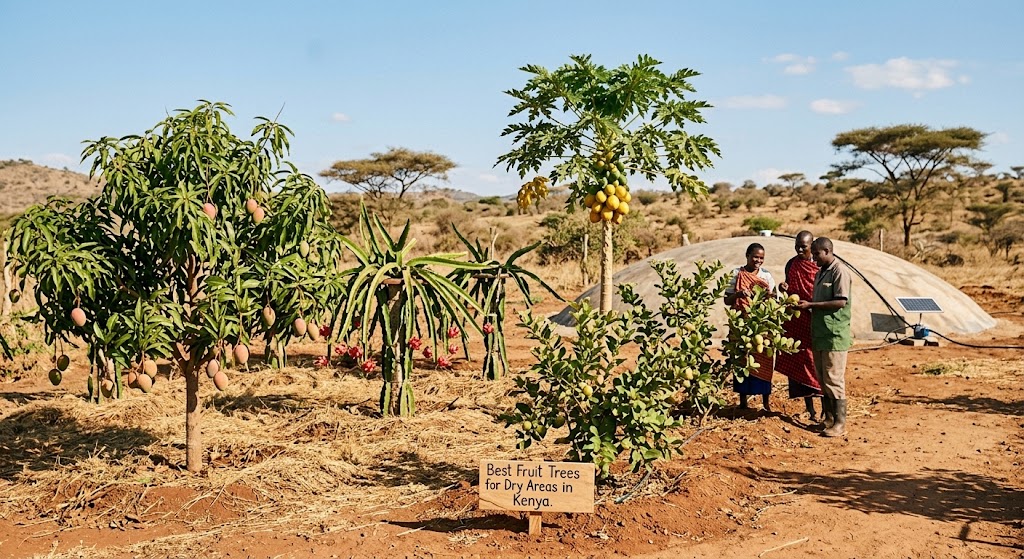
Discover the best fruit trees for dry areas in Kenya. Complete guide for Kitui, Machakos, Kajiado, and Garissa covering varieties, farm layout, and returns.
Best Fruit Trees to Farm in Semi-Arid (ASAL) Counties: Kitui, Machakos, Kajiado & Garissa Farm Layout
Agricultural investors, commercial developers, and smallholder farmers working in Kenya’s Arid and Semi-Arid Lands (ASALs), especially within Kitui, Machakos, Kajiado, and Garissa counties, face a difficult production environment. High heat levels, low annual rainfall that often falls under four hundred millimeters, intense daily sunlight, and long dry spells make ordinary rain-fed field crops a risky investment. When a farmer relies entirely on maize, beans, or sorghum in these dry zones, a single missed rain cycle can wipe out an entire season of work and capital.
Shifting your focus to the best fruit trees for dry areas Kenya offers a steady and profitable alternative. Deep-rooted fruit trees, specialized cacti, and heat-adapted deciduous varieties tap into deep subsoil water reserves. They survive long dry spells and produce solid financial returns per acre for decades. Once a fruit tree establishes its root framework, it continues to gather underground moisture and nutrients even when surface soils look completely bone dry.
Building a commercial orchard in these dry zones requires matching specific fruit varieties to local soil pH levels, altitude ranges, and water salinity profiles. When you combine proper variety selection with smart rainwater harvesting structures and a planned layout, you unlock the true commercial potential of dryland farming. Success does not come from guessing what might grow. It comes from understanding how specific plant species interact with soil physics, water availability, and regional heat patterns.
Regional Microclimates and Soil Profiles
The semi-arid counties of Kenya vary greatly in altitude, soil composition, and water chemistry. An orchard business that thrives in the higher, cooler areas of Machakos will experience severe heat stress in the low, flat plains of Garissa. You must study these microclimates carefully before spending any money on land clearing or buying seedlings.
| County Zone | Altitude Range | Average Annual Rainfall | Dominant Soil Type | Key Climatic Challenge |
| Machakos | 1,000m to 1,800m ASL | 500mm to 800mm | Volcanic loam & sandy loam | Seasonal dry spells, moderate heat |
| Kitui | 400m to 1,100m ASL | 400mm to 600mm | Sandy red soils & gravelly clay | High heat, rapid topsoil drying |
| Kajiado | 600m to 1,600m ASL | 300mm to 500mm | Black cotton clay & alkaline loam | Strong winds, high soil salinity |
| Garissa | 100m to 400m ASL | 150mm to 350mm | Alluvial silts & saline soils | Extreme heat, severe water scarcity |
In Machakos County, higher elevation areas like Kangundo, Mua Hills, and Machakos Central feature deep, well-drained volcanic loam soils and mild temperatures. These conditions make it easier to establish fruit trees because the air stays slightly cooler and the soil holds moisture longer. However, lower elevation zones in the same county, such as Katangi, Mwala, and Yatta, experience higher temperatures and unpredictable rainfall. Farming in these lower zones requires deep-rooting fruit species, heavy organic mulching, and efficient drip irrigation systems.
Kitui County consists mostly of sandy red soils and gravelly clay loams. Regions like Mutomo, Kitui South, and Mwingi experience high daytime temperatures that dry out topsoils very quickly. Soils in Kitui require heavy additions of organic compost and manure to build up organic matter, improve water-holding capacity, and support long-term feeder root development. Without organic matter, applied irrigation water quickly drains straight past the shallow root zone and gets wasted.
Kajiado County presents a combination of alkaline loams and heavy black cotton clay soils across Isinya, Kajiado Central, and Namanga. High evaporation rates, strong sun exposure, persistent winds, and saline underground water create unique challenges. Farmers here must choose salt-tolerant tree varieties and rootstocks, construct windbreak borders, and plant on raised earth mounds to keep root collars from rotting in heavy clay.
Garissa County sits along the alluvial plains of the Tana River Basin and stretches out into dry hinterlands. It experiences extreme heat and very low annual rainfall. Commercial farming here relies on heat-tolerant fruit species, river basin flood-plain soils, or micro-drip irrigation using treated or settled river water. The high heat speeds up plant growth, but it also means trees will dry out within hours if water delivery stops unexpectedly.
Detailed Commercial Fruit Variety Selection
Choosing the correct commercial fruit varieties dictates whether your orchard survives, when it harvests, and how much money it generates at the market.
1. Mango Varieties (Mangifera indica)
Mangoes form a reliable foundation when selecting the best fruit trees for dry areas Kenya, especially in Machakos, Kitui, and lower Eastern Kenya. A mature mango tree develops a strong taproot that reaches up to six meters underground, accessing deep water tables during severe droughts.
Apple Mango is an early to mid-season variety that produces medium to large round fruits with a bright yellow and red blush. The flesh is sweet, rich, and completely free of stringy fibers. It remains the top choice for local fresh fruit markets and export markets in the Middle East because of its taste and attractive appearance.
Kent is a late-season variety that produces large, oval fruits with dark green skin that develops a deep red blush as it matures. Its smooth, fiberless flesh allows farmers to harvest and sell fruit late in the year after the main Apple Mango harvest has finished, capturing much higher prices.
Tommy Atkins is a firm fruit with a dark red skin that resists handling damage during transport. Although its flesh contains mild fiber, its long shelf life and resistance to bruising make it a favorite choice for long-distance transport to distant regional markets.
Van Dyke is a medium-sized, oval fruit featuring a smooth bright yellow background covered by a heavy crimson blush. It offers a pleasant sweet flavor, strong natural tolerance to fungal diseases, and excellent visual appeal on retail shelves.
Ngowe is the traditional standard variety for coastal and low-altitude zones. It produces long, curved fruits with a distinct pointed hook at the bottom. Although it has some fiber near the seed, its rich juice content makes it perfect for commercial processing into fruit juice concentrate.
Sabin, also known as Sabina, is a tough, heavy-bearing local selection that performs exceptionally well in hot lowlands. It shows strong natural tolerance to anthracnose and powdery mildew, producing consistent yields even when weather patterns fluctuate.
Alphonso is a famous international variety valued for its rich aroma, saffron-colored flesh, and high sugar content. It commands premium prices in processing facilities and high-end fresh fruit markets.
2. Sweet Orange, Mandarin, and Hybrid Varieties (Citrus sinensis & C. reticulata)
Sweet oranges and mandarins rank among the best fruit trees for dry areas Kenya when grafted onto drought-tolerant rootstocks such as Rough Lemon or C-35 Citrange, which provide resistance to root rot and soil-borne pests.
Pixie Orange is the top commercial choice for Ukambani and Kajiado counties. It produces medium-sized, easy-peeling, seedless fruits with very high sugar levels. Its yellow-orange skin and long post-harvest shelf life drive high demand and premium prices in urban supermarkets.
Washington Navel is an early-maturing orange that produces large, seedless fruits with a characteristic navel structure at the base. It features deep orange skin and juicy flesh, performing best in the slightly cooler, elevated zones of Machakos and Kajiado.
Valencia Late is a late-season commercial variety that produces medium to large fruits with smooth, thin skin and exceptional juice content. The fruit can hang on the tree for months after maturing without losing quality, allowing farmers great flexibility when scheduling harvests.
Blood Orange varieties, including Maltese and Moro, develop deep red pigmentation inside the flesh when exposed to warm sunny days and cool night temperatures in drylands.
Cara Cara Navel is a red-fleshed navel orange variety featuring sweet, low-acid pinkish-red pulp. It commands top prices in boutique fruit shops and upscale supermarket chains.
Tangerines and Mandarins are easy-peeling, aromatic citrus varieties that yield heavily in warm lowlands, producing sweet, juicy fruits with thin, bright skins.
Minneola Tangelo is a hybrid between a grapefruit and a tangerine, easily recognized by a distinct neck at the stem end. It produces large, deep reddish-orange fruits with a rich, tart-sweet juice profile.
3. Lemon & Lime Varieties (Citrus limon & C. aurantifolia)
Lemons show stronger drought tolerance and soil adaptability than sweet oranges, making them an ideal, low-risk choice for challenging locations in Kajiado, Kitui, and Garissa.
Meyer Lemon is a smooth-skinned hybrid between a lemon and a mandarin. It produces rounder, less acidic fruits with a floral aroma and high juice yield, bearing fruit continuously throughout the year when given light water.
Lisbon Lemon is a tough, thorny tree that produces smooth, thin-skinned, highly acidic fruits with exceptional juice volume. It handles high heat and drought stress in hot lowlands without dropping its foliage.
Eureka Lemon is the most widely grown commercial variety, bearing fruit in multiple flushes year-round. It produces medium-sized, oblong fruits with rough yellow skin, a prominent point at the tip, and high citric acid content.
Variegated Pink Lemon is a novel variety featuring green-and-cream striped leaves and striped young fruits that turn yellow with pink flesh as they mature. It serves high-end culinary and ornamental markets.
Kaffir Lime is grown primarily for its highly aromatic double-lobed leaves and bumpy green fruits, which are used in commercial food flavorings, Asian cooking, and essential oil extraction.
Normal Rough Lemon consists of extremely tough local trees used mainly as a resilient rootstock base or grown directly for local fresh juice production because of their deep, aggressive root systems.
Bitter Lemon, also called Seville or Sour Orange, consists of extremely hardy trees that survive in poor, saline soils, producing sour fruits used for marmalade production, medicinal extracts, and rootstock production.
4. Commercial Low-Chill Apple Varieties (Malus domestica)
Apple production in semi-arid environments relies on low-chill varieties that do not need cold winters to trigger bud break and flowering.
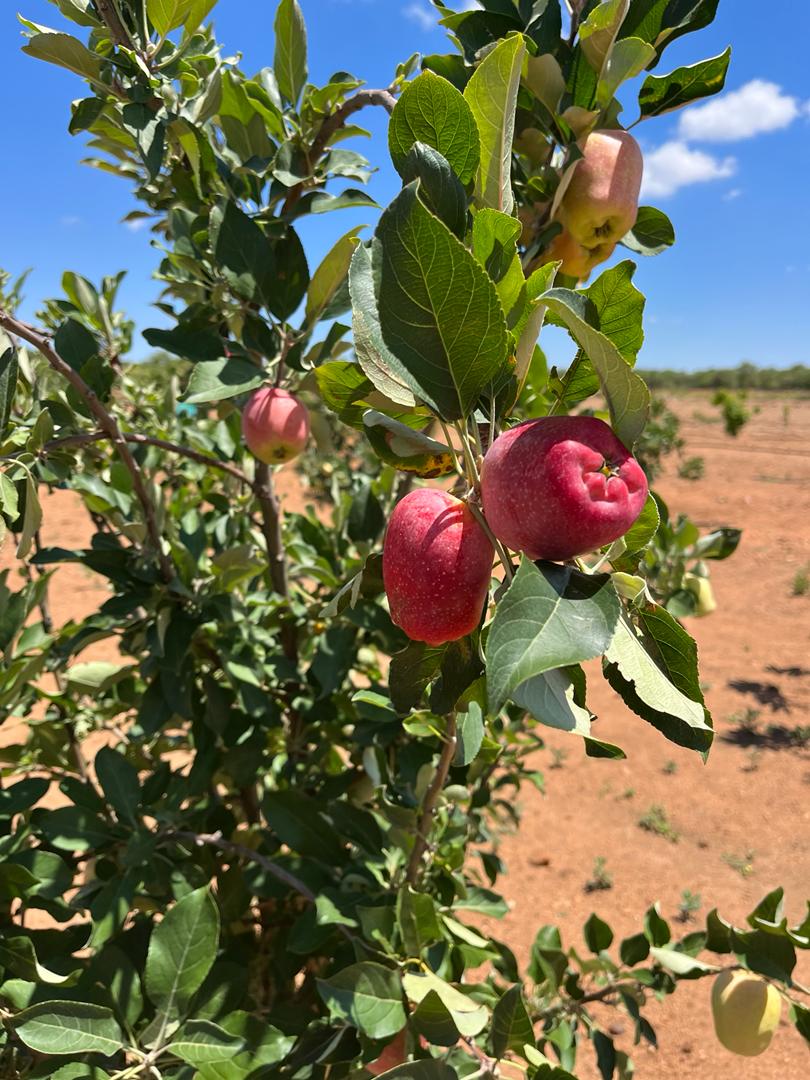
Anna Apple is a low-chill variety specifically suited for warm climates. It produces large, light green fruits with a red blush, offering a crisp, sweet-tart flavor. It flowers early and yields heavily when cross-pollinated with Golden Dorset.
Wambugu Apple is a locally adapted, tough apple selection developed in Kenya. It features a strong root system, high heat tolerance, and heavy production of medium to large, sweet, firm apples that store very well at room temperature.
Golden Dorset is a complementary low-chill variety that produces golden-yellow fruits. It acts as an effective cross-pollinator for Anna Apple, improving fruit set and shape across the orchard.
5. Table and Wine Grape Varieties (Vitis vinifera)
Grapes possess deep root systems that thrive in hot, dry climates with abundant sunshine. The low humidity in drylands reduces fungal leaf diseases compared to wet highland regions.
Red Globe is a popular table grape producing large, seeded red berries in heavy clusters. It features firm flesh, sweet flavor, and excellent resistance to damage during transport.
Crimson Seedless is a late-season seedless table grape producing bright red, cylindrical berries with a crisp texture and high sugar content.
Thompson Seedless is a versatile white grape used for fresh eating, raisin making, and juice production. It yields heavily under drip irrigation in light, warm soils.
Muscat of Alexandria is an aromatic white grape known for its intense floral flavor, suitable for fresh consumption and boutique wine production.
Sourcing Certified Planting Material
When planting an orchard in semi-arid environments, using uncertified or wild seedlings leads to frequent plant deaths and financial loss. Weak seedlings fail to establish deep roots, succumb quickly to root rot, or turn out to be wild, unproductive tree types.
A certified seedling consists of a proven scion grafted onto a drought-hardy rootstock. The scion delivers high-yielding, true-to-type fruit, while the rootstock provides deep taproot growth, resistance to soil nematodes, and tolerance to root rot. Hardening the seedling under full sunlight before planting ensures it withstands high field temperatures.
Fruit Africa Veriplant Nurseries produces certified, sun-hardened fruit tree seedlings specifically raised for tough semi-arid field conditions across its nursery hubs in Murang’a, Embu, Nairobi, and Kiambu. You can reach their technical team via www.fruitafrica.org, info@fruitafrica.org, or 0714-994444.
Integrated One-Acre ASAL Farm Layout Guide
To maximize every square meter of land, shield crops from strong dry winds, and collect every drop of rainfall, you must follow a clean, structured multi-crop plan for a one-acre (64m x 64m) farm.
Designing an integrated layout requires putting tall trees on the windward side of your land to block destructive winds. You must construct water collection points at the lowest elevation point of your slope and group crops into blocks based on their spacing needs and water consumption patterns.
Planting two rows of Casuarina equisetifolia or Melia volkensii along your northern or windward farm boundaries reduces wind speeds, lowers water loss through evaporation, and prevents wind from blowing blossoms off your fruit trees. Establishing a live fence of Kei Apple or Euphorbia tirucalli along the perimeter fence keeps out wandering livestock.
Digging a lined farm pond at the lowest corner of your land captures surface water runoff during heavy rains, providing a water reserve for drip irrigation during long dry seasons.
Block A occupies the upper section and contains tall canopy trees like Grafted Mangoes planted at an eight-meter by eight-meter spacing. Block B occupies the middle section and holds medium canopy trees like Pixie Oranges, Lemons, or Pomegranates planted at a four-meter by four-meter spacing. Block C occupies the lower section near the water storage pond and contains low canopy or trellised crops like Low-Chill Apples, Grapes, or Dragon Fruit.
Step-by-Step Planting and Establishment Guide
-
Test your soil pH, soil texture, and water salinity through an agricultural testing laboratory before buying or planting any fruit varieties.
-
Mark out plant locations carefully using measuring tapes and alignment strings according to your chosen crop spacing grid.
-
Dig planting holes measuring sixty centimeters wide, sixty centimeters long, and sixty centimeters deep, keeping topsoil in one pile and subsoil in another.
-
Mix the topsoil pile with twenty kilograms (two full wheelbarrows) of well-rotted manure and one hundred and fifty grams of Rock Phosphate or DAP per hole before backfilling.
-
Install double-line drip irrigation systems with two four-liter-per-hour button drippers positioned at each tree basin.
-
Transplant certified, sun-hardened seedlings at the start of the seasonal rains. Slice open the nursery bag carefully using a sharp blade, keeping the soil root ball intact. Ensure the graft union sits fifteen to twenty centimeters above the ground level.
-
Apply a fifteen-centimeter layer of dry organic mulch around each tree basin, keeping a ten-centimeter gap away from the trunk to prevent stem rot.
Commercial Return Comparison Across ASAL Fruit Crops
Evaluating long-term financial returns per acre helps you choose the right mix of crops for your farm business.
| Fruit Crop | Time to First Revenue | Full Bearing Year | Average Yield Per Acre (Peak) | Average Farm-Gate Price | Projected Net Annual Income / Acre |
| Grafted Mango | Year 3 to 4 | Year 7 | 12 to 18 Tonnes | KES 30 to KES 50 / kg | KES 450,000 to KES 750,000 |
| Pixie Orange | Year 3 | Year 6 | 15 to 22 Tonnes | KES 80 to KES 150 / kg | KES 1,200,000 to KES 2,200,000 |
| Dragon Fruit | Year 1 to 2 | Year 4 | 10 to 14 Tonnes | KES 400 to KES 600 / kg | KES 3,800,000 to KES 5,500,000 |
| Low-Chill Apples | Year 2 | Year 5 | 8 to 12 Tonnes | KES 150 to KES 250 / kg | KES 1,200,000 to KES 2,500,000 |
| Table Grapes | Year 2 | Year 4 | 6 to 10 Tonnes | KES 200 to KES 350 / kg | KES 1,000,000 to KES 2,200,000 |
Action Plan for Commercial ASAL Developers
Test your irrigation water for total dissolved solids and electrical conductivity to choose trees that tolerate your water quality.
Build farm ponds, water catchment pits, and earth contours before planting seedlings to capture maximum rainwater runoff.
Plant border windbreak trees six months before planting delicate fruit seedlings.
Buy verified, disease-free seedlings from Fruit Africa Veriplant Nurseries to ensure high field survival and true-to-type fruit yields.
Combine drip irrigation systems with heavy organic mulching to get the highest water efficiency possible.
Detailed Crop Agronomy and Botanical Adaptation Principles
Understanding the botanical mechanisms that allow the best fruit trees for dry areas Kenya to survive dry conditions helps you manage your orchard more effectively. When a plant faces high heat and low soil moisture, it uses specific physical and chemical defense mechanisms to protect its tissues.
Deep taproot systems represent the primary line of defense for trees like mangoes and citrus. These taproots push past dry surface soils to find deep underground moisture layers. The deep root network absorbs water continuously, pumping it up through the trunk to keep leaves cool during hot afternoons. If surface soil dries out completely, the taproot keeps the tree alive, while fine feeder roots near the surface go dormant until rain returns.
Succulent stem structures and specialized photosynthetic pathways give crops like dragon fruit an edge in dry regions. Dragon fruit belongs to the cactus family and stores water inside thick, fleshy stems. Instead of opening its breath pores during the day, it keeps them tightly closed to prevent water evaporation. It opens its pores only at night when temperatures cool down, absorbing carbon dioxide and storing it for use during the next sunny day. This unique adaptation allows dragon fruit to produce heavy fruit yields using a fraction of the water required by ordinary fruit trees.
Wax layers and thick leaf surfaces protect trees like apples, citrus, and grapes from losing water. The glossy coating on citrus leaves reflects excess sunlight, keeping internal leaf temperatures cool. Some trees also drop part of their leaf canopy during extreme droughts to reduce overall water demand. Once you understand these natural survival methods, you can schedule irrigation, pruning, and fertilizer applications to support the tree without disrupting its natural stress responses.
Managing soil health in semi-arid zones requires a long-term strategy built around organic matter and soil biology. Synthetic chemical fertilizers can help feed plants, but they do not improve soil structure or water retention. When applied to dry soils without sufficient organic matter, synthetic inputs increase soil salinity, burning delicate root tips and making it harder for roots to absorb water.
Applying large quantities of well-rotted animal manure and compost transforms hard, sandy, or clay soils into spongy, moisture-retaining growing media. Organic matter binds fine soil particles into stable crumbs, creating air spaces that hold both water and oxygen. It feeds beneficial soil microbes, such as mycorrhizal fungi, which attach to plant roots and extend their reach, gathering water and minerals from soil spaces the root tips cannot reach on their own.
Complete Soil Preparation and Planting Methodologies
Proper soil preparation establishes the foundation for your orchard’s success over its entire thirty-year lifespan. Hurrying through land preparation or planting seedlings in small, poorly prepared holes restricts root growth, stunts tree development, and leads to high mortality rates during the first dry season.
Begin land preparation by clearing deep-rooted brush and noxious weeds across the entire plot. Deep-rip or plough the land to a depth of forty-five centimeters to break up hard pan layers formed by years of livestock grazing or shallow cultivation. A broken subsoil allows tree roots to push downward quickly without meeting physical resistance. Disc-harrow the surface to create a clean, level field that allows easy layout measurement and smooth movement of farm equipment.
Mark out exact planting locations using alignment strings, measuring tapes, and wooden stakes according to your target crop spacing. For mangoes, space holes eight meters by eight meters. For citrus, apples, and lemons, use four meters by four meters. For dragon fruit, space concrete posts three meters by two meters. Measure accurately to ensure straight rows that simplify drip line installation and future orchard operations.
Dig planting holes measuring sixty centimeters wide, sixty centimeters long, and sixty centimeters deep. As you dig, place the fertile topsoil in one pile and the infertile subsoil in a separate pile. Digging a large hole loosens the surrounding soil, allowing delicate young feeder roots to spread outward without difficulty.
Mix the topsoil pile thoroughly with twenty kilograms (two full wheelbarrows) of well-decomposed cattle, goat, or poultry manure and one hundred and fifty grams of Rock Phosphate or DAP. Rock phosphate supplies slow-release phosphorus, which stimulates rapid root division and extension during the seedling’s first months in the field.
Backfill the enriched topsoil mixture into the hole, firming it gently to eliminate large air pockets. Leave a shallow basin about ten centimeters below the surrounding ground level. This basin acts as a water catchment structure, directing rainfall and drip irrigation water straight to the root zone.
Transplant healthy, sun-hardened seedlings at the beginning of the rainy season. Slice open the plastic nursery bag carefully with a razor blade, taking care not to break the soil ball or damage delicate root tips. Position the seedling in the center of the basin at the exact depth it was growing inside the nursery bag. Ensure the graft union remains fifteen to twenty centimeters above the ground level to prevent soil-borne fungi from infecting the joint.
Firm the soil gently around the root ball using your hands. Water each newly planted seedling immediately with ten to fifteen liters of water to settle the soil around the roots. Apply a fifteen-centimeter layer of dry organic mulch around the basin, keeping a ten-centimeter gap away from the stem to prevent collar rot.
Advanced Irrigation, Water Harvesting, and Conservation
Water management determines the success or failure of dryland commercial orchards. Relying on rainfall alone in ASAL areas leads to low yields and frequent crop losses. You must combine efficient water collection, storage, and application systems to maintain consistent production.
Constructing lined farm ponds or earth pans allows you to capture thousands of liters of surface runoff during heavy seasonal rains. Excavate the pond at the lowest elevation point of your farm so gravity directs surface water into the storage basin. Line the pond with a heavy, UV-treated plastic liner (0.5mm to 0.75mm thickness) to prevent water from seeping away into sandy subsoils. Cover or fence the pond to ensure safety and reduce evaporation losses.
Drip irrigation represents the most efficient method for applying water to fruit trees in semi-arid zones. Unlike overhead sprinklers or hose flooding, drip systems deliver small, precise amounts of water directly to the root zone, minimizing evaporation losses and weed growth between rows. Install pressure-compensating button drippers along your lateral lines, placing two to four drippers around each tree basin depending on tree size and canopy spread.
During the seedling establishment phase (the first six months), run drip systems to deliver ten to fifteen liters of water per tree twice a week. As trees grow larger and develop deeper roots, increase the water volume but reduce the application frequency. Deep, infrequent watering encourages roots to grow downward searching for moisture, creating a stronger, more drought-resilient root framework.
Mulching acts as an essential companion to drip irrigation. Applying a thick layer of organic mulch—such as dry cereal straw, wood shavings, or slashed grass—across the tree basin reduces soil water evaporation by up to seventy percent. Mulch shields topsoils from direct sunlight, keeps root zones cool during hot afternoons, suppresses weed competition, and decomposes gradually to enrich soil organic matter.
Integrated Pest, Disease, and Environmental Stress Management
High temperatures and dry conditions present unique pest and disease challenges in ASAL orchards. While low atmospheric humidity reduces many fungal leaf diseases common in cool highlands, drylands encourage specific sap-sucking insects, mites, and soil pathogens.
Thrips, red spider mites, and scale insects thrive in hot, dry weather. Thrips feed on tender young leaves, flower blossoms, and developing fruitlets, causing leaf curling, flower drop, and rough, scarred fruit skins. Mites multiply rapidly during dry spells, sucking sap from leaf undersides and causing foliage to turn bronze and drop prematurely. Inspect foliage weekly using a hand lens. Control infestations early using mineral horticultural oils, neem-based organic sprays, or targeted selective insecticides to protect beneficial predator insects.
Fruit flies (Ceratitis and Bactrocera species) pose a major threat to commercial mangoes, citrus, and guavas. Female fruit flies sting ripening fruit, laying eggs beneath the skin that hatch into maggots, causing internal rot and total commercial rejection. Manage fruit flies using an integrated approach: hang protein bait traps across the orchard to catch adult flies, collect and destroy fallen, infested fruits daily, and apply targeted male annihilation technique (MAT) blocks.
Powdery mildew and anthracnose affect fruit trees during seasonal rain transitions or humid mornings. Powdery mildew appears as a white, dusty growth on young shoots, flower clusters, and young fruits, causing blossoms to dry up and drop. Anthracnose creates dark, sunken lesions on leaves, flowers, and fruits. Manage fungal diseases by pruning tree canopies to improve air circulation and sunlight penetration, and apply protective copper-based fungicides before peak bloom.
Environmental stress, including trunk sunburn and heat damage, occurs when intense sunlight strikes exposed tree trunks and main branches. Sunburn cracks the bark, creating entry points for wood-boring insects and fungal decay. Protect young trees by painting trunks with a white, water-based neutral paint mixed with copper fungicide. This white coating reflects sunlight, keeping trunk tissues cool and preventing bark cracking.
Harvest, Post-Harvest Handling, and Quality Control
Harvesting fruit at correct maturity stages and handling it carefully preserves fresh quality, extends shelf life, and ensures top market prices.
Harvesting fruit prematurely results in poor sugar development, uneven ripening, and customer complaints. Conversely, leaving fruit on the tree too long reduces post-harvest shelf life and increases losses from birds, fruit flies, and natural dropping. Monitor maturity indicators carefully: track days from flower set, observe skin color shifts from dark green to yellow or blush red, measure fruit firmness, and test sugar levels (Brix) using a portable refractometer.
Harvest fruit during the cool early morning hours before field heat builds up in the tissue. Use clean, sharp pruning shears to snip fruit stems cleanly, leaving a short stem attached where appropriate. Never pull or twist fruit off branches by hand, as tearing the skin creates entry wounds for rot fungi. Handle fruit gently, placing it directly into padded field crates rather than dropping it onto bare ground.
Move harvested field crates immediately to a shaded, cool packing area. Exposure to direct sunlight accelerates fruit respiration, water loss, and softening. Sort and grade fruit by size, weight, color, and freedom from cosmetic blemishes. Pack graded fruit into clean, ventilated cardboard cartons or plastic crates designed to protect produce during transport to distant urban markets.
Detailed Financial Planning and Return on Investment (ROI)
Commercial fruit farming requires patience during the initial setup and vegetative growth phases, but delivers strong, long-term financial returns once trees reach maturity.
Initial Capital Setup Costs Per Acre (Sample Mix: 250 Citrus / Pixie Trees)
| Expense Item Category | Specification & Quantities | Unit Cost (KES) | Total Cost (KES) |
| Land Clearing & Tillage | Ripping, ploughing, disc harrowing, layout pegging | Per Acre Bulk | 25,000 |
| Hole Digging & Preparation | Digging 250 holes (60cm x 60cm x 60cm) | 100 per hole | 25,000 |
| Manure & Soil Amendments | 5 tonnes manure + Rock Phosphate / DAP | Bulk Total | 45,000 |
| Certified Seedlings | 250 grafted Pixie seedlings | 350 per plant | 87,500 |
| Drip Irrigation System | Main lines, sub-mains, button drippers, fittings | Per Acre Setup | 95,000 |
| Planting & Mulching Labor | Planting, basin building, mulching, initial watering | Bulk Labor | 20,000 |
| Total Setup Investment | Complete 1-Acre Commercial Citrus Establishment | — | 297,500 |
Five-Year Revenue Projection Per Acre (Pixie Orange Example)
| Orchard Growth Year | Yield Per Tree (kg) | Total Acre Yield (kg) | Average Price (KES/kg) | Gross Annual Income (KES) |
| Year 1 | 0 kg (Vegetative) | 0 kg | KES 0 | KES 0 |
| Year 2 | 0 kg (Flower removal) | 0 kg | KES 0 | KES 0 |
| Year 3 | 15 kg to 25 kg | 3,750 kg to 6,250 kg | KES 100 | 375,000 to 625,000 |
| Year 4 | 40 kg to 60 kg | 10,000 kg to 15,000 kg | KES 100 | 1,000,000 to 1,500,000 |
| Year 5+ (Peak Bearing) | 80 kg to 120 kg | 20,000 kg to 30,000 kg | KES 100 | 2,000,000 to 3,000,000 |
Annual operational expenses from Year 3 onward average KES 250,000 per acre (covering drip irrigation power, manure, mineral fertilizers, pest control, pruning, weeding, harvesting, and packaging). At an average farm-gate price of KES 100/kg for Pixie oranges, net operating profit exceeds KES 1.7 million per acre annually at full maturity. Initial setup capital is fully recovered during Year 3 or 4, with the orchard remaining productive for over twenty-five years.
Action Plan for Commercial ASAL Fruit Developers
Test your irrigation water quality for electrical conductivity and total dissolved solids before choosing crop species.
Build farm ponds, contour bunds, and micro-catchment structures to capture seasonal rainwater runoff before planting.
Establish perimeter windbreak tree lines six months before transplanting delicate fruit seedlings into the field.
Buy certified, disease-free seedlings from Fruit Africa Veriplant Nurseries (www.fruitafrica.org / info@fruitafrica.org / 0714-994444) to ensure high field survival and true-to-type fruit yields.
Combine precise drip irrigation with heavy organic mulching to achieve the highest water-use efficiency possible.