
Tissue culture banana farming in Kenya: how clean seedlings break the Fusarium wilt, nematode, weevil and BXW cycle which suckers carry into your shamba.
By John Matemo, Director, Fruit Africa Veriplant
Tissue culture banana farming in Kenya begins with one decision: where your planting material comes from. Many farmers still cut suckers from a neighbour’s stool or from an old block of their own. A sucker is a piece of the mother plant, corm and roots included. When the mother stool carries Fusarium wilt, banana bacterial wilt (BXW), nematodes or weevil grubs, the sucker carries them into your new block.
A tissue culture seedling takes a different route. Laboratory staff grow a tiny piece of banana tissue in sterile conditions. The young plant then spends weeks in a hardening nursery before the seedling reaches your farm. When the laboratory and the nursery do their work well, the seedling arrives free of the pests and diseases which suckers pass on. This is the whole benefit, and the benefit is real. IITA, the research centre which has worked on clean banana planting material in Africa for more than 35 years, names tissue culture as the first method the centre used to give farmers healthy plants.
Clean at planting does not mean protected for life. A tissue culture banana seedling has no resistance to disease. Plant the seedling in soil which already holds Fusarium, BXW or nematodes and the seedling falls sick like any sucker. The seedling protects you from the planting material. Good field hygiene protects you from the soil, the tools and your neighbours’ suckers. You need both, and this article shows you how to do both.
We are Fruit Africa Veriplant. We grow grafted fruit seedlings in our nurseries and serve farmers from our nurseries in Murang’a, Nairobi and Embu, with our head office in Ruiru, Kiambu County. We help you plan a clean banana block from the seedling to the first bunch.
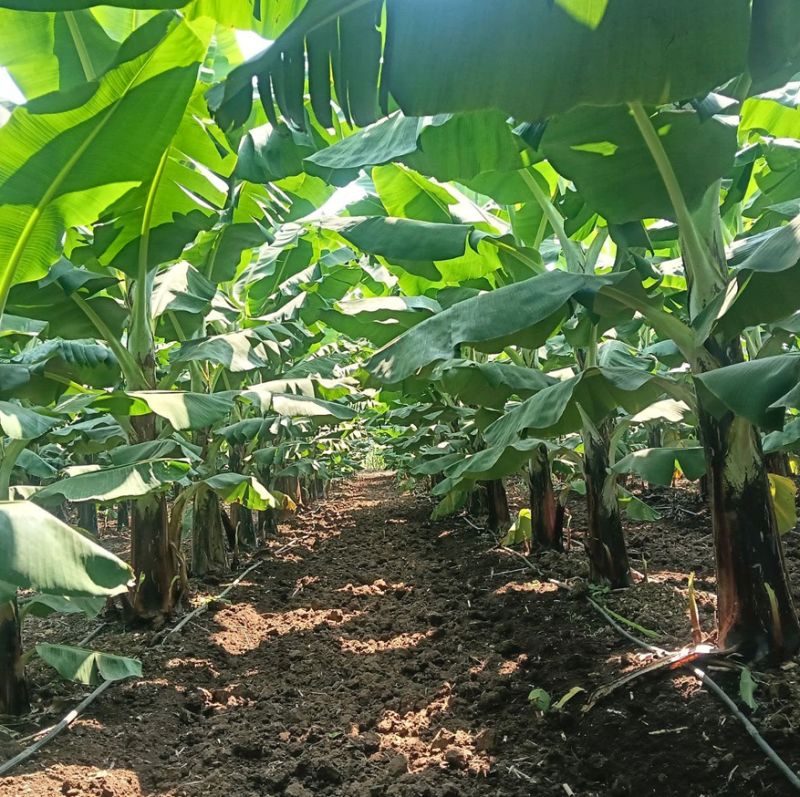
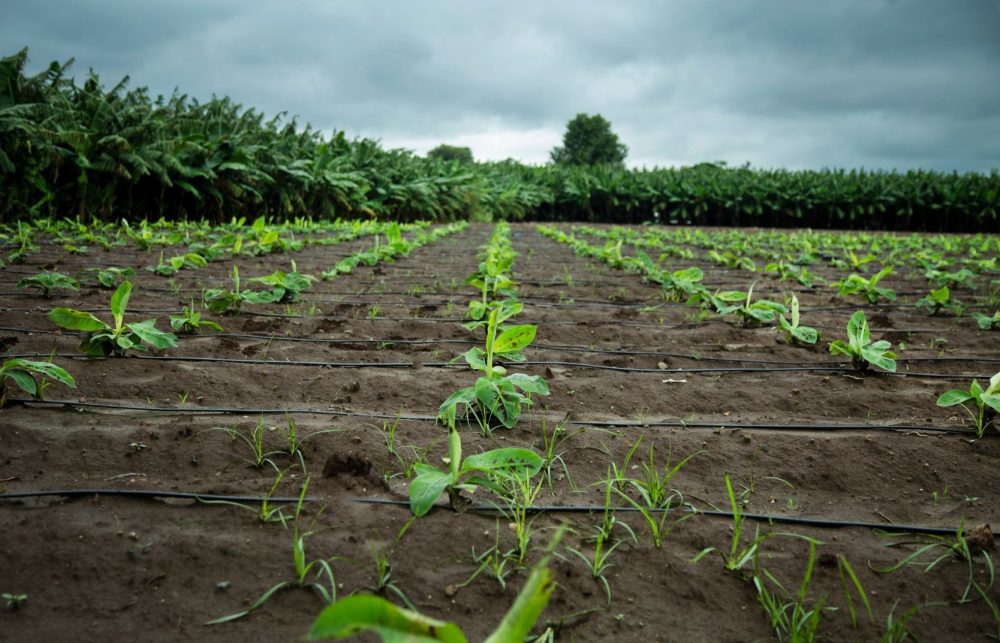
A healthy tissue culture banana farm from Fruit Africa Veriplant Seedlings
Banana Farming in Kenya: Production Figures and Disease Challenges
Banana is one of the main fruit crops on Kenyan farms. The 2026 Economic Survey from the Kenya National Bureau of Statistics (KNBS) puts the area under banana at 80,286 hectares in 2025 and production at 2.1 million tonnes. These are provisional figures, and they average out to about 26 tonnes per hectare across the country. A December 2025 report on a KEPHIS training puts the number of smallholder banana growers above 200,000, mostly in Kisii, Meru, Kirinyaga, Taita Taveta, Embu, Bungoma and Murang’a.
Pests and diseases take a large share of the harvest. The same report puts losses at up to 40 percent. BXW takes up to 100 percent of the yield on a farm where nobody controls the disease. The Principal Secretary for Agriculture, Paul Rono, told The Star in 2024 Fusarium TR4 causes losses of up to 100 percent in infested areas.
Yield tells the same story from the other side. A 2025 study of banana farms in Taveta quotes the national average at 11.8 tonnes per acre against a potential of 35 tonnes per acre. Variety, altitude, water, spacing, soil fertility, pest control and general care all decide where a farm lands between those two numbers. Planting material is the one factor you settle completely on the day you plant, because the seedling or sucker you choose sets the pests and diseases your block starts with.
How Banana Suckers Spread Pests and Diseases
A sucker is a young shoot growing from the base of a mother plant. The shoot shares the corm and the roots of the mother, with everything living in them. A sucker from a clean stool in a field with no disease history carries a low risk. A sucker from a stool with yellowing leaves, tunnels in the corm or a history of wilt carries the problem with the shoot. Looking at a sucker will not tell you which kind you hold, because the fungus, the bacterium, the nematodes and the grubs live inside the corm.
Guidance prepared for the World Banana Forum, hosted on the FAO website, states the rule plainly: never use suckers from plants which show symptoms, even when the suckers look healthy. The same guidance says Fusarium wilt travels over long distances in infected planting material, and the fungus stays alive in the soil for many years once the fungus arrives.
The threats help one another. Nematodes injure the roots and give Fusarium and BXW a way in. A weevil-damaged or nematode-damaged stool gives weak suckers. When a farmer plants the weak suckers in a new block or hands them to a neighbour, the problem moves with them. Years ago the Nation reported a warning from KARI, the former Kenya Agricultural Research Institute, against sourcing suckers from neighbours. The advice still stands today.
Major Banana Diseases and Pests in Kenya
Five threats matter for a new banana block: Fusarium wilt, BXW, nematodes, banana weevils and viruses. Each one reaches a farm through planting material, and each one needs a different response.
Fusarium wilt
Fusarium wilt, also called Panama disease, comes from a fungus living in the soil. The fungus enters through the roots. Older leaves turn yellow, starting at the leaf edges, then brown, dry and collapse. The base of the pseudostem splits and the inside of the stem turns reddish brown. FAO-linked guidance states the hard truth about the disease: once the fungus is in a field, no fungicide or cultural practice gets rid of the fungus. The only real protection is to keep the fungus out and to grow a variety which tolerates the strain present.
Researchers in Kenya have reported Fusarium wilt of the older Race 1 type for years. The Star reported in 2016 Race 1 is endemic, with a higher frequency in the Central region and heavy damage to Apple banana in Meru South. A plant clinic is the place to confirm which strain you face.
Tropical Race 4, known as TR4, is the strain every banana country wants to keep out. FAO says TR4 has no full cure and survives in soil for decades. KEPHIS reported on 17 July 2026 the results of the banana pest surveillance: neither TR4 nor banana bunchy top virus has been detected in Kenya to date. Inspectors and plant health officers collected field data in Taveta, Meru, Embu, Kirinyaga, Bungoma, Kisii and Migori, which KEPHIS describes as major banana-growing regions.
The Star reported in 2024 TR4 had been detected in the Comoros and Mozambique, and the Ministry of Agriculture says eradication is not technically feasible once TR4 arrives, so exclusion is the national strategy. KEPHIS tests imported banana planting material for freedom from TR4 and holds the material in quarantine.
A national result does not clear your farm. Buy planting material from a source you know and report any suspicious symptom to KEPHIS or your county agriculture office. Check the latest official update before you plan around any disease status.
A 2025 study of 329 farms in Taveta found Fusarium wilt on 7 farms and BXW on 3. Most of those farms planted tissue culture seedlings, and the reports of disease were mostly minor.
Banana bacterial wilt
Researchers from Bioversity International and IITA call BXW the most important and widespread disease of banana in East and Central Africa since 2001. The bacterium enters the plant through wounds. Contaminated tools carry the bacterium for up to a week after cutting an infected plant. Insects such as bees and flies carry the bacterium from infected male buds to healthy plants. Infected planting material spreads the disease to new farms. Every banana cultivar is affected, and losses reach 100 percent.
Kenya reported the first cases in 2006 in Teso, Bungoma and Busia. The disease reached Bondo, Siaya, Mumias, Butere and Mount Elgon in 2007. No chemical controls BXW. Clean planting material, tool hygiene and quick action on sick plants do the work, and we cover them in the BXW section below.
Nematodes
Nematodes are microscopic worms which feed on banana roots. A damaged root system takes up less water and fewer nutrients, and the plant weakens and falls over under a heavy bunch. A national survey across 13 banana-growing districts found Pratylenchus goodeyi as the most common species, Pratylenchus coffeae common in Murang’a, and Radopholus similis limited to Oyugis and Homa Bay.
A 2026 study in Kirinyaga County sampled soil and roots in four agro-ecological zones. Most surveyed farmers practised mixed cropping and did not know about toppling disease. Radopholus was rare in the lower zones, and Pratylenchus showed up mainly in the upper zones. Species differ by zone, so the species on your farm decides the advice you need.
Banana weevils
Banana weevil grubs tunnel through the corm. They weaken the stool and plants fall in wind or under a heavy bunch. A trial in western Kenya, run from 1994 to 1997 and reported by Lucas Ngode in 2012, compared planting materials. The table shows what happened.
| Planting material in the trial | Damage score | Bunch weight | Yield loss |
|---|---|---|---|
| Healthy suckers | 16.3 percent over three crop cycles | 15.3 kg | Reference |
| Suckers protected with an insecticide | 12.6 percent | 14.5 kg | 8.3 percent |
| Infested suckers, pared and hot-water treated | 17.6 percent | 13.3 kg | 16.6 percent |
| Infested suckers, untreated | 66 percent | 6.8 kg | 53.1 percent |
Untreated infested suckers lost 53.1 percent of the yield, and the bunch weight fell by 8.5 kg, from 15.3 kg to 6.8 kg. Paring and hot-water treatment helped a great deal, and the treated suckers still lost 16.6 percent. They did not match plants from healthy material. A clean start is the first line of defence against weevils.
Banana viruses
Banana streak virus and banana bunchy top virus (BBTV) travel in planting material. The Standard reported in 2016 conventional suckers spread both viruses, and properly indexed tissue culture plantlets are expected to be free of them. Indexing means the laboratory tests the mother plant for viruses before multiplying the plant. KEPHIS reported in July 2026 BBTV has not been detected in Kenya. Planting material moves viruses between farms, so ask every nursery whether the laboratory indexes the mother plants.
How to tell the threats apart
Several threats occur on one farm and the signs overlap. Use the table to narrow the cause, then confirm before you uproot anything.
| What you see | Points to |
|---|---|
| Older leaves yellow and droop like a skirt, the pseudostem splits, and the cut stem shows reddish-brown streaks | Fusarium wilt |
| Male bud dries and turns black, fingers ripen early and rot, and a cut stem shows yellow or brown ooze | BXW |
| Plants topple at fruiting, with poor roots | Burrowing nematodes, among other causes |
| Tunnels in the corm and a stool weakening from the base | Banana weevil |
A plant clinic or your county agricultural officer confirms the cause. Confirmation saves you from two costly errors: uprooting a healthy block, and treating the wrong disease for a whole season.
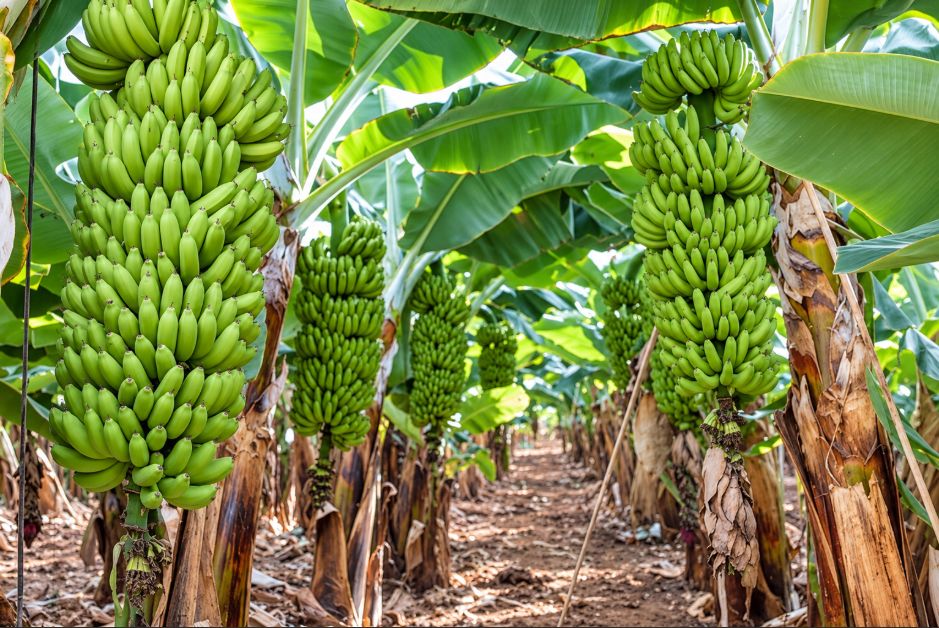
Tissue Culture Banana Farming in Kenya
Banana Regions of Kenya and the Risks Each Region Faces
Banana grows from the lake basin to the slopes of Mount Kenya and into the irrigated lowlands of Taita Taveta. The risks change with the region, so a farmer in Bungoma needs a different watch list from a farmer in Kirinyaga.
Western Kenya met BXW first. The first cases came in 2006 in Teso, Bungoma and Busia, and the disease reached Bondo, Siaya, Mumias, Butere and Mount Elgon in 2007. Tools, male buds and suckers from other farms carry the bacterium, so the BXW rules matter most here. Use a forked stick for the male bud, put bleach on every tool and take no suckers from strangers.
Central Kenya faces Fusarium wilt and nematodes together. Fusarium wilt of the Race 1 type is endemic in Kenya, with a higher frequency in the Central region. Pratylenchus coffeae is common in Murang’a. In Kirinyaga, a 2026 study found Radopholus rare in the lower zones and Pratylenchus mainly in the upper zones, and most farmers surveyed did not know about toppling disease. If you farm in Murang’a or Kirinyaga, sample the roots before you replant, fix drainage and pH, and ask a plant clinic which nematode species lives on your land.
Meru and Embu sit in the area KEPHIS surveyed in July 2026. Fusarium wilt has done heavy damage to Apple banana in Meru South. Avoid the highly susceptible types on old banana ground, and confirm any wilt with a plant clinic before you name the strain.
Kisii and Migori also fall inside the KEPHIS surveillance area, and Kisii is among the main banana counties. Where many small farms sit close together, one infected stool endangers many neighbours. Agree on the same tool and planting rules with the farmers around you.
Taita Taveta is the irrigated example. Most farms in the 2025 Taveta study irrigated, and Grand Nain dominates the plantings. The study recorded Fusarium wilt on 7 of 329 farms and BXW on 3. Good water and a clean start work well together, and neither replaces hygiene in the field.
Banana Varieties and Their Response to Fusarium Wilt
Kenyan research bodies rate banana varieties against Fusarium wilt in different words. KALRO’s Fusarium wilt factsheet lists Giant Cavendish, Lacatan and FHIA hybrids as resistant, and rates Apple banana and the Gros Michel and Kampala types as highly susceptible. The pamphlet on commercial dessert varieties adds the details in the table.
| Variety | Response to Fusarium wilt | Months to bunch |
|---|---|---|
| Grand Nain | Not stated in the pamphlet | 18 to 22 months |
| Williams | Resistance to Fusarium races 1 and 2 | 18 to 24 months |
| Giant Cavendish | Resistant in the factsheet, tolerant to Panama disease in the pamphlet | 18 to 24 months |
| Dwarf Cavendish, also called Lakatan | Resistance to Fusarium wilt and wind damage | 18 to 24 months |
| Valery | Tolerant to Panama wilt | 18 to 24 months |
| Apple banana, Gros Michel, Kampala types | Highly susceptible | Not stated |
The Ministry of Agriculture training material for model farmer groups also lists Giant Cavendish and Chinese Dwarf as resistant to Fusarium wilt.
Every rating above describes the Fusarium wilt now present in Kenya. None of the ratings speaks for TR4, and a variety which tolerates Race 1 gives you no promise against a new strain. Grand Nain, the variety most Taveta farmers planted, has no Fusarium rating in the pamphlet, so ask your county agricultural officer before you plant a large Grand Nain block on land with a wilt history.
Choosing a variety
Ask your buyer first. A banana nobody buys is a poor investment, whatever the disease record. After the market, match the variety to your altitude, your water and your field history.
Grand Nain is the main variety in the Taveta programme, where 96.6 percent of the seedlings were Grand Nain. The pamphlet calls the variety early-maturing and high-yielding, and the Ministry training material says Grand Nain needs propping. Williams gives large bunches with good flavour, aroma and taste when ripe, though the ripe fruit keeps for a short time. Giant Cavendish tolerates drought and needs propping, and the pamphlet says the variety is susceptible to black Sigatoka. Dwarf Cavendish stands about 2 metres tall and resists wind damage. Valery is tall with a strong pseudostem. The Taveta study also lists Kimalindi and Kingurue among the tissue culture varieties farmers plant.
Five Benefits of Tissue Culture Banana Seedlings
Each benefit below removes one way in which suckers bring trouble into a banana block. Each benefit holds only when the laboratory and the hardening nursery work to a good standard, which is why the buying advice later in this article matters.
Benefit 1: The Fusarium fungus and the BXW bacterium stay out of the planting hole
Banana is propagated from pieces of the plant, so any disease in the mother plant travels with the planting material. This is why FAO-linked guidance asks growers to use clean planting material, preferably from disease-free certified plants. The Fusarium factsheet lists tissue culture and clean suckers as disease-free planting materials. A study of Kenyan tissue culture projects reports the plants are free of BXW when they reach the farmer.
Keeping the fungus out costs far less than removing the fungus, because nothing removes the fungus once the fungus is in the soil. This is the same logic behind the national policy on TR4. The Ministry says eradication is not technically feasible, so Kenya relies on keeping the strain out. On your own farm, a clean seedling in a clean field is the farm-sized version of the same policy.
Benefit 2: Nematodes and weevils stay behind
Nematodes live in banana roots and corm tissue, and weevil grubs tunnel in the corm. An infested sucker carries both to your new block. A tissue culture seedling starts with a clean root system and a corm free of grubs. The roots then grow in your soil. Where the soil holds no banana nematodes, the plant stays clean for years. Where the soil holds them, the seedling meets them from the soil and no longer from the planting material. For this reason we advise a root and soil test before you replant a block where bananas yellowed, toppled or died.
The weevil trial in western Kenya shows the size of the effect. Untreated infested suckers lost 53.1 percent of the yield, against healthy suckers as the reference. A clean seedling removes this risk on planting day.
Benefit 3: You know the virus status of the plant
Indexing is the laboratory test of a mother plant for viruses before the laboratory multiplies the plant. When a laboratory indexes the mother plants, the plantlets start free of the viruses tested. A sucker has no such test behind the shoot. Ask the nursery for the laboratory’s indexing practice in writing.
Benefit 4: A uniform stand is easier to manage and to sell
A laboratory multiplies one chosen mother plant many times, so you receive plants of one variety, one age and one size. A uniform block is easier to water, feed, desucker and harvest on a schedule. A buyer who wants a fixed weekly volume also prefers fruit which ripens in step. The Taveta programme supplied farmers with 476,035 tissue culture seedlings, and nearly all of them were one variety.
Benefit 5: A paper trail from the laboratory to your block
A sucker from a neighbour has no record. A tissue culture seedling from a good nursery comes with a laboratory name, a variety, a batch number and an invoice. The paper trail matters when something goes wrong. A batch record lets you and the nursery check whether other farmers received plants from the same batch, and the laboratory name lets KEPHIS or your county office follow a problem back to the source. Write the variety, the batch, the supplier and the planting date for every plot in one farm notebook. The habit costs nothing and protects you for the life of the block.
What Tissue Culture Seedlings Do Not Prevent
Honest advice includes the limits, and a farmer who knows the limits blames the soil and the hygiene instead of the seedling.
The seedling has no resistance. A study of Kenyan tissue culture projects says tissue culture plants are clean when they leave the flask but not resistant, and pests and diseases infect them easily in infested soil. The seedling is also fragile and needs hardening and careful handling in the first weeks. A seedling costs more than a sucker, and farmers in Taveta reported KSh 90 to 150 each in 2025.
Quality varies from one nursery to another. The same study notes off-types and accidental mixtures of varieties, which is why the nursery you choose matters as much as the seedling. Supply is short, and the study names lack of supply as the main reason farmers do not use plantlets. Inputs still decide the yield, because farmers with little money apply too little fertiliser and the harvest stays low. Location matters as well. The study found tissue culture profitable for farmers near an urban market and not for remote farmers.
Farmers also drift back to suckers. Mbaka and colleagues reported in 2008 many farmers who had adopted tissue culture went back to suckers from their own farm or a neighbour’s, and most Kenyan farmers still plant suckers today.
Once a tissue culture banana plant matures, the plant produces ordinary suckers. These suckers do not keep the laboratory-clean status when the mother plant has picked up pests or diseases in the field. A second block planted from the first block’s suckers repeats the old risk and carries whatever the first block met in the soil. Buy fresh seedlings for every new block.
Tissue Culture Seedlings Versus Conventional Suckers
A seedling from a good laboratory starts free of the fungal and bacterial pathogens tested, free of nematodes and grubs, and free of the viruses tested when the mother plant is indexed. A sucker carries a risk whenever the mother stool is infected or infested. Neither one carries resistance once planted in the field. The seedling costs KSh 90 to 150, the sucker costs little or nothing, and the seedling comes with a laboratory name, a batch and an invoice while the sucker usually comes with none.
Tissue culture is not the only clean-start method. IITA also promotes macropropagation, where farmers raise plantlets from pieces of stem in humidity chambers built from local materials. IITA describes boiling water treatment of suckers as a simple and effective way to sanitise locally propagated material. The western Kenya weevil trial shows what this treatment achieves: treated suckers lost 16.6 percent of the yield against 53.1 percent for untreated ones, and healthy planting material remained the better start. When seedlings are out of reach, treated suckers from a healthy stool beat untreated suckers by a wide margin.
From the Laboratory to the Hardening Nursery: What You Pay For
Knowing what happens before a seedling reaches your farm helps you judge a quotation. The process starts with a chosen mother plant. A good laboratory tests the mother plant for viruses, which is the indexing described earlier. Staff then cut a tiny piece of growing tissue and place the piece on a sterile growth medium. Under controlled light and temperature the tissue grows into a cluster of shoots. Staff divide the cluster and repeat the step many times, and healthy shoots move on to a rooting stage. All of this happens under sterile conditions, because one contaminated flask loses the whole batch.
A rooted plantlet is not ready for open air. The plantlet has never faced dry air, strong light or ordinary soil. Hardening is the stage which trains the plantlet for life outside the flask. The nursery moves plantlets into a sterilised medium and keeps them in shade with high humidity. Staff then bring the plants step by step into brighter light and drier air. A good nursery inspects the plants, sorts them by size and strength, and releases only the sturdy ones. The Ministry of Agriculture training material sets the target at about 30 cm in height with at least five healthy leaves.
The price you pay covers the sterile laboratory work, the virus indexing, the hardening space and labour, the inspection and the batch records. A hardened seedling costs more than a non-hardened one, and the extra money buys weeks of nursery care you otherwise give yourself. A price far below the usual KSh 90 to 150 deserves a direct question about which step the seller skipped.
Fusarium Wilt Control for Bananas in Kenya
A clean seedling needs a clean field. Fusarium wilt control for bananas in Kenya rests on prevention, because nothing cures a field once the fungus arrives. We arrange the advice by stage.
A soil test does not prove a field is free of Fusarium
Test your soil before planting, because the result guides your lime and fertiliser. A soil fertility test measures properties such as pH and nutrient levels. The test does not tell you whether the Fusarium fungus is present. Only a plant health diagnostic service, such as a plant clinic or a KEPHIS office, confirms the disease, and the confirmation comes from plants showing symptoms. When the factsheet says to plant on a clean field with no disease history, the words mean a field with no known history of the disease. Ask the previous owner, the neighbours and your county agriculture office what grew on the land and whether plants wilted.
Before planting
Choose a field with no known history of banana wilt and rotate crops before you establish a new orchard. Pick a variety using the ratings above. Fix drainage first, because the factsheet says warm moist soil, poor drainage, poor aeration and low pH favour the fungus, while higher pH and well-drained, aerated soil work against the fungus. Lime on the advice of your soil test.
Water carries the fungus. Surface run-off from a diseased area spreads Fusarium spores, so dig trenches to divert run-off away from the new block. FAO-linked guidance adds a rule many farmers skip: clean soil and debris from boots, vehicles and tools before they enter any farm, including your own. Spores ride on a shovel, a knife or a ladder as easily as on a sucker.
Disinfect tools before they enter the new block and after any work in an infected patch. Dip them for one minute in household bleach mixed at one part bleach to five parts water, the mix the BXW factsheet gives. Methylated spirit also works. Avoid formalin, which is hazardous to handle.
At planting
Plant clean tissue culture seedlings from a nursery whose laboratory you know. Do not mix seedlings with suckers from another farm in one block. Do not bring soil, banana trash or manure from a diseased farm. Plant in the cool of the day, water well and mulch.
After planting
Walk the block every week and look at the lower leaves, because yellowing on the lower leaves is the first sign of Fusarium wilt. Avoid injuring the roots, the corm and the base of the plant when you weed, because injuries give the fungus a way in. Send samples of suspect plants to a plant clinic and wait for the result before you act on a guess.
When a stool is confirmed, remove the whole stool with the roots, and never take suckers from a plant showing symptoms. The factsheet advises drying the removed material on the surface and then burying or burning the material. Burn plant material only and never plastic, away from healthy stools and within the rules of your county. Ask your agricultural officer for the right method in your area before you start. Disinfect your tools after the work. Keep people, boots and run-off from carrying soil from the sick patch into the healthy block. After an outbreak, do not replant susceptible varieties on the same ground.
What about fungicides and Trichoderma?
Be careful with products. The factsheet lists Trichoderma-based products and fungicide dips for planting material as support measures at planting. No product removes the fungus from soil, so no product replaces clean seedlings, good drainage and hygiene. A laboratory seedling usually has no need of a dip. Ask your agricultural officer whether your field history calls for one, buy only products registered with the Pest Control Products Board, and follow the label.
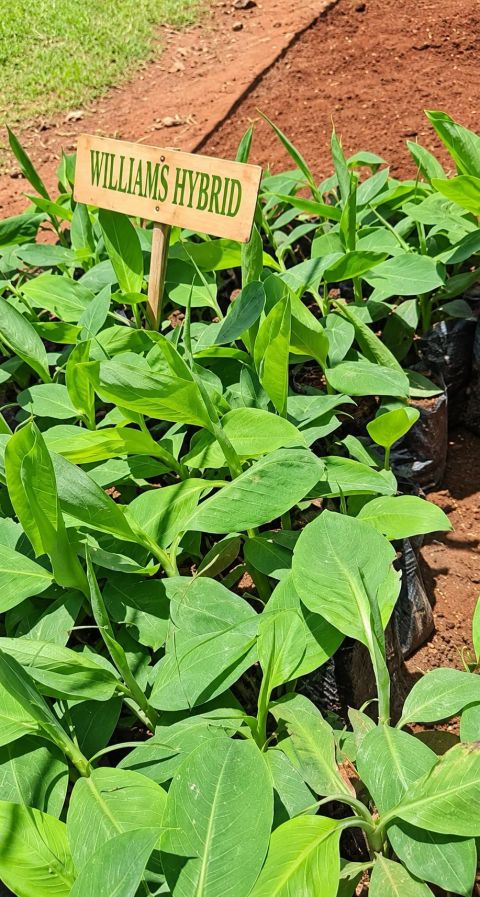
Tissue Culture Seedlings at Fruit Africa Veriplant
Banana Bacterial Wilt in Kenya: Keeping BXW Out of the Block
BXW has a separate cause and separate controls from Fusarium wilt, so we treat BXW separately. Both diseases share two rules, clean planting material and clean tools. After these two rules the diseases part ways. No chemical controls BXW, so hygiene and quick action carry the whole job.
Start with clean planting material and respect quarantine. Do not buy suckers from traders and do not move planting material between regions, because banana trade from western Kenya has been a route into central and eastern Kenya. Use tissue culture seedlings from a traceable source.
Remove the male bud. Insects visit the male bud and carry the bacterium from plant to plant, and Bioversity and IITA researchers report early removal with a forked stick, never a knife, proved highly effective in preventing the disease. Remove the bud early.
Disinfect every tool. Contaminated tools carry the bacterium for up to a week. Bioversity and IITA researchers found household bleach the most effective disinfectant, and the BXW factsheet gives one part bleach to five parts water. Dip the knife, the panga and the pruner between plants, not only between fields.
Remove sick plants quickly. Symptoms usually show within about three weeks of infection, and faster in the wet season and in young plants, so a weekly walk catches the first sick plant. The researchers describe two ways to deal with a sick mat. Uprooting the whole mat takes one person about a day for two mats, and lateral shoots keep coming up, so most farmers did not adopt the method. Single diseased stem removal means cutting only the visibly diseased pseudostems at soil level.
The method takes far less labour and lowers the amount of bacteria in the field over time. At least one field in Uganda, one in Kenya and one in eastern DR Congo recovered from moderate and heavy infection with the method. The method works only alongside prevention of new infections. Infection hides in lateral shoots for up to 24 months before symptoms show, so keep watching the mat for years. The bacterium survives less than 35 days in soil or plant debris, so chop the debris and heap the pieces at the edge of the field, or bury or burn the pieces as the factsheet advises. Ask your agricultural officer which method suits your area.
Rest the soil before you replant. The Bioversity and IITA review recommends a fallow of about six months, and says the bacterium survives for less than 35 days in soil or plant debris. In one Ugandan study, plants put into a field after a one-month fallow survived at a rate of 25 percent, against 100 percent after seven months.
Act together. Control works best as a package applied across whole villages. In Uganda about 85 percent of farmers learned to recognise BXW after awareness campaigns, and only about 30 percent applied the controls. Farmer field schools of up to 30 farmers have taught the controls, and the researchers link thorough community action to a sharp fall in disease. Talk to your neighbours, because their tools and their suckers are as much your problem as your own.
Farm Gate Rules to Protect a Clean Block
Disease reaches a clean block on boots, tools, vehicles and hands as often as on plants. The World Banana Forum guidance names infected planting material, boots, vehicles and tools as the ways Fusarium wilt travels. Make your farm gate the first line of defence.
Keep a separate set of tools for the new block and paint the handles a colour nobody uses elsewhere. Never lend these tools to a neighbour and never borrow tools in return. Wash boots and wheels at the entrance. Ask workers who farm elsewhere to wash their boots before they walk in, and ask visitors, traders and extension staff to follow the same rule.
Accept no soil, banana trash, manure or suckers from outside the block. Give no suckers away either. A stool of yours which carries a hidden problem passes the problem to a neighbour, and the neighbour’s problem returns to you through the next trade.
Brief every worker on the male bud rule and the bleach dip. Knowing a rule is not enough, so supervise the work in the first seasons until the bleach dip becomes a habit.
Receive new seedlings at one place, check them against the delivery record and look at the roots before you plant. Keep a short written log of visitors, deliveries and tool use. The log costs a few minutes a week and shows you where a problem entered if one appears.
Replanting After a Wilt Outbreak
A confirmed outbreak changes the plan for the field. The right response depends on the disease.
After BXW, remove the diseased plants, destroy the debris and rest the ground for about six months, as the BXW section above explains. Do not shorten the rest, because a field replanted early loses plants. Keep watching the mats for two years and replant with clean seedlings only.
After Fusarium wilt, treat the field as infected for a long time. The World Banana Forum guidance says the fungus survives in the soil for many years, perhaps indefinitely, and advises growers not to replant susceptible varieties on the same ground. If you replant bananas on infected land, ask a plant clinic or your county agricultural officer about a variety with a Fusarium rating for your zone. A rating for the present Kenyan strain gives no promise against TR4. Keep the tool and boot rules above in force so the sick patch does not spread to the rest of your farm.
In both cases, never take suckers from the healthy-looking stools beside the sick patch. Those stools are the ones most likely to carry the disease unseen.
Banana Nematode Control and Banana Weevil Management
The seedling starts clean, while the soil and the neighbours stay as they are. Four habits keep the block in good shape.
Banana nematode control
Sample soil and roots before replanting an old banana block and ask the plant clinic for the nematode species. Radopholus, Pratylenchus and the other genera differ in damage and in distribution, and a generic nematode label gives you little to act on. Do not buy a nematicide before you know the species and have checked the Pest Control Products Board register and the label. Taveta farmers in the 2025 study used about 10 kg of decomposed manure or compost in each planting hole, and some added a nematicide at planting. We do not recommend a product here.
Banana weevil management
Clean planting material is the first step. Keep crop residue tidy, because the grubs live in old stumps and trash. Set split pseudostem traps early. The western Kenya trial found traps work best when weevil numbers are low and less well where infestation is already high. Check the base of mats for tunnels. A trapping routine costs little and gives you an early count of adult weevils in the block. The Taveta study links frequent weevil reports to poor field sanitation and inadequate monitoring.
Feed the soil, and watch the manure
The weevil trial found manure improved banana performance, and heavy bunches then need support because corms weaken and stems snap. Use well-decomposed manure. Avoid any material contaminated with infected banana residue or soil from a diseased farm, because a bag of manure moves a pathogen as easily as a sucker. Ask the seller where the manure came from and mix the manure with topsoil in the planting hole.
Tissue Culture Banana Farming Costs Per Acre in Kenya
A tissue culture seedling costs more than a free sucker, so count the cost before you plant. The seedling bill is one line in the cost of an acre. We start there, then look at what a bunch earns and what a bad start costs, and we end with the other lines you must price.
The seedling bill for an acre
Farmers in the 2025 Taveta study paid KSh 90 to 150 for a tissue culture seedling. Hardened seedlings from a university laboratory sold at KSh 130, and lead farmers sold hardened seedlings at KSh 150. The Kenya Year Book reports a similar range of KSh 100 to 150. The same study lists how many plants an acre holds at each spacing, counting an acre as 4,000 square metres. The table gives the seedling bill at three prices.
| Spacing | Plants per acre | At KSh 90 | At KSh 130 | At KSh 150 |
|---|---|---|---|---|
| 2 by 2 metres | 1,000 | KSh 90,000 | KSh 130,000 | KSh 150,000 |
| 3 by 3 metres | 444 | KSh 39,960 | KSh 57,720 | KSh 66,600 |
| 4 by 3 metres | 333 | KSh 29,970 | KSh 43,290 | KSh 49,950 |
| 4 by 4 metres | 250 | KSh 22,500 | KSh 32,500 | KSh 37,500 |
Add an allowance for replacing dead plants in the first months. The plant counts use an acre of 4,000 square metres and leave out paths, drains and windbreaks, so a real plot holds fewer plants. Order the count from your own plot map and not from the table.
Wider spacing lowers the seedling bill and the number of bunches too, so pick the spacing for your variety, your soil and your market. The 2 by 2 metre spacing comes from a high-density trial in Taveta, and the study found significant yield differences between this spacing and the wider ones. High density increases the competition for water, nutrients and light, and the spacing does not suit every variety or every location.
How much revenue does one banana bunch generate?
Take KSh 10 per kg as a working farm-gate price. A 15.3 kg bunch brings about KSh 153, and a 6.8 kg bunch brings about KSh 68. One Murang’a farmer quoted KSh 200 a bunch in December 2025. Your own price depends on county, season, buyer and bunch size, so ask a trader for a written price before you plan.
Against a seedling price of KSh 150, one good bunch pays back the plant in sales. A weevil-damaged bunch of 6.8 kg does not. These are revenue figures and not profit. Land preparation, manure, fertiliser, water, labour, crop protection, harvesting and transport all come out of the sales before you count anything as profit.
What a bad start costs: an illustration
Return to the western Kenya weevil trial of 1994 to 1997. Take an acre of 444 plants at 3 by 3 metres, and assume every plant gives one bunch at the trial weight. Healthy planting material gives about 6,793 kg of fruit, worth about KSh 67,900 at KSh 10 per kg. Untreated infested planting material gives about 3,019 kg, worth about KSh 30,200. The gap is about 3,774 kg, or about KSh 37,700 of lost sales in one crop.
This is close to the KSh 39,960 seedling bill for the same acre at KSh 90 per plant. Your own bunch weights and prices will differ, because variety, zone and season change both. The lesson holds on any farm: a bad start costs a crop, and a crop costs about as much as the seedlings you tried to save.
What the Taveta yield gain means in shillings: an illustration
The Taveta programme raised yield from about 18.59 to 23.56 tonnes per acre, a gain of 4.97 tonnes. At the working price of KSh 10 per kg, a gain of 4.97 tonnes equals about KSh 49,700 of extra gross sales on an acre. The seedling bill for 444 plants is KSh 39,960 at KSh 90 and KSh 66,600 at KSh 150. On these numbers the extra sales cover the seedling bill in about one year at the low price and about one year and four months at the high price.
Treat this as an illustration and not as a forecast. The programme paid for training, credit and buyers as well as seedlings, so the yield gain belongs to the whole package. The figures are gross sales, and they leave out land preparation, manure, labour, water, harvest and transport. Your own yield and price will differ.
The other lines in your budget
Price every line before you buy a single plant. Land preparation and holes of about 60 cm, as Taveta farmers dig them. Seedlings and an allowance for replacements. About 10 kg of decomposed manure or compost for each hole. Lime and fertiliser from your soil test. Water, with the equipment, fuel or power and labour. Mulch and props for heavy bunches. Traps, tool disinfectant and plant clinic samples. Labour for weeding and desuckering through the first year. Harvest labour, transport and any fee your buyer or cooperative charges. Write each cost in your farm notebook next to a quotation from a local supplier.
What a failed stool costs
A diseased plant costs you the seedling, the manure, a season of labour, the bunch and the delay of a replacement. A diseased stool also threatens the stools beside the stool. A single plant with Fusarium wilt or BXW costs more than the plant, because the whole stool must be removed and BXW spreads from plant to plant. Put a clean start and a field plan ahead of every other input.
Choosing a Reliable Tissue Culture Banana Nursery
A clean start is only as clean as the seller. Kenya’s Crops (Horticultural Crops) Regulations require nursery operators to sell planting materials certified by KEPHIS. The regulations also provide for the registration of nurseries and set requirements for nurseries which supply planting material to the export market.
Two terms need care. KEPHIS-certified planting material describes the plants and the batch you buy. A registered nursery describes the operator. Some sellers hold one and not the other, so do not accept “certified nursery” as a loose substitute for “KEPHIS-certified planting material”. Ask for evidence of both.
Questions to ask every seller
Ask for the name and location of the tissue culture laboratory which produced the plantlets, and write the name in your farm file. Ask to see evidence of KEPHIS certification of the planting material, and keep a copy. Ask for the nursery’s registration details and keep a copy of those too.
Ask for the variety and the batch number, and make sure both appear on your invoice. Off-types and mixed varieties occur in tissue culture, so the batch number is your protection. Ask for a purchase invoice and a delivery record, because these two documents trace the plants to your plot.
Ask how long the plants were hardened, in what medium, and who inspected them for plant health before dispatch. Hardened seedlings cost more than non-hardened ones, and they save you the hardening work. Ask whether the laboratory indexes the mother plants for viruses.
Look at a plant out of the bag. A sound plant has a healthy root ball with no rot and no tunnelling. The Ministry of Agriculture training material says to transplant tissue culture seedlings when they stand about 30 cm tall and carry at least five healthy leaves, so use the size as a check at delivery. Keep the plants in shade, water them and plant soon after delivery.
Finally, agree the price, the delivery date and the replacement rule for dead seedlings in writing before you pay. A plant with no laboratory, no batch and no invoice is, for your purposes, a sucker with a better price.
Keep a farm file
Keep the quotation, the invoice, the copy of the KEPHIS certification evidence, the nursery registration details, the batch and delivery record, a plot map with the planting date, and every plant clinic report in one folder. If a problem appears in year two, the folder tells you and the nursery where to look first.
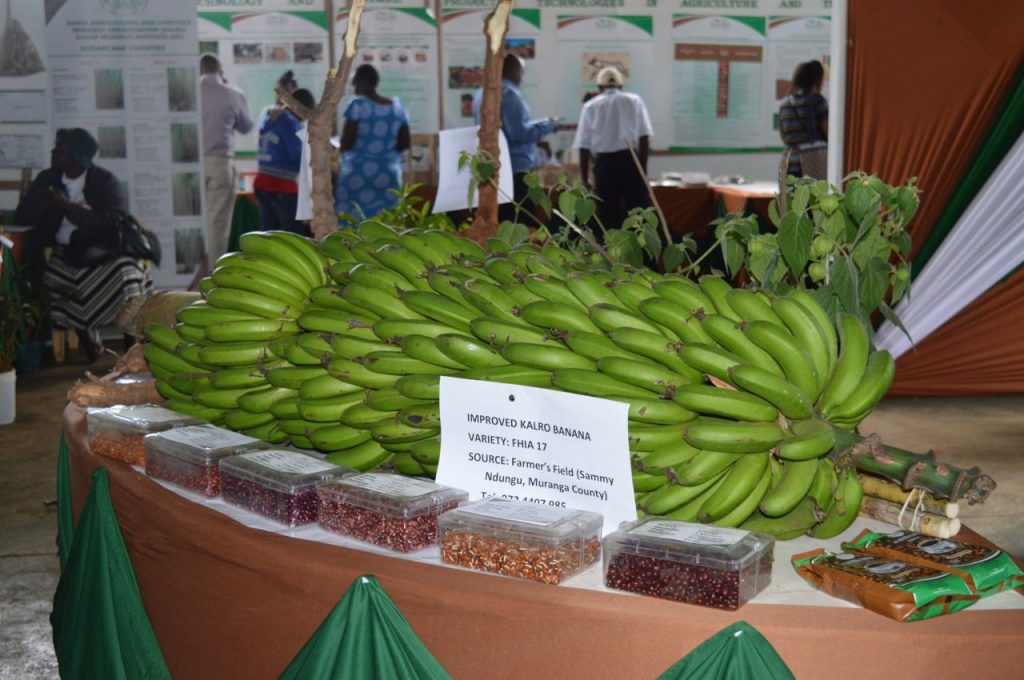
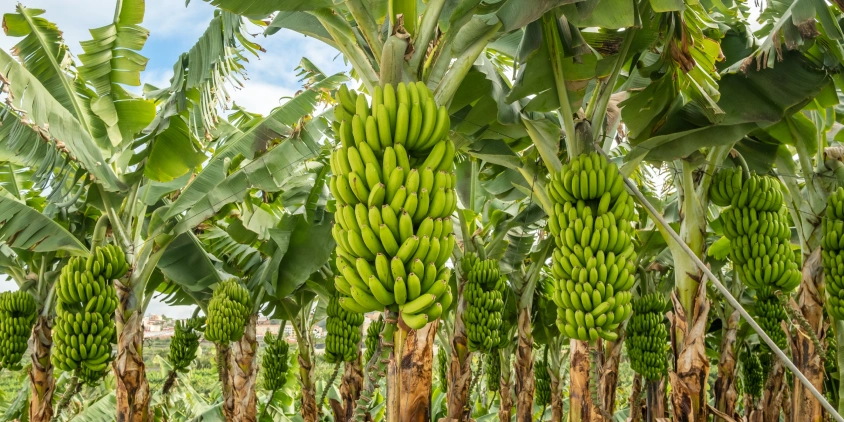
A tissue culture banana bunch
Who to Call: KEPHIS, Plant Clinics and Your County Office
Four offices help a banana farmer, and each office does a different job. Knowing the job of each office saves you weeks.
KEPHIS certifies planting material, inspects nurseries and runs the national surveillance for pests such as TR4 and banana bunchy top virus. Report any suspicious symptom to KEPHIS, and ask KEPHIS about the certification of a batch you plan to buy.
Your county agriculture office gives extension advice, knows the disease history of your ward and holds the current rules of the county. Ask the officer about the varieties which do well in your zone, the planting seasons and the correct way to dispose of diseased plants.
A plant clinic or a plant health diagnostic service confirms what is wrong with a plant. Take fresh samples from plants which show symptoms and write down the date, the variety, the batch and the field. The Pest Control Products Board registers pest control products, so check the register before you buy any chemical or biological product.
Carry a short list of questions when you visit. Ask which wilt diseases the officer has seen in your ward in the last two years. Ask which varieties the officer recommends for your altitude and water. Ask where the nearest plant clinic is and how long a result takes. Ask which nurseries in your area hold current registration and supply KEPHIS-certified planting material. Write the answers in your farm file with the date and the name of the officer.
Site, Water and Soil for a New Banana Block
Choose the site before you order seedlings. Banana needs steady moisture and good drainage together, and the combination is hard to find on poor land. Pick ground where water drains away after rain and does not stand around the stools. The Fusarium factsheet names poor drainage and poor aeration among the conditions which favour the fungus.
Secure the water before you plant. Most farms in the Taveta study irrigated at every spacing. Whatever your source, a dry spell in the first months costs you plants. Ask an agronomist about the water if you draw from a stream which runs through other banana farms.
Think about wind. A banana plant carrying a heavy bunch topples in a strong wind. Plant a windbreak on exposed ground and prop tall varieties. Short varieties such as Dwarf Cavendish, which the pamphlet describes as resistant to wind damage, suit exposed sites better than tall ones.
Test the soil for pH and nutrients and follow the lime and fertiliser advice. Look at the road too. A buyer collects fruit from a block which lorries reach in all weather, and a study of Kenyan tissue culture projects found the plants profitable for farmers near an urban market and not for remote farmers. Last, check the history of the field and the neighbouring fields. A clean seedling next to an infected block starts under pressure from the first day.
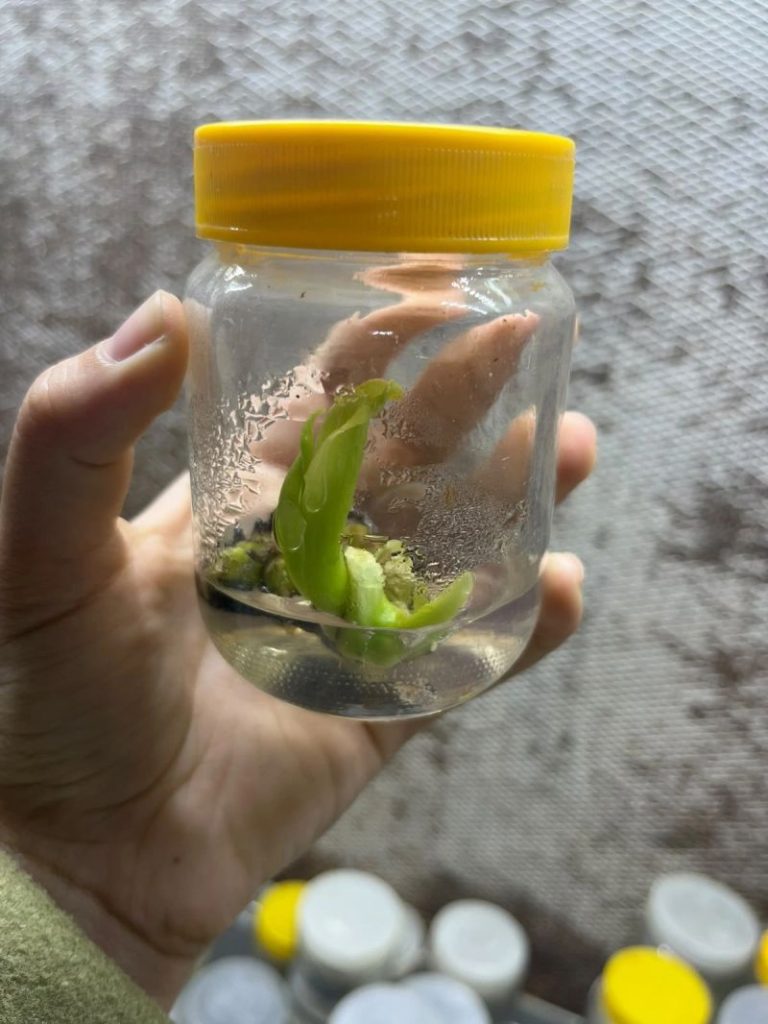
Emergence of new green shoots in banana plants during the multiplication stage using plant tissue culture techniques
Banana Seedling Spacing, Varieties and First-Year Management
Banana seedling spacing
The Ministry training material for model farmer groups ties spacing to the height of the variety. Tall varieties go at 4 by 4 metres, which is 250 plants per acre. Medium varieties go at 3 by 4 metres, and short varieties at 3 by 3 metres. The Taveta study tested a high-density spacing of 2 by 2 metres against wider ones. The right spacing depends on the variety, the soil, the water and the market, so settle the spacing with an agronomist before you order seedlings.
Planting practice
Plant at the onset of the rains where you grow rain-fed bananas. Taveta farmers dug holes of 60 cm each way and filled each hole with about 10 kg of decomposed manure or compost, and most irrigated at every spacing. The Ministry material says to plant seedlings about 30 cm deep for anchorage and to apply heavy mulch. Use well-decomposed manure from a farm free of banana disease and mix the manure with topsoil. Keep the soil moist and the drainage good.
When to plant
Plant at the start of a rainy season where you grow rain-fed bananas. Much of Kenya has long rains which start in March and short rains which start in October, and your county agricultural officer knows the pattern for your zone. Dig the holes and bring in the manure before the first rains, so the seedlings go into the ground within days of delivery. An irrigated block takes seedlings in any month, and you still avoid the hottest dry weeks, because a young plant loses water faster than the roots take water up.
Book seedlings early. A nursery hardens plantlets in batches, so a late order often means a late delivery, and a late delivery means a missed rainy season. Agree the delivery date with the nursery in writing and prepare the field to match the date.
Receiving and holding seedlings
Mark the rows and dig the holes before the seedlings arrive. A seedling which waits hours in shade does well, and a seedling which waits days in the heat does not. Unpack the plants as soon as they reach you, check the roots and the leaves against the batch record, and stand the plants in the shade. Water them lightly and never stack the bags or leave the plants in the back of a vehicle in the sun.
Reject a plant with rotting roots, tunnels in the corm or yellow, collapsing leaves, and write down the batch number and the reason. Plant the rest in the cool of the day. The Ministry of Agriculture training material sets the transplant size at about 30 cm in height with at least five healthy leaves, so a much smaller plant needs more time in the nursery.
Intercropping in the young block
A young banana block leaves bare ground between the stools for the first months. In Taveta, farmers who intercropped with beans, maize and vegetables earned an additional 45 percent from sales, according to The Star. The extra income helps you carry the block until the first bunch.
Keep the intercrop away from the base of the banana plants and dig with care, because a cut in the root or the corm is an entry point for disease. Use clean tools in the intercrop, as you do in the bananas, and never bring crop residue or manure from a banana farm with a disease record. Pull out the intercrop once the banana canopy closes and the leaves shade the ground.
Feeding, propping and desuckering
Feed the plants from the first season. Put well-decomposed manure in each hole, as Taveta farmers do, and follow your soil test for lime and fertiliser. Mulch heavily to keep the soil moist and the weeds down. Weed with care, because a cut in the roots, the corm or the base of the plant is an entry point for disease. Good feeding also supports the plant against BXW, though feeding never replaces hygiene. In pot studies reviewed by Bioversity and IITA, potassium, calcium and nitrogen lowered BXW incidence and lengthened the time to symptoms, and the results differed by cultivar.
Desucker on schedule. A stool left to produce suckers freely becomes a crowd of weak stems. Taveta farmers kept two to four suckers per stool, and we advise the mother plant and one or two followers. Cut the unwanted suckers with a clean tool and dip the tool afterwards. Never plant the surplus suckers in a new block.
Prop early. Grand Nain and Giant Cavendish need propping, and a heavy bunch on a weak stem snaps the plant. Place the prop before the bunch bends the plant, and use a clean, dry pole.
Walk the block every week. Look at the leaves, the pseudostem, the male bud and the base of each stool. Write the date and what you saw in your notebook. A problem found in the first week costs one plant, and a problem found in the sixth week costs a patch.
Time to first harvest
Time to first harvest depends on the variety, the altitude, the quality of the planting material, the water supply and the crop management. The varieties pamphlet gives Grand Nain bunches ready after 18 to 22 months, and gives Williams, Giant Cavendish, Dwarf Cavendish and Valery 18 to 24 months. The Ministry training material says harvesting starts 9 to 18 months after planting, with full production in two to three years. These figures describe the first bunch from a planted seedling, and followers fruit on their own timetable. Use 18 to 22 months for Grand Nain as your planning reference, and confirm the time for your growing area with an agronomist before you promise a buyer a date.
Your first months, step by step
Before planting, check the field history, sample the soil, fix drainage and pH, disinfect tools and confirm the variety with your buyer. On planting day, plant in the cool of the day, firm the soil, water well and mulch, and write the batch number in your notebook.
In months one to three, water, weed and mulch. Walk the block each week and replace any dead plant with a seedling from the same batch. From month three to month nine, desucker, feed according to the soil test, set weevil traps and send samples of any suspect plant to a plant clinic. From month nine to month fifteen, keep the weekly walk, prop tall plants and keep the notebook up to date. From about month fifteen, watch for the male bud, remove the bud with a forked stick after fruiting, disinfect the tools and plan the harvest with your buyer. These timings are our planning guide, and your variety and altitude will move them.
After the First Bunch: Managing the Stool in Year Two
A banana stool goes on producing after the first harvest, and the work in year two decides whether the block lasts. Cut the harvested pseudostem with a clean tool and dip the tool afterwards. Chop the stem and spread the pieces away from the base of the stool, because grubs live in old stumps and trash.
Keep a mother plant, one follower and a young sucker on each stool, in line with the advice we gave earlier, and remove the rest with a clean tool. The followers stay where they grew. Do not dig them up for a new block, because a follower carries whatever the stool met in your soil. Buy fresh seedlings for every new block.
Write the bunch weight of each stool in your notebook. After two harvests the record shows you which stools carry heavy bunches and which stools carry weak ones. A stool which gives light bunches for two seasons needs a check: look at the base for tunnels, ask a plant clinic to sample the roots and review the feeding and the water.
Replace a dead stool with a clean seedling from the same nursery, but first find out why the stool died. A seedling planted into a hole where a stool died of Fusarium wilt or BXW starts in the problem. Remove the stool, disinfect your tools and talk to your agricultural officer before you plant again in the same spot.
Renew the mulch each season and test the soil again every one or two years. Keep the weekly walk going. Year two is the time when farmers relax, and disease finds the relaxed farmer first.
Harvest, Aggregation and Selling Your Bananas
Plan the sale before you plant. Agree with a buyer or a cooperative on the variety, the weekly volume, the delivery point and the price, and put the agreement in writing. Uniform seedlings help here. Plants of one variety and one age ripen within a narrow window, and a buyer who wants a steady weekly volume pays attention to a farmer who supplies one.
Sell as a group wherever you have the chance. In Taveta, the Taita Taveta Banana Cooperative raised the volume the cooperative gathers from 20 to 48 tonnes a week during the programme, and the programme reported post-harvest losses falling by 85 percent. Farmers who gather, grade and deliver together lose less fruit on the way to the buyer.
Handle fruit with care. Harvest at the stage your buyer specifies, keep bunches out of the sun, carry them gently and avoid dragging them along the ground. Transport the fruit the same day where possible.
Keep a harvest record for every plot with the date, the number of bunches, the weight and the price, and set the record beside your planting record. After two or three harvests you know which variety, which plot and which month pay best, and you make the next planting decision from your own numbers.
Keep the clean-start discipline after harvest. Cut the harvested stem with a clean tool, remove the male bud on time and manage the new suckers. A farmer who sells well in year two and carries BXW in on a trader’s sucker in year three loses the gain.
Lessons From the Taveta Banana Programme
The Star reported on 25 October 2025 on the Danida Market Development Partnership, a five-year programme which ran in Taveta, Taita Taveta County, from 2020 to 2025. The Micro-Enterprise Support Programme Trust (MESPT) worked with Danida, the Danish development agency, the Taita Taveta Banana Cooperative and commercial buyers, and the KEPHIS Horticultural Crops Directorate took part in the certification of seedlings. Farmers took certified seedlings on credit and repaid after harvest.
The programme distributed 476,035 tissue culture seedlings, and 96.6 percent were Grand Nain. Yield rose by 27 percent, from about 18.59 to 23.56 tonnes per acre. The programme reports post-harvest losses down by 85 percent. Monthly household income rose by 35 percent, from KSh 22,925 to KSh 30,858, and annual net income from banana sales rose by 62 percent, from KSh 137,750 to KSh 223,136. The Taita Taveta Banana Cooperative increased the volume the cooperative gathers from 20 to 48 tonnes a week, and the linked buyers took 29,488 tonnes of bananas, which met 97 percent of the target.
Training and marketing carried as much weight as the plants. The programme trained 2,167 farmers in good agricultural practices and climate-smart agriculture and linked 2,197 farmers to commercial buyers. Adoption of the practices rose from 57 percent at the start to 82 percent at close-out, and 83 percent of farmers now use mulch. Farmers who intercropped with beans, maize and vegetables earned an additional 45 percent from sales. The programme also reports 398 jobs, with women holding 39 percent and youth 36 percent.
The Star describes the organic banana cluster in Taveta as the first organic banana cooperative in Africa, and reports more than 28,000 tonnes of organic bananas supplied under a premium export arrangement running to 2034.
The gains belong to the whole package of seedlings, training, credit and buyers, and not to the seedlings alone. A farmer who buys seedlings and nothing else does not buy this package. The Taveta result still shows the order of work which wins in a Kenyan county. Start with clean material and a known variety. Train the farmer. Line up a buyer before the first harvest. Then keep the discipline of the field, season after season.
Where Fruit Africa Veriplant Fits In
A clean start begins with a seller whose source you know. We do not run a tissue culture laboratory. We buy laboratory plantlets from KEPHIS-certified laboratories, harden them in our nurseries and supply the seedlings to farmers across Kenya through our hubs in Murang’a, Nairobi and Embu. For every order we record the laboratory, the variety and the batch, and we give you an invoice. We also help you plan the block before the plants leave the nursery.
Send us your county, your altitude, your soil test results, the history of the field, the number of acres and the spacing you plan, your water source, your buyer and your planting date. Our agronomy team uses these details to choose the variety, work out the number of seedlings and set the delivery and nursery schedule. We do not diagnose disease in a laboratory, and we do not certify planting material. For a diagnosis, take samples to a plant clinic or ask your county agricultural officer. We do not promise a fixed yield or a fixed price for your bananas. Request a quotation at fruitafrica.org/request-for-quotation, and we quote the price per plant in writing.
Common Mistakes in Tissue Culture Banana Farming
Most failed banana blocks trace back to the same few errors. The first is planting clean seedlings in an old infected block. The soil reinfects the seedlings, so confirm the field history, sample the roots, fallow or choose a clean field. The second is reading a soil fertility test as a Fusarium test. The test measures pH and nutrients and does not detect the fungus, so use a plant clinic for disease diagnosis.
The third is planting a new block from the first block’s suckers, which repeats the risk and ends the clean start. The fourth is mixing seedlings and neighbours’ suckers in one block, because one sick sucker puts the whole block at risk. The fifth is buying from a seller with no laboratory record, which leaves you with no trail to the plants.
The sixth is cutting the male bud with a knife, which carries BXW from plant to plant. The seventh is using tools from a sick patch in a healthy block, because tools carry Fusarium and BXW. Disinfect after every stool and every patch. The eighth is copying a high-density spacing for every variety, so plants compete for water, nutrients and light. The ninth is promising a harvest date before you know the variety and the zone. The tenth is skipping manure, water and desuckering, which leaves the plants weak and leads the farmer to blame the seedling.
Frequently Asked Questions About Tissue Culture Banana Farming in Kenya
What is tissue culture banana farming in Kenya?
Tissue culture banana farming means planting seedlings grown in a laboratory from a small piece of banana tissue and hardened in a nursery, in place of suckers cut from another farm. A laboratory multiplies one chosen mother plant many times. With good laboratory and nursery practice, the seedlings reach you free of the pests and diseases which suckers carry.
Are tissue culture banana seedlings resistant to Fusarium wilt?
No. A seedling starts free of the fungus and has no resistance. In infested soil the seedling falls sick like any sucker. Resistance or tolerance belongs to the variety, and Kenyan research bodies rate Williams and the Cavendish types as resistant or tolerant to the Fusarium wilt now in Kenya. Those ratings do not cover TR4. A clean seedling, a clean field and a suitable variety work together.
Is TR4 present in Kenya?
KEPHIS reported on 17 July 2026 the results of the banana pest surveillance: neither TR4 nor banana bunchy top virus has been detected in Kenya to date. Inspectors collected data in Taveta, Meru, Embu, Kirinyaga, Bungoma, Kisii and Migori. TR4 has been detected in the Comoros and Mozambique. A surveillance result covers the country and does not clear your farm, so buy planting material from a source you know, report suspicious symptoms to KEPHIS or your county agriculture office, and check the latest official update.
How do farmers control BXW?
Hygiene controls BXW, because no chemical does. Use clean planting material, remove the male bud early with a forked stick, disinfect tools between plants with bleach, remove sick plants quickly and rest the soil for about six months before replanting. Bioversity International and IITA researchers say the controls work best when whole villages apply them together.
How much do tissue culture banana seedlings cost in Kenya?
Farmers in the 2025 Taveta study reported KSh 90 to 150 for a seedling, and the Kenya Year Book reports a range of KSh 100 to 150. Prices change with variety, hardening and distance. Ask for a written quotation with the quantity, the variety and the delivery day. We quote the price per plant in writing when you send us your details.
How many seedlings fit on an acre?
The 2025 Taveta study lists 1,000 plants at 2 by 2 metres, 444 at 3 by 3 metres, 333 at 4 by 3 metres and 250 at 4 by 4 metres. Tall varieties suit the 4 by 4 metre spacing. High density does not suit every variety and location. Add a small allowance for replacement and settle the spacing with an agronomist.
Which banana variety suits my farm?
Ask your buyer first, then match the variety to your altitude, your water and your field history. Grand Nain dominates the Taveta programme. Williams, Giant Cavendish, Dwarf Cavendish and Valery are other dessert varieties with documented Fusarium ratings. Read the variety table in this article and confirm the rating for your zone with your county agricultural officer.
How long does Grand Nain take to mature?
The varieties pamphlet gives Grand Nain bunches ready after 18 to 22 months. Altitude, water, planting material and care move the time up or down, so confirm the figure for your area before you promise a buyer a date.
Where do farmers buy certified banana planting materials?
Buy from a seller who names the laboratory and shows evidence of KEPHIS certification of the planting material. Ask for the nursery’s registration details, the variety, the batch number, an invoice and a delivery record. Ask your county agriculture office or KEPHIS for the current list of suppliers in your area.
Are suckers from tissue culture bananas suitable for a new block?
No. Once a tissue culture banana plant matures, the plant produces ordinary suckers. These suckers do not keep the laboratory-clean status when the mother plant has picked up pests or diseases in the field. Buy fresh seedlings for every new block.
How do I know whether my field is free of Fusarium?
A soil fertility test measures pH and nutrient levels and does not detect the fungus. Confirming Fusarium wilt needs a plant health diagnostic service such as a plant clinic, and the confirmation comes from plants with symptoms. Start with the field history, ask the neighbours and your county agriculture office, and send samples of any suspect plant for diagnosis.
Is tissue culture banana farming profitable?
Profit depends on yield, price, the road and the buyer. A study of Kenyan tissue culture projects found the plants profitable for farmers near an urban market and not for remote farmers. The Taveta programme reported yields up 27 percent and net income from banana sales up 62 percent, with seedlings, training and buyers together. Count your costs with the budget lines in this article and your own prices before you plant.
What is hardening?
Hardening is the nursery stage which trains a laboratory plantlet for life outside the flask. The nursery moves the plantlet into a sterilised medium, keeps the plantlet in shade with high humidity, and then brings in brighter light and drier air step by step. A hardened seedling costs more than a non-hardened one and saves you weeks of nursery care.
What is the difference between Fusarium wilt and BXW?
Fusarium wilt comes from a fungus in the soil. Older leaves turn yellow and droop, the pseudostem splits and the cut stem shows reddish-brown streaks. BXW comes from a bacterium. The male bud dries and turns black, fruit ripens early and rots, and a cut stem shows yellow or brown ooze. Each disease needs different controls, so a plant clinic confirms the cause before you act.
How soon is replanting safe after BXW?
Bioversity and IITA researchers recommend a fallow of about six months after you remove the diseased plants and destroy the debris. Replant with clean seedlings, disinfect every tool and keep watching the mats for up to two years.
Do tissue culture seedlings belong beside old banana suckers?
Keep the two apart. One sick sucker puts a whole block at risk, and the clean start ends when old suckers share the ground. Plant the new block with seedlings only, in a separate field wherever you have one.
Are tissue culture bananas resistant to BXW?
No. A clean seedling starts free of the bacterium and has no resistance. Bioversity and IITA researchers report every banana cultivar is affected. Tools, insects at the male bud and infected planting material bring the bacterium to the plant, so the male bud rule and the bleach dip matter in every block.
How do farmers control banana weevils and nematodes?
Start with clean planting material, keep crop residue tidy, set split pseudostem traps early and check the base of the mats for tunnels. For nematodes, sample the roots and soil, ask a plant clinic for the species before you buy any product and use decomposed manure from a clean source.
Is intercropping allowed in a young banana block?
Yes. In Taveta, farmers who intercropped with beans, maize and vegetables earned an additional 45 percent from sales, according to The Star. Keep the intercrop away from the base of the banana plants, use clean tools and dig with care near the roots.
Final Advice for Farmers
Four steps separate a banana block which lasts from one which fails early. Plant a clean seedling from a seller whose laboratory, variety and batch you know. Plant the seedling in a field with no known disease history, in a variety your buyer wants and the Kenyan ratings support for your zone. Keep tools, soil, manure and neighbours’ planting material away from the block. Walk the block every week and act on the first sign. Tissue culture banana farming in Kenya lowers your disease risk only when all four steps run together.
The numbers show what is at stake. Kenya grows more than 2 million tonnes of banana on over 80,000 hectares. Pests and diseases take up to 40 percent of the yield, and BXW and TR4 each take up to 100 percent where they strike. A weevil-infested sucker lost 53.1 percent of the yield in a Kenyan trial, and one crop of this loss costs about as much as the seedlings for the acre. A clean start is a cheap decision compared with a failed block.
Start this week. Walk the field you plan to plant, write the history and take a soil sample. Send samples of any suspect plant to a plant clinic. Ask your buyer which variety pays. Then send us your county, your altitude, your soil test and your plan, and our agronomy team will help you set the spacing and the first-year plan for traceable tissue culture banana seedlings.
Sources and References
- KALRO, Integrated pest management of major banana diseases, Fusarium wilt factsheet, 2024: https://kalro.org/navcdp/docs/banana/INTEGRATED%20PEST%20MANAGEMENT%20OF%20MAJOR%20BANANA%20DISEASES%20Fusarium%20Wilt%20%20factsheet.pdf
- KALRO, Diagnosis and management of banana bacterial wilt factsheet: https://www.kalro.org/navcdp/docs/banana/Diagnosis%20and%20Management%20of%20%20Banana%20Bacterial%20Wilt%20%20factsheet.pdf
- KALRO, Selected commercial banana dessert varieties, pamphlet: https://kalro.org/navcdp/docs/banana/SELECTED%20COMMERCIAL%20BANANA%20DESSERT%20VARIETIES%20Pamphlet.pdf
- KEPHIS, KEPHIS enhances surveillance of banana pests using APP digital tools, 17 July 2026: https://kephis.go.ke/kephis-enhances-surveillance-banana-pests-using-app-digital-tools
- Kenya National Bureau of Statistics, Economic Survey 2026, banana area and production for 2025 (figures from Table 7.20 as reported by Streamline Feed): https://www.knbs.or.ke/reports/2026-economic-survey/ and https://streamlinefeed.co.ke/news/what-kephis-july-survey-means-banana-growers
- Blomme G., Ocimati W., Tinzaara W., Karamura E., Beed F., Nakato V. and Tripathi L., Controlling banana Xanthomonas wilt in East and Central Africa, European Journal of Plant Pathology 139, 2014 (Bioversity International and IITA): https://www.africamuseum.be/publication_docs/blomme2014.pdf
- IITA and CGIAR, Healthy banana and plantain planting material for Africa: https://www.cgiar.org/innovations/healthy-banana-and-plantain-planting-material-for-africa
- Jackson G., Banana Fusarium wilt, prepared for the World Banana Forum, FAO website, 2014: https://www.fao.org/fileadmin/templates/banana/documents/Docs_Resources_2015/TR4/2-banana-fusarium-wilt.pdf
- UN News, FAO warning on the banana disease TR4, 14 April 2014: https://news.un.org/en/node/466112
- Ministry of Agriculture, Livestock and Fisheries, banana production training material for model farmer groups, 2016: https://www.jica.go.jp/project/english/kenya/015/materials/c8h0vm0000f7o8cj-att/materials_03.pdf
- Government of Kenya, The Crops (Horticultural Crops) Regulations, 2020, Kenya Law: https://new.kenyalaw.org/akn/ke/act/ln/2020/118/eng@2022-12-31
- Ngode L., Cultural management of banana weevil Cosmopolites sordidus Germar for improved banana field in western Kenya, 2012, trial period 1994 to 1997: https://ir-library.ku.ac.ke/handle/123456789/3710
- Reddy K.S., Prasad J.S., Speijer P., Sikora R.A. and Coyne D.L., Distribution of plant-parasitic nematodes on Musa in Kenya, Infomusa 16(1-2), 2007: https://agris.fao.org/search/en/records/67236e60b605bda15e0b0077
- Gatheru P.K., Thagana W.M. and Nchore S.B., Burrowing nematode (Radopholus similis) abundance, distribution and agronomic impact on bananas in Kirinyaga County, Kenya, International Journal of Horticultural Science 32, February 2026: https://ir-library.ku.ac.ke/items/2d8948b1-ce8d-43bc-bd4f-cdb17f5ca152
- Wasilwa L.W. and colleagues, Evaluation of farmer practices in high density banana production, agronomic aspects in Taveta County Kenya, IJRSI, July 2025: https://rsisinternational.org/journals/ijrsi/articles/evaluation-of-farmer-practices-in-high-density-banana-production-agronomic-aspects-in-taveta-county-kenya/
- Mbaka J.N., Mwangi M. and Mwangi M.N., Banana farming as a business: the role of tissue cultured planting materials in Kenya, Journal of Applied Biosciences 9(1), 2008: https://ir-library.ku.ac.ke/handle/123456789/14736
- Kikulwe E., Banana tissue culture: community nurseries for African farmers, in Case Studies of Roots, Tubers and Bananas Seed Systems, 2016: https://core.ac.uk/download/132691608.pdf
- The Star, Taveta banana farmers turn despair into a multi-million shilling industry, 25 October 2025: https://www.the-star.co.ke/news/2025-10-25-taveta-banana-farmers-turn-despair-into-a-multi-million-shilling-industry
- The Star, Kenya takes early action to prevent pest, 2024: https://www.the-star.co.ke/news/star-farmer/2024-05-24-kenya-takes-early-action-to-prevent-pest
- The Star, Kenya mobilises against Panama disease, 1 June 2016, as published by FreshPlaza: https://www.freshplaza.com/north-america/article/2158656/kenya-mobilises-against-panama-disease
- The Standard, It’s time to try out profitable tissue culture bananas, 2016: https://www.standardmedia.co.ke/amp/article/2000203240/it-s-time-to-try-out-profitable-tissue-culture-bananas
- Nation Africa, Seeds of Gold, A new disease is on the prowl, Kari warns: https://nation.africa/kenya/business/seeds-of-gold/a-new-disease-is-on-the-prowl-kari-warns–976630
- Nation Africa, Seeds of Gold, Watch out for banana disease giving farmers sleepless nights: https://nation.africa/kenya/business/seeds-of-gold/watch-out-for-banana-disease-giving-farmers-sleepless-nights-1202338
- Kenya Year Book, Tissue culture technology enhancing banana quality: https://sectors.kenyayearbook.go.ke/?p=1034
- Kenya News Agency, report on the KEPHIS training on preventing the entry of Fusarium TR4, December 2025: https://www.kenyanews.go.ke/?p=124990
- Kenya News Agency, report on Maragua farmers switching to plantain, 21 December 2025: https://www.kenyanews.go.ke/?p=137284
- Fruit Africa Veriplant: https://www.fruitafrica.org
Contact Our Agronomy Team Today
- Head Office Location: Ruiru, Kiambu County, Kenya
- Nursery Distribution Hubs: Murang’a, Nairobi and Embu
- Phone Direct: +254 714 994 444
- WhatsApp Assistance: Message us on WhatsApp
- Official Email: sales@fruitafrica.org
- Official Website: www.fruitafrica.org
- Request a Quotation: fruitafrica.org/request-for-quotation/