Cost of starting apple farm in Kenya: a 1-acre budget for 1,200 trees, high density apple spacing, a 3-year cash flow and apple profitability per acre.
The 1-Acre High-Density Apple Orchard Budget: Spacing 1,200 Trees (1 m x 3 m) vs. Traditional Spacing and 3-Year ROI.
The cost of starting apple farm in Kenya on one acre with high density apple spacing of 1 m by 3 m is about KSh 1.9 million in the first year. That covers 1,260 certified seedlings at KSh 600 each (1,200 trees plus 5 percent spares), a trellis, drip irrigation, land preparation, basal fertilizer, planting labour and one year of upkeep. A traditional orchard at 5 m by 5 m costs about KSh 580,000 in the same year, because it needs only 168 trees and no trellis.
The extra money buys speed. In our base case the high-density block gives its first small crop in year 2, covers its running costs in year 3 and pays back the whole investment in year 6. The traditional block gives no fruit for three years and pays back in year 8. Over the first three years, however, both orchards are still behind, and the high-density one is further behind because it spends more. This article gives the numbers for both so that you can see exactly where the money goes.
All figures are planning estimates built on stated assumptions. Prices change by county and season, and apple yields in Kenya are not yet well documented. Replace each line with your own quotes before you commit money.
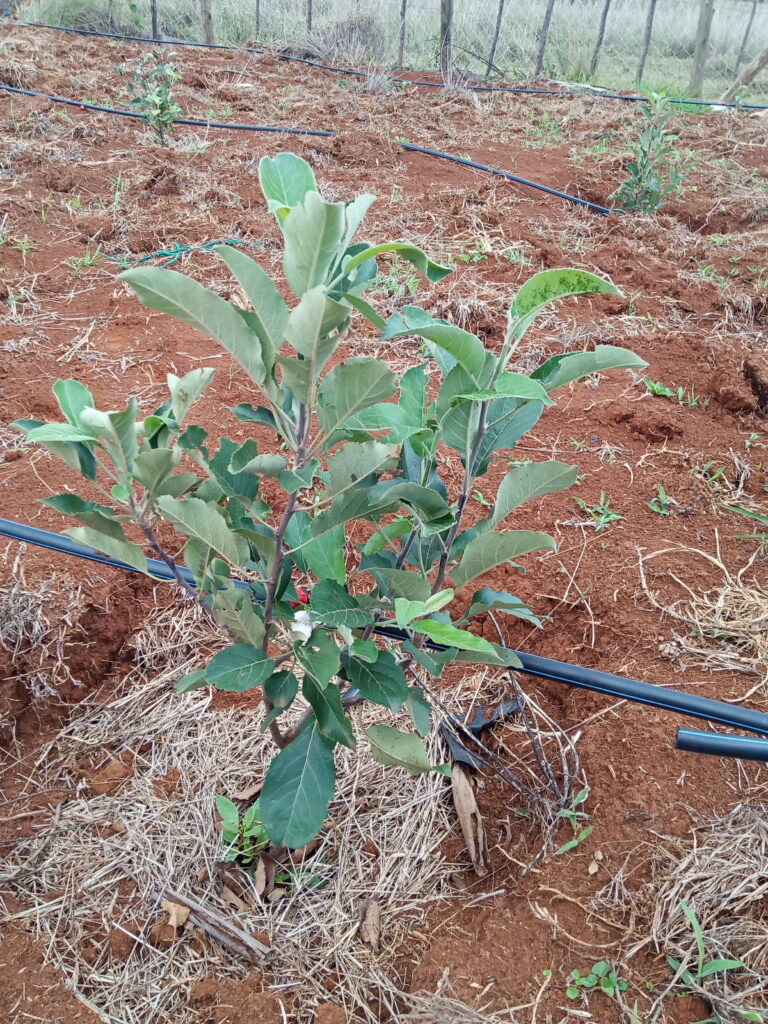
The budget at a glance
| Item | High density, 1,200 trees | Traditional, 160 trees |
|---|---|---|
| Spacing | 1 m by 3 m, on a trellis | 5 m by 5 m, staked |
| Seedlings bought | 1,260 at KSh 600 | 168 at KSh 600 |
| Establishment cost | KSh 1,662,220 | KSh 472,080 |
| Year 1 running cost | KSh 241,000 | KSh 108,000 |
| Total cost in year 1 | KSh 1,903,220 | KSh 580,080 |
| First crop | Year 2 (light) | Year 4 (light) |
| Operating profit first positive | Year 3 | Year 5 |
| Cumulative result after 3 years | -KSh 2,128,220 | -KSh 822,080 |
| Payback year (base case) | Year 6 | Year 8 |
The base case uses a farm-gate price of KSh 150 per kilogram. The sensitivity section shows what happens at KSh 100 and KSh 200.
Assumptions Behind the Numbers
A budget is only as good as its assumptions, so here they are in plain terms.
The farm is one acre, which is 4,047 square metres, in a highland site that suits apples, as described in our guide to the best regions for apple farming in Kenya. The land is already yours, so there is no cost for buying or leasing it. You have a reliable water source, and its cost is not in the budget. The trees are certified grafted seedlings from an inspected nursery, priced at KSh 600 each. High-density trees are on M9 rootstock. Traditional trees are on a semi-dwarf rootstock that needs no trellis.
Labour is paid at local rates. If you and your family do part of the work, your cash cost will be lower. No loan interest is counted, prices stay flat for the whole period, and tax is ignored. Fruit is sold at one blended farm-gate price, which allows for a mix of grades.
Yield assumptions are the weakest part of any apple budget in Kenya, because few local records are public. We use cautious figures and explain them in the yield section. If you have access to real records from a nearby orchard, use those instead.
High Density Apple Spacing Explained
What the numbers mean
High density apple spacing means planting small trees very close together in rows, and holding them upright on a trellis. A common system is the tall spindle, where each tree is a slim, central stem with short side branches, kept to about 2.5 to 3 metres high. Trees are 1 metre apart in the row and the rows are 3 metres apart.
One acre is 4,047 square metres. At 1 m by 3 m, each tree has 3 square metres, so the arithmetic gives about 1,349 trees. In practice you lose space at the ends of the rows for posts, anchors and access, and along paths and the fence. That is why we plan on 1,200 trees. On a 64 m by 64 m block this works out as 21 rows of about 57 trees each, or about 1,197 trees, with roughly 3.5 metres left at each end of the rows.
A tractor or a power sprayer needs more headland to turn than this. If you plan to use machines, leave 4 to 5 metres at each end and expect the tree count to fall a little.
Why close planting gives earlier fruit
Trees on M9 rootstock fruit very early, usually in the second or third year. Because there are so many of them, even a light crop per tree adds up to a meaningful crop per acre. The orchard also fills its space quickly, so it catches more sunlight early in its life. A traditional orchard of 160 large trees takes years to fill its ground, and in those years most of the sunlight falls on bare soil.
Small trees are also cheaper to look after. Pruning, thinning, spraying and picking can be done from the ground or from a low platform. There are no tall ladders, and workers are safer and faster.
What close planting demands
The trade-offs are real. Trees on M9 have brittle roots, so every tree must be tied to a trellis for life. Water and feeding must be steady, because the shallow roots dry out quickly. Pruning and training must be exact, because crowded trees shade each other and hold humidity inside the canopy, which feeds apple scab. M9 is very susceptible to fire blight and woolly apple aphid, and in hot, dry or shallow soils it can underperform. We cover these in our guide to M9 rootstock apple trees in Kenya.
Variety matters too. Low chill varieties such as Anna and Dorsett Golden are spur-type trees that already grow compactly, and a dwarfing rootstock can shrink them further. At 1 m spacing on weak soil they may be too small to carry a good crop. Ask your nursery for evidence of your chosen variety on M9 at your altitude before you plant 1,200 of them.
Spacing options compared
| Spacing | Trees per acre (theory) | Trees planned | Support | Typical use |
|---|---|---|---|---|
| 1 m by 3 m | About 1,349 | 1,200 | Trellis, 4 wires | Very high density on M9 |
| 1 m by 3.5 m | About 1,156 | About 1,050 | Trellis | High density on M9 |
| 1.5 m by 4 m | About 675 | About 600 | Trellis or stakes | Medium density, semi-dwarf or M9 |
| 5 m by 5 m | About 162 | 160 | Stakes | Traditional, vigorous trees |
| 6 m by 6 m | About 112 | 110 | None or stakes | Traditional, very vigorous trees |
This article compares the first and the fourth rows. If a 1,200-tree block is more than you can manage or finance, the middle rows are a sensible step down.
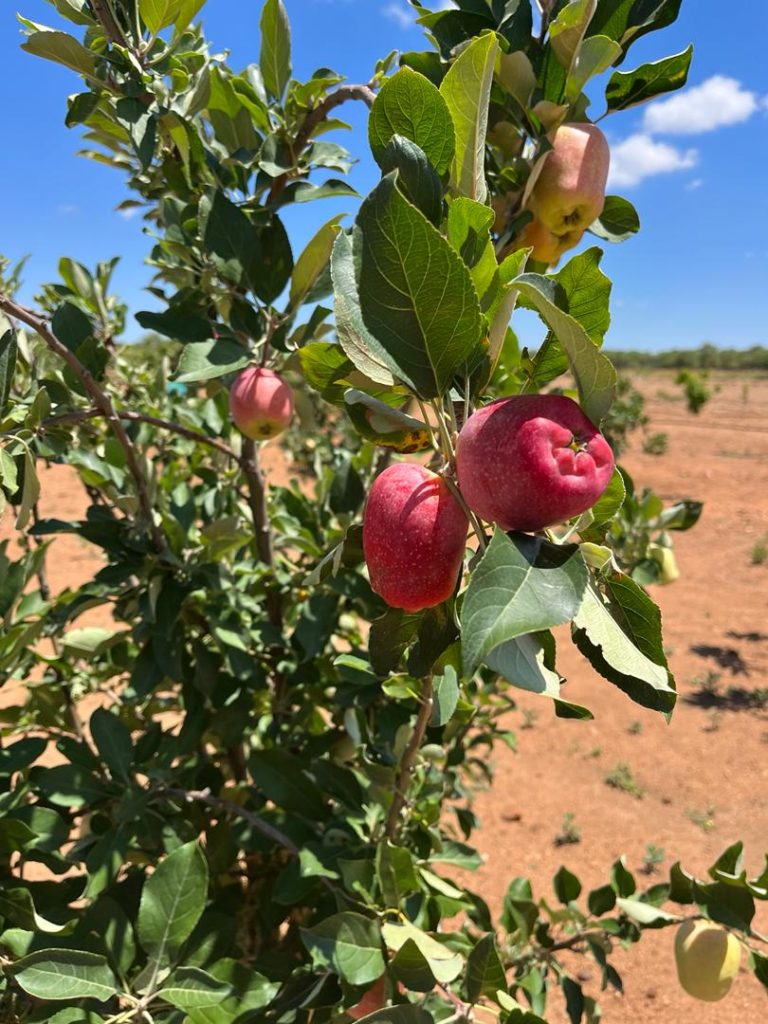
The Full Cost of Starting an Apple Farm in Kenya: Itemized Budget
The tables below follow the money in the order you spend it. Unit prices are our planning assumptions. Check each one against local quotes.
1. Land preparation
| Item | Working | Cost (KSh) |
|---|---|---|
| Soil test | Laboratory analysis of a few samples | 5,000 |
| Clearing, ploughing and subsoiling | One acre | 20,000 |
| Lime and soil amendment allowance | If the soil test shows a pH below 5.5 | 15,000 |
| Marking the layout | Pegs, twine and labour for 21 rows | 8,000 |
| Subtotal | 48,000 |
Do the soil test first. A working pH range for apples in Kenya is 5.5 to 6.5. Many highland soils are acidic, and lime should go on several months before planting. Subsoil the rows to break any hard layer, because roots need to go deep. Test drainage by filling a one-metre pit with water. If it has not drained in six hours, fix the drainage or plant on raised beds.
2. Trellis for 21 rows
A high-density orchard cannot stand up without a trellis. We assume four wires on posts about 3 metres high, with strong posts at each row end.
| Item | Working | Cost (KSh) |
|---|---|---|
| Line posts | 189 posts at 450 | 85,050 |
| End posts and anchors | 42 posts at 900 | 37,800 |
| High-tensile wire | About 5,000 m at 15 per metre | 75,000 |
| Tensioners, staples and fittings | Allowance | 25,000 |
| Canes or ties for each tree | 1,260 trees at 40 | 50,400 |
| Subtotal | 273,250 |
The line posts are spaced about 6 metres apart, which gives about nine per row plus two end posts. Treated posts last longer and cost more, so ask about the expected life of each type. A weak trellis is one of the costliest mistakes in the orchard, because a collapse under a crop can destroy whole rows.
3. Drip irrigation lines and water system
Drip irrigation is not optional in a high-density block. Shallow M9 roots need frequent, small amounts of water, and drip keeps the leaves dry, which helps against scab.
| Item | Working | Cost (KSh) |
|---|---|---|
| Drip line with in-line emitters | 21 rows of about 64 m, about 1,344 m at 45 | 60,500 |
| Main and sub-main pipes | About 100 m at 400 | 40,000 |
| Disc filter | One unit | 18,000 |
| Valves, connectors and fittings | Allowance | 20,000 |
| Tank and stand | 10,000 litres | 60,000 |
| Pump | Small electric or solar pump | 30,000 |
| Fertigation injector | Venturi type | 8,000 |
| Installation labour | 18,000 | |
| Subtotal | 254,500 |
The design is one drip line per row, with an emitter about every 50 centimetres, which gives each tree roughly 4 litres an hour. A mature orchard at peak use needs about 14 to 20 litres per tree per day, so each tree would run for about 3.5 to 5 hours daily. Divide the block into two or three zones so that a small pump can serve it. The cost of the water source itself, such as a borehole or pan, is not included and varies a great deal from site to site.
4. Certified seedlings at KSh 600
Seedlings are the largest single line in the budget. We use KSh 600 per certified grafted apple seedling, and buy 1,260 to allow for 5 percent spares.
| Seedling price | Cost for 1,260 seedlings | Difference from base (KSh) |
|---|---|---|
| KSh 500 | KSh 630,000 | -126,000 |
| KSh 600 (base) | KSh 756,000 | 0 |
| KSh 800 | KSh 1,008,000 | +252,000 |
| KSh 1,000 | KSh 1,260,000 | +504,000 |
Do not cut this line by buying cheap, unlabelled trees. A seedling with no graft union, no variety name and no papers may be grown from seed, and a seed-grown tree will not give uniform fruit. In a block of 1,200 trees, a wrong tree means a wrong row, and a weak graft union will snap under its first crop. Check the union, the label, the roots and the nursery certificates, as we describe in our guide on grafted apple seedlings in Kenya. Order early, name the variety split and the rootstock clone, and plan the delivery for the start of the rains.
You will also need pollinizer trees. A common plan is to mix a second compatible variety through the rows, at about one tree in every eight to ten. Put that split on your order.
5. Planting and basal fertilizer
Basal fertilizer goes into the hole or planting strip at planting. It feeds young roots and helps them establish.
| Item | Working | Cost (KSh) |
|---|---|---|
| Digging holes, planting and tying | 1,260 trees at 60 | 75,600 |
| Farmyard manure | 12.6 tonnes at 3,500 per tonne (10 kg per tree) | 44,100 |
| Double superphosphate (DSP) | 126 kg at 130 per kg (100 g per tree) | 16,380 |
| Trichoderma biological fungicide | 25.2 kg at 1,200 per kg (20 g per tree) | 30,240 |
| Mulch | Materials and labour | 20,000 |
| Subtotal | 186,320 |
Mix the topsoil with the manure, DSP and Trichoderma and use the mixture to fill around the roots. Use fully decomposed manure, because fresh manure can burn roots. Set each tree so that the graft union stays at least 10 centimetres above the soil. If the union is buried, the scion can root and the tree loses the dwarfing effect. Water each tree at planting and mulch the row, keeping the mulch clear of the stem.
6. Fence
A fence of about 260 metres at KSh 250 per metre costs KSh 65,000. If your land is already fenced, remove this line.
7. Contingency
We add 5 percent of the establishment items for the things nobody plans for, such as a delayed delivery, extra posts or a pump repair. On the items above, this is about KSh 79,150.
Establishment total, high density
| Group | KSh |
|---|---|
| Land preparation | 48,000 |
| Trellis | 273,250 |
| Drip irrigation | 254,500 |
| Seedlings | 756,000 |
| Planting and basal fertilizer | 186,320 |
| Fence | 65,000 |
| Contingency, 5 percent | 79,150 |
| Establishment total | 1,662,220 |
Year 1 Running Costs
Once the trees are in, the orchard needs care every week. We assume one full-time worker and some casual labour.
| Item | Working | Cost (KSh) |
|---|---|---|
| Full-time worker | 12,000 a month for 12 months | 144,000 |
| Casual labour | Planting follow-up, weeding, tying | 30,000 |
| Fertiliser top dressing | Based on soil test | 25,000 |
| Water and power | 12,000 | |
| Pest and disease control | Fungicide, insecticide, sprayer use | 30,000 |
| Running costs in year 1 | 241,000 |
Total cost in year 1 is therefore KSh 1,662,220 plus KSh 241,000, which is KSh 1,903,220.
The Traditional Spacing Budget for Comparison
To compare fairly, we price a traditional orchard of 160 trees at 5 m by 5 m on a semi-dwarf rootstock, with stakes and no trellis. Seedlings cost the same KSh 600 each. Holes are larger, and the manure, DSP and Trichoderma per hole are doubled to 20 kg, 250 g and 50 g.
| Item | Working | Cost (KSh) |
|---|---|---|
| Land preparation | Soil test, clearing, ploughing, lime allowance, layout | 45,000 |
| Stakes | 160 trees at 150 | 24,000 |
| Drip irrigation | 13 rows, pipes, filter, 5,000-litre tank, pump | 152,300 |
| Seedlings | 168 at 600 | 100,800 |
| Planting and basal fertilizer | Holes 25,200, inputs 27,300, mulch 10,000 | 62,500 |
| Fence | 260 m at 250 | 65,000 |
| Contingency, 5 percent | 22,480 | |
| Establishment total | 472,080 | |
| Running costs in year 1 | Labour 84,000, fertiliser 8,000, water 6,000, pest control 10,000 | 108,000 |
| Total cost in year 1 | 580,080 |
The traditional orchard costs about 30 percent as much to establish. It also earns nothing for three years. The next sections show what that means for cash flow.
Yield Assumptions: How Much Fruit per Tree and per Acre
Yield is the number that moves every other number, so we set it out clearly. These are cautious planning figures, not forecasts.
| Year | High density: kg per tree | High density: kg per acre (1,200 trees) | Traditional: kg per tree | Traditional: kg per acre (160 trees) |
|---|---|---|---|---|
| 1 | 0 | 0 | 0 | 0 |
| 2 | 0.5 | 600 | 0 | 0 |
| 3 | 3 | 3,600 | 0 | 0 |
| 4 | 6 | 7,200 | 3 | 480 |
| 5 | 10 | 12,000 | 10 | 1,600 |
| 6 | 10 | 12,000 | 20 | 3,200 |
| 7 | 10 | 12,000 | 30 | 4,800 |
| 8 | 10 | 12,000 | 40 | 6,400 |
A few notes explain these figures.
In year 1 we assume the flowers are removed. Trees on M9 are so precocious that they try to fruit when they are barely established, and a young tree that carries a crop too early can lose vigour and stay small. A light crop in year 2 and a modest crop in year 3 are the aim.
At maturity the high-density block is held at 10 kilograms per tree, or about 12 tonnes per acre. That is a cautious figure. Well-run high-density orchards in good apple-growing countries report much higher yields per acre, but conditions there differ from Kenya, and we have found few published Kenyan yield records. Some Kenyan reports claim fruit within the first year, and we do not count on that either.
The traditional orchard of large trees takes longer to start and keeps growing for many years. We take it to 40 kilograms per tree in year 8, and it would continue to rise. The two systems may end up with similar yields per acre in the long run, so the real difference is timing and capital, not the final crop.
The yield figures count all fruit. Not every apple will be top grade, and we deal with that by using a blended price per kilogram.
Running Costs from Year 2 to Year 5
Running costs rise each year as the trees grow, the crop increases and the pruning, spraying and picking workload grows.
| Cost item | Year 2 | Year 3 | Year 4 | Year 5 |
|---|---|---|---|---|
| Full-time worker | 144,000 | 144,000 | 144,000 | 144,000 |
| Casual labour | 50,000 | 90,000 | 130,000 | 180,000 |
| Manure and fertiliser | 60,000 | 90,000 | 110,000 | 130,000 |
| Water and power | 24,000 | 40,000 | 50,000 | 60,000 |
| Pest and disease control | 50,000 | 70,000 | 80,000 | 90,000 |
| Bee hire | 0 | 8,000 | 8,000 | 8,000 |
| Harvest, grading and crates (KSh 15 per kg) | 9,000 | 54,000 | 108,000 | 180,000 |
| Trellis and drip upkeep | 10,000 | 12,000 | 15,000 | 18,000 |
| Total (KSh) | 347,000 | 508,000 | 645,000 | 810,000 |
From year 6 we hold running costs at about KSh 830,000 a year in the base case.
The fertiliser line covers manure, balanced NPK, potassium and calcium, and a leaf spray of boron and zinc before flowering. Bee hire assumes about four hives at KSh 2,000 each per season from year 3, when the orchard starts to carry a crop. The harvest line is charged per kilogram, so it rises with the crop.
Labour is the largest group of costs. High-density orchards need more skilled hours per acre than traditional ones, because trees must be tied, pruned and thinned every year. A trained worker pays for himself, so budget for training in the first year.
The 3-Year Cash Flow: High Density Apple Spacing at 1 m by 3 m
The table brings together the costs, yields and a base price of KSh 150 per kilogram.
| Year | Fruit (kg) | Revenue (KSh) | Costs (KSh) | Net (KSh) | Cumulative net (KSh) |
|---|---|---|---|---|---|
| 1 | 0 | 0 | 1,903,220 | -1,903,220 | -1,903,220 |
| 2 | 600 | 90,000 | 347,000 | -257,000 | -2,160,220 |
| 3 | 3,600 | 540,000 | 508,000 | 32,000 | -2,128,220 |
| Total, years 1 to 3 | 4,200 | 630,000 | 2,758,220 | -2,128,220 |
After three years the orchard has earned KSh 630,000 and spent KSh 2,758,220. The cumulative result is a loss of KSh 2,128,220, which is a return on investment of about -77 percent.
That figure looks bad, and an honest article has to say so. A high-density orchard puts most of its money in at the start and takes it back later. The numbers to watch are different. Year 3 is the first year in which the orchard earns more than it costs to run, with a net of KSh 32,000. The lowest point of cumulative cash, KSh 2,160,220, comes at the end of year 2. That is the amount of cash you must be able to fund before the orchard begins to repay it.
Years 4 to 8: when the investment is repaid
| Year | Fruit (kg) | Revenue (KSh) | Costs (KSh) | Net (KSh) | Cumulative net (KSh) |
|---|---|---|---|---|---|
| 4 | 7,200 | 1,080,000 | 645,000 | 435,000 | -1,693,220 |
| 5 | 12,000 | 1,800,000 | 810,000 | 990,000 | -703,220 |
| 6 | 12,000 | 1,800,000 | 830,000 | 970,000 | 266,780 |
| 7 | 12,000 | 1,800,000 | 830,000 | 970,000 | 1,236,780 |
| 8 | 12,000 | 1,800,000 | 830,000 | 970,000 | 2,206,780 |
The orchard passes break-even during year 6. By the end of year 5 the cumulative loss has shrunk to KSh 703,220, an ROI of about -17 percent. By the end of year 8, total revenue is KSh 8,910,000 against total costs of KSh 6,703,220, a net gain of KSh 2,206,780, or about 33 percent of the money spent.
The 3-Year Cash Flow for Traditional Spacing
The traditional orchard of 160 trees at 5 m by 5 m tells a different story.
| Year | Fruit (kg) | Revenue (KSh) | Costs (KSh) | Net (KSh) | Cumulative net (KSh) |
|---|---|---|---|---|---|
| 1 | 0 | 0 | 580,080 | -580,080 | -580,080 |
| 2 | 0 | 0 | 114,000 | -114,000 | -694,080 |
| 3 | 0 | 0 | 128,000 | -128,000 | -822,080 |
| 4 | 480 | 72,000 | 161,200 | -89,200 | -911,280 |
| 5 | 1,600 | 240,000 | 218,000 | 22,000 | -889,280 |
| 6 | 3,200 | 480,000 | 280,000 | 200,000 | -689,280 |
| 7 | 4,800 | 720,000 | 341,000 | 379,000 | -310,280 |
| 8 | 6,400 | 960,000 | 400,000 | 560,000 | 249,720 |
After three years the traditional orchard has spent KSh 822,080 and earned nothing, so its three-year ROI is -100 percent. It first earns more than it costs to run in year 5, and it breaks even in year 8. By then it has cost KSh 2,222,280 and earned KSh 2,472,000, a net gain of KSh 249,720, or about 11 percent.
High Density vs. Traditional: The Head-to-Head Comparison
| Measure | High density, 1,200 trees | Traditional, 160 trees |
|---|---|---|
| Cash needed before the first payback | About KSh 2.16 million at the low point | About KSh 0.91 million at the low point |
| First crop | Year 2 | Year 4 |
| First year of operating profit | Year 3 | Year 5 |
| Cumulative result, end of year 3 | -KSh 2,128,220 | -KSh 822,080 |
| Cumulative result, end of year 5 | -KSh 703,220 | -KSh 889,280 |
| Cumulative result, end of year 8 | +KSh 2,206,780 | +KSh 249,720 |
| Payback year | Year 6 | Year 8 |
| Skill and labour needed | High | Moderate |
| Main extra risk | Trellis, M9 weaknesses, disease spread in crowded rows | Slow return, tall trees that are hard to manage |
High density loses more money in the first three years and overtakes traditional spacing in year 5. By year 8 it is more than KSh 1.9 million ahead. These gaps come from our yield assumptions, in particular the faster start of M9 trees and the slower start of large trees. If your own trees start later or crop less, the gap narrows, so test these assumptions with your nursery before you decide.
The cash needed is the other half of the story. A farmer who cannot fund KSh 2.2 million, or who is borrowing it, may be better placed with a smaller high-density block or a medium-density layout.
Apple Profitability per Acre in Kenya
Once the orchard is mature, profit per acre depends on yield, price and running cost. In the base case, a mature high-density acre earns KSh 1.8 million a year from 12 tonnes of fruit at KSh 150 per kilogram, and costs about KSh 830,000 a year to run. That leaves about KSh 970,000 a year, an operating margin of about 54 percent. A traditional acre at year 8 earns KSh 560,000 on its way up.
Two cautions apply. The first is that profit per acre is only half of the answer. You also need to spread the cost of establishment over the years, which the payback and ROI tables do. The second is that these results depend on the price you get. We show how in the next section.
Net return per kilogram
Another way to read the numbers is to divide each year’s running cost by the kilograms sold.
| Year | Running cost per kg (KSh) | Sale price per kg (KSh) | Net per kg (KSh) |
|---|---|---|---|
| 3 | 141 | 150 | 9 |
| 4 | 90 | 150 | 60 |
| 5 | 68 | 150 | 82 |
| 6 | 69 | 150 | 81 |
In year 3 each kilogram costs almost as much to produce as it sells for, because the crop is still small. By year 5 each kilogram earns about KSh 82 after running costs. If you spread the whole eight-year cost, including establishment, over the 59,400 kilograms produced, the full cost is about KSh 113 per kilogram. The average sale price of KSh 150 then leaves about KSh 37 per kilogram over the first eight years, and that margin rises every year after.
What If the Price, Yield or Seedling Cost Is Different?
Price and yield are the two inputs that change the result most. We have no verified farm-gate price series for Kenyan apples, so the base price of KSh 150 is an assumption. Talk to supermarkets, produce buyers and traders before you plant, and use the price they would actually pay for your grades.
The table below changes one input at a time for the high-density block. Everything else stays as in the base case.
| Case | Price per kg | Yield | Cumulative net, end of year 3 (KSh) | End of year 5 (KSh) | Payback year |
|---|---|---|---|---|---|
| Low price | KSh 100 | Base | -2,338,220 | -1,873,220 | Year 11 |
| Low yield | KSh 150 | 30 percent below base | -2,298,320 | -1,650,920 | Year 9 |
| Base case | KSh 150 | Base | -2,128,220 | -703,220 | Year 6 |
| High price | KSh 200 | Base | -1,918,220 | 466,780 | Year 5 |
The spread is wide. A price of KSh 100 pushes payback out to year 11. A yield 30 percent below the base case pushes it to year 9. A price of KSh 200 brings it forward to year 5. Before you invest, ask yourself whether the project still works in the low cases. If it does not, you need either a lower-cost layout, better access to a high-price market, or a smaller first block.
The seedling price also matters, because 1,260 trees multiply any difference. The table shows the effect on the cumulative result at the end of year 6, with the base price and yield.
| Seedling price | Extra cost against base (KSh) | Cumulative net, end of year 6 (KSh) |
|---|---|---|
| KSh 500 | -126,000 | 392,780 |
| KSh 600 (base) | 0 | 266,780 |
| KSh 800 | 252,000 | 14,780 |
| KSh 1,000 | 504,000 | -237,220 |
At KSh 1,000 per seedling, payback slips from year 6 to year 7. Quality still matters more than price. A cheap tree with a weak graft costs far more in the long run than a sound one.
Money, Interest and Cash Planning
The budget assumes no loan. If you borrow, interest changes the picture. For example, a loan of KSh 1.5 million at 15 percent a year costs about KSh 225,000 in interest every year. In the base case the orchard earns only KSh 32,000 in year 3 and KSh 435,000 in year 4, so interest would take most of the early surplus.
If you have to borrow, ask for a grace period that matches the orchard, with little or no repayment in the first two years. Phase your spending. You can install the drip system and trellis in stages and plant only as much as you can water. And keep a cash reserve for the second year, when the orchard is still spending without earning.
Risks to Plan For and How to Manage Them
The numbers above are only as safe as the orchard behind them. These are the main risks.
A wrong site is the biggest. Apples need cool nights, no frost at flowering, good water, deep and well-drained soil and a pH of 5.5 to 6.5. Rate your farm against the scorecard in our guide to the best regions for apple farming in Kenya before you spend a shilling.
A wrong tree is the next. Check the variety, the rootstock clone, the graft union and the nursery certificates. A mixed or mislabelled block is hard to fix once it is in the ground.
Apple scab and other leaf diseases thrive when leaves stay wet, and close planting holds humidity in the canopy. Prune to an open shape, use drip and not overhead sprinklers, remove fallen leaves and time registered fungicides to wet spells. Fire blight and woolly apple aphid are known weaknesses of M9, so scout every week.
Water failure is a risk in dry spells and in dry zones. A trellised orchard on shallow roots can suffer within days of a pump breakdown. Keep spares for the pump and a storage tank.
Trellis failure under a heavy crop or wind can flatten rows. Use proper end posts and anchors, and check wires and ties each season.
Weather risks include frost at flowering, hail and strong wind. Plant on a slope, use windbreaks that leave gaps for cold air to drain, and price hail netting and insurance for larger blocks.
Market risk is the last. Prices move, and buyers want steady supply, size and quality. Agree on buyers, grades and delivery before the first crop.
Ways to Improve the Return
There are practical ways to improve the result without changing the yield figures.
Start with a smaller block. A quarter acre of about 300 trees lets you learn pruning, training and pest control at much lower cost. The pump, tank and filter do not scale down in proportion, but the seedling, trellis and labour bills do. Expand when your own records show that the trees flower, set fruit and sell.
Learn the system before you plant. Send your worker for training on spindle pruning and training, and keep a simple record for each row, with dates of flowering, fruit set, spray dates and yield.
Buy certified seedlings in one order. Nurseries often give better terms on a larger volume, and a single delivery lowers transport costs. Do part of the work yourself where you can, because labour is the largest running cost.
Grade and pack carefully. Buyers pay more for clean, uniform, well-coloured fruit. Look for a use for the lower grades, such as juice or drying, since fruit that is not top grade still has value.
Sell as a group. Growers who pool fruit can offer a steady supply and often get better prices, and can share the cost of crates, cold storage and transport.
Frequently Asked Questions
What is the cost of starting apple farm in Kenya per acre?
In this budget, a high-density acre of 1,200 trees at 1 m by 3 m costs about KSh 1,903,220 in the first year, made up of KSh 1,662,220 to establish and KSh 241,000 to run. A traditional acre of 160 trees at 5 m by 5 m costs about KSh 580,080. Your own cost depends on seedling price, labour rates, water source and whether your land is already fenced.
How many apple trees fit on an acre at high density?
At 1 m by 3 m, an acre fits about 1,349 trees in theory and about 1,200 in practice, after allowing for row ends, posts and paths. At 1 m by 3.5 m it fits about 1,050 trees, at 1.5 m by 4 m about 600, and at 5 m by 5 m about 160.
What is high density apple spacing?
It means planting small trees on a dwarfing rootstock such as M9 very close together, often 1 metre apart in rows 3 metres apart, and holding them on a trellis. The trees fruit early and are easy to prune and pick, but they need a trellis, steady water and skilled management.
How much does a certified apple seedling cost in Kenya?
This budget uses KSh 600 per certified grafted seedling. The real price depends on the variety, the rootstock, the size of the tree and the number you order, so ask your nursery for a written quote that names the variety and the rootstock clone.
How profitable is apple farming per acre in Kenya?
In our base case a mature high-density acre earns about KSh 1.8 million a year from 12 tonnes of fruit at KSh 150 per kilogram and costs about KSh 830,000 to run, leaving about KSh 970,000. These are planning figures. Your result depends on your yield, your price and your costs.
How long does a high-density apple orchard take to pay back?
In the base case, break-even comes in year 6. At a price of KSh 100 per kilogram it takes until year 11, and at KSh 200 it comes in year 5. A traditional orchard in the base case pays back in year 8.
How much does a trellis cost for one acre?
In our assumptions a four-wire trellis for 21 rows costs about KSh 273,250, including posts, anchors, wire, fittings and ties for 1,260 trees. Post prices and wire prices vary, so get quotes.
How much water does a high-density apple orchard need?
A mature orchard uses roughly 4 to 6 millimetres of water a day at peak, which is about 16,000 to 24,000 litres per acre per day, or about 14 to 20 litres per tree for 1,200 trees. Young trees use much less.
Is high density better than traditional spacing?
It is faster and, in our base case, more profitable by year 8, but it costs about three times as much to start, needs a trellis and skilled labour, and carries more risk. If cash or skills are limited, a smaller high-density block or a medium-density layout can be a better first step.
What are the biggest risks of a high-density apple orchard?
A wrong site, mislabelled or weakly grafted trees, scab and fire blight in crowded rows, water failure, trellis failure and low prices. Each can be reduced with the right planning, as set out above.
Talk to Us Before You Plant
At Fruit Africa Veriplant we supply KEPHIS-inspected grafted apple seedlings from our nursery distribution bases in Murang’a, Nairobi and Embu. Send us your acreage, your spacing, your altitude and your planting date, and we will help you work out how many trees you need, which varieties and rootstock suit your site, and what the seedling order will cost. We can give you a written quote that names the variety and the rootstock clone.
Contact Our Agronomy Team Today:
- Head Office Location: Ruiru, Kiambu County, Kenya
- Nursery Distribution Hubs: Murang’a, Nairobi, and Embu
- Phone Direct: +254 714 994 444
- WhatsApp Assistance: Message us on WhatsApp
- Official Email: sales@fruitafrica.org
- Official Website: www.fruitafrica.org
- Request a Quotation: fruitafrica.org/request-for-quotation/
Summary
The cost of starting apple farm in Kenya on one acre at high density apple spacing is about KSh 1.9 million in the first year for 1,200 trees, against about KSh 580,000 for a traditional orchard of 160 trees. The high-density orchard fruits in year 2, earns more than it costs to run from year 3, and in the base case pays back in year 6, two years before the traditional orchard. Over the first three years, both are still behind, and the high-density orchard is further behind because it spends more.
Apple profitability per acre in Kenya depends mostly on price, yield and the cost of money. At KSh 150 per kilogram a mature high-density acre leaves about KSh 970,000 a year after running costs, but at KSh 100 payback stretches to year 11. Test your price with real buyers, check your site against the scorecard, buy certified grafted trees, plant a small block first, and build your own version of these tables with local quotes.