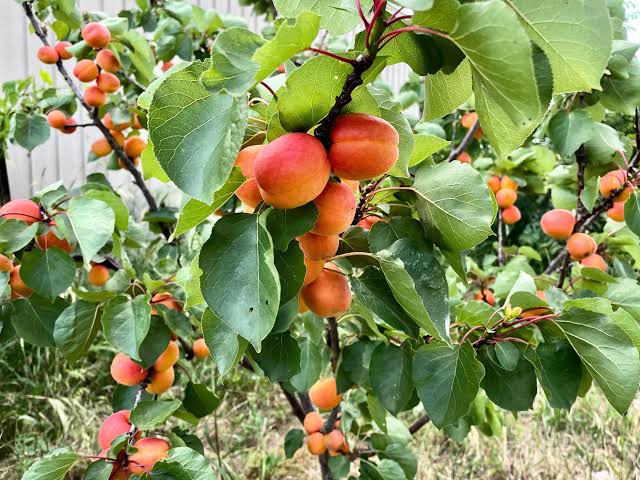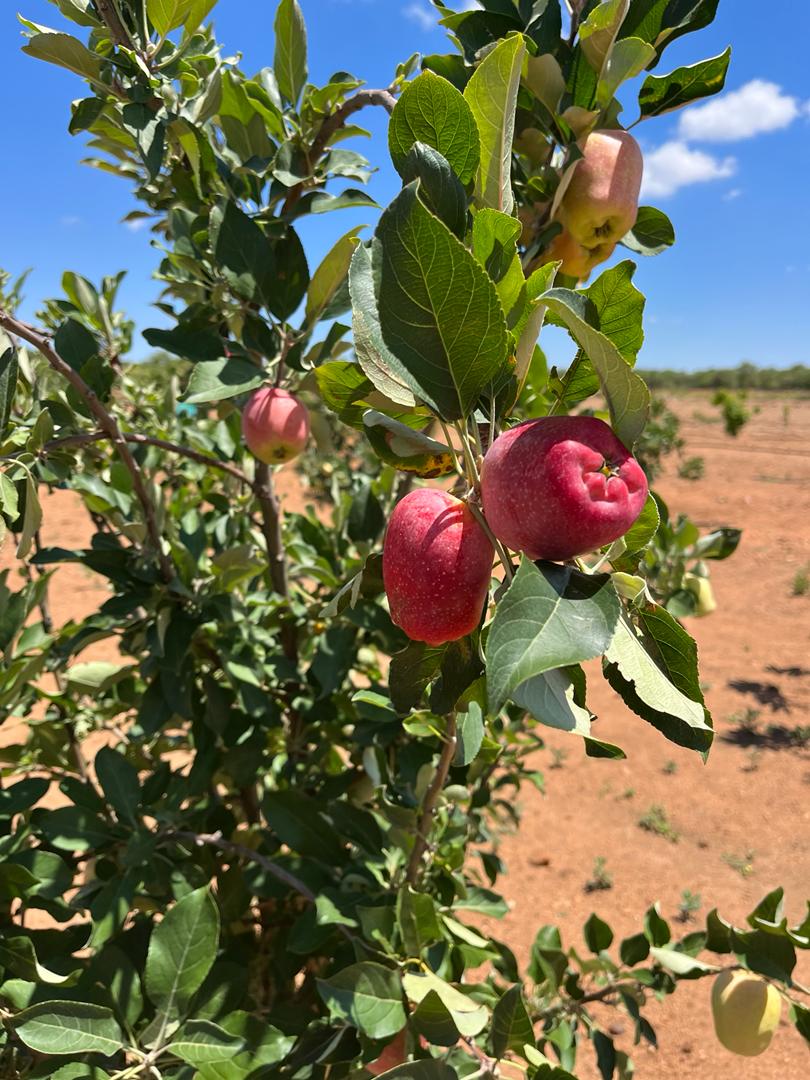
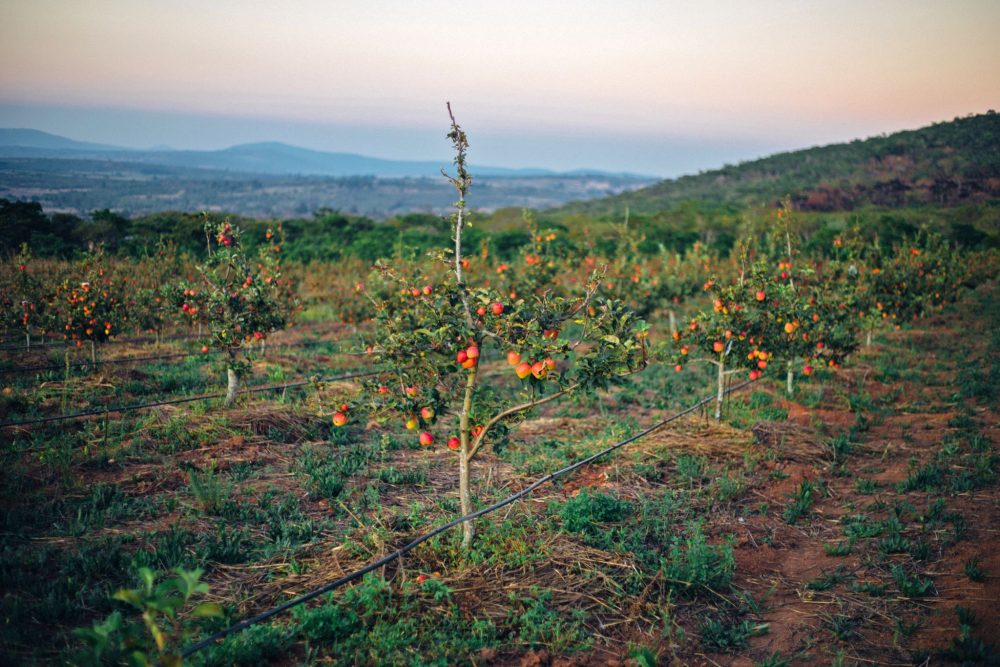
Compare M9 dwarfing rootstock versus seed-grown apple trees in Kenya. Discover why grafting quality, clonal rootstock selection, and certified nurseries in Murang’a determine your 20-year orchard yield.
M9 Dwarfing Rootstock vs Seed-Grown Apple Trees Kenya: 20-Year Yield Guide
Establishing a commercial apple orchard (Malus domestica) is a long-term capital investment designed to generate steady annual income for twenty to thirty years. However, the single most critical decision a Kenyan farmer makes before digging a single hole is not the choice of fruit variety, but the underlying rootstock architecture.
For decades, informal markets in East Africa have traded un-grafted seed-grown apple trees or trees grafted onto random, uncertified rootstocks. While these seedlings appear cheap initially, they create massive, uncontrollable trees that take six to eight years to bear small sample crops and produce low lifetime yields.
In contrast, modern commercial orchards rely on clonally propagated dwarfing rootstocks. specifically M9 (Malling 9) joined to high-value scion varieties like Anna, Wambugu, Dorsett Golden, or Pink Lady. Selecting high-quality grafted apple seedlings in Kenya sourced from a certified apple nursery in Murang’a guarantees early bearing, high fruit density per acre, and maximum returns per square meter.
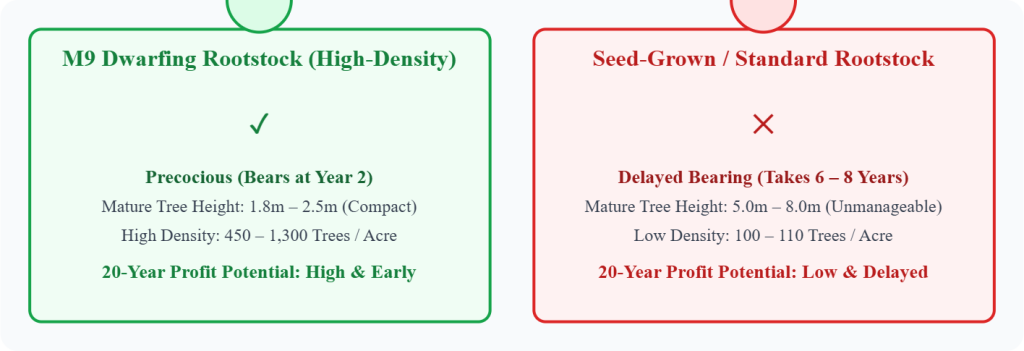
| Agronomic Parameter | M9 Dwarfing Rootstock System (Clonal) | Seed-Grown Apple System (Random Seedling) |
| Average Seedling Price | KSh 600 to KSh 1,000 per certified tree | KSh 200 to KSh 400 per wild plant |
| Genetic Uniformity | 100% Identical clonal performance | Highly variable due to genetic segregation |
| Precociousness (First Crop) | Year 2 (Sample crop); Full commercial crop Year 3–4 | Year 6 to 8 before initial commercial crop |
| Mature Tree Height | 1.8 m to 2.5 m (Compact, manageable canopy) | 5.0 m to 8.0 m (Massive vegetative growth) |
| Plant Density Capacity | Standard: 450–500 trees/acre; High-Density: 1,200–1,300 trees/acre | 100 to 110 trees per acre maximum |
| Harvest Efficiency | 100% ground-level or low-platform picking | Requires tall ladders, high labor risk |
| Phytophthora (Root Rot) Resistance | High Resistance to collar and root rot | Highly variable; susceptible to root rot |
| Structural Support Needed | Permanent stake or trellis required (Brittle roots) | Self-anchoring taproot system |
| 20-Year Cumulative Yield/Acre | 350 to 500 Tonnes total output | 60 to 120 Tonnes total output |
Buy Grafted Trees, and Check the Graft
Buy grafted apple seedlings in Kenya, not trees grown from seed. A tree grown from an apple seed does not copy its parent. It takes many years to fruit, grows large and gives fruit of unpredictable quality. A grafted tree joins a named variety to a rootstock that controls its size and early fruiting. M9 rootstock apple trees in Kenya stay small, fruit in the second or third year and can be planted close together. They also need permanent support, steady water and a deep, well-drained site that is not too hot.
Whichever rootstock you choose, the quality of the graft decides what your orchard gives for the next 20 years. Buy only from a nursery that is registered and inspected, and that can show you the variety, the rootstock and the papers.
This guide explains the difference between seed-grown and grafted trees, what M9 is and where it works, how to inspect a grafted seedling, and how to choose a certified apple nursery in Murang’a or anywhere else in Kenya.
At a glance
| Feature | Seed-grown tree | Grafted on a seedling rootstock | Grafted on M9 rootstock |
|---|---|---|---|
| Variety is true to type | No | Yes | Yes |
| First fruit | Often 6 to 10 years or more | Often 4 to 6 years | Often year 2 or 3 |
| Size at maturity | Very large | Large | About 45 to 50 percent of a standard tree |
| Needs support | No | No | Yes, for life |
| Trees per acre | Few | Few | Many |
| Main risk | Poor and uneven fruit | Slow start, tall trees | Weak anchorage, fire blight, heat and dry soil |
The time to first fruit for seedling rootstocks is a general range and varies with variety and care. The M9 figure comes from extension and nursery sources that report fruiting in the second or third leaf.
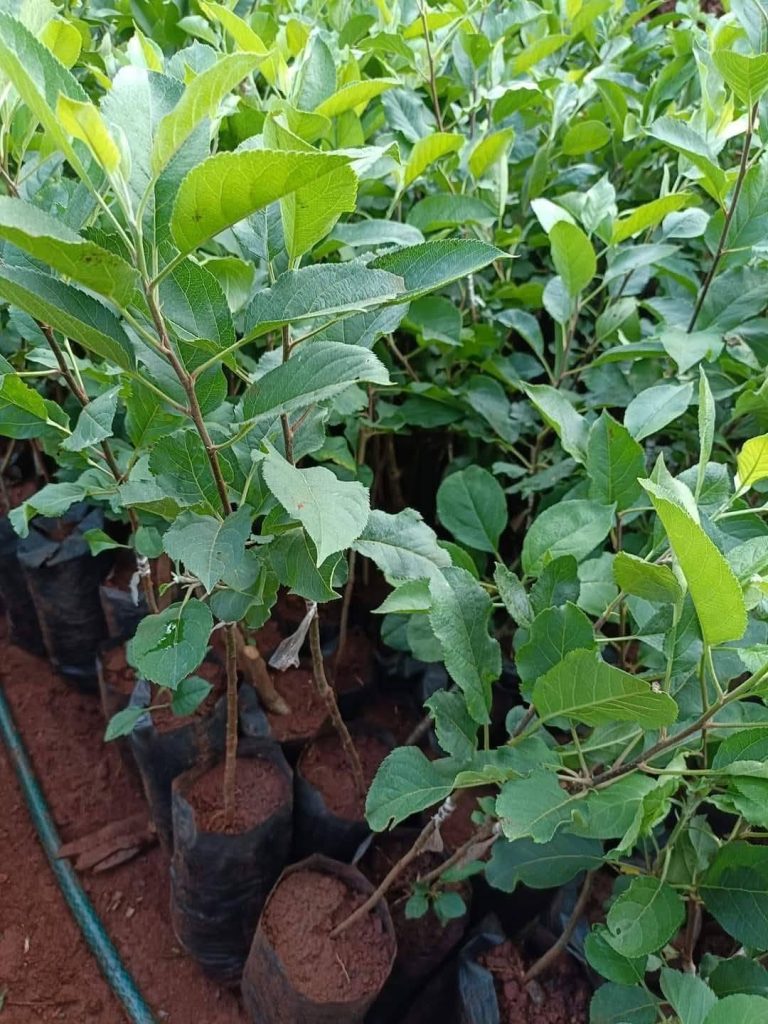
Three Kinds of Apple Trees You Can Buy
When farmers ask for an apple tree, they may mean three quite different things. The names are confusing, so it helps to define them first.
1. A seed-grown tree
A seed-grown tree is raised from the pips of an apple. It grows on its own roots, with no graft. Whatever you plant is a new, untested tree. Nobody knows what its fruit will be like until it fruits.
2. A grafted tree on a seedling rootstock
A grafted tree has two parts. The scion is a cutting from a known variety, such as Anna or Dorsett Golden, and it forms the top of the tree. The rootstock forms the roots and the lower trunk. The point where they join is the graft union, which shows as a slight bump on the stem. In older nursery practice the rootstock itself was a seedling raised from apple seed. This gives a tall, vigorous tree that stands without support and lives a long time, but it is slow to fruit.
3. A grafted tree on a dwarfing rootstock
Here the roots are a named, cloned rootstock such as M9, which is propagated by cuttings or layering and not from seed. Every tree has the same roots, so every tree behaves in much the same way. M9 makes a small tree that fruits early.
Some nurseries also sell interstem trees. These have three parts: a vigorous rootstock, a short piece of dwarfing stem such as M9 about 15 cm long, and the scion on top. The vigorous roots give better anchorage and hardiness, and the dwarfing piece controls tree size.
Why Seed-Grown Apple Trees Fail in an Orchard
A commercial orchard depends on trees that behave the same way. Seed-grown trees do not.
Every seed is a new tree
Apple trees cannot pollinate themselves well. Pollen from one variety fertilises the flowers of another, so each seed in an apple carries genes from two different parents, and those parents are themselves mixed. The seeds of one apple can grow into trees that differ in size, shape, time of flowering, disease resistance, and in the colour, flavour, texture and size of the fruit. A pip from a good Gala apple will not grow a Gala tree.
Most seed-grown trees give fruit that is small, sour, soft or dull. A very few give something good. Two famous varieties, McIntosh and Granny Smith, started as chance seedlings found by farmers. They were rare finds, and they were then multiplied by grafting. They were never multiplied by sowing seed.
The wait is long
A seed-grown tree must grow up before it flowers. It often takes six to ten years, and sometimes longer, before the first crop. In the meantime you pay for land, water and labour. By the time the fruit appears you may find that the apples cannot be sold.
The orchard is uneven
In an orchard of seed-grown trees, every tree is different. They flower at different times, so pollination is hard to plan. They ripen at different times, so harvest is hard to plan. They need different spray timing and give fruit of mixed size and quality. A buyer who wants a uniform, graded product will not take them.
The trees grow too big
Unrestrained apple trees can reach several metres in height and width. Pruning, spraying and picking from ladders become slow and costly. Labour for these jobs is the largest cost in many orchards.
No way to prove what you have
A nursery can only show papers for a variety if the tree was propagated from a registered parent tree. A seed-grown tree has no named variety, no scion source and nothing to check. If you are told it is an Anna or a Wambugu apple, you cannot confirm it.
For all these reasons, treat any apple seedling that has no graft union as a risk, whatever the label says.
What Is M9 Rootstock?
M9 is a dwarfing rootstock. It is also written as Malling 9 or M.9. It was selected in the early 1900s at the East Malling research station in England from a group of French apple types known as Jaune de Metz. Its parentage is unknown. Today it is one of the most widely used dwarfing rootstocks in the world, especially in high density orchards.
What M9 does well
M9 makes a tree about 45 to 50 percent of the size of a standard tree. With the Cox variety in the United Kingdom, that means a tree of about 1.8 to 2.5 metres. Trees on M9 are very precocious, which means they flower and fruit young, usually in the second or third year after planting. They are efficient, giving a lot of fruit for the amount of wood they carry. The fruit is often large and colours well, and extension sources describe M9 as hardy in winter.
A small tree is easier to prune, thin, spray and harvest from the ground or from a low platform. Fruit is lit evenly by the sun, which improves colour and quality.
What M9 does badly
M9 has real weaknesses that you need to know before you buy.
The roots are brittle and shallow, and anchorage is poor. A tree on M9 will lean or fall over when it carries a crop unless it is held up. Permanent support is not optional. A post and wire trellis or a strong stake is needed for the whole life of the orchard.
M9 is very susceptible to fire blight, a bacterial disease that can kill a tree, and to woolly apple aphid. It produces many burr knots, which are small lumps on the lower stem that can let disease in. It also produces some suckers from the roots. Sources differ on crown and root rot. Most describe M9 as fairly resistant, but good drainage is still needed.
There is a further point that matters for Kenya. Research and grower reports from Australia found that M9 is sensitive to high soil temperatures, shallow soils and heat, and that orchards on M9 in warm areas sometimes failed to reach their expected yield. Trees on the more vigorous MM106 rootstock produced better in those conditions. We return to this below.
M9 is a family, not one plant
The name M9 covers several clones. Common ones include EMLA 9, T337 (also called NAKB 337), Pajam 1 and 2, and Nic 29 (also sold as RN29). Cleaning virus out of a rootstock can change how big it grows, and some clones are a little more vigorous than others. Nic 29, for example, is described as stronger than other M9 types while still being a full dwarf.
When you order, ask for the exact clone, and ask whether it is virus-tested. A nursery that only says “M9” without the clone may not know what it is using.
M9 Compared with Other Rootstocks
M9 is one choice among many. The table compares it with a seedling rootstock and with two semi-dwarfing rootstocks used in many countries.
| Rootstock | Tree size | Support | Main strengths | Main weaknesses |
|---|---|---|---|---|
| Seedling | Largest | Not needed | Free-standing, good survival, long-lived | Slow to fruit, tall trees, variable roots |
| M9 | About 45 to 50 percent of standard | Needed for life | Very early fruiting, high efficiency, small tree | Brittle roots, fire blight, woolly aphid, heat and dry soil |
| MM106 | Semi-dwarf | Usually not needed | Resists woolly aphid, productive | Susceptible to crown rot in wet soil, fire blight |
| MM111 | About 85 to 100 percent of seedling | Not needed | Vigorous, tolerant of fire blight and crown rot | Larger trees, later fruiting |
A rootstock must be matched to the orchard system, the vigour of the variety, and the climate and soil. There is no single best rootstock for all conditions. Many Kenyan farmers will find that a semi-dwarf is the safer choice on warmer or drier sites, while M9 is best kept for cooler sites with deep soil, drip irrigation and a proper trellis.
How M9 Changes the Way You Design an Orchard
Small trees can be planted close together, and the number of trees per acre rises sharply. That changes the cost of seedlings, trellis and irrigation, and the money you can make early on.
| Spacing | Trees per acre | Typical use |
|---|---|---|
| 6 m by 6 m | About 112 | Large trees on seedling rootstock |
| 5 m by 5 m | About 160 | Vigorous trees, low density |
| 4 m by 1.5 m | About 675 | Semi-dwarf or dwarf, trellised |
| 3.5 m by 1 m | About 1,155 | Dwarf trees such as M9, trellised |
| 3 m by 1 m | About 1,350 | Very high density, tested in tropical trials |
The 3 m by 1 m spacing is the one used in lowland apple trials in the Philippines. Those trials combined close spacing with growth control, defoliation and branch bending. Local conditions, the variety and your skills decide what suits you. In general, a closer spacing needs better management, so do not go beyond what you can look after.
What it costs to plant more trees
Higher density means more seedlings. As an example only, if a grafted seedling cost KSh 500, 160 trees would cost KSh 80,000 and 1,155 trees would cost KSh 577,500. Add to that the posts, wire and drip lines for every row. In return you get trees that fruit sooner and a smaller tree that is cheaper to manage. The right choice depends on your money, your water, your labour and your market, and you should price each item with real quotes before deciding.
Support and trellis
Trees on M9 must be tied to a post and wire system. In a typical layout, strong posts stand at the end of each row and at intervals inside it, with two or three wires carrying the trees. Each tree is tied to the wires or to its own stake. Plan the trellis before you plant, because the cost of posts and wire is a real part of the budget and cannot be skipped.
Do M9 Rootstock Apple Trees Suit Kenya?
This is the question most guides skip. M9 was selected in a cool, wet part of England, and it works best in places with cool, deep, even soil. Kenya is different in several ways, so it is worth thinking through before you buy hundreds of trees.
Heat and soil temperature
Grower reports from Australia, where summers are hot and the light is strong, found that M9 is sensitive to high soil temperatures and shallow topsoils. Orchards on M9 in warm areas sometimes failed to reach the yields expected from European experience, while trees on the more vigorous MM106 produced better. The same risk applies in warm parts of Kenya. M9 roots are shallow, so they heat up and dry out faster than the deep roots of a vigorous tree.
Water
A tree with a small, shallow root system cannot reach deep water in a dry spell. M9 trees need steady irrigation, and drip lines with a mulch layer over the roots are close to a requirement. If you do not have a reliable water source, a semi-dwarf rootstock is the safer choice.
Wind, rain and support
Brittle roots and heavy crops mean that wind can lean or topple an unsupported tree. Sites that get strong wind need a windbreak and a sturdy trellis. In wet seasons, poorly drained soil adds to the risk of root rot, so choose ground that drains well.
Disease
M9 is very susceptible to fire blight and to woolly apple aphid. Ask your county extension officer or KEPHIS about the fire blight situation in your area, and report any tree whose shoots turn black and bend over like a shepherd’s crook. For aphids, check shoots and branch joints for white, woolly patches and treat early.
Low chill varieties and M9
Florida extension notes that Anna, Dorsett Golden and Tropic Sweet are spur-type trees, which means they already grow with a compact habit, and that dwarfing rootstocks can reduce tree size further. On weak or dry soil, an M9 tree of a spur-type variety may end up too small to carry a good crop. Ask your nursery for field results of the exact variety on the exact rootstock you plan to buy, and test both M9 and a semi-dwarf on your own farm before you commit a large area.
A practical rule
Use M9 on cooler highland sites with deep, well-drained soil, drip irrigation, mulch and a trellis. On warmer, drier or shallower sites, look at semi-dwarf rootstocks such as MM106 or an interstem tree. In both cases, plant a small trial block of each and record the results for two or three seasons.
What Grafting Quality Really Means
Two apple seedlings can look the same in a nursery and give very different orchards. The difference is in the quality of the grafting. These are the parts that matter.
The first is the identity of the scion. The cutting must come from a named, true-to-type parent tree, kept in a mother block with records. If the parent is wrong or mixed, every tree grafted from it is wrong.
The second is the rootstock. It should be a named clone, such as an M9 type, bought from a reliable source and ideally tested for virus. An untested or mislabelled rootstock may give trees that vary in size and vigour. Some viruses cause trouble only on certain combinations. For example, tomato ringspot virus can cause apple union necrosis and decline when a sensitive variety sits on a sensitive rootstock, and it is spread by soil nematodes.
The third is the union itself. A good union is smooth, fully healed all the way around, and has no gap, crack or hard swelling. A weak union may hold for a year and then snap under the weight of a crop or a strong wind. That kind of break cannot be repaired, and the tree is lost.
The fourth is the root system. Roots should be well branched, light in colour and filling the bag without circling around the inside. Tight, twisted roots can strangle a tree years later.
The fifth is plant health. The seedling should be free of pests and disease, with a straight stem and a healthy bud or leaf cover.
The last is traceability. A good nursery can tell you which mother block each batch came from, which rootstock clone was used and when the grafts were made. If it cannot, you cannot trace a problem when one appears.
How to Inspect Grafted Apple Seedlings in Kenya Before You Pay
Walk through the nursery with this list. A seedling that fails any point should stay at the nursery.
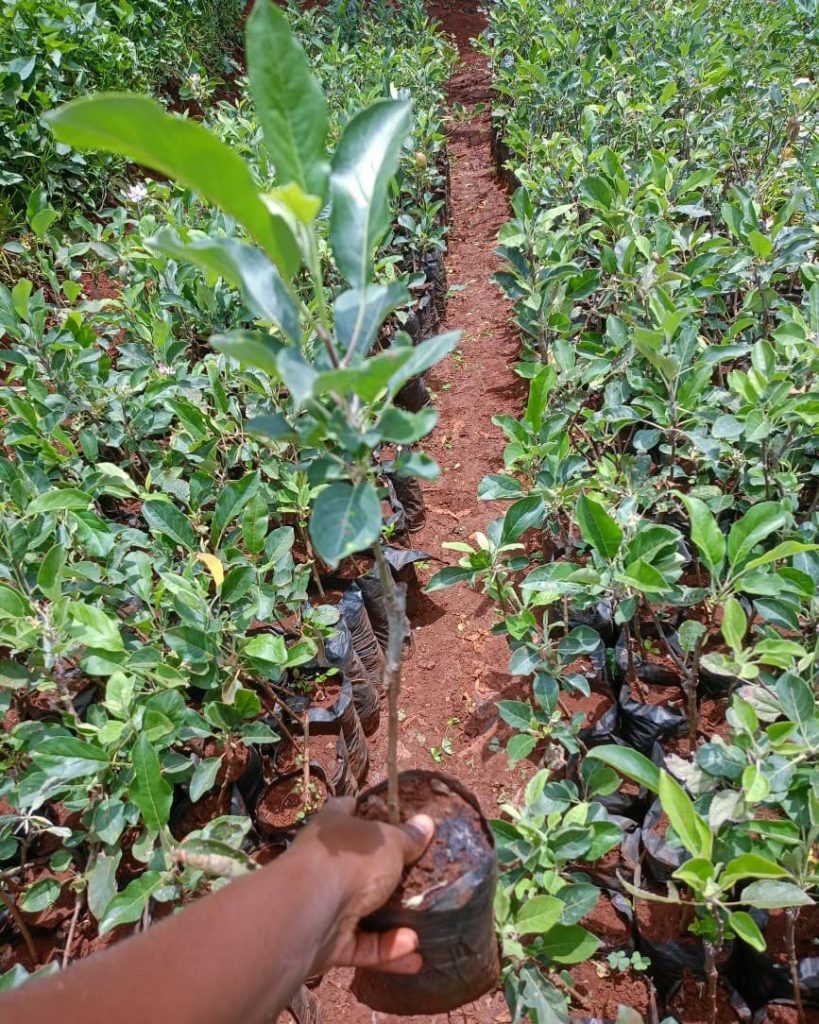
- Find the graft union. It should be a clean bump on the lower stem, usually 10 to 20 cm above the soil. A straight, smooth stem with no bump suggests the tree was grown from seed.
- Check the union is fully healed. Look all the way around for gaps, cracks, dead bark or a knobbly swelling.
- Check the label. It should give the variety, the rootstock and the batch. Ask what is written on the nursery record.
- Look at the stem. It should be straight and firm, not bent, scarred or covered in spots.
- Look at the leaves and buds. Avoid yellow, curled or spotted leaves, and any sign of insects or white woolly patches.
- Check the roots without damaging them. Roots should fill the bag, be pale and healthy, and not grow out through the bottom in a thick mat.
- Compare the trees. Seedlings of the same variety and rootstock should look similar in height and thickness. Very uneven stock suggests mixed sources.
- Ask for the papers. You want the nursery licence, the KEPHIS inspection certificate and a receipt that names the variety and rootstock.
How to Choose a Certified Apple Nursery in Murang’a
The nursery matters as much as the rootstock, because the nursery does the grafting.
What certification means in Kenya
In Kenya, a nursery must be registered and certified before it can legally sell planting material to the public. The process has two parts. The Horticultural Crops Directorate of the Agriculture and Food Authority inspects the nursery, registers it and issues a licence. Then the Kenya Plant Health Inspectorate Service, KEPHIS, inspects it and issues a nursery inspection certificate.
KEPHIS looks at how the plants are propagated, the skill of the operator, where the propagation material comes from (seed, scions and buds), sanitation and hygiene, the structures in place, the quality of the seedlings and the records the nursery keeps. The aim is to stop pests and disease spreading through planting material and to make sure farmers get healthy, correctly named plants.
Questions to ask
Ask to see the licence and the KEPHIS certificate, and check the date. Check that the certificate covers fruit trees, and ask whether apple is among the crops. Ask where the scion wood and the rootstocks come from, and whether the nursery keeps mother-block records.
Ask which M9 clone it uses, and whether it is virus-tested. Ask about its replacement policy if trees die in the first weeks, and whether it will advise you on planting and support. If you can, visit the nursery in person. A well-run nursery is clean, labelled and organised, and it is glad to show you the graft unions.
If you want to confirm a certificate, contact the issuing office directly and ask them to verify it. Do not rely on a photo of a certificate alone.
Why a nursery in Murang’a can make sense
Murang’a County is in the central highlands, close to Nairobi, Kiambu, Nyeri and Embu, and it has been named in reports as an area where apple farming is growing. A nursery in the region raises trees in a climate close to that of many apple farms. Trees that are hardened in a similar climate suffer less shock when planted, and a short journey reduces stress on the seedlings.
Fruit Africa Veriplant lists Murang’a among its nursery distribution bases, together with Nairobi and Embu, and supplies KEPHIS-inspected grafted planting stock. Ask them, as you would any nursery, for the variety, the rootstock clone and the certificate details for the apple stock you want.
Planting and Early Care for Trees on M9
Good grafting is wasted if the tree is planted badly. These steps matter most for M9.
Prepare the site first. Test the soil, correct acidity with lime well ahead of planting, and set out the trellis posts and drip lines before the trees arrive. Choose deep, well-drained loam. Avoid shallow, stony or waterlogged ground.
Dig a hole about 60 cm wide and deep, keeping the topsoil and subsoil apart. Mix the topsoil with well-decomposed farmyard manure and a little phosphate. Plant at the start of the rains.
Keep the graft union at least 10 cm above the soil. If you bury it, the scion can form its own roots. The tree then grows far larger than planned and loses the benefit of the dwarfing rootstock.
Tie each tree to a stake or wire when you plant, and water it well. Spread mulch around the base to cool the soil and hold moisture, but keep it clear of the stem. Keep a weed-free strip along the row.
In the first year, remove the flowers. M9 trees are so precocious that they will try to fruit very young, and a young tree that carries a heavy crop may lose vigour and stay small. Let the tree build its framework first and take a light crop in the second or third year. Remove suckers from the base and keep an eye on the burr knots.
Train young trees to a central leader or slender spindle, so that light reaches every branch. Water on a schedule, and feed according to the soil test, with attention to potassium and calcium.
A 20-Year View: What Grafting Quality Does to Your Orchard
An apple orchard is a long investment. The following table shows the kind of problems that poor grafting causes, and when you are likely to find out. By then it is too late to fix them cheaply.
| Problem | When you notice it | What it costs you |
|---|---|---|
| Wrong or mixed variety | Year 3 to 6, when the fruit appears | Unsellable fruit, years of lost income |
| Weak or incomplete graft union | Year 1 to 6, often under a crop or in wind | Tree lost, replanting, gaps in the row |
| Virus or disease in the rootstock | Year 3 to 10, as slow decline | Weak trees, low yields, early removal |
| Buried union, scion rooted | Year 3 to 8 | Oversized tree, lost dwarfing, crowded rows |
| Mixed or untested rootstock clones | Year 2 onward | Uneven trees, uneven crop |
| Poor roots | The first season | Slow growth, wilting, dead trees |
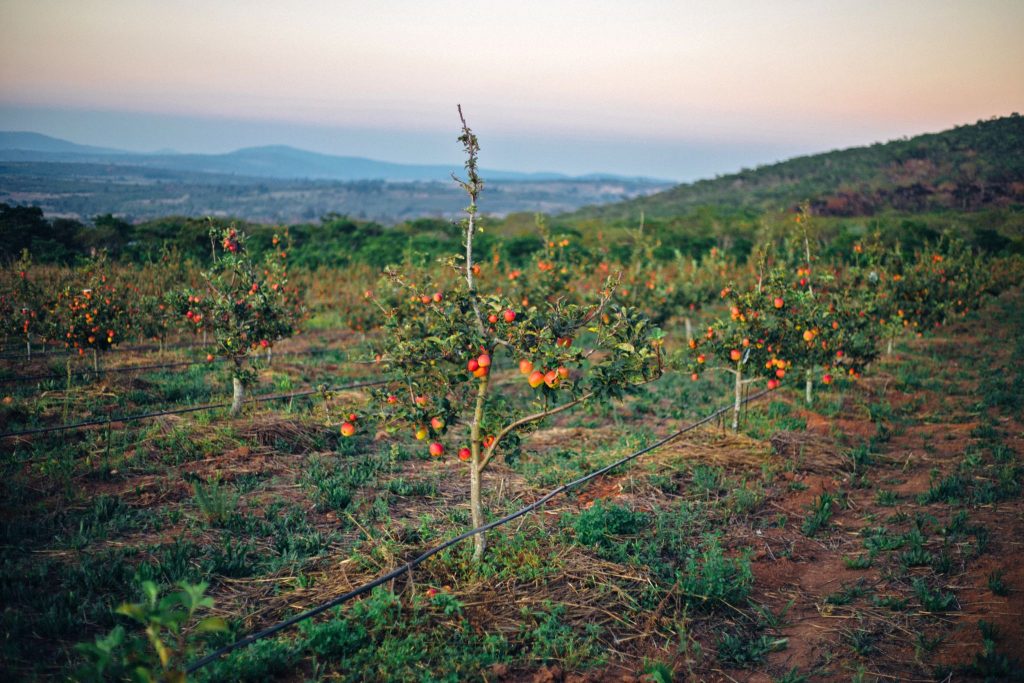
A well-grafted orchard on a suitable rootstock behaves differently. Trees reach the trellis in the first two or three years and give a first crop soon after. The canopy fills in over the next few years. After that, a well-managed block can stay productive for a long period. Many high density orchards are renewed after about 15 to 25 years, depending on variety, market and tree health, so plan your first plantings with replacement in mind.
We are not aware of long-term Kenyan trial data on M9 for the 20-year period in the title. What the research and grower experience from other countries show is clear enough. Trees that are true to type, on a suitable rootstock, with a sound graft, give a regular and even crop. Trees that are not, do not. The first cost of the seedling is small next to the cost of the trellis, the water, the labour and the years you will spend on the orchard.
Mistakes to Avoid
The most common mistake is buying on price. A cheap apple seedling with no graft union, no label and no papers may be a seed-grown tree, and you will not find out for years.
The second is buying “M9” without checking what it is. Ask for the clone, the source and the papers.
The third is planting M9 and skipping the trellis. Brittle roots and heavy crops mean unsupported trees will lean or fall.
The fourth is planting M9 on hot, shallow or dry ground without irrigation, and expecting it to behave as it does in cool Europe.
The fifth is burying the graft union. The sixth is letting young trees overcrop. The seventh is ignoring fire blight and woolly aphid, which M9 does not resist.
The last is planting a whole farm at once. Start with a trial block, learn what works at your altitude and soil, and then expand.
Frequently Asked Questions
What is M9 rootstock?
M9 is a dwarfing apple rootstock selected at East Malling in England in the early 1900s. Grafted trees on M9 grow to about 45 to 50 percent of the size of a standard tree, fruit very early, and need permanent support because the roots are brittle.
Do M9 rootstock apple trees grow well in Kenya?
They can in cooler highland areas with deep, well-drained soil, drip irrigation and a trellis. On hot, shallow or dry sites, M9 may underperform and a semi-dwarf rootstock such as MM106 may be safer. Test a small block of each before you plant a large area.
How tall do apple trees on M9 grow?
They are small trees. With the Cox variety in the United Kingdom, M9 gives a tree of about 1.8 to 2.5 metres. In Kenya, height depends on the variety, soil and care, so ask your nursery for an expected height for your variety.
Do M9 apple trees need support?
Yes. M9 has brittle roots and poor anchorage, so the trees need a post and wire trellis or a strong stake for their whole life.
Can I grow apples from seed in Kenya?
You can grow a tree from an apple pip, but it will not match the parent, may take six to ten years or more to fruit, and often gives poor fruit. For an orchard, plant grafted trees of a named variety.
How can I tell a grafted apple seedling from a seed-grown one?
Look for a healed bump on the lower stem, usually 10 to 20 cm above the soil. A smooth stem with no bump suggests the tree was grown from seed. Also check the label and ask for the nursery papers.
How long do apple trees on M9 stay productive?
Well-managed high density orchards are commonly renewed after roughly 15 to 25 years. How long yours lasts depends on variety, soil, water, disease control and the market you sell into.
What papers should a certified apple nursery show?
Ask to see the nursery licence from the Horticultural Crops Directorate, the current KEPHIS nursery inspection certificate, and a receipt that lists the variety, the rootstock and the number of trees.
Where can I buy grafted apple seedlings in Kenya?
Buy from a registered and inspected nursery that can name the variety and rootstock and show its certificate. Fruit Africa Veriplant, which has a nursery distribution base in Murang’a, supplies KEPHIS-inspected grafted planting stock.
How many apple trees fit on one acre with M9?
It depends on spacing. At 3.5 m by 1 m, about 1,155 trees fit on an acre, and at 4 m by 1.5 m about 675. Closer spacing needs a stronger trellis, more water and better management.
Buy Grafted Apple Seedlings in Kenya
For grafted apple seedlings with named varieties and rootstocks, and KEPHIS-inspected planting stock, contact Fruit Africa Veriplant. Tell them your altitude, your soil, your water source and the number of trees you plan to plant, and ask for a written quote that names the variety and the rootstock clone.
- Head Office Location: Ruiru, Kiambu County, Kenya
- Nursery Distribution Bases: Murang’a, Nairobi, and Embu
- Phone Direct: +254 714 994 444
- WhatsApp Assistance: Message us on WhatsApp
- Official Email: sales@fruitafrica.org
- Official Website: www.fruitafrica.org
- Request a Quote: fruitafrica.org/request-for-quotation/
Summary
A seed-grown apple tree is a gamble. A grafted tree joins a known variety to a rootstock that controls size and early fruiting. M9 gives a small tree that fruits in the second or third year and suits high density orchards, but it needs a trellis, steady water, deep well-drained soil and protection from heat. On warmer or drier sites a semi-dwarf rootstock may serve you better.
Whatever rootstock you pick, the graft decides the result. Check the union, the label, the roots and the papers. Choose a registered and inspected nursery, test a small block first, and expand when your own records show the trees are doing well.