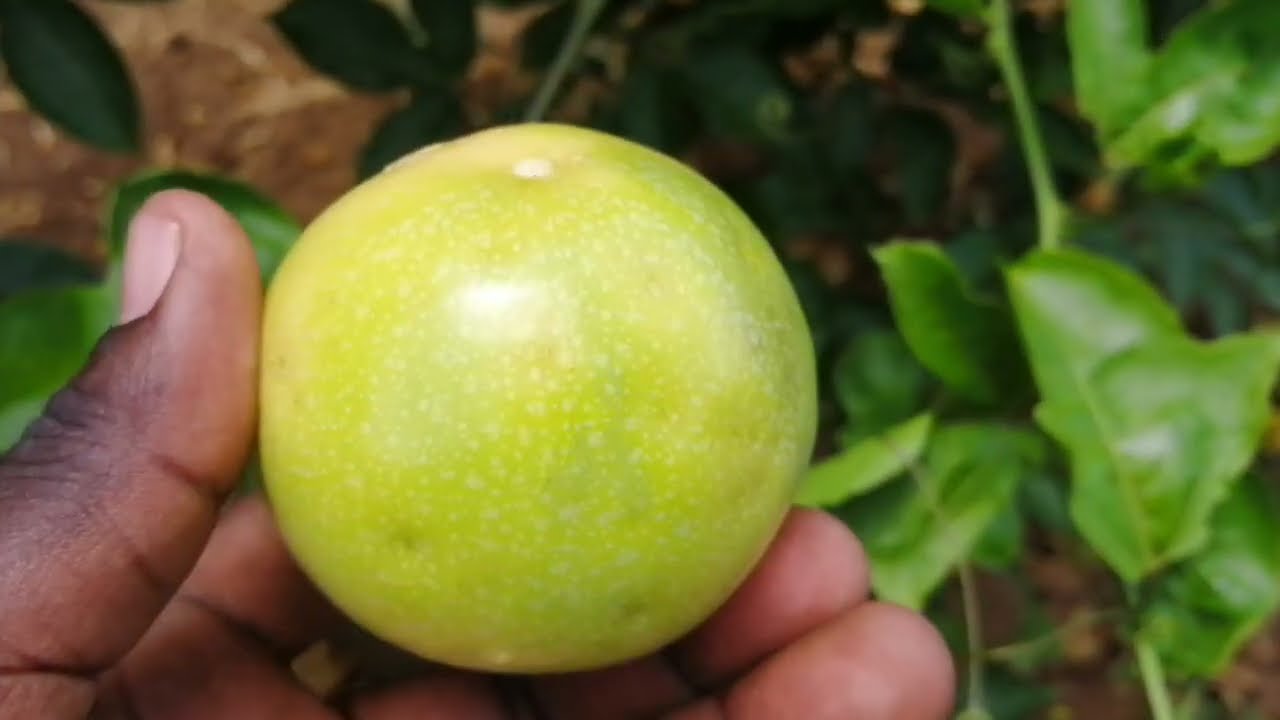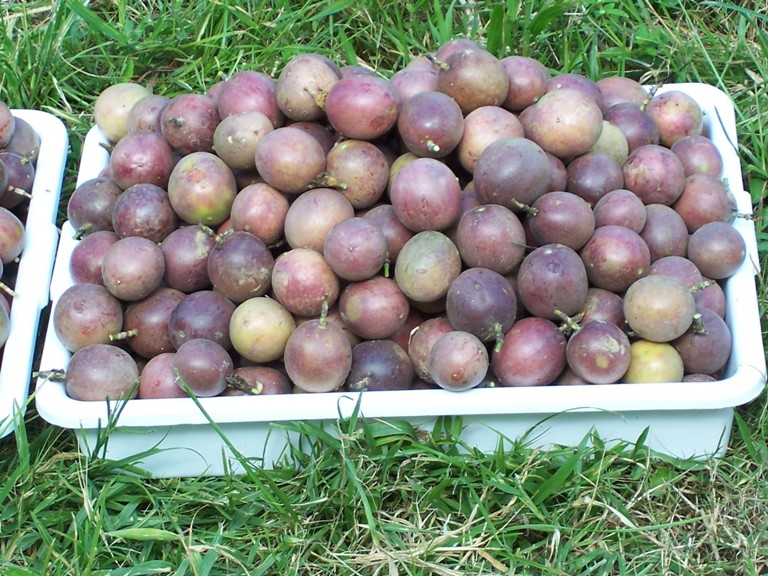

- Granadilla passion fruit seedlings in Kenya at KSh 150 from Fruit Africa Veriplant. Full guide to Sweet Granadilla and Giant Granadilla farming.
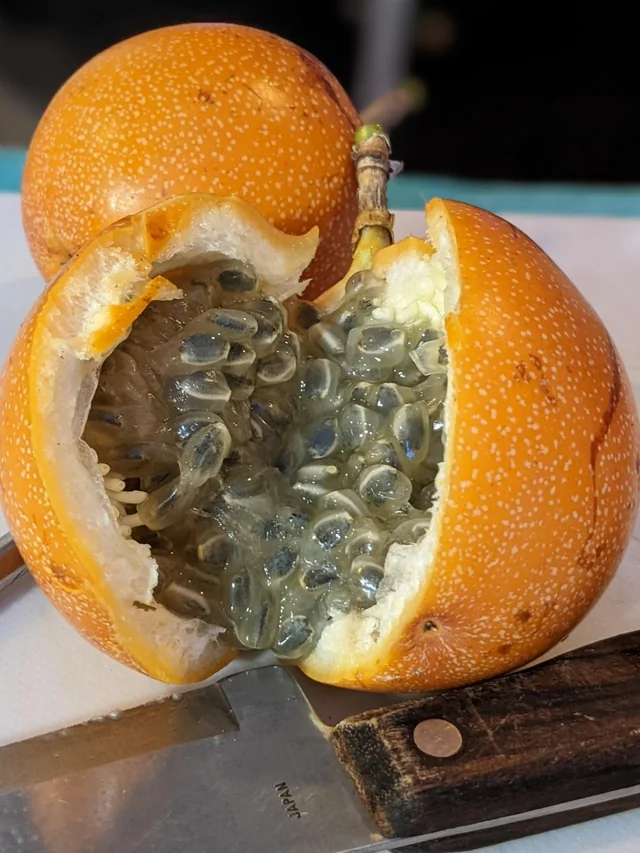
Sweet Granadilla Passion Fruit
Granadilla Passion Fruit Seedlings in Kenya: Sweet and Giant Varieties, Price, Planting and Farming Guide
Fruit Africa Veriplant sells granadilla passion fruit seedlings at KSh 150 each. Two granadilla varieties sit in this category, and they behave like two different crops. Sweet Granadilla, Passiflora ligularis, produces a small to medium fruit with a hard orange-brown shell and sweet aromatic pulp. Giant Granadilla, Passiflora quadrangularis, produces the largest fruit in the passion fruit family, sometimes reaching thirty centimetres in length and weighing over one kilogram.
A farmer buying granadilla seedlings is choosing between these two fruits. The choice depends on altitude, market, and how much trellis work you are willing to do. Sweet Granadilla suits high-altitude farms and fresh fruit buyers. Giant Granadilla suits warmer lowland farms and buyers who pay premium prices for size and appearance.
This guide covers both varieties in detail. It explains what each one is, where each one grows best in Kenya, how to plant and manage the vines, how to handle pests and diseases, and what costs and returns you should plan for before you invest.
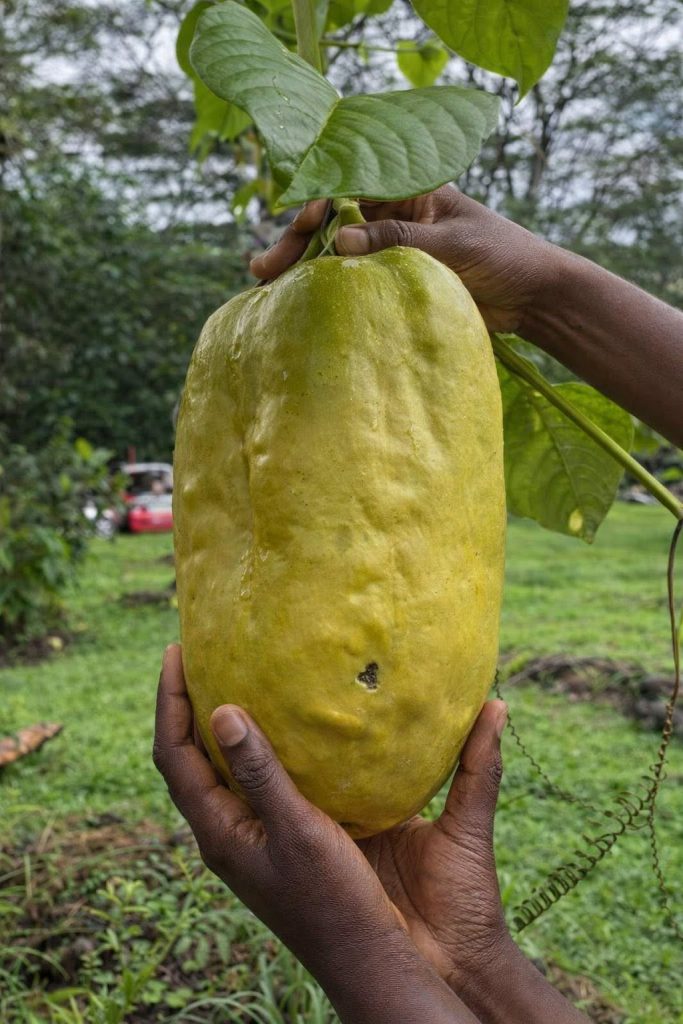
Giant Granadilla Passion Fruit
Granadilla Passion Fruit Seedlings at a Glance
| Item | Sweet Granadilla | Giant Granadilla |
|---|---|---|
| Scientific name | Passiflora ligularis | Passiflora quadrangularis |
| Seedling price | KSh 150 | KSh 150 |
| Fruit size | 7 to 8 cm diameter | 20 to 30 cm long |
| Fruit weight | 80 to 115 grams | 120 to 480 grams, up to 1 kg |
| Skin | Hard, orange-brown | Thick, pale yellow-green |
| Pulp | Sweet, aromatic, low acid | Mild, watery, acid-sweet |
| Best altitude | 1,500 to 2,700 metres | 800 to 1,800 metres |
| Main market | Fresh eating, ice cream, beverages | Hotels, premium retail, juice |
What Is Sweet Granadilla?
Sweet Granadilla is a vigorous woody climbing vine that produces one of the sweetest fruits in the passion fruit family. The vine carries entire leaves and greenish-white flowers that open in the morning. The fruit is an oval berry, seven to eight centimetres in diameter, with a hard orange-brown shell when fully ripe.
The shell protects the pulp for a long time after harvest, which is one reason the fruit travels well. The pulp inside is juicy and aromatic, with lower acidity than common passion fruit. Sweet Granadilla gets its name from that low acidity. A ripe fruit can be opened with a spoon and eaten straight from the shell without added sugar.
The fruit weighs eighty to one hundred fifteen grams. The juice recovery sits between twenty-four and twenty-six percent, which is lower than common passion fruit. The total soluble solids range from twelve to sixteen Brix, and the acidity sits around three to four percent, which is higher than purple passion fruit but lower than the yellow form.
Sweet Granadilla grows at high elevations in the tropics. It thrives in humid conditions and prefers cooler temperatures than common passion fruit. The vine is more cold-tolerant than other Passiflora species, which is why highland farmers can grow it where other passion fruits struggle.
What Is Giant Granadilla?
Giant Granadilla is the largest fruit in the Passiflora genus. The vine is a perennial climber with scented flowers and large, angular stems. The fruit is an oblong berry, twenty to thirty centimetres long, with a thick pale yellow-green skin when ripe.
The fruit weighs between one hundred twenty and four hundred eighty grams, and some fruits reach over one kilogram. Inside, the fruit holds watery red-purple juice and an acid-sweet pulp with many dark brown seeds covered in white jelly-like arils. The flavour is mild and refreshing, less acidic than common passion fruit.
Giant Granadilla grows best in warm, humid conditions. It tolerates heat better than Sweet Granadilla but does not tolerate frost. The vine is exceptionally vigorous and needs strong trellis support because the fruits are heavy. A vine carrying thirty fruits at one kilogram each carries thirty kilograms on the trellis at one time.
The unripe green fruit is boiled and eaten as a vegetable in some countries. The ripe fruit is eaten fresh, blended into juices, and used in desserts and ice cream. The pulp also contains pectin, which suits jam making.
How Granadilla Differs from Common Passion Fruit
Granadilla is not the same as the common purple passion fruit sold in Kenyan markets. The three belong to the same family, but they are different species with different fruit characteristics and growing requirements.
Purple passion fruit, Passiflora edulis, produces a round purple fruit with sweet aromatic pulp. It is the most common passion fruit in Kenya and the mainstay of the fresh market. Yellow passion fruit, Passiflora edulis flavicarpa, produces a larger, more acidic yellow fruit used mainly for processing.
Sweet Granadilla is a different species. The fruit is smaller than common passion fruit, the shell is hard and orange-brown, and the pulp is sweeter. It grows at higher altitudes than common passion fruit and prefers cooler conditions. The vine is slower to establish but lives longer.
Giant Granadilla is also a different species. The fruit is dramatically larger, the skin is thicker, and the pulp is milder and more watery. It grows at lower altitudes than Sweet Granadilla and tolerates warmer conditions.
A farmer who already grows purple passion fruit should not assume granadilla performs the same way. The planting material, the site requirements, the trellis needs, and the market are all different.
Why Farmers Grow Granadilla in Kenya
Granadilla gives Kenyan farmers a fruit that sits outside the crowded purple and yellow passion fruit market. Sweet Granadilla sells to consumers who want a sweet fruit that can be eaten straight from the shell. Giant Granadilla sells to hotels, premium supermarkets, and juice processors who want a fruit with visual impact and a mild, refreshing flavour.
The market for granadilla in Kenya is smaller than the market for common passion fruit, but the prices are higher. A single Giant Granadilla fruit sells for eighty to one hundred fifty shillings depending on size and location. Sweet Granadilla sells in smaller volumes but commands a premium in fresh markets where customers know the fruit.
Granadilla also suits farmers who want to diversify. A farmer with an existing passion fruit block can add a small granadilla block to spread market risk and test a new crop without abandoning the established one.
The vines are productive when managed well. A mature Giant Granadilla vine produces thirty to fifty fruits per season, and each fruit weighs one to two kilograms. That works out to forty to eighty kilograms of fruit per vine per year. Sweet Granadilla yields less per vine but the fruit holds a premium in fresh markets.
Ecological Conditions for Sweet Granadilla
Sweet Granadilla suits high-altitude tropical farms. It grows best between one thousand five hundred and two thousand seven hundred metres above sea level, depending on the local climate. Highland farmers in Kenya who already grow coffee, bananas, and temperate fruits can add Sweet Granadilla to the mix.
The vine prefers cooler temperatures than common passion fruit. It does not tolerate high heat, and it performs best in areas with moderate daytime temperatures and cool nights. Daytime temperatures between eighteen and twenty-four degrees Celsius suit the vine. Night temperatures below eight degrees slow growth but do not kill the plant.
Rainfall of one thousand millimetres or more per year, well distributed, supports the crop. Sweet Granadilla thrives in humid conditions. The vine also tolerates mist and cloud cover, which suits highland areas that receive afternoon mist.
Soil should be deep, well drained, and rich in organic matter. The ideal pH range runs from five point five to six point five. Waterlogged soil kills the vine, so drainage matters as much as soil fertility.
Sweet Granadilla grows in Colombia, Ecuador, Peru, and parts of East Africa. In Kenya, it suits the highland areas of Kiambu, Murang’a, Nyeri, Kirinyaga, Nyandarua, Meru, Embu, Nakuru, Kericho, and the higher parts of Kisii and Nyamira.
Ecological Conditions for Giant Granadilla
Giant Granadilla suits warmer, lower-altitude farms. It grows best between eight hundred and one thousand eight hundred metres above sea level. The vine tolerates heat better than Sweet Granadilla but does not tolerate frost.
Altitude affects fruit size and yield. Higher altitudes within the suitable range give slower growth but larger fruit. Lower altitudes give faster growth and earlier harvest but slightly smaller fruit on average.
Rainfall of one thousand millimetres or more per year, well distributed, supports the crop. Giant Granadilla needs consistent moisture and does not tolerate prolonged drought. A dry spell longer than three weeks during flowering cuts fruit set.
Soil should be deep, well drained, and fertile. The ideal pH range runs from five point five to six point five. The vine is a heavy feeder, especially during flowering and fruiting, so organic matter and regular fertiliser matter.
Giant Granadilla grows well in Kiambu, Murang’a, Nyeri, Kirinyaga, Meru, Embu, Nakuru, Kericho, Nandi, Uasin Gishu, Bungoma, Kakamega, and Kisii. The crop also grows in other warm to cool areas with fertile, well-drained soils.
Land Preparation for Granadilla
Prepare land two to three months before the seedlings arrive. Clear the site of weeds, bushes, and old stumps. Do not burn the cut material on the plot, because fire kills soil life. Stack the material away from the planting area, and use it later as mulch after it dries.
Plough to loosen the topsoil, then harrow to break clods and level the surface. If your soil is compacted, consider subsoiling to break the hardpan. A hardpan layer traps water above it and blocks root growth below it, which is the worst combination for granadilla.
Test the soil before planting. Send a sample to a laboratory for pH, organic matter, and basic nutrients. If the pH falls below five point five, apply lime at the rate the soil test recommends, and work it into the topsoil at least one month before planting.
Check drainage carefully. Granadilla dies in waterlogged soil. If your site collects water after heavy rain, dig open drains along the lowest part of the field. On flat land with heavy clay, plant on raised beds to lift the root zone above the water table.
Mark your rows and planting points before you dig. At two metres between plants and three metres between rows for Sweet Granadilla, or three metres by three metres for Giant Granadilla, you peg a grid across the field. Straight rows make trellis construction, pruning, and harvest easier.
How to Prepare Planting Holes
Dig each planting hole sixty by sixty by sixty centimetres for Sweet Granadilla. For Giant Granadilla, dig larger holes at eighty by eighty by eighty centimetres, because the vine grows bigger and needs more root room. Keep topsoil and subsoil in separate heaps.
Mix the topsoil with ten to twenty kilograms of well-rotted manure or compost, and add one hundred to one hundred fifty grams of a phosphorus-rich fertiliser if the soil test calls for it. Mix thoroughly so no concentrated lumps remain.
Do not fill the hole with raw manure. Fresh manure burns young roots. Let the prepared hole rest for one to two weeks before planting, so the soil settles and the manure begins to break down.
Spacing for Granadilla
Spacing for granadilla differs by variety and by the trellis system you use.
Sweet Granadilla grows on a moderate vine and suits spacing of two to three metres between plants and three metres between rows. At two metres by three metres, each plant occupies about six square metres, which gives about six hundred seventy-four plants per acre in theory. At three metres by three metres, each plant occupies nine square metres, which gives about four hundred fifty plants per acre.
Giant Granadilla grows on a very vigorous vine and needs wider spacing. Commercial plantings use three metres by three metres, and some growers go wider. At three metres by three metres, each plant occupies nine square metres, which gives about four hundred fifty plants per acre in theory.
The wider spacing for Giant Granadilla reflects the size of the vine and the weight of the fruit. A vine carrying thirty to fifty fruits at one to two kilograms each carries a heavy load, and the trellis and the spacing must support that load.
| Variety | Spacing | Theoretical Plants per Acre |
|---|---|---|
| Sweet Granadilla | 2m by 3m | About 674 |
| Sweet Granadilla | 3m by 3m | About 450 |
| Giant Granadilla | 3m by 3m | About 450 |
Order five percent extra for gap filling. The practical number you plant is usually lower than the theoretical maximum, because paths, boundaries, and access points take up space.
Seedling Cost at KSh 150 Per Seedling
Seedling cost comes from multiplying the number of plants by KSh 150.
| Variety | Spacing | Practical Plants | Seedling Cost at KSh 150 |
|---|---|---|---|
| Sweet Granadilla | 2m by 3m | 620 | KSh 93,000 |
| Sweet Granadilla | 3m by 3m | 420 | KSh 63,000 |
| Giant Granadilla | 3m by 3m | 420 | KSh 63,000 |
The seedling price covers only the plant. Budget separately for land preparation, planting holes, manure, fertiliser, trellis posts, trellis wire, labour, irrigation, mulch, and pest management.
Trellis Design for Granadilla
Granadilla vines need strong trellis support. The vine climbs by tendrils, and without a trellis it falls to the ground and produces poorly. A vine that sprawls on the ground loses fruit to rot and pests, and it becomes almost impossible to manage.
A standard trellis uses wooden or concrete posts spaced six to eight metres along each row. Posts stand at least two metres above ground. Run a top wire at about one point eight to two metres above the ground, and one or two lower wires below.
Post spacing at six metres along a three metre row spacing gives one post per eighteen square metres. On one acre, that works out to about two hundred twenty posts.
Giant Granadilla needs a stronger trellis than Sweet Granadilla because the fruits are heavier. Use thicker posts and stronger wire. Brace end posts against the pull of the wire. A weak trellis collapses under a heavy fruit load, and the vines fall with it.
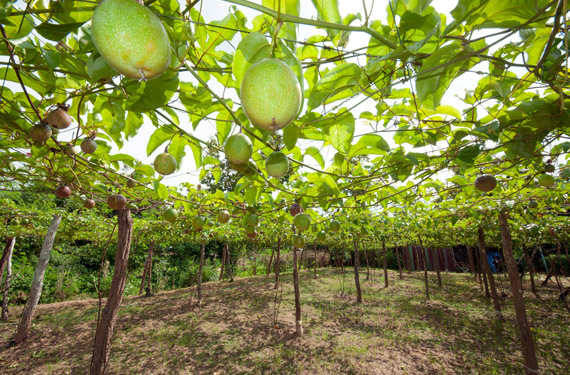
Structure for Giant Granadilla
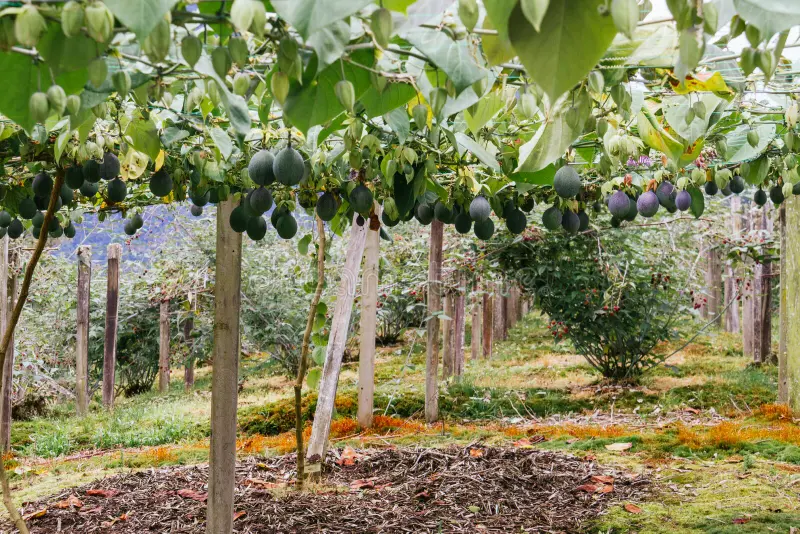
Trellis for Sweet Granadilla
Post Material and Post Depth for Granadilla
Wooden posts work well if treated against termites and rot. Use a preservative that does not leach into the soil around the vine. Concrete posts cost more upfront, but they last many seasons and do not need treatment.
Drive each post at least sixty centimetres into the ground for Sweet Granadilla and deeper for Giant Granadilla. On soft soils, go deeper still. The post must hold steady when the vine carries a heavy fruit load and when wind pushes against the trellis.
Wire Gauge and Tensioning for Granadilla
Use a wire gauge that carries the weight of a mature vine without stretching. Run the top wire along the top of the posts and secure it with staples or wire clips. Run a second wire about sixty centimetres below the top wire, and a third wire about one hundred twenty centimetres below the top wire if your trellis is tall.
Tension the wire with a wire strainer at the end of each row. A well-tensioned wire stays level through the season.
End Posts and Anchors
End posts carry the pull of the wire across the whole row. Set end posts deeper than intermediate posts, and brace them against the pull. A common approach is a diagonal brace from the top of the end post to a short anchor post set in the ground a metre away.
Row Orientation for Granadilla
Rows running east to west give even light across the canopy through the day. Rows running north to south also work. Choose the orientation that fits your field shape and access.
Training Granadilla Vines onto the Trellis
Training begins from day one. Tie the young vine to the stake with soft ties that do not cut the stem. Guide it upward as it grows. When the vine reaches the top wire, pinch the growing tip to encourage branching. Let side branches develop along the wire.
Remove shoots that grow below the top wire. The vine should carry its growth above the trellis. Remove tangled tendrils that make pruning difficult later.
Giant Granadilla is exceptionally vigorous and needs regular training and pruning to remain manageable. Select one strong main stem and tie it to the trellis. Remove all side shoots until the vine reaches the top wire. Once the vine reaches the top, allow four to six lateral branches to develop along the wires.
Early Training Rhythm for Granadilla
Check the vine every week during the first three months. Tie new growth to the stake, remove side shoots below the top wire, and guide the main stem upward. Small adjustments each week prevent the vine from developing a shape that is hard to correct later.
What to Do When a Granadilla Vine Reaches the Wire
When the main stem reaches the top wire, cut the tip. This forces the vine to branch. Choose strong side branches, one running each way along the wire, and tie them in place. Remove all other branches at this stage, so the vine puts its energy into the main arms.
Pruning and Canopy Management for Granadilla
Granadilla produces fruit on new growth. Pruning keeps the canopy open and encourages fresh shoots.
After each harvest, cut back the fruiting branches. Remove dead, damaged, and crossing branches. Thin the canopy so light reaches the inner branches and air moves through the vine.
For Giant Granadilla, maintenance pruning removes dead, diseased, or overcrowded branches. Cut back overly long shoots to encourage branching. Prune after each harvest to stimulate new growth for the next season.
Rejuvenation pruning every three to four years renews the canopy. Cut back the main vines to a height of one to two metres to renew the canopy and maintain productivity. Without rejuvenation, the vine produces less each year and the fruit size drops.
Managing the Canopy Above the Wire
Keep the canopy above the top wire. Vines that hang below the wire produce fruit close to the ground, where fruit rot and pests do more damage. Lift low branches back onto the wire, and remove branches that hang below the lower wire.
Water Management for Granadilla
Granadilla needs consistent moisture. Young vines need water two to three times a week during dry spells. Mature vines need water every five to seven days during dry spells.
Giant Granadilla needs copious watering and does not tolerate prolonged drought. Mulching heavily around each plant helps retain soil moisture and suppress weeds. A layer of mulch ten centimetres thick reduces evaporation from the soil surface.
Signs of water stress include wilting in the afternoon, yellowing lower leaves, and slow new growth. Signs of overwatering include yellowing leaves across the plant, root rot, and vine collapse. Check soil moisture before you irrigate. If the soil stays moist a few centimetres below the surface, the vine has enough water.
Drip Irrigation for Granadilla
A drip system for one acre uses a tank or pump, a filter, a main line, and lateral lines with two emitters per vine. Run laterals along each row, and place emitters on opposite sides of the vine. Flush the filter weekly and check emitters monthly.
Irrigation and Fruit Quality
Consistent moisture during fruit fill supports fruit size and juice content. Irregular watering during fruit development causes fruit cracking and drop. Once the fruit matures and harvest approaches, reduce irrigation slightly to concentrate sugars in the fruit.
Fertilizer and Nutrition for Granadilla
Granadilla is a heavy feeder, especially during flowering and fruiting.
For Giant Granadilla, young plants in year one receive one hundred grams of NPK 17:17:17 per plant every two to three months, plus ten kilograms of manure per plant annually. Mature plants from year two onward receive two hundred to three hundred grams of NPK 17:17:17 per plant every two months during the growing season, supplemented with fifteen to twenty kilograms of manure per plant annually. Increase potassium during flowering and fruit development to improve fruit size and quality.
Foliar sprays containing micronutrients, particularly zinc, boron, and magnesium, improve flowering and fruit set.
Read the leaves for signs of shortage. Yellowing between the veins points to magnesium shortage. Yellowing across whole leaves points to nitrogen shortage. Purple or reddish leaf edges point to phosphorus shortage. Take a photograph of the symptom and send the photograph to your agronomist before you apply any product.
Split Applications and Timing for Granadilla
Granadilla responds best to small, frequent feeds rather than large, infrequent ones. Split the annual fertiliser into two or three applications through the growing season. Apply the first at the start of the rains, the second at the start of flowering, and the third as the first fruit fills.
Avoid applying fertiliser during drought unless you can water it in. Dry fertiliser on dry soil stays put and burns roots when rain finally arrives.
Organic Matter and the Long-Term Soil
Add compost or well-rotted manure every year, and let mulch break down into the soil. Organic matter builds slowly but improves water holding and nutrient release across the life of the field.
Weed Management for Granadilla
Keep a clean ring of about sixty centimetres radius around each vine, and slash the rest of the field. Plan four weeding rounds per year. Avoid deep hoeing near the vine, because granadilla roots grow shallow.
Mulch reduces weed pressure and holds soil moisture. Keep mulch a few centimetres away from the stem.
Managing Weeds in the Trellis Row
Weeds in the trellis row are the hardest to remove because the wire and posts limit hoe access. Hand-pull the weeds closest to the vine, and use a slasher for the rest. Do not apply herbicide in the vine ring, because granadilla roots grow shallow and easily absorb herbicide.
Pollination and Fruit Set for Granadilla
Giant Granadilla flowers are self-fertile but benefit from insect pollination. Introducing beehives, two to three hives per acre, during flowering improves fruit set and yields while providing honey as an additional income stream.
Fruit set is often poor outside the region of origin unless the flowers are hand-pollinated. Hand pollination lifts fruit set on small blocks where pollinator activity is low.
Sweet Granadilla also benefits from insect pollination. Encourage pollinators by planting flowering plants near the field, and avoid spraying insecticides during flowering.
Hand Pollination for Granadilla
If fruit set is poor and pollinator activity is low, hand pollination lifts fruit set on small blocks. Pick a fresh flower in the morning, brush the anthers against the stigma of another flower, and repeat across the block. Hand pollination is slow, but it lifts fruit set on farms where pollinator numbers have dropped.
Pests Affecting Granadilla
Aphids cluster on new shoots and the undersides of leaves. They suck sap and transmit viral diseases. Control with neem oil, insecticidal soap, or appropriate insecticides. Encourage natural predators like ladybirds.
Spider mites cause stippling, discoloration, and premature leaf drop. Severe infestations reduce plant vigour. Control with miticides or sulphur-based sprays. Regular watering and maintaining humidity around the canopy helps suppress mite populations.
Fruit flies lay eggs in developing fruit, leading to maggot infestation, fruit decay, and premature drop. Use pheromone traps and protein bait sprays. Practice strict orchard sanitation by removing and destroying fallen and infested fruits.
Scale insects attach to stems and leaves, sucking sap and causing yellowing and stunted growth. Control with horticultural oil or systemic insecticides.
Mealybugs feed on stems and leaves and produce honeydew that attracts ants. Ant control is part of mealybug management.
For any pesticide use, follow the product label and local regulations. Respect pre-harvest intervals. Use protective equipment.
Diseases Affecting Granadilla
Fusarium wilt is a soil-borne fungal disease that causes yellowing, wilting, and eventual vine death. Prevention is the only effective approach. Plant disease-free seedlings, avoid waterlogged soils, and rotate with non-host crops. Remove infected vines immediately and do not replant granadilla on the same site.
Leaf spot and powdery mildew appear as spots or white powdery growth on leaves. Prune to improve air circulation. Apply copper-based fungicides or sulphur-based products preventively during wet periods.
Root rot develops in waterlogged soils. Drainage is the main prevention.
For chemical control, use only products registered for passion fruit, follow the label, and respect pre-harvest intervals. Integrated pest and disease management gives better results than spraying alone.
Field Hygiene as the First Defence
Remove and destroy infected vines as soon as you identify them. Do not leave infected material in the field or on the compost heap, because the disease spreads from plant debris. Disinfect pruning tools between vines with a household bleach solution or a registered disinfectant.
Rotating Away from Old Granadilla Ground
Do not replant granadilla into ground that grew granadilla within the last two seasons. The soil carries Fusarium and Phytophthora that attack young vines. Grow a cereal or a legume for one or two seasons before replanting, or plant a new block on fresh ground.
Flowering and Fruit Development for Granadilla
Granadilla vines begin flowering under good conditions. Sweet Granadilla produces one fruit crop per year. Giant Granadilla fruits more or less continually all year in warm conditions, and a productive vine fruits year-round in areas with steady warmth and moisture.
Fruit develops over four to six months from flowering for Giant Granadilla. Sweet Granadilla fruit develops over a similar period, depending on temperature and water.
The first harvest usually comes six to nine months after planting, depending on the time of transplanting. Approximately eighteen months after planting, the crop reaches full bearing potential.
Flowering Cycles Through the Year
A healthy vine flowers in waves through the year, with a strong flush during the warm season and a smaller flush during cooler months. Manage each flush by keeping water steady, avoiding heavy pruning, and reducing insecticide sprays during the flowering window.
Fruit Development and What Affects Fruit Size
Fruit size depends on pollination, water during fruit fill, potassium availability, and the number of fruit the vine carries. A vine carrying a heavy load produces smaller fruit than one carrying a moderate load. If your market pays for size, thin the fruit slightly after the first set, so the remaining fruit grow larger.
Harvesting Granadilla
Sweet Granadilla fruit is ready for harvest when the skin turns orange-brown and the fruit gives slightly when gently squeezed. The fruit does not drop from the vine when ripe, so harvesting must be done by hand. Clip the fruit from the vine with sharp pruning shears, leaving a short stub attached.
Giant Granadilla is ready for harvest when the skin becomes translucent and glossy and begins to turn yellowish at the apex. Clip the fruit from the vine with sharp pruning shears. Handle carefully to avoid bruising or damaging the skin.
Harvest every few days through the harvest window. Sort fruit after harvest, and remove damaged or diseased fruit before delivery.
Picking Rhythm Through the Week
Granadilla does not ripen all at once. Pick every two or three days through the harvest window. Daily picking during the peak flush keeps ripe fruit from over-maturing on the vine and spoiling.
Post-Harvest Handling and Storage for Granadilla
Sort fruits by size, colour, and quality. Remove any fruits with blemishes, cracks, or signs of disease. Store in a cool, well-ventilated area away from direct sunlight.
Ripe Giant Granadilla fruits have a relatively short shelf life, one to two weeks at room temperature and three to four weeks when refrigerated between eight and twelve degrees Celsius.
Pack fruit in ventilated crates rather than sealed plastic bags. Store fruit in a cool, shaded place before transport. Deliver to the buyer within two to three days of harvest.
Packing for Different Buyers
Supermarkets and premium retailers want uniform size and colour. Hotels buy fruit for fruit platters and desserts, and they often want a specific size. Juice processors accept mixed grades but pay based on pulp weight. Ask each buyer what packing they want, and pack separately for each buyer rather than sending mixed crates.
Selling Granadilla
Granadilla has several market channels. The strongest is premium fresh market and hotels.
Giant Granadilla sells through upscale supermarkets, hotels, and juice processors. The fruit’s size and visual impact suit hotel fruit platters and premium retail displays. A single fruit sells for eighty to one hundred fifty shillings depending on size and location.
Sweet Granadilla sells in fresh markets where customers know the fruit. It also sells to ice cream makers and beverage processors.
Hotels and juice makers in Nairobi, Mombasa, and Kisumu source Giant Granadilla for its unique flavour and presentation.
Identify your market before you plant. Visit hotels, supermarkets, and processors, and confirm their requirements.
Buying Agreements and Consistent Supply
A buyer who receives consistent volume and quality becomes a repeat buyer. If a hotel or supermarket agrees to buy from you, keep the volume and grade steady through the season. A written agreement stating weekly volume, grade, and price protects both sides.
Yield Estimation for Granadilla
Yield varies widely between farms. Variety, plant population, vine age, water, nutrition, pruning, pollination, pest control, and disease pressure all affect the crop.
For Giant Granadilla, a mature vine produces thirty to fifty fruits per season, each weighing one to two kilograms. That works out to forty to eighty kilograms of fruit per vine per year. At four hundred twenty plants per acre, that gives sixteen thousand eight hundred to thirty-three thousand six hundred kilograms per acre per year.
For Sweet Granadilla, a mature vine produces a moderate crop of smaller fruits. Yield varies with site and management.
These are planning scenarios, not guarantees. Actual results depend on your site and management.
Weight Versus Fruit Count
Buyers often buy by weight rather than by fruit count. A Giant Granadilla fruit weighs between one hundred twenty and four hundred eighty grams, and some reach over one kilogram. Convert your fruit count into weight when you plan revenue, because the price per kilogram is what most buyers quote.
Marketable Yield Versus Total Yield
Not every fruit that grows on the vine reaches the buyer. Bruising, pest damage, and disease reduce marketable yield. Plan with marketable yield rather than total yield, and aim to keep losses below ten percent through careful harvest, sorting, and packing.
Revenue Calculations for Granadilla
Revenue comes from multiplying marketable yield by the price per fruit or per kilogram. Use your own market price when you run the numbers.
Number of marketable fruits × average selling price = gross sales.
Marketable yield in kilograms × farm-gate price per kilogram = gross revenue.
Gross revenue is not profit. Deduct production costs to reach gross margin, and deduct all other costs to reach net profit.
Working Through a Simple Example
Assume four hundred twenty Giant Granadilla plants and a middle scenario of forty marketable fruits per vine. That gives sixteen thousand eight hundred fruits. If your buyer pays one hundred shillings per fruit, gross revenue comes to one million six hundred eighty thousand shillings. If your buyer pays by weight and each fruit averages one kilogram, the crop weighs sixteen thousand eight hundred kilograms. At one hundred shillings per kilogram, gross revenue comes to one million six hundred eighty thousand shillings. Replace these figures with your own buyer price before you plan.
Farm Establishment Costs for Granadilla
Seedling cost is easy to calculate from the KSh 150 price. Other costs depend on your location, materials, and labour.
| Cost Category | Notes |
|---|---|
| Seedlings | Number of plants × KSh 150 |
| Land preparation | Ploughing, harrowing, drainage work |
| Planting holes | Labour for digging and filling |
| Manure and compost | Based on soil test and local rates |
| Planting fertiliser | Based on soil test |
| Trellis posts | One post per 18 square metres |
| Trellis wire | Top wire and lower wires |
| Labour | Planting, training, weeding, pruning |
| Irrigation | System installation if needed |
| Mulch | Materials and labour |
| Pest and disease management | Monitoring and inputs |
| Harvesting | Labour and containers |
| Transport | Farm to buyer |
Trellis Costs Often Lead the Budget
Trellis material is usually the largest single cost after seedlings. Posts, wire, and labour to build the trellis can exceed the seedling bill on a one-acre block. Plan the trellis first, because the vine needs it from day one, and a weak trellis costs more to replace than to build properly at the start. Giant Granadilla needs a stronger trellis than Sweet Granadilla, so the trellis cost for Giant Granadilla runs higher.
Labour Costs Through the Season
Granadilla needs labour at planting, training, weeding, pruning, spraying, and harvest. Labour demand peaks during harvest, when you may need daily pickers. Plan for extra labour during the harvest window, and agree on pay per day or per kilogram with your workers before the season starts.
Common Mistakes Farmers Make with Granadilla
Planting Sweet Granadilla in low-altitude hot areas where it does not perform.
Planting Giant Granadilla in high-altitude cold areas where it grows slowly.
Building a weak trellis that collapses under a heavy Giant Granadilla fruit load.
Burying the root collar at planting.
Skipping soil testing and guessing at fertiliser.
Letting weeds grow around young vines.
Pruning heavily during flowering.
Spraying insecticides during peak flowering and reducing pollinators.
Ignoring disease symptoms until the vine collapses.
Planting the same field to granadilla year after year without a break.
When to Replace Weak Granadilla Vines and Replant
Replace weak vines as soon as you notice them. A vine that wilts and stays wilted, shows vascular browning, or produces poorly across two seasons costs you space and inputs. Remove the vine, destroy the plant material, and plant a fresh seedling in the gap.
Replant the whole field when yields drop across most vines, usually after three to four seasons. Prepare the new field with a break crop or a fallow period before you replant.
Deciding on the Replant
Walk the field and count the vines that are producing well. If fewer than six in ten vines carry a good crop, the field is due for replanting. If seven or more in ten vines produce well, keep the field for another cycle and remove the weak vines.
How to Identify Healthy Granadilla Seedlings
A healthy granadilla seedling has clear signs.
The leaves are green and free of yellowing, spotting, or insect damage. The shoot is firm and upright.
The root ball holds together when you slide the seedling from its bag. Roots look pale and healthy rather than brown or mushy.
The bag carries a label with the variety name, the batch number, and the sowing date. Sweet Granadilla and Giant Granadilla are different species, so confirm the variety before you pay.
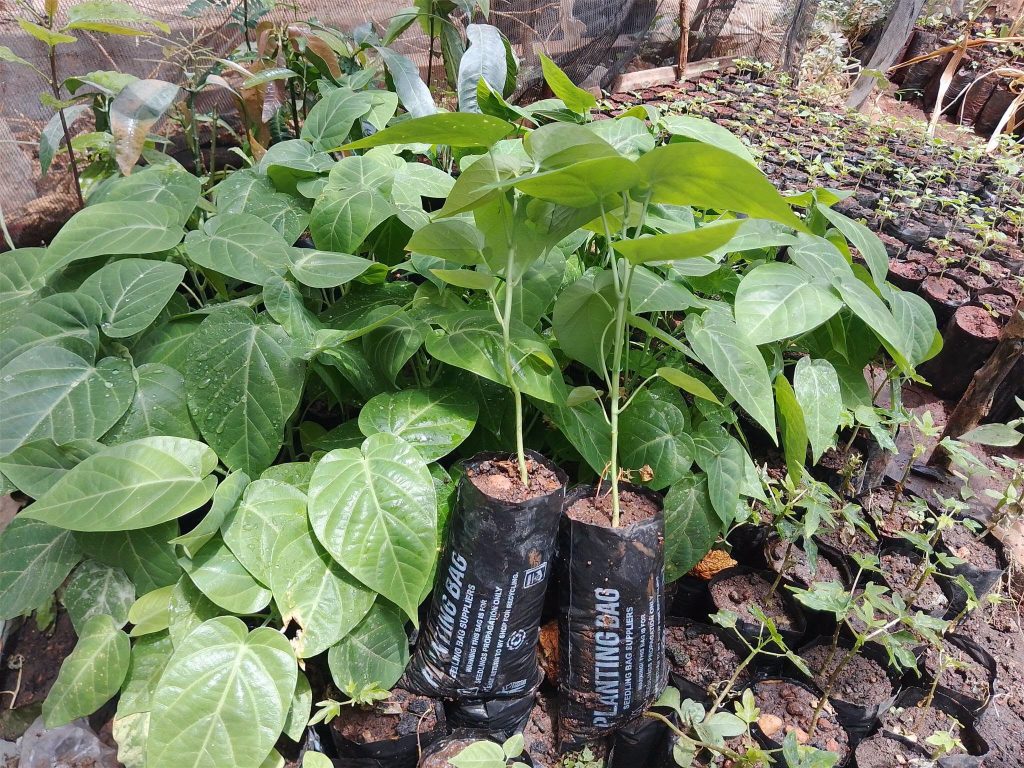
Sweet granadilla Passion fruit seedlings at Fruit Africa Veriplant
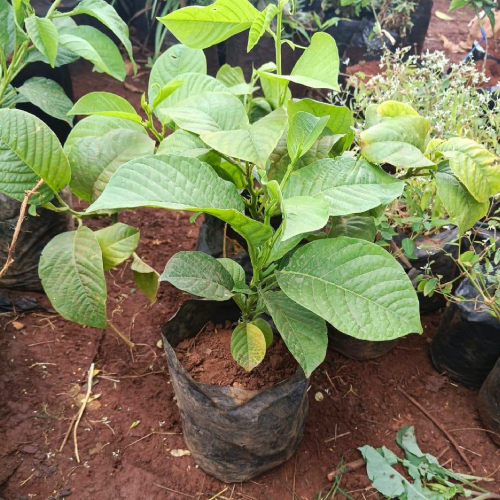
What to Check at the Nursery
Visit the nursery if you can. Ask to see the mother plants and the seedlings for sale. Confirm the variety and the seed source. Ask how the nursery hardens seedlings before dispatch. Ask about replacement policy for plants that die in transit. Ask for the current price in writing.
Buy only from a registered nursery with clear records. Ask about plant health documents before you move seedlings across counties. Fruit Africa Veriplant answers these questions on the phone, so call 0714994444 and ask for the batch details.
Transporting Granadilla Seedlings and Planting Immediately
Load seedlings upright and pack them tight enough to stop movement. Cover the load to block wind, and drive at a steady pace on rough roads. Travel during the cooler hours of the morning if the road is long. Unload on arrival, water each bag, and plant within twenty-four to forty-eight hours.
Where to Buy Granadilla Passion Fruit Seedlings in Kenya
Fruit Africa Veriplant supplies granadilla passion fruit seedlings at KSh 150 each. The company serves farmers across Kenya through nurseries and delivery arrangements that you confirm before ordering.
Call 0714994444 or write to sales@fruitafrica.org with your county, your farm size, your water source, and the number of seedlings you need. The team confirms variety, seed source, price, and delivery options for your area.
Fruit Africa Veriplant
Phone: 0714 994 444
WhatsApp: https://wa.link/di12my
Email: sales@fruitafrica.org
Contact Us: https://fruitafrica.org/contact-us/
Request for Quotation: https://fruitafrica.org/request-for-quotation/
Questions Farmers Should Ask Before Ordering
Which granadilla variety is this, Sweet Granadilla or Giant Granadilla?
What is the seedling age, and how was the seedling hardened?
What does the root ball look like on a sample from this batch?
What plant health documents come with the batch?
What is the replacement policy for plants that die in transit?
What is the price per seedling in writing?
What is the delivery arrangement to my county?
Frequently Asked Questions About Granadilla Passion Fruit Seedlings
1. How much are granadilla passion fruit seedlings in Kenya?
Fruit Africa Veriplant sells granadilla passion fruit seedlings at KSh 150 each. Confirm the current price before ordering because nursery prices and availability change with batch.
2. What is the difference between Sweet Granadilla and Giant Granadilla?
Sweet Granadilla produces a small to medium fruit with a hard orange-brown shell and sweet aromatic pulp. Giant Granadilla produces the largest fruit in the passion fruit family, up to thirty centimetres long and over one kilogram in weight, with a mild, watery pulp.
3. How many granadilla seedlings do I need for one acre?
Sweet Granadilla at two metres by three metres spacing gives about six hundred seventy-four plants per acre in theory. Giant Granadilla at three metres by three metres gives about four hundred fifty plants per acre. Most farmers order five percent extra for gap filling.
4. What is the spacing for granadilla?
Sweet Granadilla suits two to three metres between plants and three metres between rows. Giant Granadilla needs three metres by three metres because the vine is more vigorous and the fruit is heavier.
5. Do granadilla seedlings need a trellis?
Yes. Granadilla is a vine and needs a trellis from day one. Giant Granadilla needs a stronger trellis than Sweet Granadilla because the fruits are heavier.
6. How long do granadilla seedlings take to produce?
The first harvest usually comes six to nine months after planting. Full bearing potential arrives about eighteen months after planting.
7. What altitude suits Sweet Granadilla?
Sweet Granadilla grows best between one thousand five hundred and two thousand seven hundred metres above sea level. It prefers cooler temperatures than common passion fruit.
8. What altitude suits Giant Granadilla?
Giant Granadilla grows best between eight hundred and one thousand eight hundred metres above sea level. It tolerates heat better than Sweet Granadilla but does not tolerate frost.
9. What diseases affect granadilla?
Fusarium wilt, leaf spot, powdery mildew, and root rot are the main problems. Good drainage, crop rotation, and prompt removal of infected vines all help.
10. How much does one Giant Granadilla fruit weigh?
A Giant Granadilla fruit weighs one hundred twenty to four hundred eighty grams, and some fruits reach over one kilogram. The fruit can reach twenty to thirty centimetres in length.
11. How much do Giant Granadilla fruits sell for in Kenya?
A single Giant Granadilla fruit sells for eighty to one hundred fifty shillings depending on size and location. Confirm current prices with local buyers before you plant.
12. Can I plant granadilla for fresh fruit sales?
Yes. Sweet Granadilla sells fresh and to ice cream makers. Giant Granadilla sells to premium supermarkets, hotels, and juice processors.
13. Where can I buy granadilla passion fruit seedlings in Kenya?
Fruit Africa Veriplant supplies granadilla passion fruit seedlings at KSh 150 each. Call 0714994444 or email sales@fruitafrica.org for current availability and delivery.
Final Guidance Before You Buy
Granadilla passion fruit seedlings offer two very different crops under one name. Sweet Granadilla suits high-altitude farms and the fresh market. Giant Granadilla suits warmer lowland farms and the premium fresh market, hotels, and juice processors.
Confirm the variety before you pay, because Sweet Granadilla and Giant Granadilla are different species with different growing requirements. Match the variety to your altitude and your market. Build the trellis before the seedlings arrive, and build a stronger trellis for Giant Granadilla than you would for a common passion fruit block.
Plan for a field life of three to four seasons, with rejuvenation pruning every three to four years to renew the canopy. Keep records of every harvest round, every input, and every disease symptom. The records tell you when to replant and what to change.
Fruit Africa Veriplant supplies granadilla passion fruit seedlings at KSh 150 each. Contact the team to confirm current availability and delivery arrangements for your county.
Fruit Africa Veriplant
Phone: 0714 994 444
WhatsApp: https://wa.link/di12my
Email: sales@fruitafrica.org
Contact Us: https://fruitafrica.org/contact-us/
Request for Quotation: https://fruitafrica.org/request-for-quotation/