
Description
- Marula seedlings in Kenya cost Sh2,500 each. This guide covers where to buy, how to plant, spacing, trees per acre, fruiting time, costs, market reality and health benefits for Kenyan farmers.
Marula Seedlings in Kenya: Price, Planting, Spacing, Yield and Farming Guide
Marula seedlings in Kenya cost Sh2,500 each. Plant them at 6m by 6m for roughly 110 trees per acre, or at 8m by 8m for roughly 60 trees per acre. The tree takes five to seven years to fruit from seed. Marula is dioecious, which means male and female flowers grow on separate trees. Only female trees bear fruit, and you cannot tell the sex of a seedling until it flowers. Fruit Africa Veriplant supplies marula seedlings to farmers in Kenya and to buyers outside the country.
That covers the main things a farmer wants to know before spending money. What follows explains the biology behind those facts, how to select planting material, where the tree grows in Kenya, what establishment costs look like, how much fruit a mature tree produces, and how the market for marula works at present. If you farm in a dry part of the country and want a fruit tree that survives on little rainfall, this crop fits a niche that mango and avocado do not fill well.
Marula Seedlings in Kenya
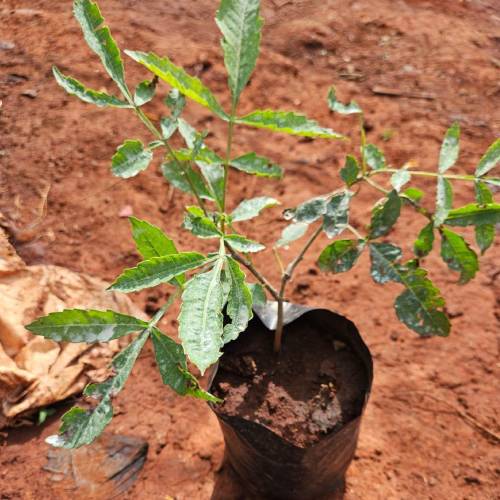
Finding marula seedlings in Kenya takes effort. Walk into most fruit nurseries and you will see mango, avocado, citrus, pawpaw and maybe jackfruit. Marula is not on the table. The tree grows wild across several parts of the country, but few farmers have planted it deliberately, and few nurseries raise it in commercial quantities.
A single marula seedling costs Sh2,500. That figure sits well above mango and avocado seedlings, which typically sell for a few hundred shillings, but below the most expensive specialty seedlings sold locally. The price reflects the work behind each seedling. Marula seed has a hard coat and strong dormancy, so it does not germinate just because it is placed in moist soil. The nursery must treat the seed, wait for germination, and raise the seedling for months before it is ready for sale.
There is another factor in the price. You cannot tell whether a seedling is male or female until it flowers. Only female trees produce fruit. A farmer who plants ten seedlings from seed may end up with several males that never bear a single fruit. That uncertainty is part of what you are paying for. Planting material from a known female parent reduces the gamble, and when it is available, it costs more because it is worth more.
Marula Seedlings in Kenya
Marula Seedlings Price in Kenya
The price of a marula seedling in Kenya is Sh2,500. This is not a market average drawn from dozens of nurseries. Supply is thin and the number of growers raising this crop is small.
Put that number beside common fruit seedlings. A mango seedling sells for Sh150 to Sh600. An avocado seedling often goes for under Sh500. A jackfruit seedling sits around Sh500. Marula costs four to five times more than a mango seedling and roughly five times more than an avocado seedling.
Three things drive the difference.
Seed treatment takes time and skill. Marula seed will not germinate reliably without scarification, soaking, or cold treatment. Each seed must be handled, and germination rates stay lower than for crops such as papaya or citrus, where seed sprouts readily.
Sex uncertainty adds value to every seedling. A farmer buying ten mango seedlings knows all ten will eventually fruit. A farmer buying ten marula seedlings has no such certainty. That uncertainty means you may need to plant more trees to end up with the number of fruiting trees you want.
Low production volume keeps the price up. A nursery producing a few hundred marula seedlings cannot spread its costs the way a nursery producing ten thousand mango seedlings can. When you buy a marula seedling, you are paying for a product made in small batches.
Where to Buy Marula Seedlings in Kenya
You will not find marula seedlings at every roadside nursery. You need a supplier who raises indigenous fruit trees or specialty crops. Fruit Africa Veriplant supplies marula seedlings directly to Kenyan farmers and to international buyers.
Before you pay, confirm what you are buying. Marula is Sclerocarya birrea. Ask the supplier where the mother tree is and whether it produces good fruit. Ask how the seed was treated and when it was sown. Ask whether the seedling comes from seed or from a known female parent. A supplier who cannot answer these questions is not a marula supplier.
Request current photos of the actual seedlings in the batch. A generic image tells you nothing. Look for healthy green leaves, a firm stem, and a seedling that has not stayed too long in a small bag.
Fruit Africa Veriplant
Phone: 0714 994 444
WhatsApp: https://wa.link/di12my
Email: sales@fruitafrica.org
Contact Us: https://fruitafrica.org/contact-us/
Request for Quotation: https://fruitafrica.org/request-for-quotation/
What Is Marula?
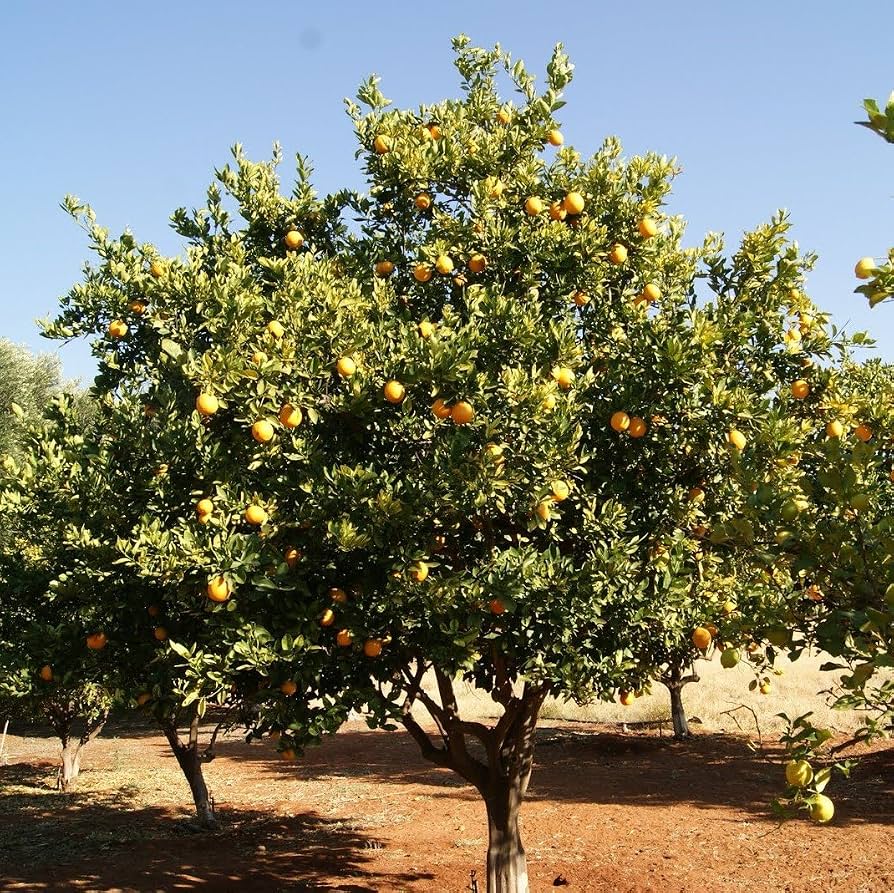
Marula is a deciduous tree native to Africa. Its scientific name is Sclerocarya birrea. It belongs to the same plant family as mango, cashew, and pistachio. The tree grows 10 to 18 meters tall with a thick trunk and a rounded crown. The bark starts grey and turns dark and cracked as the tree ages. The inner bark is pink-red.
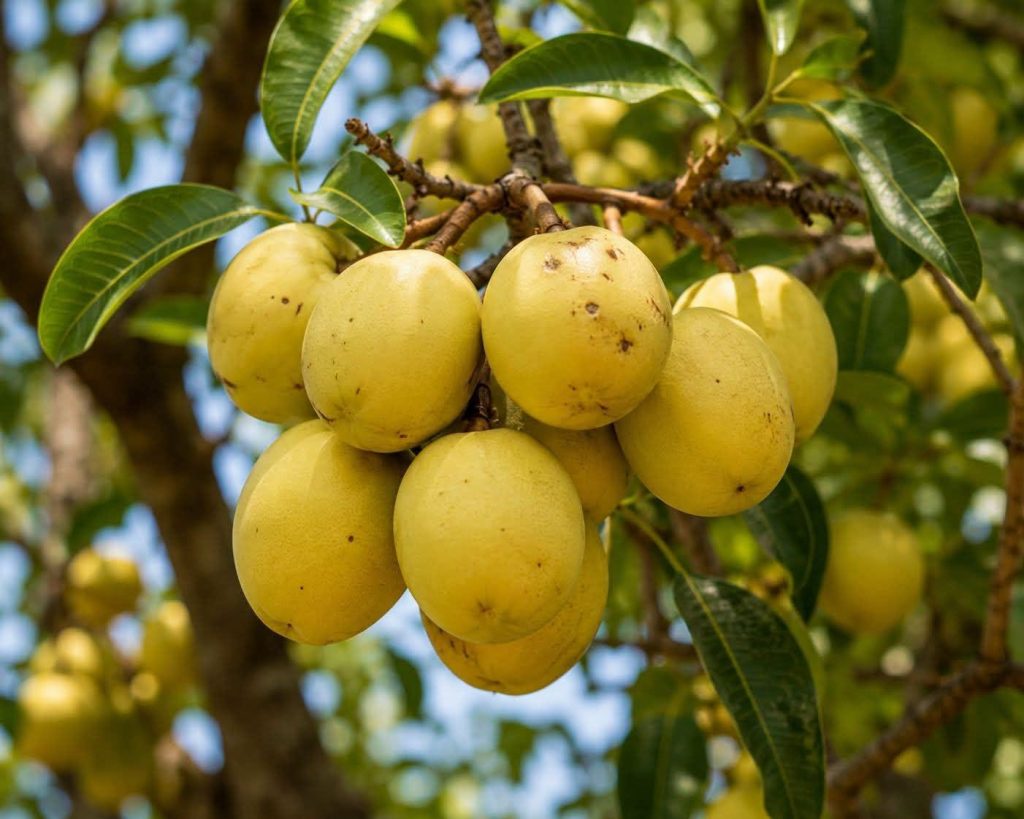
The fruit is small, about 3 to 4 centimeters across. The skin turns yellow as the fruit ripens. Inside is sweet, tangy flesh with a hard stone holding two or three oily seeds. The flesh tastes like a mix of mango and litchi, though the flavor is distinct. The seeds inside the stone are edible and rich in oil.
The tree grows across a wide band of Africa, from West Africa through Ethiopia and south to South Africa. In Kenya, it grows wild in Lambwe Valley, Moyale, West Pokot, Baringo, Kerio Valley, and parts of the coastal and eastern regions. Altitude range runs from 500 to 1,800 meters.
One fact shapes everything about marula farming. The tree is dioecious. Male and female flowers grow on separate trees in most populations. Only female trees bear fruit. When you plant seedlings from seed, you do not know which ones will fruit.
Marula Fruits Hanging on a Branch
Marula Varieties
Marula does not have the named commercial varieties that mango or avocado have. The crop remains largely undomesticated. Most planting material comes from selected wild trees.
Two subspecies grow in Kenya. Sclerocarya birrea subsp. birrea grows from Senegal to Ethiopia and is widespread in Kenya. Sclerocarya birrea subsp. caffra grows in coastal and southern Africa. The two differ mainly in leaf characteristics.
Research institutions have run domestication programs since the 1990s, selecting trees with good fruit size, yield, and oil content. Some grafted cultivars exist from South African breeding work, but they are not widely available in Kenya.
If a supplier claims to have a named marula variety, ask for documentation. The variety infrastructure for this crop is thin.
The Male and Female Tree Problem
This is the section to read twice if you are planning an orchard. Marula is dioecious. The word means “two houses,” and in practical terms it means male and female flowers sit on separate trees. A male tree produces pollen. A female tree produces fruit, but only if pollen reaches its flowers. A male tree never bears fruit, no matter how well you care for it.
The problem for a farmer buying seedlings is simple. Sex cannot be confirmed before flowering. You can inspect the leaves, the stem, the roots, and the general health of a seedling. None of that tells you whether the tree will produce fruit or pollen. You will only know when the tree flowers, which happens years after planting.
This fact shapes orchard planning in ways that do not apply to mango, avocado, or citrus. Those crops produce perfect flowers, meaning each flower has both male and female parts, so every tree has the potential to fruit. With marula, roughly half of a seedling population may turn out male. That is not a fixed ratio, and no honest supplier will promise you a specific split. But you should plan for a significant number of non-fruiting trees if you plant seedlings.
Pollination also matters. A female tree needs a male tree nearby to set fruit. If you clear all the males out of your orchard once they reveal themselves, you remove the pollen source. Some farmers keep a few males specifically for this purpose, spaced through the orchard so wind and insects can carry pollen to the females.
Planting material from a known female parent is one way around the sex problem. If the mother tree is female and the offspring is a clone or is grown from a known female line, the resulting tree will be female. This is why grafted marula and vegetatively propagated material carry a premium. They remove the guesswork.
Do not believe anyone who tells you they can sex a marula seedling before flowering by looking at the leaves or the stem. That is not possible with the methods available in Kenya today. Anyone making that claim is guessing, and their guess is not worth your money.
How Fruit Africa Veriplant Propagates Marula Seedlings
Marula propagation is not a copy of what works for mango or avocado. The seed has strong dormancy that must be broken before germination. The nursery process takes patience.
Selecting Planting Material
Mother tree selection is the starting point. Fruit from healthy, productive female trees with good fruit size provides the seed. Since marula populations include many male trees, selecting seed from known female parents improves the odds of getting fruiting offspring.
Propagation
Fresh seed goes into a nursery medium that drains well. The seed coat must be treated to break dormancy. Common methods include removing the operculum, soaking in water, or exposing the seed to cold temperatures before sowing. Without treatment, germination is slow and uneven.
Germination takes two to four weeks under good conditions. The seedling develops a taproot early. The container must be deep enough to accommodate vertical root growth. Shallow bags produce seedlings with deformed roots.
Nursery Management
Marula seedlings need consistent moisture but not waterlogging. Partial shade helps young seedlings establish. The nursery medium should be fertile but well-drained.
Root Development
The taproot grows faster than the above-ground seedling. A deep container is essential. Seedlings raised in shallow bags rarely establish well in the field because the taproot coils or bends.
Hardening
Before a seedling leaves the nursery, it needs gradual exposure to more sunlight and less frequent watering. Marula is drought-resistant once established, but young seedlings still need careful hardening.
Quality Inspection
A quality marula seedling has healthy green leaves and a firm stem. The leaves are compound, with three to eighteen pairs of leaflets. Check the root system if possible. The taproot should go straight down.
Packing and Delivery
Marula seedlings travel poorly if the root ball is disturbed. Fruit Africa Veriplant packs seedlings so the root zone stays protected during transport.
How to Choose Healthy Marula Seedlings
Size alone tells you little. A tall seedling in a small bag is often stressed. Look at the whole plant.
Check the leaves. Healthy marula leaves are green and well-formed. Yellowing or spotting suggests nutrient problems or disease.
Check the stem. The stem should be firm. A weak, leggy stem will struggle in the field.
Check the roots if possible. The taproot should be straight, not coiled. Brown or mushy roots mean the seedling stayed too wet.
Ask about seedling age. A marula seedling ready for transplanting is several months old and has reached knee height.
Ask about the mother tree. If the seed came from a known female tree with good fruit, the seedling has better odds of producing well.
Where Marula Grows Best in Kenya
Marula grows wild across a wide range of Kenyan environments. It tolerates drought, heat, and a range of soil types. That adaptability makes it easier to place than many tropical fruits.
The tree occurs naturally in Lambwe Valley, Moyale, West Pokot, Baringo, Kerio Valley, and parts of the coastal and eastern regions. Altitude range runs from 500 to 1,800 meters.
Marula performs well in dry areas that receive 200 to 1,500 millimeters of annual rainfall. It tolerates sandy soils, rocky hillsides, and dry riverbeds. Subsp. caffra is highly salt tolerant and grows well under irrigation with salty water.
The tree does not tolerate frost well. Young trees are especially vulnerable. In Israel, frost events severely damaged young trees at one experimental site. If your area experiences frost, marula is a risky choice.
Marula Tree
Marula Climate Requirements
Temperature is the first filter. Marula tolerates high heat. The tree grows naturally in areas where summer temperatures reach 40°C or higher. Cold is the limiting factor. Frost damages young trees and can kill them.
Rainfall matters less than for most fruit crops. Marula is drought-resistant once established. The tree grows in areas receiving 200 to 1,500 millimeters annually. In areas with less than 500 millimeters, irrigation during establishment helps.
Altitude range runs from sea level to about 1,800 meters.
Marula Soil Requirements
Marula adapts to a wide range of soils. It grows on sandy loam, rocky hillsides, and dry riverbeds. Optimal growth pH is around 7.
Drainage matters. Marula does not tolerate waterlogged conditions, though it is more forgiving than many fruit trees. The tree grows best on well-drained soils. Heavy clay that holds water is a problem.
How Many Marula Trees Fit on One Acre?
At 6 meters by 6 meters, you fit approximately 110 trees per acre. At 8 meters by 8 meters, you fit approximately 60 trees per acre.
One acre is about 4,047 square meters. At 6m by 6m spacing, each tree occupies 36 square meters. 4,047 divided by 36 gives roughly 112 trees, rounded to 110 for access paths.
At 8m by 8m, each tree occupies 64 square meters. 4,047 divided by 64 gives roughly 63 trees, rounded to 60.
Closer spacing gives more trees per acre and higher potential yield per acre. Wider spacing gives easier management and better air movement.
Marula Spacing
Spacing affects the orchard for decades. Get it wrong, and you live with the consequences.
At 6 meters by 6 meters, marula trees form a canopy that closes within a few years. Air movement between trees drops, and disease pressure rises. Access for weeding, spraying, and harvesting becomes harder. But you fit more trees on your land.
At 8 meters by 8 meters, trees have room to develop full canopies. Air moves freely. Access is easier. But you need more land for the same number of trees.
Marula trees can grow large, with canopies spreading wide in mature trees. Wider spacing reduces competition and allows trees to reach their full potential.
For Kenyan farmers, 6m by 6m is a reasonable middle ground if you want good production per acre. Go wider to 8m by 8m if you prioritize ease of management or if your soil is less fertile.
How to Prepare Land for Marula
Clear the land of competing vegetation. Marula seedlings do not compete well with established weeds and grasses.
Deep ploughing helps break compacted soil layers. Marula has a taproot that wants to grow deep. If your soil has a hardpan within the first meter, the taproot will struggle.
A soil test tells you the pH and nutrient status. Marula adapts to a wide pH range, but knowing your starting point helps.
Windbreaks matter for young trees. Marula is deciduous and loses leaves in the dry season. Strong winds can damage young trees. Plant windbreaks on the windward side if your area experiences strong winds.
How to Prepare Marula Planting Holes
Planting holes should be dug at least 60 centimeters by 60 centimeters by 60 centimeters. A larger hole gives the taproot room to grow straight.
Mix the topsoil with well-decomposed manure. Marula responds to organic matter. Twenty kilograms of compost or manure per hole is a reasonable starting point.
Do not fill the hole with raw manure and plant immediately. The manure needs to be decomposed. Fresh manure burns roots.
How to Plant Marula Seedlings
Plant at the beginning of the rainy season if you rely on rainfall. If you have irrigation, the timing is more flexible.
Water the seedling before removing it from the bag. Keep the root ball intact. Remove the bag carefully. Do not pull the seedling by the stem.
Place the seedling in the hole so the top of the root ball sits level with the surrounding soil. Do not bury the stem deeper than it was in the nursery.
Fill the hole with the soil-manure mix, firming gently. Water immediately after planting.
Apply mulch around the base, keeping it a few centimeters from the stem. Mulch touching the stem causes rot.
Marula Watering Requirements
Young marula seedlings need consistent moisture during the first year. The taproot is developing, and the plant cannot tolerate extended drying.
Once established, marula is drought-resistant. The tree survives on rainfall alone in areas receiving 200 to 500 millimeters annually. But during fruit development, consistent moisture supports better fruit size and quality.
If you irrigate, drip irrigation is efficient. Avoid waterlogging. Marula tolerates dry conditions better than wet ones.
Marula Manure and Fertilizer Requirements
Organic matter is the foundation of marula nutrition. Compost and well-decomposed manure improve soil structure and nutrient availability. Apply manure annually around the drip line.
For young trees, focus on organic manure. Do not push nitrogen excessively. Marula is not a heavy feeder.
For mature trees, a balanced fertilizer program supports fruit development. Potassium plays a role in fruit quality. Observe the tree’s appearance and adjust based on leaf color and growth.
Marula Mulching and Weed Management
Mulch conserves moisture, suppresses weeds, and moderates soil temperature. A layer of organic mulch 10 to 15 centimeters thick around the base of the tree helps young trees establish.
Keep mulch away from direct contact with the trunk. A gap of a few centimeters prevents stem rot.
Weed control matters most during the first three years. Weeds compete for water and nutrients. Hand weeding or careful mechanical cultivation is safer than herbicides near the shallow root zone.
Mature marula trees develop a canopy that suppresses many weeds. The area around the trunk still needs management for access.
Marula Training and Pruning
Marula pruning is minimal compared to crops like mango. The tree naturally develops a rounded crown. Pruning focuses on removing dead, diseased, or crossing branches.
Young trees benefit from formative pruning to establish a strong structure. Remove branches that grow inward or cross others. This improves air movement and light penetration.
Do not prune heavily. Marula does not respond to aggressive pruning.
Marula Pests and Diseases
Marula has few serious pests and diseases in Kenya. The tree grows wild across the country, and local pests have not adapted to devastate it.
Fruit flies attack ripening fruit. Monitoring and timely harvest reduce losses.
Termites can damage young trees, especially in dry areas. Inspect the base of the tree regularly.
Root rot can occur in poorly drained soils. Good drainage is the primary control.
Leaf diseases appear in humid conditions. Pruning for air movement reduces pressure.
The lack of documented pest and disease patterns for cultivated marula in Kenya is a limitation. Farmers planting now are building knowledge for others.
How Long Does Marula Take to Produce Fruit?
Seedling marula trees take five to seven years to begin fruiting. Grafted trees produce earlier, sometimes fruiting from the third to fifth year.
The wait is shorter than mangosteen but still significant. If you need income within three years, marula is not your answer.
The tree also has a sex problem. Seedling populations tend to include a high proportion of male trees, which never produce fruit. You will not know which seedlings are female until they flower.
This uncertainty is a major reason commercial marula farming has lagged. Grafted trees solve the sex problem because the scion comes from a known female tree. If grafted marula is available, it is worth the premium.
Marula Yield Per Tree
Marula trees produce heavily. The number of fruits per tree ranges from 2,700 to 44,200, depending on growth conditions. Fruit weight runs about 15 to 25 grams.
In Namibia, a survey found trees with canopy sizes of 5 to 35 square meters producing between 25 and 400 kilograms of fruit. An exceptional tree with a canopy of 145 square meters produced over 2,000 kilograms.
Yield varies widely between trees and between years. Older trees sometimes fruit heavily one year and lightly the next. Canopy size correlates strongly with yield in some regions.
For planning, a conservative assumption for a mature tree is 25 to 50 kilograms per year. At 60 trees per acre at 8m by 8m spacing, that is 1,500 to 3,000 kilograms per acre. At 110 trees per acre at 6m by 6m, that is 2,750 to 5,500 kilograms.
These are estimates. No documented Kenyan commercial orchard has reached full production to validate these figures.
Marula Harvesting
Marula fruit falls from the tree when still green and ripens on the ground. The skin turns yellow as it ripens. Collect fruit from the ground regularly.
The fruit perishes quickly. The skin hosts yeasts and enzymes that cause rapid fermentation. In Namibia, fruit goes from green to rotten in about seven days. This short window means you need a plan for processing or selling fruit immediately after harvest.
Handle fruit gently. Bruising speeds deterioration. Sort fruit immediately, removing damaged or diseased specimens.
The kernel inside the stone is also valuable. Cracking the stone to extract the oily seed is labor-intensive but adds value. Marula oil sells for high prices in cosmetic markets.
How to Sell Marula Fruit in Kenya
The market for marula in Kenya is undeveloped. Most Kenyans have never tasted the fruit. That is both a challenge and an opportunity.
Direct-to-consumer sales through farmers’ markets, WhatsApp groups, or farm-gate sales work if you can reach adventurous consumers. The fruit’s novelty is the selling point.
Hotels and restaurants catering to tourists may buy marula for fruit platters or traditional dishes. Chefs interested in indigenous ingredients are a potential market.
Processors use marula for juice, jam, beer, and oil. The kernel oil is valuable in cosmetics. The fruit beer is a traditional product in southern Africa and has commercial potential.
Export is the highest-value channel. International markets buy marula for functional food and cosmetic ingredients. But export requires volumes and compliance that most small Kenyan farms cannot meet alone.
Find your buyer before you plant a large orchard. Marula is rare, and rarity can be an advantage. But rarity without market development is just isolation.
Marula Farming Cost Per Acre
Establishment costs for marula are lower than mangosteen because seedlings are cheaper. At Sh2,500 per seedling and 60 trees per acre at 8m by 8m spacing, seedling cost is Sh150,000. At 110 trees per acre at 6m by 6m spacing, seedling cost is Sh275,000.
That is before land preparation, manure, planting labor, irrigation, or fencing. The table below organizes the cost categories.
| Cost Category | Notes |
|---|---|
| Seedlings | Multiply number of trees by current seedling price |
| Land preparation | Ploughing, harrowing, drainage work |
| Planting holes | Labor for digging and filling |
| Manure and compost | 20 kg per hole at minimum |
| Irrigation system | Drip or micro-sprinkler installation |
| Mulch material | Straw, grass, or other organic material |
| Fencing | Protection from livestock and wildlife |
| Labor | Planting, watering, weeding for first year |
| Tools | Hoes, pruning shears, watering cans |
A rough estimate for total establishment cost per acre, excluding irrigation infrastructure, might run Sh300,000 to Sh500,000 depending on local labor rates and input prices. Fill in your own figures based on local quotes.
Marula Farming Profit Per Acre
Profitability depends on yield, price, and how you sell the fruit. No documented Kenyan commercial orchard exists to provide real figures. The following scenarios are illustrative.
Assume 60 trees per acre at 8m by 8m spacing. Assume mature yield of 30 kilograms per tree. Total yield: 1,800 kilograms per acre.
If you sell fresh fruit at Sh200 per kilogram, gross revenue is Sh360,000. If you process into oil or value-added products, the per-kilogram value rises, but so do costs.
Assume 110 trees per acre at 6m by 6m. Assume 30 kilograms per tree. Total yield: 3,300 kilograms. At Sh200 per kilogram, gross revenue is Sh660,000.
These are gross figures. Subtract annual operating costs: labor, inputs, irrigation, harvesting, and marketing. The surplus is your profit.
The calculations depend entirely on assumptions that have not been validated in Kenya. Marula farming is a pioneering venture. Treat any profit projection with caution.
Example Marula Profitability Calculation
Assume 60 trees per acre at 8m by 8m spacing. Assume mature yield of 30 kilograms per tree. Total yield: 1,800 kilograms per acre.
Assume farm-gate price of Sh200 per kilogram for fresh fruit. Gross revenue: Sh360,000 per acre per year.
Assume annual operating costs of Sh80,000 per acre for labor, inputs, and harvesting. Estimated surplus: Sh280,000 per acre per year.
Now change the price to Sh400 per kilogram for fruit sold to processors or premium buyers. Gross revenue: Sh720,000. Surplus after Sh80,000 operating costs: Sh640,000.
Now change the yield to 50 kilograms per tree. Total yield: 3,000 kilograms. At Sh200 per kilogram, gross revenue is Sh600,000. Surplus: Sh520,000.
These scenarios show that profitability swings widely with yield and price. The assumptions matter. If you cannot achieve the yield or the price, the profit changes. Do not treat the highest scenario as normal.
The 5 to 7 year wait for first fruit means you need other income during establishment. Intercropping with shorter-term crops or off-farm income is necessary for most farmers.
Marula Health Benefits and Nutritional Value
The marula fruit is eaten fresh in many parts of Africa, and the flesh carries nutritional value that fits into a normal diet. The fruit contains vitamin C, several B vitamins, and minerals including potassium, calcium, magnesium, and phosphorus. It also provides dietary fibre and water, which matters in dry regions where fresh fruit is scarce during parts of the year.
The flesh is rich in naturally occurring plant compounds, including antioxidants. These compounds are found in many fruits and vegetables, and they contribute to the general benefits of eating a varied diet. The kernel inside the stone is also edible and contains oil that is high in oleic acid and other fatty acids. Marula oil has commercial value in cosmetic and skincare products, which is a separate market from the fresh fruit trade.
How does marula fit into a balanced diet? It provides vitamins, minerals, fibre, and energy in a form that is easy to eat fresh. It is not a medicine, and it does not cure, treat, or prevent any disease. Claims that marula fruit or marula oil can address cancer, diabetes, high blood pressure, infections, inflammation, or immune disorders are not supported by the kind of clinical evidence that would justify them. Anyone dealing with a serious health condition should work with a qualified medical professional, not rely on fruit or fruit products.
For a Kenyan farmer, the health angle matters mainly as a marketing point. Consumers interested in indigenous foods and natural nutrition are a growing segment. Selling marula as a nutritious traditional fruit is honest. Selling it as a cure for disease is not.
| Nutrient or Component | Relevance |
|---|---|
| Vitamin C | Supports normal immune function as part of a varied diet |
| B vitamins | Contribute to energy metabolism |
| Potassium | Mineral involved in normal body function |
| Calcium | Mineral needed for bone health |
| Magnesium | Mineral involved in many body processes |
| Dietary fibre | Supports digestive health |
| Water content | Helps with hydration, useful in dry regions |
| Antioxidant compounds | Naturally present in the fruit flesh |
| Kernel oil | Edible and used in cosmetic products |
Common Mistakes When Growing Marula in Kenya
Planting seedlings without confirming the mother tree is a mistake. Seedling populations include many male trees that never fruit. If you can source grafted trees from known female parents, do so.
Planting in frost-prone areas is a mistake. Marula tolerates heat and drought, but frost damages young trees. Check your local climate before planting.
Assuming a market exists without testing it is a mistake. Marula is rare in Kenya. Rare does not automatically mean high demand. Find buyers before you plant a large orchard.
Ignoring the short shelf life is a mistake. Marula fruit perishes quickly after harvest. You need a plan for processing or immediate sale.
Planting too close is a mistake. Marula trees grow large. Cramped trees compete for water and nutrients.
Can Marula Be Grown in Containers?
Marula can be grown in containers, but the tree will not reach full size. The taproot needs deep soil. A standard pot restricts root development.
If you attempt container growing, use a deep container. The medium must drain well. Partial shade helps young trees. Marula tolerates dry conditions, but container soil dries faster than field soil.
Container growing is a novelty or a way to start a tree before planting in the field. Do not expect commercial yields.
Can Marula Be Grown on a Small Farm?
Yes. Marula suits small farms in dry areas where other fruit trees struggle. The tree tolerates drought, heat, and poor soils. It needs less water than mango or avocado.
A few marula trees can provide fruit for household use and local sales. The kernel oil adds value if you are willing to process it.
The challenge is the wait for fruit and the sex uncertainty. If you plant 10 seedlings, several may be male and never fruit. Grafted trees solve this problem.
Can Marula Be Grown Commercially in Kenya?
Commercial marula farming in Kenya is possible but untested. No confirmed commercial orchard operates at scale. The crop is a pioneer opportunity.
The advantages are real. Marula tolerates conditions that challenge other fruit crops. The fruit has nutritional value and commercial potential in functional foods and cosmetics. Global interest is growing.
The risks are also real. The market in Kenya is undeveloped. The wait for fruit is five to seven years. The sex uncertainty in seedling populations complicates orchard planning. And no local playbook exists for pest management, harvest timing, or yield expectations.
Commercial success requires matching suitable land with patient capital and a marketing plan. A farm in Baringo or West Pokot with dry conditions and good drainage has a different outlook than a highland farm with frost.
Buying Marula Seedlings for Export
International buyers looking for marula seedlings from Fruit Africa Veriplant should request a quotation through email or WhatsApp. The buyer should provide the number of seedlings needed, preferred variety or propagation type, destination country, destination city, and any relevant planting material requirements.
Fruit Africa Veriplant responds with details covering freight, documentation, logistics, and estimated timeframe. Specific freight prices and delivery times are quoted based on the destination and order size.
Fruit Africa Veriplant
Phone: 0714 994 444
WhatsApp: https://wa.link/di12my
Email: sales@fruitafrica.org
Contact Us: https://fruitafrica.org/contact-us/
Request for Quotation: https://fruitafrica.org/request-for-quotation/
Frequently Asked Questions About Marula Seedlings
1. How much do marula seedlings cost in Kenya?
A marula seedling costs Sh2,500 from Kenyan suppliers. Prices vary by nursery and batch. Request a current quote before ordering.
2. Where can I buy marula seedlings in Kenya?
Fruit Africa Veriplant supplies marula seedlings directly to Kenyan farmers and international buyers. Contact through WhatsApp on 0714 994 444 or email sales@fruitafrica.org.
3. Are marula seedlings available in Kenya?
Supply is limited because few Kenyan nurseries raise this crop. Fruit Africa Veriplant and a handful of specialist suppliers stock marula seedlings. Confirm availability before travelling.
4. How long do marula seedlings take to fruit?
Seedling marula trees take five to seven years to begin fruiting. Grafted trees produce earlier, sometimes from the third to fifth year.
5. How do I tell male and female marula trees apart?
You cannot tell the sex of a marula seedling until it flowers. Male trees do not produce fruit. Grafted trees from known female parents solve this problem.
6. What spacing should I use for marula?
Spacing ranges from 6m by 6m (approximately 110 trees per acre) to 8m by 8m (approximately 60 trees per acre). Wider spacing suits less intensive management.
7. How many marula trees fit on one acre?
At 6m by 6m, approximately 110 trees per acre. At 8m by 8m, approximately 60 trees.
8. What climate does marula need?
Marula needs warm to hot conditions and tolerates drought. It does not tolerate frost. Rainfall of 200 to 1,500 millimeters annually supports the tree.
9. What soil is best for marula?
Marula adapts to sandy loam, rocky hillsides, and dry riverbeds. Well-drained soil is important. The tree tolerates a pH around 7.
10. How do I prepare a planting hole for marula?
Dig a hole at least 60cm by 60cm by 60cm. Mix topsoil with 20 kilograms of decomposed manure.
11. How often should I water marula seedlings?
Young seedlings need consistent moisture during the first year. Once established, marula survives on rainfall in most areas.
12. What fertilizer does marula need?
Young trees benefit from organic manure. Mature trees need balanced fertilizer with potassium for fruit quality. Do not push nitrogen excessively.
13. What pests attack marula in Kenya?
Fruit flies attack ripening fruit. Termites can damage young trees in dry areas. Root rot occurs in poorly drained soils.
14. What diseases affect marula?
Root rot is the main concern in wet soils. Leaf diseases appear in humid conditions. The tree has few serious disease problems in Kenya.
15. How much fruit does a mature marula tree produce?
A mature tree produces 25 to 50 kilograms per year in conservative estimates. Exceptional trees produce far more, sometimes over 400 kilograms.
16. When should I harvest marula?
Marula fruit falls from the tree when still green and ripens on the ground. Collect fruit regularly as the skin turns yellow. The fruit perishes quickly, so harvest and process without delay.
17. How do I sell marula fruit in Kenya?
Direct sales, farmers’ markets, hotels, and processors are the main channels. Export offers higher prices but requires volumes and compliance. Find buyers before planting a large orchard.
18. Is marula farming profitable in Kenya?
No documented commercial Kenyan orchard confirms profitability figures. The crop is a pioneer opportunity. Treat profit projections with caution.
19. Can marula be grown in containers?
Yes, but the tree will not reach full size. Use a deep container, well-drained medium, and partial shade. Do not expect commercial yields.
20. Can I export marula seedlings from Kenya?
Yes. Fruit Africa Veriplant supplies international buyers. Provide the number of seedlings, preferred variety, destination country, destination city, and any planting material requirements. Request a quotation through the contacts above.
Final Guide to Buying Marula Seedlings in Kenya
Buying marula seedlings is a long-term decision. The tree takes five to seven years to fruit. Male trees never produce fruit. You cannot tell the difference until flowers appear. Those facts shape everything about how you plan.
The price is Sh2,500 per seedling. At 6m by 6m spacing, you fit 110 trees per acre. At 8m by 8m, you fit 60. Seedling cost alone runs Sh150,000 to Sh275,000 per acre. Add land preparation, manure, labor, and fencing, and establishment costs climb.
Before you order, confirm your climate. Marula tolerates heat and drought. It does not tolerate frost. If your area experiences frost, choose a different crop.
Check your soil drainage. Marula does not sit in water. If your land stays wet after rain, fix the drainage before planting.
Decide how you will handle the sex uncertainty. If grafted trees from known female parents are available, they are worth the premium. If you plant seedlings, expect some males and plan accordingly.
Find your market before you plant a large orchard. Marula is rare in Kenya. Rare does not automatically mean high demand. Test the market with a few trees before you commit an acre.
Fruit Africa Veriplant supplies marula seedlings to Kenyan farmers and international buyers. Request a current quotation for pricing, availability, and delivery details.
Fruit Africa Veriplant
Phone: 0714 994 444
WhatsApp: https://wa.link/di12my
Email: sales@fruitafrica.org
Contact Us: https://fruitafrica.org/contact-us/
Request for Quotation: https://fruitafrica.org/request-for-quotation/


Reviews
There are no reviews yet.