
Description
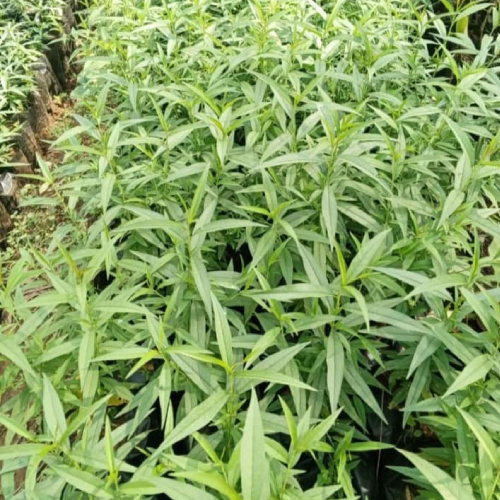
Golden peach seedlings in Kenya at KSh 1,500 grafted and KSh 800 non-grafted, propagated from cuttings. Spacing 4 m by 3 m, real market prices, detailed per-acre costs and full farming guide.
Golden Peach Seedlings in Kenya: Grafted and Non-Grafted Price, Spacing and Full Farming Guide
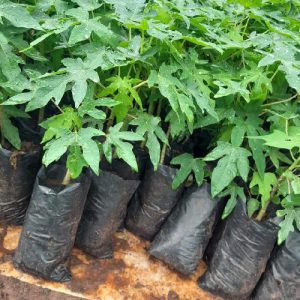
Fruit Africa Veriplant sells golden peach seedlings in two forms. Grafted golden peach seedlings cost KSh 1,500 each. Non-grafted golden peach seedlings, propagated from cuttings, cost KSh 800 each. The choice between the two matters, and this guide explains what each one gives you, how to plant, what it costs to run an acre, and what the fruit sells for in Kenya today.
Peach is a temperate fruit. It needs cold weather to flower well and warm weather to sweeten the fruit. That combination restricts where you can grow it in Kenya, because a peach planted in the wrong altitude flowers poorly and gives little or nothing. The right altitude sits between 1,500 and 2,500 metres above sea level. The right rainfall sits between 800 and 1,000 millimetres a year. The right temperature runs between 10 and 30 degrees, with about 24 degrees during fruit ripening. Outside those ranges, the tree survives but the harvest disappoints. So before you buy any seedling, confirm that your land meets the climate needs, because fixing a wrong site later is impossible.
The spacing here is 4 metres between plants and 3 metres between rows. At this spacing one plant uses about 12 square metres of land. One acre is about 4,047 square metres. So on paper an acre fits about 337 plants. That count assumes a full square block with nothing else on it. On a real farm you lose land to boundaries, access paths and turning space, so you plant fewer. At KSh 1,500 per grafted seedling, 337 seedlings cost KSh 505,500. At KSh 800 per non-grafted seedling, 337 seedlings cost KSh 269,600. The seedling cost is only one part of your total spend, and the full cost breakdown comes further down.
Kenya does not grow enough peaches for its own market. A kilogram of imported fresh peaches in Kenya costs between KSh 1,350 and KSh 2,500. Locally grown peaches range between KSh 300 and KSh 750 per kilogram. That gap between the import price and the local price is the reason peach farming in Kenya is worth looking at. Local growers who produce sweet, clean fruit can sell well below the import price and still earn far more than most other fruits bring per kilogram.
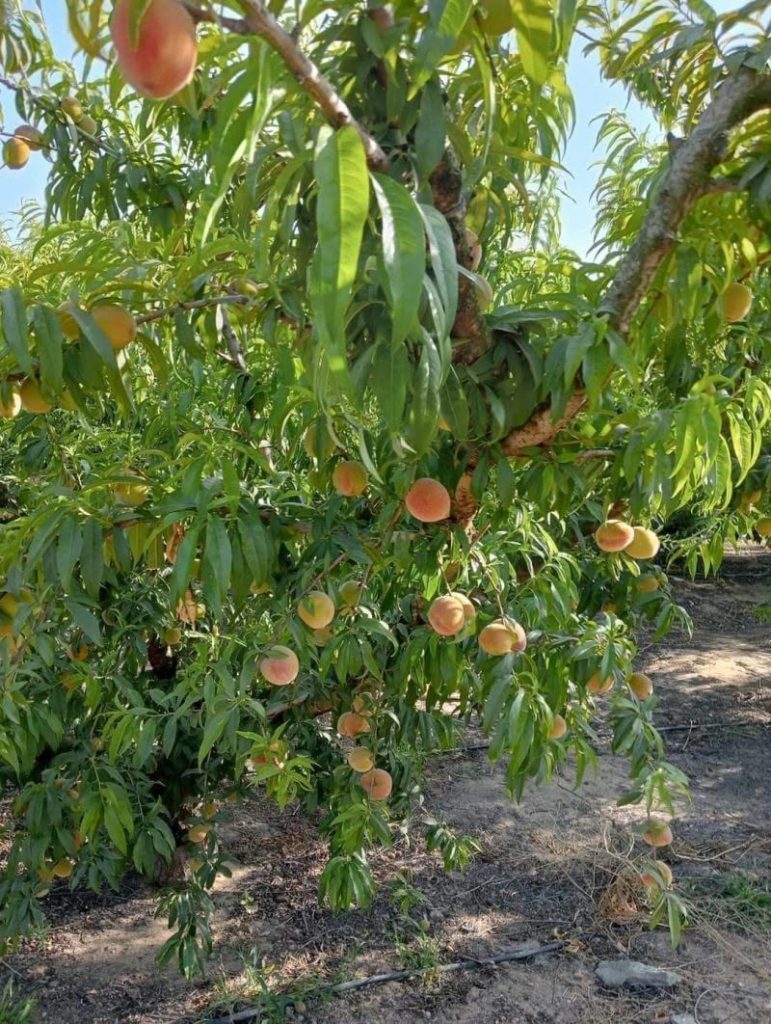
Peach Farm in Kenya
The rest of this guide covers grafted versus non-grafted in the detail you need, spacing sums for plots from a quarter acre to five acres, a real cost breakdown for one acre, real market prices at farm gate and in shops, the pests and diseases to watch, pruning which is central to peach farming, chill hours which decide whether your tree flowers, and a checklist to use before you pay.
What Are Golden Peach Seedlings
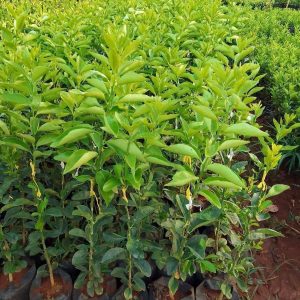
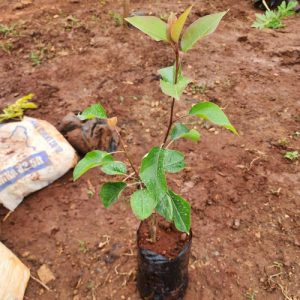
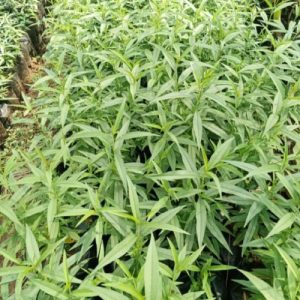
A golden peach seedling is a young peach plant raised in a nursery and sold ready to move to the field. Fruit Africa Veriplant offers golden peach seedlings in two forms: grafted and non-grafted propagated from cuttings.
A grafted seedling joins a piece of a chosen golden peach variety, called the scion, onto the roots and lower stem of a different peach plant, called the rootstock. The two grow together into one tree. The rootstock handles the soil, the pests below ground and the general hardiness. The scion decides the fruit you harvest.
A non-grafted seedling propagated from cuttings is grown from a piece of stem taken from a golden peach mother plant. The cutting roots and grows into a tree on its own roots, with no join and no separate rootstock. It carries the same genetics as the mother plant from root to tip.
The fruit from both forms is the same golden peach. The difference is in the root system, the time to first harvest and the price per seedling. A grafted tree fruits earlier because the scion is taken from a mature, fruiting-age tree. A non-grafted cutting-grown tree takes a little longer because it starts from a younger physiological state even though it carries mature genetics. The rootstock on a grafted tree adds protection on difficult soils. The cutting-grown tree stands on its own roots, which is simpler and works well on good soil.
Grafted Versus Non-Grafted Golden Peach Seedlings
Both forms give you a golden peach tree. The difference is in how the tree is built, what happens below ground and how soon the tree fruits.
Grafted Golden Peach Seedlings at KSh 1,500
A grafted tree fruits earlier, usually from the second or third year after planting, because the scion wood is taken from a mature, fruiting-age tree. The rootstock is chosen for strength, disease resistance and adaptation to local soils. On poor or nematode-prone soil, a strong rootstock keeps the tree standing and feeding where a tree on its own roots might struggle.
The graft join is a weak point until it heals fully, so handle a grafted seedling carefully and never bury the join below soil level. If soil covers the join, the scion sends out its own roots and you lose the rootstock advantage. At planting, keep the graft line clearly above the ground.
Grafted trees cost more because grafting takes extra time, skill and rootstock material. At KSh 1,500 each, the seedling bill adds up, but the earlier fruit and the root protection matter on a commercial farm.
Non-Grafted Golden Peach Seedlings Propagated from Cuttings at KSh 800
A cutting-grown tree carries the full genetics of the mother plant from root to crown. There is no graft join to worry about, no risk of the scion rooting out, and the root system is the same genetics as the top. The tree is one plant from end to end.
A cutting-grown tree generally takes longer to start fruiting than a grafted tree, because the cutting starts from a younger physiological state even though it carries mature genetics. Expect fruit from about the third or fourth year, though this shifts with care and climate.
Without a selected rootstock, the tree faces the soil on its own roots. On good, well-drained, nematode-free soil, that is fine. On poor, heavy or nematode-prone soil, the tree may struggle more than a grafted tree would. The price is lower at KSh 800, which saves a lot on the seedling bill across a large planting.
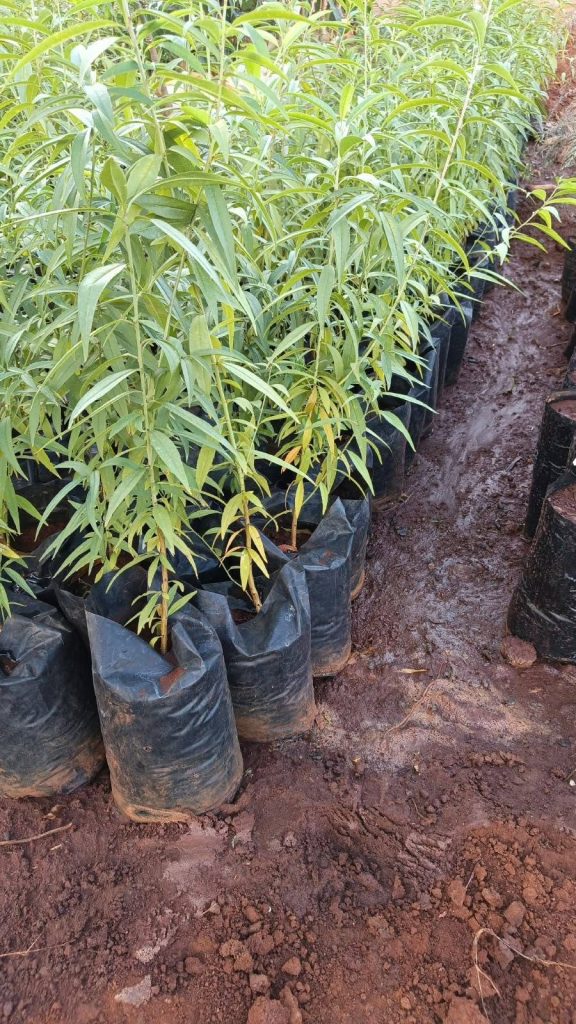
Grafted Golden Peach Seedlings
When to Pick Each One
Choose grafted seedlings when your soil is less than ideal, when nematodes or soil disease are present, and when you want the earliest possible harvest. The extra cost buys you root protection and faster returns.
Choose non-grafted cuttings when your soil is good and well-drained, when you are willing to wait a little longer for the first fruit, and when the lower seedling cost helps the budget. The simpler tree structure also appeals to growers who want no graft join to manage.
Both forms produce the same golden peach fruit. The difference is in the root system, the time to first harvest and the price per seedling. Match the form to your soil and your budget and move on to the real work of site selection, because a peach on the wrong land fails regardless of the form you chose.
Golden Peach Seedlings Price in Kenya
Fruit Africa Veriplant prices the two forms as follows:
| Form | Price per seedling | Cost for 100 | Cost for 337 (one acre on paper) |
|---|---|---|---|
| Grafted | KSh 1,500 | KSh 150,000 | KSh 505,500 |
| Non-grafted from cuttings | KSh 800 | KSh 80,000 | KSh 269,600 |
The seedlings are only one part of what you spend. Land preparation, manure, fertiliser, irrigation, sprays, pruning and labour add up to more than the seedlings on most farms. The full per-acre breakdown comes further down.
How Many Golden Peach Seedlings Do You Need Per Acre
At 4 m by 3 m, one plant uses about 12 square metres. Divide the plot size by 12 to get the plant count on paper.
| Plot size | Land (sq m) | Plant count on paper | Grafted cost at KSh 1,500 | Non-grafted cost at KSh 800 |
|---|---|---|---|---|
| Quarter acre | 1,012 | about 84 | about KSh 126,000 | about KSh 67,200 |
| Half acre | 2,024 | about 168 | about KSh 252,000 | about KSh 134,400 |
| One acre | 4,047 | about 337 | about KSh 505,500 | about KSh 269,600 |
| Two acres | 8,094 | about 674 | about KSh 1,011,000 | about KSh 539,200 |
| Five acres | 20,235 | about 1,686 | about KSh 2,529,000 | about KSh 1,348,800 |
These are the counts on paper. A real farm loses land to paths, boundaries and working space. Most one-acre plantings end up near 280 to 320 trees. Measure the land you can actually plant after taking out access paths and headlands, divide by 12, and add a few spare seedlings to replace any that fail in the first season.
How to Work Out Your Real Plant Count
Walk the block first. Mark where the access paths go, where you turn a sprayer or a wheelbarrow, and where any drainage lines run. Count only the land left after that. Divide by 12. That is your plant count. Then add about five percent more seedlings as replacements. On a one-acre block with 300 planting positions, add 15 spares and order 315. The spares cost little extra at either price but save you from gaps in the row when a few trees fail.
Plant Count for Small Growers
Not everyone plants an acre. A grower with a small homestead plot may want ten or twenty trees for home fruit and some side income. At KSh 1,500 each, ten grafted trees cost KSh 15,000. At KSh 800 each, ten non-grafted trees cost KSh 8,000. Twenty grafted cost KSh 30,000. Twenty non-grafted cost KSh 16,000. Even a small planting gives you fresh peaches and a taste of the market before you scale.
4 m by 3 m Peach Spacing Explained
Peach trees grow wide. A mature tree carries a spread of branches that needs room to open without pushing into the next tree. The 4 metre gap between plants in the row gives each tree space for that spread. The 3 metre gap between rows gives you space to walk, spray, prune and carry fruit out.
Air moves through a well-spaced orchard and dries the leaves after rain, which means less fungal disease. Light reaches the interior of each tree instead of hitting a wall of branches from the neighbour. Packing trees closer raises the count on paper but invites disease, smaller fruit and harder pruning work. Wider spacing gives bigger, better-lit trees but fewer per acre. The 4 by 3 layout gives a solid plant count with room to manage.
Run the rows so the trees catch good light through the day. On a slope, set the rows across the slope to slow soil wash and to guide water.
What Happens If You Space Too Close
At tighter spacing, say 3 m by 3 m, you fit more trees per acre on paper. The early years look good because the trees are small and the space feels fine. As the trees mature, the canopies meet and shade each other. The lower branches lose light and stop fruiting. Fungal disease rises because air cannot move. Pruning becomes a constant fight to keep gaps open. The fruit stays smaller because each tree competes with its neighbour for light, water and food. You get more trees but fewer good fruit per tree, and the management cost goes up.
What Happens If You Space Too Wide
At wider spacing, say 5 m by 5 m, each tree gets plenty of room. The canopy opens well, light and air move freely, and individual trees can be very productive. The trade-off is fewer trees per acre. At 5 by 5, one tree uses 25 square metres and an acre fits about 160 trees. That is less than half the 4 by 3 count. You need more land for the same total harvest, and the cost per unit of fruit rises because your fixed costs like fencing and irrigation spread over fewer trees.
The 4 by 3 spacing sits between the two. It gives you enough trees per acre for a commercial return while keeping each tree productive and manageable. Adjust it only if your soil is so poor that wider spacing gives the roots more room, or if you have a very vigorous rootstock that spreads wide.
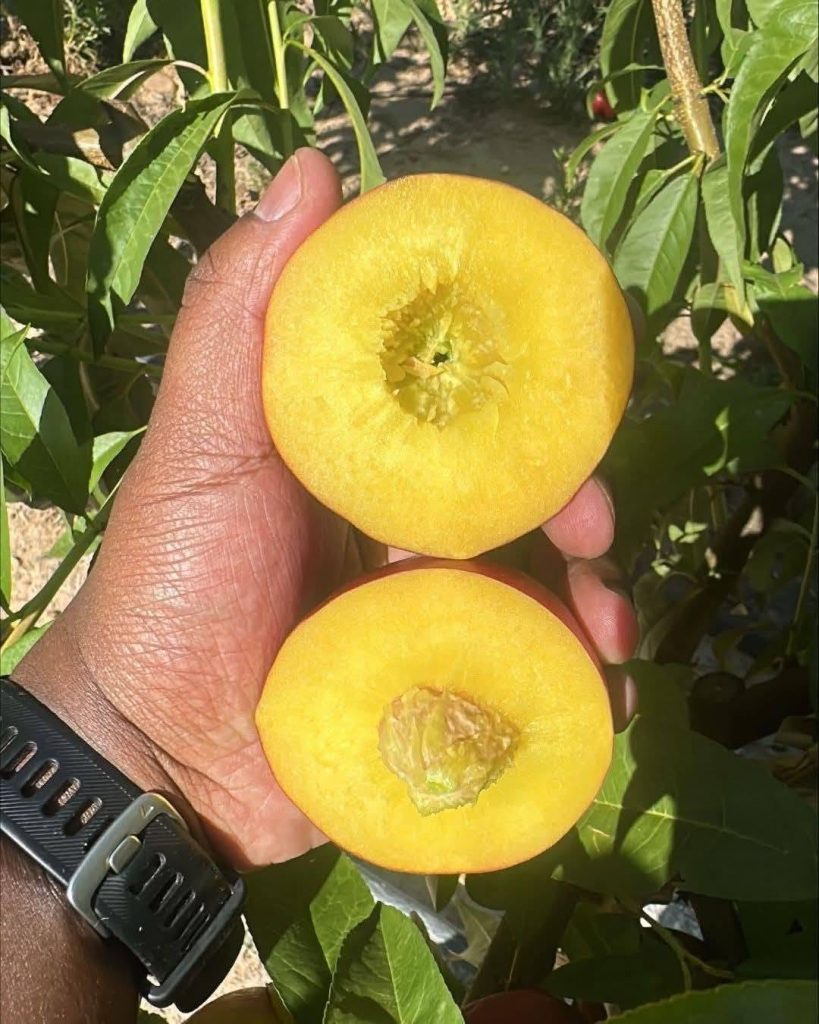
Golden Peach Fruit
Climate the Crop Needs
Peach is not a tropical fruit. It is temperate, and it needs both cold and warm conditions to produce. Get this wrong and nothing else in this guide helps.
Altitude
Golden peach grows well between 1,500 and 2,500 metres above sea level. Below that range, the cold period is too short and the tree flowers poorly or not at all. Above that range, cold damage and frost risk rise, and the growing season is too short. Kenya has many areas in this band: Nyeri, Murang’a, Meru, Limuru, Molo, Kericho, parts of Nakuru, Kiambu and the high ground of Uasin Gishu. Within those counties, the specific site still matters. Two farms in the same county can sit at different altitudes and have different results.
Temperature
The best range runs from about 10 to 30 degrees, with about 24 degrees when the fruit ripens. Peaches need warm days for sugar in the fruit. They also need cool nights for colour and firmness. Temperatures below 10 degrees during the growing season slow growth. Temperatures above 30 degrees can cause sunburn on the fruit and stress the tree, especially if water is short.
Chill Hours
This is the part many new peach growers miss, and it is the part that kills more orchards than any disease. A peach tree needs a certain number of chill hours to flower properly. A chill hour is generally counted as one hour where the temperature sits between 0 and 7 degrees. Different varieties need different totals. Low-chill varieties such as Florida Prince need about 150 to 250 chill hours. Higher-chill varieties such as O’Henry need 400 to 500 or more. If your area does not get enough chill hours for the variety you planted, the tree grows leaves but flowers weakly or not at all, and you get no fruit.
Before you buy, find out the chill hours your area receives. Your local agricultural office may have this data. Then match the variety to the chill. A low-chill variety in a high-chill area fruits early and may suffer frost on the blossoms. A high-chill variety in a low-chill area stays leafy and barren. Getting this match right is the single biggest step in peach farming.
Why Chill Hours Kill Orchards
A farmer who plants a high-chill variety in a warm lowland area watches the tree grow leaves year after year with no flowers. The tree looks healthy. The farmer waters and feeds it. Nothing happens. After three or four years of no fruit, the farmer cuts it down. The tree was fine. The climate was wrong. The chill hours were not enough to break the dormancy and trigger flowering. This is the most common reason peach orchards fail in Kenya, and it is entirely avoidable if you check before you plant.
Rainfall and Water
Peaches need about 800 to 1,000 millimetres of rain a year. Where the rain is patchy or falls in a short season, you must irrigate, because drought during fruit development drops the fruit or shrinks it. At the same time, peach roots hate standing water, so good drainage is essential. Heavy, waterlogged soil kills peach roots fast.
In many Kenyan highland areas, the rain comes in two seasons with a dry stretch between. You need irrigation to bridge the dry gap, especially during fruit development when water stress causes fruit drop and small size.
Sunlight
Peach trees need six to eight hours of direct sunlight a day. Planting in a shaded valley or beside a tall windbreak that blocks the morning or afternoon sun costs you fruit size and sugar. Choose an open, sunny site. A tree that gets half the light it needs gives you half the sugar in the fruit, and low-sugar peaches sell at the bottom of the price range.
Frost Risk
Late frost during flowering is a serious danger in high-altitude sites. A single frost event at bloom time can wipe out the entire crop for that year. If your site gets late frosts, choose a variety that flowers later in the season, or plant on a slope where cold air drains away rather than settling in a frost pocket. Low-lying flat areas at high altitude are the worst for frost. Slopes that allow cold air to flow downhill are safer.
Soil and Drainage Requirements
Peaches want deep, fertile, well-drained soil with a pH between 5.8 and 6.8. Sandy loam is ideal. Heavy clay that holds water and low ground where water collects after rain are the wrong places. Peach roots rot fast in wet soil, and once the roots go, the tree goes.
Take a soil test before you plant. It tells you the pH, nutrient levels and organic matter, and it guides your manure and fertiliser plan. Collect samples from several spots across the block, mix them and send one sample to a known lab.
If your land has a drainage weakness, fix it before you plant:
- Form raised beds or ridges so the tree sits above any water that pools.
- Cut drainage channels to carry runoff off the block after heavy rain.
- Avoid planting in the lowest part of the field where water gathers.
Raised planting is one of the best things you can do for a peach orchard on any site that is not naturally free-draining. The extra soil preparation costs time and money, but it saves trees.
Soil Depth
Peach roots go deep when the soil allows it. A deep, loose soil lets the roots reach water and nutrients below the dry surface layer. Shallow soil over rock or hardpan traps the roots near the surface where they dry out fast and suffer in hot weather. If your soil is shallow, you may need closer spacing with smaller trees, more frequent irrigation and more careful feeding.
Soil pH and Nutrient Availability
At a pH below 5.8, some nutrients become locked in the soil and the tree cannot take them up even if they are present. At a pH above 6.8, other nutrients become less available. The 5.8 to 6.8 range keeps most nutrients available to the tree. If your soil test shows pH outside that range, correct it before planting. Lime raises pH on acid soil. Sulphur lowers it on alkaline soil. The correction takes time, so do it the season before you plant.
How to Prepare Land for Peach Planting
Clear the block of tough weeds and old crop material. Remove any diseased peach or stone fruit trees from a past planting, because replanting peaches after peaches on the same ground raises the risk of soil disease and nematodes.
Plough and harrow so the roots can grow out freely. On a slope, set the rows to slow erosion and guide water. Where drainage is weak, form the raised beds or ridges now, before the holes go in.
Dig the planting holes before the rains. Make each hole about 60 centimetres wide and 60 centimetres deep. Keep the topsoil and subsoil apart as you dig. Mix well-rotted manure into the topsoil and put that soil back in the hole. How much manure depends on your soil test, so follow that guidance instead of a fixed recipe. Fresh manure burns roots and brings weed seeds, so use manure that has broken down properly. Correct any pH or nutrient gaps now, while the hole is open and it is easy.
Marking Out the Rows
Measure and mark the planting positions before you dig. Use a measuring tape and stakes to set out the rows at 3 metre intervals and the planting positions along the row at 4 metre intervals. A straight, well-measured orchard is easier to manage, spray and harvest than a crooked one. Take the time to get the layout right, because once the trees are in the ground, moving them is not practical.
How to Plant Golden Peach Seedlings
Plant at the onset of the rains or under irrigation, when the soil is warm and moist. Peach settles best when it moves into moist, warm ground.
For grafted seedlings, keep the graft join clearly above the soil line. Burying the join lets the scion root and kills the point of the rootstock. Check this again after the first rains, because soil can wash up and cover the join.
For non-grafted cuttings, plant at the same depth the seedling grew in the nursery bag. Firm the soil around the roots without stamping it hard. Water each tree right after planting. Spread mulch around each tree to hold moisture and hold back weeds, keeping the mulch a little away from the stem so the base stays dry and does not rot.
Stake young trees on windy sites, because a young peach tree with a small root system blows over easily. The stake supports the tree for the first year until the roots anchor it.
Watch for failures in the first weeks and replace dead or weak trees early, while the gaps are easy to fill. This is why you order a few spare seedlings.
Planting on a Slope
On sloping land, plant the trees on the contour or slightly off it to slow water runoff and reduce soil erosion. Build small semi-circular basins on the downhill side of each tree to catch rainwater and hold it while it soaks in. These basins also catch any fertiliser you apply, keeping it near the root zone instead of washing it downhill.
Watering In
Water each tree thoroughly right after planting, even if the soil looks moist. The water settles the soil around the roots and removes air pockets that dry out the roots. In the first week after planting, water every two to three days if the rain is not steady. After that, water weekly unless the soil dries out faster.
Water and Irrigation for Peach Trees
Peaches need steady moisture during the growing season and dry feet all year. Young trees need frequent watering as their roots are small and the soil dries fast around them. Mature trees handle longer gaps but suffer badly if water runs short when the fruit is developing, because the fruit drops or shrinks.
Drip irrigation works well for peaches. It puts water at the root zone and keeps the surface drier, which reduces root rot and fungal problems on the lower trunk. Mulch works with the drip line to hold moisture and cut the frequency of watering.
Avoid overhead irrigation on peaches if you can, because wet leaves invite fungal disease, especially leaf curl. If you must use overhead, water early in the day so the leaves dry before night.
The two watering mistakes to avoid are letting the trees dry out during fruit development and overwatering into waterlogging. Either one costs you fruit.
Water Needs by Season
In the dry season and during fruit development, a mature peach tree can use a significant amount of water each week. The exact amount depends on the soil, the tree size, the weather and the crop load. Sandy soil in hot weather with a full crop needs the most water. Heavy soil in cool weather with a light crop needs the least. Read the soil and the tree rather than following a fixed schedule.
In the rainy season, cut back irrigation and check the drainage. A tree sitting in waterlogged soil for even a few days can develop root rot that kills it over the following months, even after the surface dries out.
Fertiliser and Nutrition for Peach Trees
Peach trees are heavy feeders when they are growing and fruiting. Build the feeding plan on your soil test, not on a fixed recipe, because the right amounts depend on your soil’s starting levels.
Nitrogen drives leaf and shoot growth early in the season. Use too much and the tree grows leaves at the expense of fruit. Phosphorus builds the roots and early growth. Potassium supports fruit quality and size, and the tree needs more of it as it bears. Calcium keeps the fruit firm and helps prevent storage problems after harvest. Micronutrients such as zinc and boron matter in small amounts, and a shortage shows up fast in a fruit crop.
Rotted manure at planting and topped up each year feeds the soil alongside the mineral fertiliser. Split the fertiliser through the season instead of dumping a large amount at once, so the tree gets a steady supply. Let the soil test and a local agronomist set the rates, and adjust as the trees show you how they grow and fruit.
Feeding by Growth Stage
In the first year, the tree builds roots and shoots. Nitrogen and phosphorus matter most. Apply in small amounts at planting and again when the first growth flush starts.
In the second and third years, the tree continues to build structure. Feed to support growth without pushing so hard that the tree grows soft, disease-prone wood.
From the first fruiting year onward, shift the balance toward potassium for fruit quality and calcium for firmness. Keep nitrogen steady but do not overdo it, because excess nitrogen gives large, soft, poorly coloured fruit that does not store or travel well.
Pruning Peach Trees
Pruning is not optional on a peach tree. A peach that is not pruned grows into a thick, tangled mass of branches, the inner wood goes dark and dead from lack of light, fruit quality drops, and the tree bears less each year. Peach bears fruit on the wood that grew the previous year, so every year you remove old wood and make room for new shoots that will carry the next crop. If you skip pruning for even one season, the yield and fruit quality fall.
The Open Vase Shape
The most common shape for a peach tree is the open vase or open centre. You remove the central leader when the tree is young, leaving three or four main branches spreading out like a vase. This shape lets light into the centre of the tree, lets air move through the canopy, and keeps the fruiting wood low enough to reach.
How to Form the Open Vase
At planting, cut the young tree back to about knee height if it has no branches. This forces the tree to branch low. In the first growing season, select three or four well-spaced branches that spread in different directions and remove the rest. In the second year, cut out any new growth that grows straight up through the centre of the tree. The goal is to keep the centre open and the main branches spreading outward.
What to Cut Every Year
Remove dead, diseased and damaged wood first. Then take out branches that cross and rub each other. Thin out the dense areas so light reaches the inner branches. Cut back the branches that grew the previous year to encourage new shoots for next year’s crop. Remove any suckers that grow from below the graft join on grafted trees, because those are rootstock growth and will not give golden peach fruit.
When to Prune
The main pruning happens in the dormant season, after the leaves fall and before the new buds swell. In Kenya’s highland areas, that period falls in the dry, cool months. Summer pruning is a lighter trim to remove water sprouts and control growth during the season. Pruning at the wrong time, especially in wet weather, opens cuts to fungal infection.
What Happens If You Do Not Prune
The tree grows tall and thick. The lower branches die from shade. The fruit gets smaller, fewer and higher up where you cannot reach it. Fungal disease takes hold in the crowded canopy. The tree lives but the harvest shrinks every year until you either cut it back hard or remove it. If you are not ready to prune every year, do not plant peaches.
Rejuvenation Pruning
If you inherit a neglected peach tree that has grown into a tall, thick mess, you can cut it back hard over two seasons to bring it back into production. Remove about half the old wood in the first year and the rest in the second. This forces new growth from lower down. The tree will not fruit well for a year or two after hard pruning, but if the roots are healthy, it recovers.
Fruit Thinning on Peach Trees
Peach trees often set far more fruit than they can carry to a good size. A tree loaded with too many small fruit gives you a harvest of tiny peaches that sell poorly, and the weight can snap branches. Thinning means removing some of the young fruit early, so the tree puts its energy into the remaining fruit and they grow to a good size.
Thin the fruit when they are about the size of a thumbnail, spacing them about 10 to 15 centimetres apart along the branch. It feels wrong to take off fruit you just watched the tree set, but thinning is what turns a harvest of small, cheap fruit into a harvest of large, premium fruit. The difference in market price between a small and a large peach is wide, and thinning pays for itself many times over.
How to Thin
Use your fingers or small scissors to remove the excess fruit. Start with the smallest, damaged or misshapen fruit and keep the largest, best-placed ones. Leave one fruit every 10 to 15 centimetres along the branch. On a heavy-setting tree, this may mean removing two out of every three young fruit. The remaining fruit will be larger, sweeter and more valuable than the full set would have been.
Why Thinning Matters for Revenue
A large peach weighing 150 grams at KSh 750 per kg is worth about KSh 112 per fruit. A small peach weighing 60 grams at KSh 300 per kg is worth about KSh 18 per fruit. The difference per fruit is roughly six times. Thinning fewer but larger fruit off the same tree gives you more total money than many small fruit. The math is simple and the work is worth it.
Pest Management for Peach Trees
Peach draws several pests, and the mix changes with place and season. Walk the orchard often so you catch trouble early.
Aphids cluster on new shoots and under the leaves, sucking sap and distorting growth. They also spread viruses between trees, so keep them down. Fruit flies sting the fruit, lay eggs inside and the larvae eat the flesh from within, causing the fruit to rot and drop. Pick up and destroy all stung and fallen fruit instead of leaving it on the ground, because fallen fruit is where the next generation breeds. Peach tree borer larvae tunnel under the bark at the base of the trunk, weakening and sometimes killing the tree. Look for gumming and frass at the base. Spider mites bronze and stress the leaves during hot, dry spells. Scale insects settle on stems and branches and drain the plant slowly.
Handle pests through integrated pest management, not routine spraying by the calendar. Scout regularly, name the pest correctly and act when numbers reach a level that threatens the crop. Clean orchards, removal of fallen and stung fruit, and help for natural enemies all cut the need for chemicals. Where you must spray, pick a product registered for that pest on peaches, follow the label rate and the pre-harvest interval, and obey the local regulations.
Fruit Fly Traps
Bait traps help monitor fruit fly populations and catch some adults before they sting the fruit. Hang the traps in the canopy before the fruit starts to colour. Check them weekly and refill the bait as needed. Traps alone do not control a heavy infestation, but they tell you when to spray and they reduce the pressure.
Borers at the Base
Check the base of each trunk for gumming and sawdust-like frass, which are signs of borer activity. If you find a borer hole, use a wire to probe and kill the larva inside. Keep the base of the trunk clean and free of mulch piled against the bark, because mulch against the trunk gives borers cover and moisture.
Disease Management for Peach Trees
Peach leaf curl is the disease most likely to hit a young orchard in Kenya’s highlands. It is caused by the fungus Taphrina deformans. Infected leaves thicken, curl, turn red or yellow and fall early. Severe infections weaken the tree badly and can kill young trees. Leaf curl attacks in cool, wet spring weather, which is exactly the weather many Kenyan highland sites get at the start of the rains.
Spray a copper-based fungicide at the right time to control leaf curl. The timing matters more than the product. Spray before the buds swell in late winter or very early spring, because once the buds open and the fungus gets in, spraying does little. Clean up and destroy all fallen infected leaves to reduce the source for the next season. Where leaf curl is a regular problem, spray preventively every year at the right time.
Other diseases to watch include brown rot, which rots the fruit on the tree and after harvest, showing as brown, fuzzy spots. Good air flow from proper spacing and pruning reduces brown rot. Gummosis shows as gum oozing from the trunk or branches, often following a wound, insect damage or wet conditions. Root and crown rots follow waterlogging, one more reason drainage matters so much. Powdery mildew coats leaves and shoots with a white powder in dry, warm spells with cool nights. Bacterial canker causes sunken, gummy lesions on the bark.
Prevention beats treatment for all of these. Plant clean seedlings, drain the soil, prune for air flow, remove infected wood and fruit, avoid overhead watering, and keep the tree healthy with proper feeding and watering. Where a fungicide or bactericide is needed, use a registered product at the label rate and follow the pre-harvest interval and local rules.
Leaf Curl Timing in Kenya
In most Kenyan highland areas, the buds start to swell in late July to early August, depending on the altitude and the year. Spray before that swelling starts. If you wait until you see the curled leaves, the damage is done for that season. Mark the spray date on your calendar the previous year and stick to it.
Nematodes and Peach Roots
Nematodes are tiny worm-like pests in the soil that feed on peach roots. They cause galls or knots on the roots, and a tree with damaged roots cannot take up water and food properly, even when you supply both. The tree looks stunted, yellow and weak no matter what you do above ground.
Nematodes are a real concern on land that previously grew other host crops, and on sandy soils where they move freely. This is one of the main reasons to choose grafted seedlings if your land has a nematode problem, because the right rootstock resists nematodes better than the golden peach’s own roots.
If you suspect nematodes, take a soil sample and have it tested before you plant. On infected land, you can fallow the soil for a season or two, plant a nematode-resistant cover crop, or choose a grafted seedling on a resistant rootstock. Planting non-grafted cuttings on nematode-infested soil is a gamble that often loses.
Signs of Nematode Damage Above Ground
The tree looks weak and yellow despite adequate water and fertiliser. Growth is stunted. Leaves are small. The tree never reaches the size of its healthy neighbours. If you dig up a struggling tree and examine the roots, you will see galls or knots where the nematodes have fed. There is no cure for an infected tree. The solution is to remove it, treat the soil and replant with a grafted seedling on a resistant rootstock.
Flowering and Fruit Set on Peach Trees
Peach trees flower before the new leaves come, or as the leaves start. The flowers need pollination to set fruit. Most peach varieties are self-fertile, meaning the tree pollinates its own flowers with help from wind and insects, and you do not need a second variety nearby. A few varieties benefit from cross-pollination, but golden peach grown in Kenya is generally self-fertile.
Cold weather during flowering can damage the blossoms and reduce the fruit set. Frost at bloom time is a serious risk in high-altitude sites. Wind and rain during flowering wash pollen away and reduce the number of flowers that set. Good weather at bloom time makes a big difference in the final harvest.
Avoid spraying insecticides during flowering so you do not kill the bees and other insects that help move the pollen.
What Good Flowering Looks Like
A healthy peach tree in the right climate produces a heavy set of pink blossoms along the length of the previous year’s branches. The blossoms open over a short period and set heavily if the weather is warm and calm. A tree that flowers sparsely or not at all is either in the wrong chill zone or under too much stress.
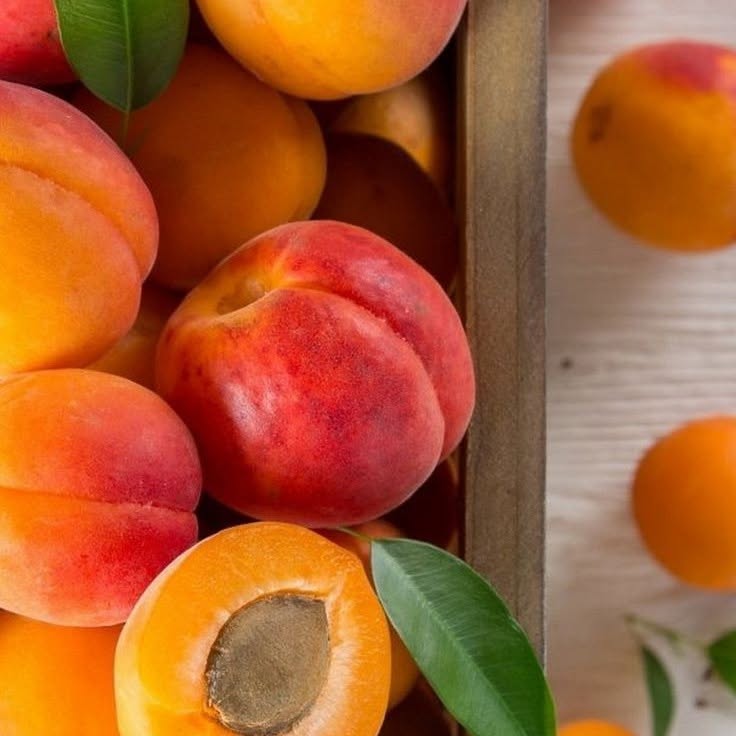
Packaged Golden Peach Fruit
When Golden Peach Starts Producing
A grafted golden peach tree usually starts fruiting in the second or third year after planting. A non-grafted tree from cuttings takes a little longer, often from the third or fourth year. The first harvest is light, and yields build over the next few years as the tree matures.
A well-managed peach tree reaches full production around the sixth to eighth year. Under good care, a mature tree can produce hundreds of fruits a year. The economic life of a peach orchard runs roughly 12 to 15 years before yields drop enough to justify replanting.
The exact timing shifts with climate, care, soil and variety. A tree on a warm, well-fed, well-watered, well-pruned site fruits sooner and heavier than a neglected tree on marginal land.
The Early Years and Cash Flow
The first two to four years after planting cost money and return little or nothing. You spend on seedlings, land preparation, irrigation, fertiliser and labour, and you wait. This is normal for a tree crop. Plan your cash flow to carry you through this gap. Do not commit your last shilling to the orchard without keeping a reserve for the waiting years, because a tree that runs short of water or food in its early growth never catches up.
Peach Yield Per Acre
No single yield figure fits every farm, because production swings with the variety, the site, the chill hours, the pruning, the feeding, the water and the pest and disease pressure. A well-pruned, well-fed tree on good land with the right chill gives far more than a neglected tree on a marginal site.
Yield also depends on fruit size, and fruit size depends on thinning. A tree carrying 600 small fruit gives a lower total weight than a tree carrying 200 large fruit, and large fruit sells for more per kilogram. This is why thinning matters for both total weight and total income.
Work out your own likely harvest instead of trusting a headline number:
- Count the marketable fruit on a set of average trees over a harvest season, and weigh them.
- Scale that per-tree weight across the number of trees you actually planted.
- Take off the fruit you lose to pests, disease, grading and handling, and keep only the sellable weight in your estimate.
The things that move the result are chill hours and flowering, pruning quality, fruit thinning, feeding, water, pest and disease control, and the age of the trees. Any yield figure you use should carry its assumptions in plain sight and be tested against a bad season as well as a good one.
Detailed Cost of Peach Farming in Kenya Per Acre
Below is a worked example for one acre planted at 4 m by 3 m, using about 300 trees as a realistic planted count after paths and working space. Only the seedling prices are fixed. Every other figure is an example to show the size of the job, and you must confirm your own numbers with local suppliers, because prices differ by region, season and how much work you do yourself.
Cost Table: Grafted Golden Peach at KSh 1,500 Each
| Cost item | Example estimate for one acre (confirm locally) | Notes |
|---|---|---|
| Grafted seedlings, about 300 at KSh 1,500 | KSh 450,000 | Fixed seedling price. Add spares for gaps |
| Land clearing, ploughing, harrowing | KSh 15,000 to KSh 30,000 | Depends on land state and hire rates |
| Digging holes, making raised beds or ridges | KSh 10,000 to KSh 25,000 | More on heavy or sloping land |
| Well-rotted manure | KSh 20,000 to KSh 50,000 | Depends on rate per hole and transport |
| Basal and season fertiliser | KSh 30,000 to KSh 70,000 | Set by soil test, split through the season |
| Drip irrigation system for one acre | KSh 60,000 to KSh 150,000 | Wide range by brand and layout. One-off cost |
| Water and power for irrigation | KSh 15,000 to KSh 60,000 per year | Depends on source and dry spells |
| Mulch | KSh 5,000 to KSh 20,000 | Grass, crop trash or bought mulch |
| Crop protection sprays and equipment | KSh 20,000 to KSh 50,000 | Leaf curl spray timing is critical |
| Staking and wind protection | KSh 5,000 to KSh 20,000 | Needed on windy sites |
| Labour through the season | KSh 60,000 to KSh 150,000 | Planting, pruning, spraying, picking |
| Packaging and transport to market | Varies | Depends on volume, distance and buyer |
| Estimated first-year total (before marketing) | KSh 680,000 to KSh 1,075,000 | Seedlings are the biggest single line |
Cost Table: Non-Grafted Golden Peach from Cuttings at KSh 800 Each
| Cost item | Example estimate for one acre (confirm locally) | Notes |
|---|---|---|
| Non-grafted seedlings, about 300 at KSh 800 | KSh 240,000 | Fixed seedling price. Add spares for gaps |
| Land clearing, ploughing, harrowing | KSh 15,000 to KSh 30,000 | Same as above |
| Digging holes, making raised beds or ridges | KSh 10,000 to KSh 25,000 | Same as above |
| Well-rotted manure | KSh 20,000 to KSh 50,000 | Same as above |
| Basal and season fertiliser | KSh 30,000 to KSh 70,000 | Same as above |
| Drip irrigation system for one acre | KSh 60,000 to KSh 150,000 | One-off cost |
| Water and power for irrigation | KSh 15,000 to KSh 60,000 per year | Same as above |
| Mulch | KSh 5,000 to KSh 20,000 | Same as above |
| Crop protection sprays and equipment | KSh 20,000 to KSh 50,000 | Same as above |
| Staking and wind protection | KSh 5,000 to KSh 20,000 | Same as above |
| Labour through the season | KSh 60,000 to KSh 150,000 | Same as above |
| Packaging and transport to market | Varies | Same as above |
| Estimated first-year total (before marketing) | KSh 470,000 to KSh 845,000 | Lower seedling cost saves about KSh 210,000 |
A few honest points on this budget. The drip system is a one-off cost that serves you for the life of the orchard, so spread it over the years when you judge the crop. Manure, fertiliser and labour repeat every season. The seedling cost repeats only when you replant. The grafted option costs about KSh 210,000 more in seedlings alone for 300 trees, which is real money on a tight budget, so the choice between grafted and non-grafted is partly a cash-flow decision.
Get written quotes for each line before you plant, and keep a cash reserve for the season, because an orchard that runs short of water or fertiliser halfway through the year loses far more than the money you tried to save. The first two or three years cost money and return nothing, so plan for that gap.
Annual Running Costs After Establishment
Once the orchard is planted, the main annual costs are fertiliser, sprays, water, labour for pruning and picking, and packaging and transport. These costs run every year whether the crop is good or bad. A rough guide for annual running costs on one acre of mature peach trees sits between KSh 150,000 and KSh 350,000, depending on how much you do yourself, your spray programme and your labour costs. Your own figure comes from your actual quotes.
Peach Revenue and Profitability
Revenue is not profit, so keep the two apart. Here are the real market prices in Kenya, followed by how to use them.
What Peaches Sell For in Kenya
Peaches are a high-value fruit in Kenya, and the prices show it.
A kilogram of imported fresh peaches in Kenya costs between KSh 1,350 and KSh 2,500. These are the peaches you see in premium supermarkets, flown in from South Africa, Europe or elsewhere. A single imported peach in a Nairobi supermarket sells for about KSh 150 to KSh 250, depending on size and season.
Locally grown peaches range between KSh 300 and KSh 750 per kilogram. The wide range reflects the difference in quality, variety, sweetness and where you sell. Sweet, large, clean fruit sold direct or through a good grocer sits near the top of that range. Small, blemished fruit sold at the farm gate to a trader sits near the bottom.
The gap between the import price and the local price is wide. Imported peaches at KSh 1,350 to KSh 2,500 per kilogram sit far above locally grown at KSh 300 to KSh 750. That gap is your room to operate. A local grower who produces sweet, clean fruit can sell at KSh 500 to KSh 750, earn well per kilogram, and still sit far below the import price, which is why hotels, restaurants and premium buyers switch to local when the quality is there.
What Moves the Price
Grade and quality come first. Sweet, firm fruit with no blemishes and no chemical residue earns the top prices. Small, soft or damaged fruit sells at the bottom of the range. Location comes second, because the same fruit earns more in a Nairobi supermarket or hotel than at the farm gate in a rural area. Timing matters too, because peaches outside the main harvest window are scarce and command a premium.
A Worked Revenue Example
This is an example to show the method. It is not a promise of what you will earn. Test it with your own yield and your own price.
Say you plant 300 trees on an acre. For illustration, assume each tree gives 20 kilograms of sellable fruit per year at full production. That is an assumption you must check against your own crop, because yields vary widely.
- 300 trees times 20 kg equals 6,000 kg of sellable fruit.
- At a local price of KSh 300 per kg, gross revenue is 6,000 times 300, which is KSh 1,800,000.
- At a local price of KSh 500 per kg, gross revenue is 6,000 times 500, which is KSh 3,000,000.
- At a local price of KSh 750 per kg, gross revenue is 6,000 times 750, which is KSh 4,500,000.
- If you sell part of the crop to hotels or premium buyers at the top of the local range or near import levels, that portion earns far more per kilogram.
Now bring in the costs. Gross revenue is not what you keep.
- Gross revenue minus running costs equals gross margin. Running costs are the annual costs like fertiliser, sprays, water, labour, pruning, packaging and transport.
- Gross margin minus your share of the set-up costs equals net profit. Set-up costs include the seedlings, land preparation and the drip system, spread over the 12 to 15 years the orchard produces.
So from a gross of KSh 1,800,000 to KSh 4,500,000, you subtract the annual running costs and a fair share of the set-up costs to see what is left. Whether the number that remains is good depends on your real yield, the price you get, and how tightly you control costs. Build your own version of this with your figures, and run a bad-season version next to a good one, because a frost at bloom time, a leaf curl outbreak or a market glut can turn a strong plan into a weak one.
Also remember that the first two to four years produce little or no fruit while costs continue, so the real return shows after the orchard reaches full production. Your cash plan needs to carry you through those early years.
The Import Gap Is Your Margin
Think about what the import price means for you. If a Nairobi supermarket sells imported peaches at KSh 1,350 to KSh 2,500 per kilogram, and you can grow and deliver sweet, clean local peaches at KSh 500 to KSh 750 per kilogram, the supermarket still makes a margin by switching to your fruit, and you make a margin far above most other crops. The importer pays for air freight, cold chain and import duties. You pay for farm gate packing and road transport. The cost difference is large, and it sits in your favour as a local grower.
Harvesting and Post-Harvest Handling
Peaches bruise easily, and a bruise rots fast, so gentle handling matters at every step from tree to buyer.
Pick when the background colour of the skin changes from green to yellow or yellow-white. The fruit should feel firm, not soft, because firm fruit travels and ripens off the tree. A fully soft peach on the tree is overripe for market, though fine for home eating.
Pick often during the season, because peaches ripen in stages and a tree left too long between pickings loses overripe fruit to fall and rot. Use clean containers that do not crush the bottom layers. Keep the fruit cool and out of direct sun after picking, because heat speeds softening and rot. Sort out damaged and diseased fruit and grade the rest by size, because an even lot sells better than a mixed one.
Peaches store best at about 0 to 2 degrees with high humidity, but most Kenyan farms lack cold storage, so get the fruit to the buyer quickly. The shorter the chain from tree to buyer, the less fruit you lose. If you must hold fruit for a day or two, keep it in the coolest, best-ventilated place you have.
Picking Technique
Twist the fruit gently upward and to the side. A ripe peach separates cleanly from the branch with a slight twist. If you have to pull hard, the fruit is not ready. A fruit picked too green never ripens properly and tastes flat. A fruit picked overripe bruises in the container and arrives at market soft. Learn the right stage by watching a few fruit through the colour change and tasting them.
Grading for Market
Sort the harvest into at least two grades. Grade one is large, well-coloured, unblemished fruit for premium buyers. Grade two is smaller or slightly marked fruit for the fresh market or processing. Cull any diseased, badly bruised or split fruit. Grading takes time but it earns money because premium buyers pay for an even pack, and a mixed pack sells at the lowest grade in the lot.
Marketing Peaches in Kenya
Line up your buyer before you plant, because peach harvests come in a window and a grower with no buyer sells at whatever the day offers.
- Supermarkets and premium grocers pay the top local prices for clean, sweet, well-graded fruit. They compete with imports and want local supply at a lower cost.
- Hotels and restaurants want steady supply of good fruit and often pay well for quality, which is where the KSh 500 to KSh 750 range opens up.
- Fresh markets and local retailers take whole fruit graded by size and ripeness, at mid-range prices.
- Wholesale traders buy in bulk and move fruit to bigger markets, usually at a lower price for the convenience of selling in volume.
- Value addition such as jams, dried peaches and juices extends the life of any fruit that does not sell fresh and adds another income stream.
Talk to buyers early, learn what they pay, what grade and volume they want, and when the supply is shortest so you can target that window. The price difference between selling at peak supply and selling in the off-season can be large.
Export Opportunity
Kenya already exports small volumes of peaches to neighbouring countries. A grower who meets the quality and phytosanitary standards of export markets can access prices above the local range. Export requires additional investment in cold chain, packaging and certification, but the returns are higher. Talk to an export agent about what your target market requires before you commit.
Health Benefits of Peaches
Ripe peaches are a good food, and their value helps them sell. The points below are nutrition facts, not medical claims. Peaches are part of a healthy, mixed diet, not a cure for any illness.
- Vitamin C. Peaches give vitamin C, which supports the body’s normal defences.
- Vitamin A from carotenoids. The orange and yellow flesh holds carotenoids such as beta-carotene, which the body converts to vitamin A for normal sight and skin.
- Fibre. Peaches give dietary fibre for normal digestion.
- Potassium. Peaches hold potassium, a mineral for normal muscle and nerve function.
- Antioxidants. Peach flesh contains antioxidants, including chlorogenic acid.
- Low calorie. Peaches are relatively low in calories for their size, which suits a balanced diet.
Eat peaches as part of a varied diet. For any special diet need or health concern, ask a qualified health worker.
Uses of Peach Fruit
How ripe the fruit is decides how you use it, which widens your market. Ripe fruit goes into fresh eating, fruit salads, smoothies, desserts and baking. Peaches pair well with yoghurt, ice cream and pastries, and these uses feature in hotels and restaurants that pay premium prices.
Firm or slightly underripe fruit works in cooking and preserves. Peach jam, peach chutney and canned peaches are all value-added products that extend the shelf life and give you something to sell outside the fresh fruit season. Dried peaches are a growing market, especially for export. The broader the range of uses you can sell into, the less you depend on a single buyer at a single time.
Common Peach Farming Mistakes
Most peach failures come from a short list of avoidable errors:
- Planting at the wrong altitude, where chill hours are too few for flowering or frost hits the blossoms.
- Planting on wet or poorly drained land, which rots the roots.
- Skipping pruning, which turns the tree into a dense, unproductive mess within a season or two.
- Skipping fruit thinning, which gives you many small, cheap fruit instead of fewer large, valuable ones.
- Ignoring leaf curl spray timing, so the fungus gets in and weakens the tree year after year.
- Buying cheap seedlings of unknown origin, which may be the wrong variety or carry disease.
- Planting a high-chill variety in a low-chill area, and then wondering why the tree stays leafy and gives no fruit.
- Letting nematode-infested soil go unchecked, which slowly starves the tree no matter how much you feed and water above ground.
- Neglecting the first two to four years, expecting fruit before the tree is ready, and then giving up before the orchard reaches production.
- Rough handling at harvest, which bruises fruit and brings rot.
- Overfeeding with nitrogen, which gives large, soft, poorly coloured fruit that stores and travels badly.
Remove trees that show clear disease, fail to grow or produce nothing after the expected time. Replant a whole block when yield and quality drop as the trees age, and after a disease loss move to fresh ground with clean seedlings.
How to Choose Healthy Golden Peach Seedlings
Your orchard starts with the seedling, so read it before you pay. A healthy seedling has firm green leaves with no spots, curling or distortion, a strong straight stem, and white, well-spread roots with no rot or knots when you tip it from the bag. On a grafted seedling, the graft join should be clean and healed, not loose or splitting.
Run this checklist at the nursery:
- Confirm the variety and that the seedling is a true golden peach.
- Choose grafted or non-grafted based on your soil and budget.
- On grafted seedlings, check that the graft join is clean and fully healed.
- On grafted seedlings, ask about the rootstock and what it gives you in your soil type.
- On non-grafted cuttings, confirm the cutting was taken from a productive, healthy mother plant.
- Check the leaves for curling, spots or mottling that point to disease.
- Check the base of the stem for gumming, soft rot or canker.
- Check the roots for white, well-spread growth free of galls or knots from nematodes.
- Confirm the seedlings have been hardened for full sun.
- Pick stocky, well-rooted seedlings, not overgrown pot-bound plants.
- Confirm the number you need against your usable land, and the total at KSh 1,500 or KSh 800 each.
- Ask the nursery about chill hours for the variety and whether it suits your area.
- Agree how delivery works, and ask what happens if plants arrive damaged.
Plant on the day the seedlings arrive or as soon after as possible. Dig the holes and form the beds first. Keep the plants shaded and upright in transport, water them in on planting, and mulch without delay.
Buyers Outside Kenya: We Export Golden Peach Seedlings
You do not have to be in Kenya to buy from us. Fruit Africa Veriplant exports golden peach seedlings, so buyers outside the country can order too.
Peaches are not sold as seeds, so there is no seed packet to post. When you order from outside Kenya, tell us your country, the quantity you want and whether you need grafted or non-grafted seedlings, and we will explain how the export works for your order.
Follow the plant and produce import rules of your own country. Most countries ask for the correct paperwork and health certificates before anything crosses the border, and bringing in planting material without that paperwork is against the law in most places. Reach us early through the contacts in this guide so we sort the details before you commit.
Where to Buy Golden Peach Seedlings in Kenya
Fruit Africa Veriplant supplies golden peach seedlings in both forms covered in this guide. Grafted golden peach seedlings cost KSh 1,500 each. Non-grafted golden peach seedlings propagated from cuttings cost KSh 800 each. Orders and questions go through the contacts below.
- Phone: 0714 994 444
- WhatsApp: https://wa.link/di12my
- Email: sales@fruitafrica.org
- Contact page: https://fruitafrica.org/contact-us/
- Request for quotation: https://fruitafrica.org/request-for-quotation/
Whatever nursery you buy from, name the variety, confirm the rootstock on grafted trees, ask about chill hours, and check the seedlings against the list above before they leave for your farm.
Frequently Asked Questions
1. How much are golden peach seedlings in Kenya?
Fruit Africa Veriplant sells grafted golden peach seedlings at KSh 1,500 each and non-grafted seedlings propagated from cuttings at KSh 800 each. Multiply the number by the price you choose. Budget separately for land work, drainage, manure, fertiliser, water, sprays and labour, which cost more than the seedlings over the life of the orchard.
2. How many golden peach seedlings do I need for one acre?
At 4 m by 3 m, one tree uses about 12 square metres, so an acre fits about 337 trees on paper. After paths, boundaries and working space, most growers plant near 280 to 320 per acre and keep spares for gaps. Measure the land you can actually plant, divide by 12, and add a few extra.
3. What spacing should I use for golden peach trees?
Plant 4 metres apart within the row and 3 metres between rows. This gives each tree room to spread, lets you walk and work through the rows, lets in light and air, and reduces fungal disease.
4. How much do 300 grafted golden peach seedlings cost?
At KSh 1,500 each, 300 grafted seedlings cost KSh 450,000. At KSh 800 each, 300 non-grafted seedlings cost KSh 240,000. The grafted option costs KSh 210,000 more in seedlings alone.
5. What is the difference between grafted and non-grafted golden peach seedlings?
Grafted seedlings join a golden peach scion to a separate rootstock. They fruit earlier, from year two or three, and the rootstock handles poor soil and nematodes better. They cost KSh 1,500 each and the graft join must stay above soil level. Non-grafted seedlings are grown from cuttings on their own roots, with no graft join. They cost KSh 800 each, fruit from about year three or four, and suit good, well-drained, nematode-free soil. Both give the same golden peach fruit.
6. Why are grafted seedlings more expensive?
Grafting takes extra time, skill and rootstock material. The nursery raises a rootstock plant, takes a scion cutting from a mature golden peach tree, joins the two and waits for the graft to heal. The extra steps and the rootstock material add cost per seedling.
7. What are chill hours and why do they matter?
A chill hour is roughly one hour where the temperature sits between 0 and 7 degrees. Peach trees need a certain number of chill hours over the cold season to flower properly. If your area does not get enough chill hours for the variety you planted, the tree grows leaves but flowers weakly or not at all, and you get no fruit. Match the variety to your area’s chill hours before you buy.
8. At what altitude can I grow golden peach in Kenya?
Golden peach grows well between 1,500 and 2,500 metres above sea level. Below that, chill hours may be too few. Above that, frost risk rises and the growing season shortens. Suitable areas include Nyeri, Murang’a, Meru, Limuru, Molo, Kericho and parts of Nakuru and Kiambu.
9. What soil does golden peach need?
Deep, fertile, well-drained soil with a pH between 5.8 and 6.8. Sandy loam is ideal. Heavy clay that holds water and low ground where water collects are the wrong places. Peach roots die fast in waterlogged soil.
10. When should I plant golden peach seedlings?
Plant at the onset of the rains or under irrigation, when the soil is warm and moist. Avoid planting in the cold, dry season when growth is slow. Keep the graft join above soil on grafted trees.
11. When will my golden peach tree start fruiting?
Grafted trees usually fruit from year two or three. Non-grafted cuttings take longer, often from year three or four. Full production comes around year six to eight. The first harvest is light and yields build from there.
12. Do I need to prune peach trees every year?
Yes. Peach bears fruit on last year’s wood. If you skip pruning, the old wood builds up, new growth drops, light cannot reach the centre, and fruit quantity and quality fall. The open vase shape keeps fruiting wood low and productive. Pruning is not optional.
13. What is fruit thinning and why should I do it?
Thinning means removing some young fruit early so the remaining fruit grow larger. A tree left full sets hundreds of small, cheap fruit. A tree thinned to about 10 to 15 cm spacing along the branch gives fewer but much larger, more valuable fruit. Thinning also prevents branch breakage from excess weight.
14. What is peach leaf curl and how do I control it?
Peach leaf curl is a fungal disease caused by Taphrina deformans. Infected leaves thicken, curl, turn red or yellow and fall early, weakening the tree. Control it by spraying a copper-based fungicide before the buds swell in late winter or early spring. Once the buds open and the fungus enters, spraying does little. Clean up and destroy fallen infected leaves.
15. What pests and diseases should I watch for?
Key pests include aphids, fruit flies, peach tree borers, spider mites and scale insects. Key diseases include peach leaf curl, brown rot, gummosis, root rot, powdery mildew and bacterial canker. Nematodes attack roots below ground. Good spacing, pruning, drainage and regular scouting matter most for prevention.
16. How much do peaches sell for in Kenya?
Imported fresh peaches cost KSh 1,350 to KSh 2,500 per kilogram. Locally grown peaches range between KSh 300 and KSh 750 per kilogram. Sweet, large, clean fruit sold to hotels and premium buyers sits near the top. Small or blemished fruit at the farm gate sits near the bottom.
17. Is peach farming profitable in Kenya?
It can be, if you match the variety to the chill hours, plant on well-drained soil at the right altitude, prune and thin properly, control leaf curl and other diseases, and sell to the right buyers. The gap between the import price and the local price gives room to earn. The first years cost money and return nothing, so plan your cash flow through the early period.
18. How long does a peach orchard last?
A well-managed peach orchard produces for about 12 to 15 years before yields drop enough to justify replanting. Individual trees can live longer but the commercial return falls after that point.
19. Can I buy golden peach seedlings from outside Kenya?
Yes. Fruit Africa Veriplant exports golden peach seedlings. Peaches are not sold as seeds. Contact us with your country, quantity and form preference, and we will explain how export works. Follow your own country’s plant import and phytosanitary rules.
20. Where can I buy golden peach seedlings in Kenya?
Fruit Africa Veriplant supplies them. Grafted golden peach seedlings at KSh 1,500 each, non-grafted at KSh 800 each. Reach us on 0714 994 444, on WhatsApp at https://wa.link/di12my, by email at sales@fruitafrica.org, through https://fruitafrica.org/contact-us/, or request a quote at https://fruitafrica.org/request-for-quotation/. Name your variety, confirm the rootstock on grafted trees, ask about chill hours, and check the seedlings before you pay.
Before you order, settle the two decisions that matter most. Confirm that your land sits at the right altitude and gets the right chill hours for golden peach, and pick the seedling form that fits your soil and your budget. Then plan your beds, water and wind protection, get local quotes for every cost line, measure the land you can plant, and order seedlings to match it at 4 m by 3 m with a few spare. Prune every year, thin the fruit, spray for leaf curl at the right time, and sell to the buyers who pay for quality. The gap between the import price and the local price is where your margin lives, and filling that gap with clean, sweet, well-grown Kenyan peaches is the whole opportunity.



Reviews
There are no reviews yet.