
Description
- Dwarf coconut seedlings in Kenya from Fruit Africa Veriplant at KSh 1,500. Learn varieties, planting, spacing, yield and profit for coastal and lowland farmers.
Dwarf Coconut Seedlings in Kenya: Price, Varieties, Planting, Yield and Profit
Dwarf coconut seedlings are young palms of the shorter, earlier-flowering type of coconut, and Fruit Africa Veriplant raises them in nurseries in Murang’a and Nairobi for farmers who plant in warmer parts of Kenya. Before you order, you need straight answers to a few questions. Does your farm have the warmth, rainfall, and soil coconut needs? Which dwarf variety are you buying? How many palms fit on your land? What will the orchard cost before the first nut sells, and what might the first harvests earn?
This guide takes those questions in the order you meet them. You start with site suitability, varieties, and seedling price. You then work through spacing, planting, water, feeding, and pests, and finish with bearing age, yield, costs, markets, and harvest handling. The money sections use planning scenarios and not promises. Kenyan farm records for dwarf coconut are thin, so the figures below show you how to test your own farm against a low, a middle, and a higher outcome.
For current variety, stock, price, and delivery arrangements, call Fruit Africa Veriplant on 0714994444 or write to sales@fruitafrica.org.
Dwarf Coconut Seedlings in Kenya at a Glance
What you buy: a young palm grown from a seed nut and raised in a polybag. Age and size at sale depend on the batch, so confirm both.
Where the crop suits: warm, humid lowlands, mainly the Coast and other warm areas with enough rain or irrigation. Highland and cool areas do not suit commercial coconut.
Spacing: KALRO recommends at least 7.5 m by 7.5 m for a pure coconut stand, which gives about 72 palms per acre.
Bearing: dwarf palms often flower from about the third year in good conditions. First harvests and commercially meaningful crops arrive later, and timing varies by farm.
Yield: AFA reports national averages of roughly 28 to 38 nuts per tree per year. This guide plans with 30, 50, and 80 nuts per tree as illustrative scenarios.
Price of seedlings: confirm the current price with the nursery. The cost model below uses a planning allowance and not a quoted price.
Money: AFA reports an average farm-gate price near KSh 15 per mature coconut. At that price, a rain-fed acre struggles to cover its running costs, so your market matters as much as your palms.
What Is a Dwarf Coconut?
A dwarf coconut is a coconut palm of a short-statured variety. Botanically, dwarf and tall coconuts belong to the same species. Breeders and farmers separate them by growth habit, flowering age, and how the palm reproduces.
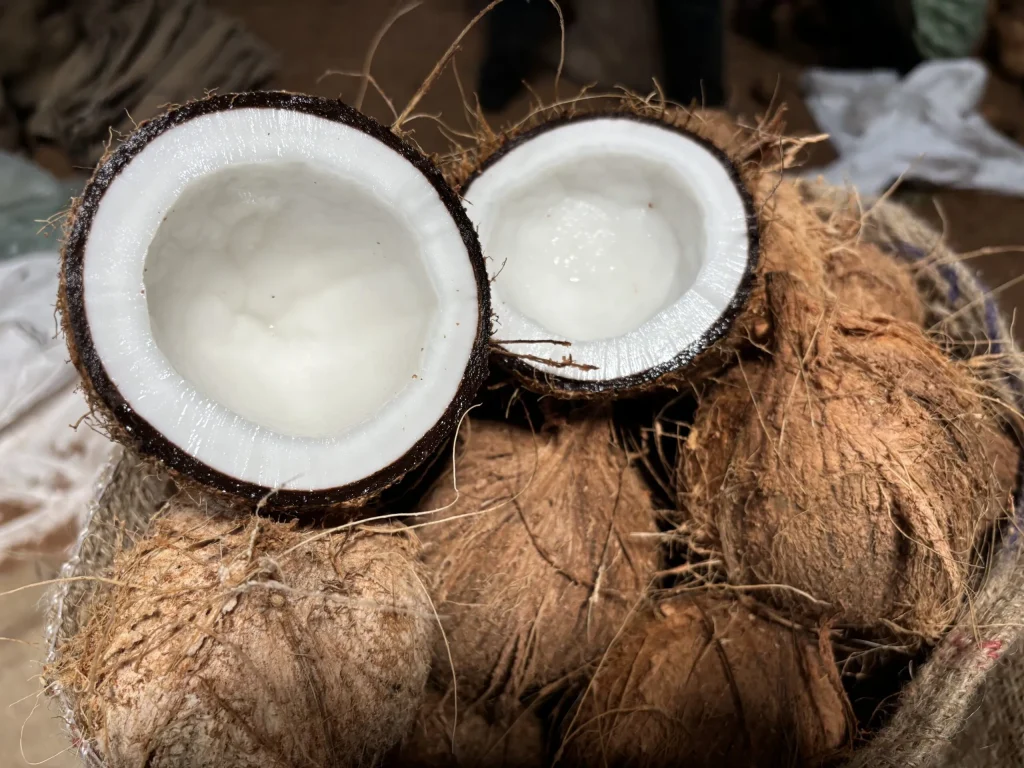
Coconut Fruit
Growth habit and size
Tall coconut types, such as East African Tall, often reach 15 to 18 metres or more. Dwarf types stay noticeably lower, usually somewhere between roughly 5 and 10 metres depending on variety and age. Dwarf palms also have thinner trunks and smaller fronds, so more of them fit on a given area than tall palms.
That difference in size changes your daily work. A short palm means a worker with a pole knife reaches the bunches for many years. You do not pay a climber on every harvest, and you avoid the fall risk that comes with tall palms.
Bearing characteristics
Dwarf palms flower earlier than tall palms. Indian research stations report first flowering as early as the third year after planting for dwarfs, while tall types take much longer. Dwarfs also tend to self-pollinate, which means each palm sets nuts from its own pollen. Nuts are usually smaller than tall-palm nuts and carry less copra, which is why dwarfs suit tender nut sales better than oil or copra.
Early flowering does not mean early profit. First flowers appear before the palm has the leaf area and root system to carry a heavy crop. The first nuts may be few, and the first commercially meaningful harvest usually arrives a year or two after the first flowers.
Ease of harvest and farm size
A shorter palm makes harvest safer and cheaper, because a worker with a pole knife reaches bunches without climbing for many years. Dwarfs also suit farmers with small plots, since orchard yield per acre depends on palm number and management and not on trunk height.
Dwarf versus tall: the trade-offs
Dwarf palms do not beat tall palms on every measure. Tall palms usually tolerate drought and poor soils better, live longer, and give larger nuts with more copra. Dwarfs tend to need steadier moisture and better soils, and some dwarf varieties show more sensitivity to certain diseases.
Reported productive lifespans differ between sources. Dwarfs are generally described as shorter-lived than tall types, and figures from 40 to 60 years appear in the literature, so treat any single number with caution.
Choose dwarf coconut seedlings when early flowering, easy harvest, and tender nut sales fit your plan and your site offers reliable moisture. Consider tall types if you farm dry ground with poor water access or if your goal is copra and oil.
Hybrids
Hybrids come from crossing a dwarf with a tall parent. They aim to combine early flowering with larger nuts and more copra. In 2023, the government, with DANIDA, MESPT, KALRO, and the Kilifi County government, imported 6,000 Sampoorna hybrid seedlings from India for a pilot at the Coast. Hybrids need good management, and performance data from Kenyan farms is still limited.
Dwarf Coconut Varieties
Dwarf varieties are usually named for nut colour and place of origin. Common names include Malayan Yellow Dwarf, Malayan Green Dwarf, Malayan Red Dwarf, and Chowghat Orange Dwarf. Each name describes where the variety was selected and how its nuts look when young.
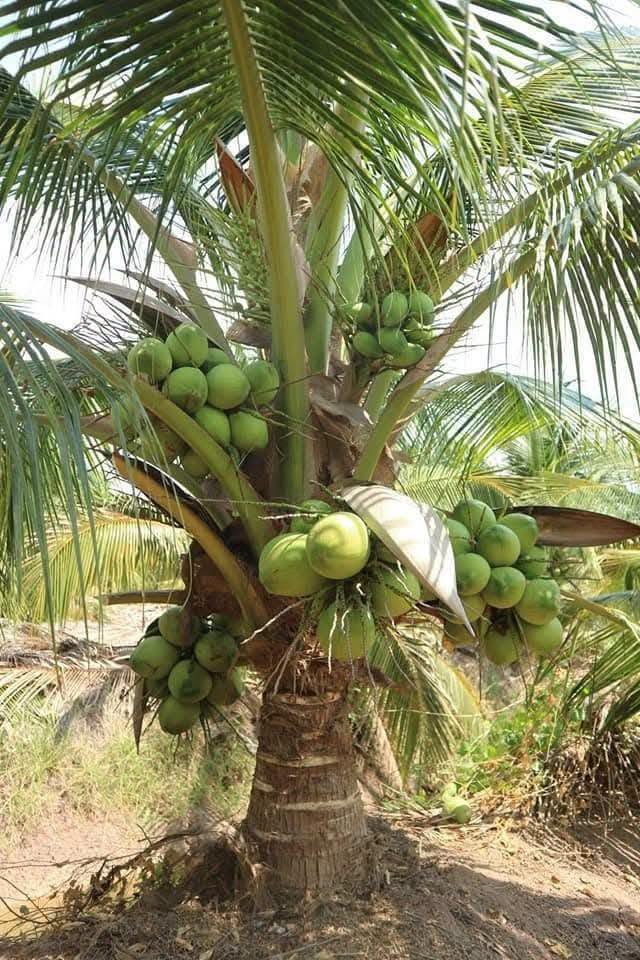
A dwarf coconut tree
What you are able to say with confidence
Chowghat Orange Dwarf comes from the Malabar coast of India, produces small orange nuts, and appears in Indian research as an early-flowering dwarf and as a parent in hybrid crosses. Malayan Yellow Dwarf is widely used as a parent in tender-nut hybrids, including in India. Malayan Green and Malayan Red Dwarf take their names from nut colour.
What no one should promise you
Published, side-by-side performance figures for these varieties under Kenyan conditions are hard to find. Nut count, water volume, drought response, and disease sensitivity change with the source of the planting material and with your site. A seller who quotes an exact yield or maturity age for a named variety without local records is guessing.
How to choose
Ask your buyers which nut colour and size they prefer before you order, because colour influences how tender nuts sell in some markets. Confirm the exact variety name and the origin of the seed nuts with the nursery. Plant one variety per block, so palms flower at similar times and harvest rounds stay regular. Buy all seedlings for a block from one batch.
If you plant two varieties in one block, harvest rounds stretch across more weeks, labour spreads unevenly, and records become hard to read. Keep separate blocks for separate varieties, and keep a page of records per block.
How Much Do Dwarf Coconut Seedlings Cost in Kenya?
Seedling prices differ between nurseries and between batches, so no single number applies everywhere. Price depends on the variety, the age and size of the seedling, the polybag, the quantity you order, and the cost of moving seedlings to your farm.
Fruit Africa Veriplant confirms the current price of dwarf coconut seedlings on request. Call 0714994444 or write to sales@fruitafrica.org with your county, the number of seedlings you need, and your planting date.
For the cost model later in this guide, we use a planning allowance of KSh 800 per seedling. This figure is an assumption for calculation and not a quoted price. Replace the figure with the price you receive in writing.
Do not choose a nursery on price alone. Seedlings account for about half of establishment cost in the model below, and weak seedlings cost you years of growth. A farmer who saves KSh 200 on each of 76 seedlings saves KSh 15,200. Losing ten seedlings and the growing years attached to them wipes out that saving.
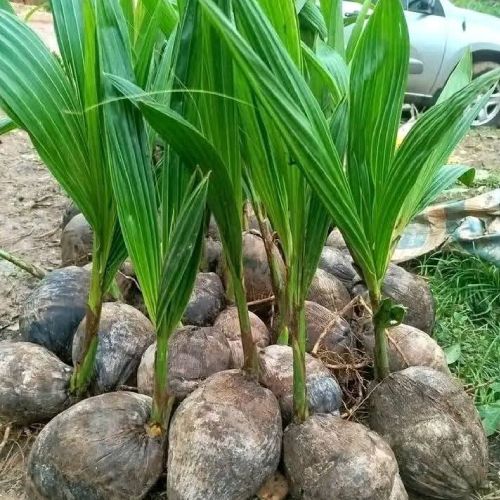
Dwarf Coconut Seedlings in Kenya
Where Can Dwarf Coconut Grow in Kenya?
Coconut is a tropical crop. Commercial success depends on a combination of factors, and altitude alone does not tell you whether your farm suits the palm. Check temperature, rainfall, soil moisture, humidity, sunshine, drainage, and wind on your own site.
Temperature
Coconut grows best where the mean annual temperature sits around 27 degrees Celsius with small seasonal swings. Growth, flowering, and nut set decline as sites get cooler. Cool nights and cold spells slow palms sharply. The exact tolerance differs between varieties, so the figure gives you a guide and not a fixed limit.
Record the lowest night temperature on your site during the coolest month. A site with regular cold nights will not carry a commercial orchard, no matter how well you manage the rest.
Rainfall and moisture
Extension guides commonly treat about 1,300 to 2,300 mm of well-spread annual rainfall as suitable for coconut, and some sources quote a wider range. The spread matters as much as the total. A palm decides how many flowers and nuts to carry many months before harvest, so a long dry spell lowers yield later. Dwarf varieties are often described as more sensitive to drought than tall types, so plan irrigation for dry spells if you farm outside the wet Coast belt.
Humidity and sunshine
Palms prefer humid air and full sun. Plant in open ground, away from tall trees and buildings which shade the crowns. Shade slows growth, reduces the number of fronds, and cuts flowering.
Wind and salt
Coconut tolerates coastal wind and moderate salt spray better than most fruit crops. Strong dry wind still damages young seedlings, so protect new plantings on exposed sites. A windbreak of fast growing shrubs or grass strips protects the block without shading the palms, as long as you keep the windbreak far enough away.
Where in Kenya
Over 95 percent of Kenya’s coconut palms grow along the Coast, and the crop concentrates in Kilifi and Kwale, with Lamu, Tana River, Mombasa, and lower Taita Taveta also growing coconut. Policy documents list Tharaka Nithi, Meru, parts of Makueni and Machakos, Busia, Homa Bay, and Siaya as areas with coconut potential. Potential is not a guarantee. Rainfall in many of these areas is lower or less reliable than at the Coast, and temperature varies between sites.
If your farm lies outside the Coast, plant a small trial block of 20 to 30 palms first, irrigate through the dry seasons, and watch growth for two years before you plant more. Highland and cool areas, including most of Nairobi, Murang’a, Kiambu, Nyeri, Nyandarua, and Nakuru, are too cold for a commercial orchard. Fruit Africa Veriplant raises seedlings in Murang’a and Nairobi, but the palms are meant for planting in warm sites.
Checks before you plant
Record night and day temperatures across the coolest months. Note the number of dry months in a normal year and in a bad year. Confirm a reliable water source for irrigation in dry spells. Look for waterlogged patches after heavy rain. Ask your county agriculture officer about local pest and disease alerts.
Soil Requirements for Dwarf Coconut
Coconut needs deep, free draining soil. It also needs air around the roots, which is why drainage matters more than almost any other soil factor. A site that collects water after heavy rain will kill young palms faster than drought.
Soil depth and texture
Coconut grows best in sandy loam, loam, and alluvial soils. Aim for at least one metre of soil depth, and one and a half metres suits palms best. Heavy clay that holds water is a poor match unless you fix drainage before planting.
pH and salinity
Coconut tolerates a wide pH range from about 5.2 to 8.0. Best growth sits between 5.5 and 7.5. Coconut also tolerates moderate salinity, which is why it grows on the coast where boreholes sometimes pull salty water. Salinity tolerance does not mean salt helps the palm. High salt slows growth and cuts yield, so test your water source before you install irrigation.
Waterlogging
Waterlogging suffocates roots and opens the palm to root rot. Dig a pit one and a half metres deep on your site and look for hardpan, rock, or a grey waterlogged layer. If you find one, choose another part of the farm or install drainage before you plant.
Soil testing
Send a sample to a laboratory for pH, organic matter, potassium, magnesium, boron, and salinity. A soil report costs a few thousand shillings and guides your fertiliser plan for many years. Take the sample before you dig holes, not after, because corrections like lime take weeks to react.
How Many Dwarf Coconut Trees Fit on an Acre?
Spacing sets your plant population, and plant population sets your income. One acre equals 4,047 square metres, and one hectare equals 10,000 square metres.
| Spacing | Palms per Acre | Palms per Hectare | Notes |
|---|---|---|---|
| 6m by 6m | 112 | 277 | Tighter spacing, needs strong management |
| 7m by 7m | 82 | 204 | Common commercial spacing |
| 7.5m by 7.5m | 72 | 177 | KALRO recommended minimum for pure stands |
| 8m by 8m | 63 | 156 | Wider spacing, easier management |
| 9m by 9m | 49 | 123 | Traditional tall palm spacing |
Use 7.5 metres by 7.5 metres square spacing for your plan. Each palm occupies 56.25 square metres, and 4,047 divided by 56.25 gives about 72 palms per acre. This spacing leaves room for sunlight, air flow, and intercrops in the early years.
Tighter spacing gives more palms per acre and higher potential income. It also raises your seedling bill and your annual fertilizer bill, and the palms close canopy sooner. Once the canopy closes, light reaching the ground drops and your intercrop window ends.
Order 5 percent extra for gap filling, because dead seedlings need replacement within one month and replacements must stay close in age to the rest. One acre needs 72 palms and 76 seedlings. At KSh 800 per seedling, that comes to KSh 60,800.
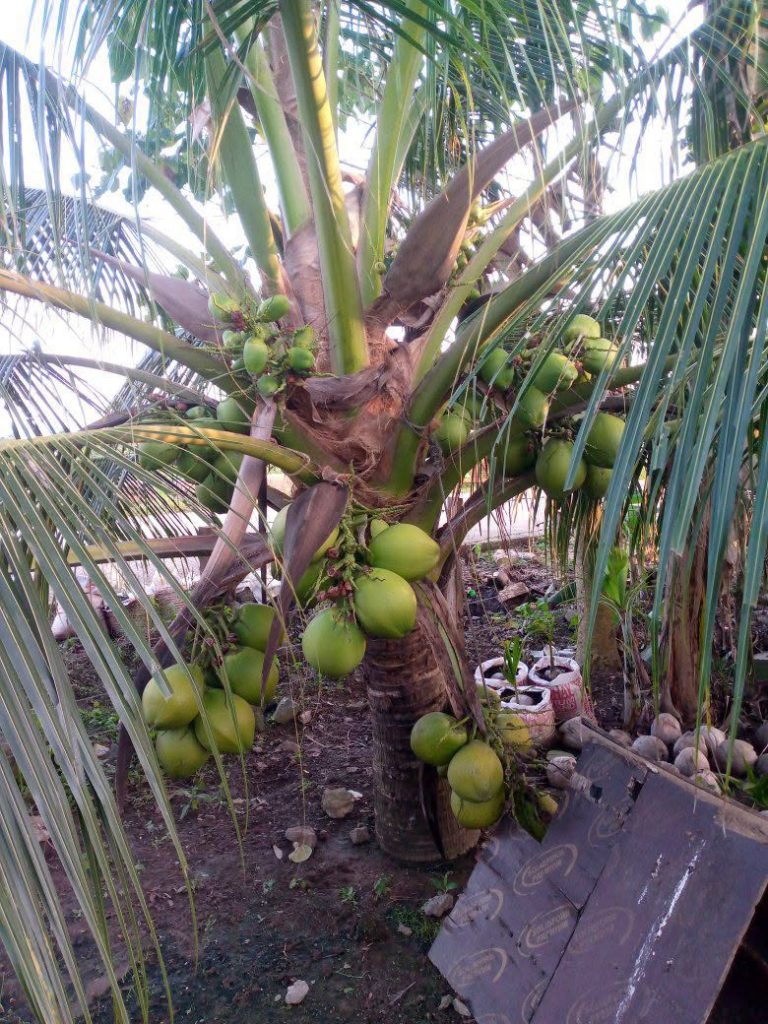
A dwarf coconut tree
How to Plant Dwarf Coconut Seedlings
Plant in the early morning or late afternoon, and on a cloudy day if you have the choice. Good planting starts with good land preparation, so begin two to three months before your seedlings arrive.
Land preparation and pegging
Clear bush and stumps, and do not burn material on the plot because fire kills soil life. Stack cut material away from the planting area, since rotting logs attract rhinoceros beetles. Run rows from north to south so palms receive even sunlight through the day, and use a rope marked at 7.5 metre intervals to peg every planting point. Straight rows make weeding, irrigation, and harvest easier.
Digging and filling holes
Dig holes 60 by 60 by 60 centimetres in sandy soil, where roots spread easily. Dig 80 by 80 by 80 centimetres in loam, and 100 by 100 by 100 centimetres in heavy or compact soil, to break compaction and improve drainage. Dig holes at least two weeks before planting so sun sterilises the soil, and keep topsoil and subsoil in separate heaps.
Mix the topsoil with 20 kilograms of well rotted manure and 200 grams of rock phosphate or triple superphosphate. In termite areas, add a registered termite control product at the label rate. Fill each hole to 15 centimetres below the surface and leave space for the seedling.
Planting steps
Open a planting space in the filled hole large enough for the bag contents. Slit the polybag along both sides and slide the bag out while keeping the soil ball whole.
Set the seedling upright at the centre of the hole. Bury the nut and the roots, and keep the collar where the shoot leaves the nut at ground level or slightly above.
Fill around the soil ball with topsoil and press firmly, leaving no air pockets. Water with 20 litres per seedling. Spread a 10 centimetre layer of mulch in a ring one metre wide, and keep mulch 10 centimetres away from the stem.
Drive a stake beside each seedling and tie loosely, because stakes hold seedlings upright in wind. Protect against termites, rats, and livestock with a light fence or individual guards in the first year. Mark each palm with a number and record the planting date.
Planting depth matters. Burying the collar causes shoot rot. Leaving the nut exposed dries roots. Aim for a buried nut and an open collar.
On slopes, plant along the contour and dig a small terrace at each hole, because terraces hold water and stop soil from washing away. Walk your field four weeks after planting and mark dead seedlings. Replace each one with a spare from the same batch, planting replacements early in the rainy season and protecting them with the same care as the first planting.
Water Management
Water requirements depend on rainfall, soil type, tree age, temperature, mulch, irrigation system, and stage of growth. There is no single litre figure that suits every farm.
Young palms
Young palms need steady moisture in the root zone. Sandy soils need more frequent water while loams hold water longer. In year one, give 20 litres per palm twice a week by bucket or hose, or 10 to 20 litres per day by drip. In year two, give 40 litres per palm twice a week, or 20 to 40 litres per day by drip. In year three, give 60 litres per palm twice a week, or 40 to 60 litres per day by drip.
Water in the morning. Water at the rim of the mulch ring where feeder roots grow rather than at the stem. Skip irrigation in weeks with more than 30 millimetres of rain, because coconut roots suffocate in saturated soil.
Signs of water stress in young palms include yellowing lower fronds, slow new leaf production, and wilting in the afternoon heat. If you see those signs, check soil moisture at the root zone before you irrigate.
Mature palms
From year four onward, give 200 litres per palm once a week, or 60 to 100 litres per day by drip. A mature palm uses about 100 litres per day in dry weather, which gives 36,500 litres per palm per year. An acre of 72 palms uses 2.63 million litres per year.
Annual rain of 1,300 millimetres delivers 5.26 million litres to one acre. The total looks sufficient until you remember that rain falls in a few months and drains away in the rest, so dry months need irrigation.
Drip irrigation for one acre
A drip system for 72 palms uses a tank or pump, a filter, a main line, and lateral lines with two to four emitters per palm. Emitters placed on opposite sides of the palm spread water across the root zone, and this matters because coconut roots spread sideways rather than down.
Flush the filter every week and check emitters for blockage every month. A system for one acre costs about KSh 40,000 in the planning figures used below, and running cost stands near KSh 6,000 per year.
Fertilizer and Coconut Nutrition
Fertilizer should follow the tree’s growth stage and soil test results rather than a fixed calendar. Coconut responds strongly to potassium and chlorine, followed by nitrogen.
Young palms
Feed each palm twice a year, at the start of the long rains and at the start of the short rains. Spread fertiliser in a ring, starting 30 centimetres from the stem and widening the ring each year, and cover with mulch after application.
In year one, apply half a kilogram of NPK compound per palm per year in two splits of 250 grams, which costs KSh 3,960 per acre at KSh 110 per kilogram. In year two, apply 1 kilogram per palm in two splits of 500 grams, which costs KSh 7,920 per acre. In year three, apply 1.5 kilograms per palm in two splits of 750 grams, which costs KSh 11,880 per acre.
Mature palms
From year four onward, apply 2 kilograms per palm in two splits of 1 kilogram, which costs KSh 15,840 per acre. At full rate, 72 palms take 144 kilograms of fertiliser per year, which equals about three bags of 50 kilograms. Add muriate of potash where your soil test shows low potassium, and follow the laboratory rate.
Reading leaf symptoms
Yellow to orange tips on older leaves point to potassium shortage, so add muriate of potash. Pale yellow across whole leaves points to nitrogen shortage, so add the next fertiliser split early and check drainage. Small, crinkled new leaves point to boron shortage, so confirm with a leaf test and apply borax at the advised rate. Brown spots on lower fronds point to magnesium shortage, so apply magnesium sulphate at the advised rate. Take a photograph of the symptom and send the photograph to your agronomist before you apply any product.
Weed Control and Mulching
Keep a clear ring of 1 metre radius around each palm and slash the rest of the field. Plan four weeding rounds per year, and avoid deep hoeing near the stem because coconut roots grow shallow. Herbicide on the ring damages young palms, so use hand tools.
Apply 20 kilograms of well rotted manure per palm each year. Spread the manure in the ring and cover with 10 centimetres of mulch such as dry grass or coconut husks. Mulch holds soil moisture, suppresses weeds, and feeds soil life, and husks from your own harvest cost you nothing. Refresh the mulch layer twice a year.
Intercropping between dwarf coconut seedlings
Sunlight reaches the ground until crowns close, so short crops earn income while your palms grow. Plant beans and cowpeas in years one to three to fix nitrogen and sell as food, plant groundnuts in years one to three to fix nitrogen and make a good cash crop, and plant sweet potatoes in years one to two to cover the soil with low inputs.
Pineapples in years one to three tolerate partial shade, while vegetables and watermelon in years one to two give fast cash and need water. Avoid maize, sorghum, cassava, and tall bananas near young palms, because these crops shade seedlings and compete for water and nutrients. Stop intercropping when crowns close, usually in year four. Plant intercrops at least 1.5 metres from each palm.
Pruning, windbreaks and fencing
Cut only dry and dead fronds. Never cut green fronds because each frond feeds the nuts. Remove dry fronds before they hang loose, since a falling frond damages a young palm.
Plant fast growing shrubs or grass strips upwind of your block on exposed sites. Fence the block against livestock, since goats and cattle eat young leaves. A live fence of thorny shrubs costs less than wire and lasts longer.
Farm records
Keep one page per block. Record planting date, variety, fertiliser dates and amounts, rainfall, pests seen, first flowering date, and nuts harvested per round. After two years, your records show which palms lag and why.
Calendar for the first year
In month zero, plant, water with 20 litres, mulch, stake, and record. In month one, gap fill and check for termites and rats. In month two, run the first weeding round and scout for beetles. In month three, apply the first fertiliser split at the start of the rains.
In months four to five, run the second weeding round and refresh mulch. In month six, apply manure and scout for pests. In month eight, run the third weeding round and apply the second fertiliser split at the start of the short rains. In month ten, run the fourth weeding round and check irrigation. In month twelve, measure collar girth and count leaves on a sample of ten palms.
Pests and Diseases
Scout your palms every two weeks, because early action costs less than late action.
Rhinoceros beetle
The rhinoceros beetle is the major pest on coconut in Kenya, causing damage of up to 80 percent of palms in some areas. Adult beetles bore into the crown and cut folded leaves, so when the leaves open you see V-shaped cuts. Remove rotting logs and manure heaps where larvae breed, set pheromone traps, and hook adults from the crown with a wire.
Coreid bug and eriophyid mite
Coreid bugs puncture young nuts and cause nut drop and scarred nuts, with a resultant nut loss of up to 30 percent. Eriophyid mites live under the nut cap and cause scarred, small nuts with brown patches under the cap, with a nut loss of up to 40 percent. Keep the field clean and seek advice on registered control options from your extension officer.
Red palm weevil
Red palm weevil larvae tunnel inside the trunk, and signs include brown ooze, chewed fibre, and a wilting crown. Avoid wounding the trunk when you prune, and report suspected cases to your extension officer.
Termites and rats
Termites attack seedling roots, and signs include seedling wilting and mud tubes on the stem, so treat holes at planting and monitor in year one. Rats gnaw nuts and bunches, so use traps, keep the field clean, and fit guards on the stems of palms with heavy nut loads.
Bud rot and leaf spot
Bud rot and leaf spot appear in wet weather as a rotting spear leaf and dark leaf spots. Improve drainage, remove infected tissue, and seek advice before you apply any product.
Lethal disease
Lethal disease, a phytoplasma disease, has struck parts of the Kenyan Coast. Signs include a yellowing crown, rapid nut drop, and a dying spear leaf. Report suspected cases to your county agriculture office at once. Buy dwarf coconut seedlings only from registered sources, do not move planting material out of outbreak areas, and never dispose of diseased palms without official advice.
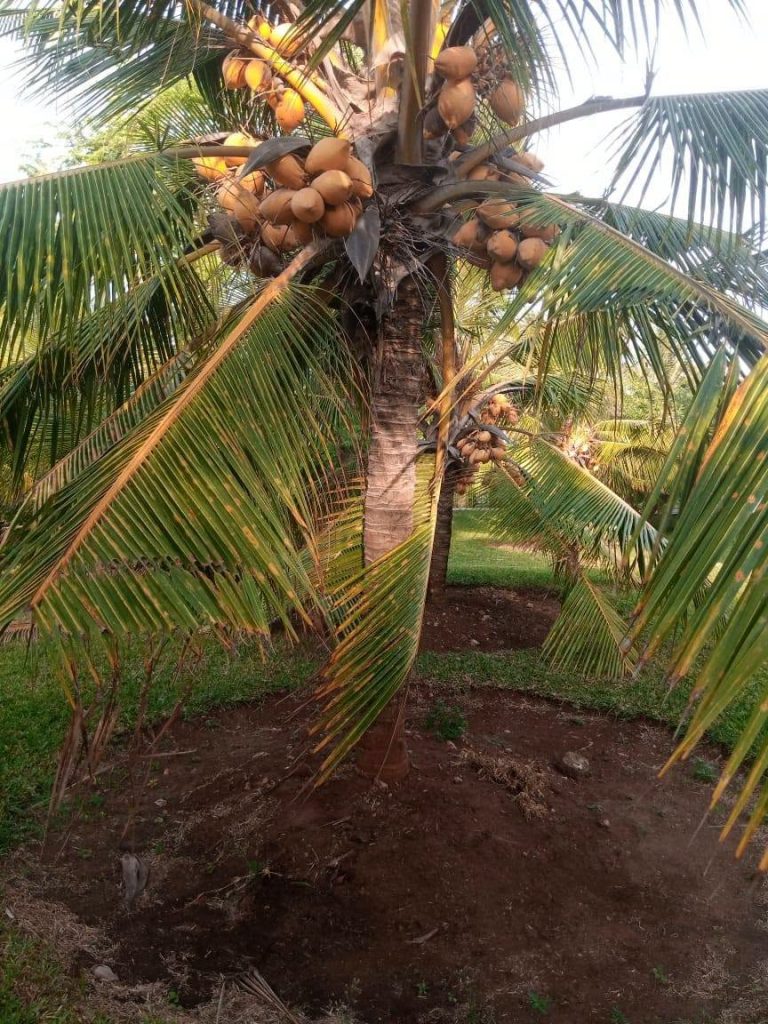
A dwarf coconut tree
When Does Dwarf Coconut Start Producing?
Bearing age varies with variety, planting material, climate, water availability, nutrition, management, and planting conditions. Distinguish between first flowering, first fruit set, first harvest, and commercially meaningful production.
First flowering comes at two and a half to four years for most dwarf types. First fruit set follows flowering by a few months. First harvest comes six to seven months after flowering for tender nuts, and eleven to twelve months for mature nuts. Commercially meaningful production begins when the palms give enough nuts to cover harvest and transport costs, usually in year four.
The common dwarf flowers in three to four years. The Deejay Sampoorna flowers in two and a half to three years. The East African Tall flowers in six to seven years.
Dwarf Coconut Yield Per Tree and Per Acre
Kenyan commercial coconut yield data is limited. The figures below are financial planning assumptions, not guaranteed yields. They help you model costs and returns. Actual results vary by site, cultivar, management, and season.
A well managed dwarf palm gives 80 to 150 nuts per year at maturity. The common dwarf gives about 200 nuts per year under good management. The Deejay Sampoorna gives 250 to 300 nuts per year.
Use the table below to plan at 72 palms per acre.
| Scenario | Nuts per Palm | Nuts per Acre |
|---|---|---|
| Conservative | 30 | 2,160 |
| Middle | 50 | 3,600 |
| Higher management | 80 | 5,760 |
These are modelling scenarios. They are not guaranteed Kenyan yields.
Cost of Establishing a Dwarf Coconut Acre
The figures below use planning prices for a rain-fed acre of 72 palms at 7.5 metres spacing. Replace each figure with quotes from your area, because prices for labour, fertiliser, and manure differ between counties.
Setup cost
| Item | Amount (KES) | Working |
|---|---|---|
| Land clearing and pegging | 8,000 | One acre, contractor rate |
| Digging holes | 10,800 | 72 holes × KSh 150 per hole |
| Dwarf coconut seedlings | 60,800 | 76 seedlings × KSh 800 each |
| Manure, rock phosphate, termite control | 9,000 | 72 holes × KSh 125 per hole |
| Planting labour | 7,200 | 72 palms × KSh 100 per palm |
| Mulch, stakes and protection | 6,000 | One acre allowance |
| Total setup cost | 101,800 | Sum of lines above |
Seedlings take about 60 percent of the setup cost, which comes from dividing 60,800 by 101,800. Each palm costs about KSh 1,414 to establish, and that figure comes from dividing 101,800 by 72 palms.
Add KSh 40,000 for a drip irrigation system if your block sits in a dry zone.
Annual running cost
| Item | Amount Per Year (KES) | Working |
|---|---|---|
| Weeding | 12,000 | 4 rounds × 6 worker days × KSh 500 per day |
| Manure | 7,500 | 1.5 tonnes per acre |
| Pest control and scouting | 3,000 | Monitoring and inputs |
| General labour | 6,000 | Pruning, mulching, fertiliser application |
| Fertiliser | 3,960 to 15,840 | Rises with palm age |
| Harvest and transport | KSh 7 per nut | Paid on each nut sold, from year four |
| Year | Fertiliser (KES) | Other Costs (KES) | Total Before Harvest (KES) |
|---|---|---|---|
| Year 1 | 3,960 | 28,500 | 32,460 |
| Year 2 | 7,920 | 28,500 | 36,420 |
| Year 3 | 11,880 | 28,500 | 40,380 |
| Year 4 onward | 15,840 | 28,500 | 44,340 |
Investment before the first harvest
| Stage | Amount (KES) |
|---|---|
| Setup cost | 101,800 |
| Year 1 running cost | 32,460 |
| Year 2 running cost | 36,420 |
| Year 3 running cost | 40,380 |
| Total investment before first harvest | 211,060 |
The total comes from adding 101,800 plus 32,460 plus 36,420 plus 40,380. Per palm, that equals about KSh 2,931.
Is Dwarf Coconut Farming Profitable in Kenya?
The calculation below uses 72 palms per acre and a yield of 25 nuts per palm in year four, 50 in year five, 80 in year six, and 100 from year seven. The sale price is KSh 40 per tender nut at the farm gate as a planning assumption. Harvest and transport cost KSh 7 per nut, and fixed running cost from year four is KSh 44,340 per year.
How each year is calculated
Take year four. Nuts per acre come from multiplying 72 palms by 25 nuts, which gives 1,800 nuts. Revenue comes from multiplying 1,800 nuts by KSh 40, which gives KSh 72,000.
Cost comes from adding the fixed running cost of KSh 44,340 to the harvest and transport of 1,800 nuts at KSh 7, which gives KSh 12,600. The total cost is KSh 56,940. Net income comes from subtracting 56,940 from 72,000, which gives KSh 15,060.
Take year seven. Nuts per acre come from multiplying 72 palms by 100 nuts, which gives 7,200 nuts. Revenue comes from multiplying 7,200 nuts by KSh 40, which gives KSh 288,000.
Cost comes from adding the fixed running cost of KSh 44,340 to the harvest and transport of 7,200 nuts at KSh 7, which gives KSh 50,400. The total cost is KSh 94,740. Net income comes from subtracting 94,740 from 288,000, which gives KSh 193,260.
Ten year cash flow per acre
| Year | Nuts per Palm | Nuts per Acre | Revenue (KES) | Cost (KES) | Net (KES) | Cumulative (KES) |
|---|---|---|---|---|---|---|
| 0 | 0 | 0 | 0 | 101,800 | -101,800 | -101,800 |
| 1 | 0 | 0 | 0 | 32,460 | -32,460 | -134,260 |
| 2 | 0 | 0 | 0 | 36,420 | -36,420 | -170,680 |
| 3 | 0 | 0 | 0 | 40,380 | -40,380 | -211,060 |
| 4 | 25 | 1,800 | 72,000 | 56,940 | 15,060 | -196,000 |
| 5 | 50 | 3,600 | 144,000 | 69,540 | 74,460 | -121,540 |
| 6 | 80 | 5,760 | 230,400 | 84,660 | 145,740 | 24,200 |
| 7 | 100 | 7,200 | 288,000 | 94,740 | 193,260 | 217,460 |
| 8 | 100 | 7,200 | 288,000 | 94,740 | 193,260 | 410,720 |
| 9 | 100 | 7,200 | 288,000 | 94,740 | 193,260 | 603,980 |
| 10 | 100 | 7,200 | 288,000 | 94,740 | 193,260 | 797,240 |
Payback and ten year result
Your cumulative position turns positive in year six at plus KSh 24,200. Payback arrives about 5.8 years after planting.
Net income from years four to ten adds up to KSh 1,008,300. Subtract your investment of KSh 211,060 and you keep KSh 797,240 per acre. That equals about 3.8 times your investment.
At full yield, each palm earns KSh 4,000 in revenue and KSh 2,684 in net income. One acre nets about KSh 16,100 per month.
What happens when the nut price changes
| Price per Nut (KES) | Revenue (KES) | Cost (KES) | Net Income (KES) |
|---|---|---|---|
| 15 | 108,000 | 94,740 | 13,260 |
| 20 | 144,000 | 94,740 | 49,260 |
| 30 | 216,000 | 94,740 | 121,260 |
| 40 | 288,000 | 94,740 | 193,260 |
| 60 | 432,000 | 94,740 | 337,260 |
The table holds yield at 100 nuts per palm and fixed cost at KSh 94,740. A price of KSh 15 matches the AFA reported average farm-gate price for mature nuts. At that price, a rain-fed acre earns KSh 13,260 before tax, which is thin. That is why you plan for tender nut sales and sign buyer agreements before you plant.
What happens when the yield changes
| Nuts per Palm | Nuts per Acre | Revenue (KES) | Cost (KES) | Net Income (KES) |
|---|---|---|---|---|
| 30 | 2,160 | 86,400 | 59,460 | 26,940 |
| 50 | 3,600 | 144,000 | 69,540 | 74,460 |
| 80 | 5,760 | 230,400 | 84,660 | 145,740 |
| 100 | 7,200 | 288,000 | 94,740 | 193,260 |
Every extra 20 nuts per palm adds about KSh 47,500 per acre per year at KSh 40 per nut.
Break even point
Your margin per nut stands at KSh 33, which comes from KSh 40 minus KSh 7 for harvest. Divide the fixed cost of KSh 44,340 by KSh 33 and you get 1,344 nuts per acre, or about 19 nuts per palm. At full yield, your cost per nut is KSh 13.16. Any sale price above that figure gives you a profit.
Effect of irrigation and farm size
Drip irrigation adds KSh 40,000 in setup and about KSh 6,000 per year in running cost. With the same yields, your cumulative position turns positive in year seven instead of year six. In dry zones, irrigation lifts yield, so the extra cost usually pays for itself.
| Acres | Investment Before First Harvest (KES) | Net Income Per Year From Year 7 (KES) |
|---|---|---|
| 1 | 211,060 | 193,260 |
| 2 | 422,120 | 386,520 |
| 5 | 1,055,300 | 966,300 |
| 10 | 2,110,600 | 1,932,600 |
Labour and management time grow with acreage. Start with the area you manage well and add blocks as your first block matures.
Coconut Markets and Selling Options
Coconut has several markets, and each pays differently. Know your market before you plant because different markets want different nuts.
Tender nuts sell to hotels, restaurants, juice bars, and street vendors. A green nut sells for 50 to 100 shillings depending on location and season. The coast and major towns carry the strongest demand.
Mature nuts sell to processors who extract oil and make copra. Copra prices follow the oil market, so they move up and down with global prices. Market prices vary substantially by location and season, so confirm the current rate with your buyer before you sell.
Coconut water sells as a packaged drink in supermarkets. This market needs larger volumes and consistent supply.
Shells sell for charcoal and handicraft production. This adds a small income stream from what would otherwise be waste.
Coconut oil sells to cosmetic and food companies. Small-scale oil pressing gives you a value-added product with a higher price than raw nuts.
Farm-gate buyers offer convenience. They collect from your farm, which saves you transport. They pay less than direct buyers. Direct sales to hotels and consumers pay more but require you to handle delivery, grading, and customer relationships.
Harvesting and Post-Harvest Handling
Harvest timing depends on the market you sell to. Drinking nuts and mature nuts come off the palm at different stages.
For drinking nuts, harvest while the nut is still green. The water inside is sweet and the flesh is soft. Hotels and juice bars buy green nuts at this stage. Harvest too early and the nut carries little water. Harvest too late and the flesh hardens and the water loses sweetness.
For mature nuts, harvest when the husk turns brown and the nut makes a sloshing sound when you shake it. Mature nuts go for copra, oil, and seed.
The short height of dwarf palms makes harvest easy. Use a pole fitted with a hook or knife to cut the bunches from the ground. You do not need a climber. This saves labour cost on every harvest and removes the safety risk of climbing.
Harvest every 30 to 45 days. Regular harvest keeps nuts from over-maturing on the palm and keeps cash coming in through the year. Sort nuts after harvest. Remove damaged or diseased nuts before delivering to the buyer.
Common Mistakes Farmers Should Avoid
- Planting above 1,000 metres and waiting for palms that never bear well.
- Choosing the cheapest dwarf coconut seedlings without asking for batch records.
- Leaving seedlings in bags for months while the land is prepared.
- Burying the collar of the seedling at planting.
- Skipping fertiliser because the palms look green in year one.
- Letting weeds grow in the palm ring.
- Planting maize or cassava next to young palms.
- Skipping irrigation in the first dry season.
- Mixing varieties in one block.
- Planting before securing a buyer for tender nuts.
Where to Buy Dwarf Coconut Seedlings in Kenya
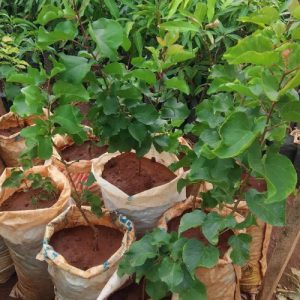
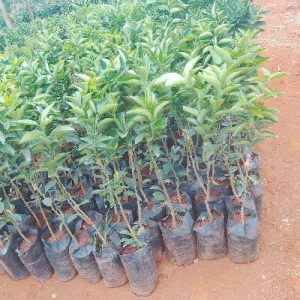
Fruit Africa Veriplant raises dwarf coconut seedlings in nurseries in Murang’a and Nairobi. The company supplies quality fruit and coconut planting material to farmers across Kenya.
Confirm the variety, availability, and delivery arrangements before you order, because stock changes with each batch.
Call 0714994444 or write to sales@fruitafrica.org with your county, your farm altitude, your acreage, your water source, and the number of dwarf coconut seedlings you need. The team confirms variety, age, price, and delivery options for your area.
Before You Buy: A Farmer’s Checklist
- Exact variety confirmed.
- Expected maturity period confirmed.
- Planting material type confirmed.
- Nursery source verified.
- Seedling health checked.
- Number of seedlings required calculated.
- Spacing decided.
- Farm suitability checked.
- Water availability confirmed.
- Soil test done.
- Transport arranged.
- Delivery condition inspected on arrival.
- Target market identified.
- Current price confirmed.
Frequently Asked Questions About Dwarf Coconut Seedlings
1. How much is a dwarf coconut seedling in Kenya?
Fruit Africa Veriplant confirms the current price of dwarf coconut seedlings on request. Call 0714994444 or write to sales@fruitafrica.org with your county, the number of seedlings you need, and your planting date. This guide uses a planning allowance of KSh 800 per seedling for the cost model, and that figure is an assumption and not a quoted price.
2. Where can I buy dwarf coconut seedlings in Kenya?
Fruit Africa Veriplant raises dwarf coconut seedlings in nurseries in Murang’a and Nairobi. Call 0714994444 or email sales@fruitafrica.org for current availability, variety, and delivery arrangements.
3. How long does dwarf coconut take to mature?
The common dwarf flowers in three to four years. The Deejay Sampoorna flowers in two and a half to three years. Meaningful harvest begins in year four, though first flowering, first fruit set, first harvest, and commercially meaningful production arrive at different points.
4. How many coconut trees can I plant per acre?
At 7.5 metres by 7.5 metres spacing, about 72 palms per acre. At 6 metres by 6 metres, about 112 palms. KALRO recommends at least 7.5 metres by 7.5 metres for a pure coconut stand.
5. What is the best spacing for dwarf coconut?
7.5 metres by 7.5 metres is the recommended minimum for pure coconut stands. Tighter spacing needs stronger management because palms close canopy sooner and compete harder for water and nutrients.
6. Can dwarf coconut grow inland in Kenya?
Coconut needs warmth and moisture. Inland areas below 1,000 metres with irrigation can support the crop. Highland areas above 1,000 metres are not suitable. If your farm lies outside the Coast, plant a small trial block of 20 to 30 palms first and watch growth for two years.
7. What soil is suitable for coconut?
Deep, free draining sandy loam or loam with a pH between 5.2 and 8.0 suits your palms. Avoid heavy clay and waterlogged land, because coconut roots need air and standing water causes root rot.
8. How much water does coconut need?
Young palms need 20 to 60 litres twice a week in dry months. Mature palms need 200 litres per week. Requirements depend on soil, rainfall, temperature, mulch, and the stage of growth.
9. When does dwarf coconut start producing?
First flowering comes at two and a half to four years. First harvest follows six to seven months later for tender nuts, and eleven to twelve months for mature nuts. Commercially meaningful production usually begins in year four.
10. How many coconuts can one dwarf coconut tree produce?
A well managed dwarf palm gives 80 to 150 nuts per year. The common dwarf gives about 200, and the Sampoorna gives 250 to 300. National averages from AFA sit at roughly 28 to 38 nuts per tree per year.
11. Is dwarf coconut farming profitable in Kenya?
Profitability depends on yield, price, and costs. At a farm-gate price near KSh 15 per mature coconut, a rain-fed acre struggles to cover running costs. At KSh 40 per tender nut, the ten-year model in this guide shows payback in about 5.8 years. Replace every assumption with your own figures before you commit funds.
12. What fertilizer is suitable for coconut?
Coconut responds strongly to potassium and chlorine, followed by nitrogen. Apply fertiliser based on soil test results and palm age. Young palms need less, and mature palms need more.
13. What pests affect coconut?
The rhinoceros beetle is the major pest in Kenya. Coreid bugs, eriophyid mites, red palm weevil, termites, and rats also cause damage. Scout every two weeks and act early.
14. Should I buy grafted coconut seedlings or seedlings from seed?
Coconut is not grafted. Dwarf coconut seedlings are raised from seed nuts of selected mother palms. Ask your nursery how they select mother palms, how many nuts each mother palm carries, and how long the source block has been bearing.
15. What should I check before buying coconut seedlings?
Check the variety, seedling age, health, and batch records. Confirm your farm is suitable, your water source is reliable, and your market is identified. Ask about the replacement policy for seedlings that die in transit.
Final Advice for Farmers
Dwarf coconut seedlings offer a faster return than tall varieties. They produce nuts in three to four years instead of six to seven. They stay short enough that you harvest without climbing. They yield more nuts per tree.
Before ordering dwarf coconut seedlings, confirm your climate suits the crop. You need warmth, rainfall or irrigation, and well-drained soil. If you are outside the coastal or lowland areas, check your specific conditions.
Start with a manageable number of trees. Learn how the palms perform on your soil. Learn how the market responds to your nuts. Then expand.
Fruit Africa Veriplant supplies dwarf coconut seedlings suited to Kenyan conditions. Contact us to confirm current availability and delivery arrangements.
Fruit Africa Veriplant
Phone: 0714994444
WhatsApp: https://wa.link/di12my
Email: sales@fruitafrica.org
Contact Us: https://fruitafrica.org/contact-us/
Request for Quotation: https://fruitafrica.org/request-for-quotation/

Reviews
There are no reviews yet.