
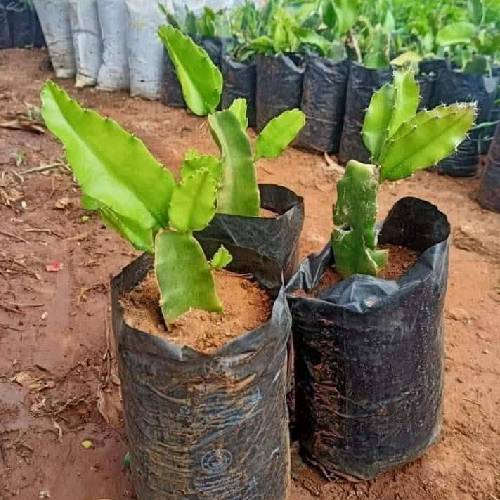
Description
Buy dragon fruit seedlings in Kenya at Ksh 500 each from Fruit Africa Veriplant. Learn the best counties, varieties, spacing, planting steps, costs and how much you can earn per acre. Call 0714 994 444.
Dragon Fruit Seedlings in Kenya: Price, Varieties, Planting and Profit
If you have been watching the fruit farming space in Kenya lately, you have probably noticed something new. Farmers in Meru, Laikipia, Tharaka Nithi and even Homa Bay are no longer talking only about avocados, mangoes and macadamia. They are talking about dragon fruit. The scaly, bright red or yellow fruit that used to be found only in supermarkets during special occasions is now being grown right here, on Kenyan soil, by farmers who planted their own seedlings.
This shift did not happen by chance. Kenya has been importing almost all the dragon fruit consumed locally, and the import bill keeps growing. But the climate in our drylands, from Meru and Tharaka Nithi to Laikipia and Homa Bay, is well suited to this cactus fruit. A single well-managed acre can bring in between Ksh 1.75 million and Ksh 5 million a year once the vines are fully productive. Those numbers are attracting serious attention.
But none of that income is possible without one thing first: good planting material. This guide walks you through everything you need to know about dragon fruit seedlings in Kenya. Where they grow best, which varieties to pick, how to plant and care for them, what they cost, and how to avoid the costly mistakes that trip up first-time growers. At the end, we will show you where to get healthy rooted seedlings at a fair price of Ksh 500 each, from Fruit Africa Veriplant.
What Are Dragon Fruit Seedlings?
A dragon fruit seedling is a young dragon fruit plant, raised either from a seed or, more commonly these days, from a stem cutting. The plant is a climbing cactus, not a tree. It belongs to the genus Hylocereus, and it originates from Mexico and northern South America. In the wild, it clings to trees and rocks, sending out aerial roots that grip the surface and allow the plant to climb.
The word “seedling” is used loosely in the trade. Strictly speaking, a plant grown from a true seed is a seedling. But seed-grown dragon fruit can take five to seven years before it bears fruit, and the fruit may not be true to the parent plant.
That is why almost all commercial dragon fruit farming in Kenya uses stem cuttings or rooted plantlets, which are genetically identical to the mother plant and start producing much earlier. Most nurseries in Kenya, including ours, still call all of these seedlings because that is the term farmers search for and understand. What actually matters is not the label, but where that young plant came from and how healthy it is.
Dragon fruit belongs to the cactus family. It is not a fussy plant. It can survive punishing heat and long dry spells that would kill most other fruit crops. That toughness is exactly why it is being pushed so hard for Kenya’s drylands, where maize and beans often fail but a dragon fruit vine will simply keep standing.
Why Kenyan Farmers Are Getting Into Dragon Fruit
A few years ago, hardly anyone in Kenya talked about growing dragon fruit commercially. Today it is one of the fastest-growing farming topics online, and for good reason.
First, the import bill is huge. Kenyans love the fruit, especially health-conscious consumers and the Asian community in Nairobi, and almost all of what we eat is shipped in from Vietnam, Thailand and other countries. Vietnam, the world’s largest producer, generates about US$1 billion in dragon fruit exports every year. That money leaves the country every single year.
Second, the government has thrown its weight behind the crop. The Kenya Plant Health Inspectorate Service recently introduced a locally developed drought-tolerant variety called Kika1, developed by Antony Kinoti at Gravity Farm in Meru County. That move signalled a national plan to expand production and position dragon fruit as a high-value alternative for farmers in arid and semi-arid regions.
Third, the returns are genuinely attractive. At the peak of the market in 2022, dragon fruit was selling at Sh800 to Sh1,500 per kilogram in Nairobi stores. Even though prices have dropped since then due to a surge in new plantings, a mature acre can still earn between Sh1.75 million and Sh5 million a year. That compares very well to pawpaw, which earns Sh300,000 to Sh1 million per acre, or mango at Sh200,000 to Sh600,000.
Fourth, dragon fruit fits our changing climate. As rainfall becomes less predictable, farmers in Meru, Tharaka Nithi, Laikipia, Makueni, Kitui and Homa Bay are looking for crops that can handle drought without dying. A dragon fruit vine, once established, needs far less water than maize or even mangoes, and it keeps producing for up to 20 years.
This is not a hype crop that will fade in two seasons. It is a long-term investment, and like any long-term investment, it starts with getting the right planting material.
Best Counties and Climate for Dragon Fruit in Kenya
Dragon fruit thrives in hot, dry conditions with plenty of sunshine and well-drained soil. It does not like waterlogging, and it does not like cold, wet highlands. The plant grows best in tropical temperatures between 21°C and 30°C, with annual rainfall of 500 to 1,500 millimetres.
The counties currently seeing the most dragon fruit activity include Meru, Tharaka Nithi, Laikipia, Makueni, Kitui, Machakos, Homa Bay, and parts of the coast. These areas share the same hot, low-humidity climate found in leading dragon fruit-producing nations such as Vietnam and the Philippines. If you farm in any of these counties, or in a similarly hot and dry pocket elsewhere in the country, dragon fruit deserves a serious look.
That said, we regularly supply seedlings to farmers outside these areas too. Parts of Kajiado, Taita Taveta, Kilifi and even sections of the Rift Valley with hot, dry microclimates and good drainage can also grow dragon fruit successfully, especially with drip irrigation. If you are unsure whether your farm is suitable, call us on 0714 994 444 and describe your location, soil and water source. We will tell you honestly whether dragon fruit will do well there.
A quick rule of thumb: if the area is naturally good for growing watermelons, onions or mangoes without much fuss, and it rarely floods, dragon fruit will probably be happy there too.
Ecological Conditions and Soil Requirements for Dragon Fruit
Beyond simply picking a “hot county,” it helps to understand exactly what a dragon fruit plant wants from its environment. Get these details right and your seedlings will establish faster and grow into stronger, more productive vines.
Temperature
Dragon fruit is a tropical cactus. It grows best where daytime temperatures sit between 21°C and 30°C during the growing season, and it can tolerate short spells up to 40°C. What it cannot handle is prolonged cold. Anything below 10°C slows growth sharply, and frost can kill young plants outright. This is exactly why the hot lowland counties, rather than Kenya’s cool highlands, are being pushed for commercial dragon fruit farming.
Rainfall and Humidity
Dragon fruit needs low to moderate rainfall, ideally between 500mm and 1,500mm a year. It does not like heavy, prolonged rain. Too much moisture during the fruiting period can cause the fruit to split or rot on the vine. Areas with high humidity or heavy rain during the fruiting period, even if they are otherwise warm, tend to produce poor-quality fruit and higher disease pressure. This is part of why the semi-arid regions of Kenya are considered better suited to dragon fruit than the wetter western and central regions.
Sunlight
Full, unfiltered sun is important. Dragon fruit needs at least six to eight hours of direct sunlight a day to flower and fruit well. Avoid planting sites shaded by buildings, hills or larger trees.
Soil Type
Dragon fruit is not particular about soil fertility, but it is particular about drainage. The ideal soil is deep, sandy or sandy-loam, and free-draining, allowing water to pass through quickly rather than sitting around the roots. Heavy clay soils that hold water for long periods after rain are the main cause of root rot in young plants. If your soil is heavy clay, you can still grow dragon fruit, but you will need raised planting mounds and extra sand or organic matter worked into each planting hole to improve drainage.
Soil pH
Dragon fruit has a wide pH tolerance compared to most fruit trees, generally thriving between pH 5.5 and 7.0. It is worth doing a simple soil test before planting on a large scale, since strongly acidic soils below pH 5.5 can lock up nutrients like iron and zinc, leading to yellowing stems even when the plant is otherwise well fed.
Water Table and Drainage Depth
Ideally, the water table should sit at least 1.5 to 2 metres below the surface. A shallow water table close to the roots encourages rot and weakens the plant’s resistance to disease, even if the surface soil looks perfectly fine.
In short, the formula for great ecological conditions is simple to remember: hot, sunny, dry air, free-draining soil, and a slightly acidic to neutral pH. Match those and a dragon fruit vine will reward you with years of production.
Rooted Seedlings vs Cuttings: What Should You Buy?
This is one of the most important decisions you will make, and it is where many first-time farmers get confused.
Unrooted cuttings are pieces of stem cut from a mature dragon fruit plant. They are usually 30 centimetres or longer. You have to plant them yourself and wait for them to form roots and callous over before they start growing. This can take weeks, and if the cutting is not handled properly, it can rot before it roots.
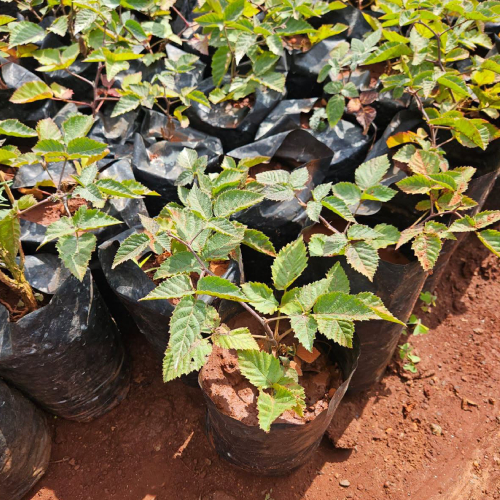
Rooted seedlings are cuttings that have already been planted in a nursery and have developed a healthy root system. This is what Fruit Africa Veriplant sells. When you buy a rooted seedling, you skip the rooting stage. The plant is already established, already hardened, and ready to go into the ground. It will start growing faster and will reach fruiting stage sooner.
Why does this matter for you as a buyer?
Rooted seedlings are cleaner, since they are grown in a controlled environment away from field pests and soil-borne diseases. They are more uniform, so your farm grows evenly instead of some vines racing ahead while others lag. They are easier to plant and establish, which matters if you are planting more than a handful of vines. And because the source mother plant is known, you can be confident about the variety and fruit quality you are buying.
At Fruit Africa Veriplant, our dragon fruit seedlings are rooted, hardened, and ready for field planting. We propagate them with strict attention to plant health and genetic trueness, so what you plant is what you will eventually harvest.
Dragon Fruit Varieties Available at Fruit Africa Veriplant
Not every dragon fruit variety performs the same way under Kenyan conditions. The colour of the flesh and the skin matters, both for the market and for the price you get. Here are the varieties we offer.
Red Skin with Red Flesh
This is the most popular type in Kenya. The fruit has bright red skin and deep red or purple flesh. The taste is sweet and rich, with a flavour that most consumers prefer over the white-fleshed types. Red-fleshed dragon fruit fetches the best prices in local markets because the colour is striking and the taste is superior. If you are planting for the fresh fruit market, this is the variety to start with.
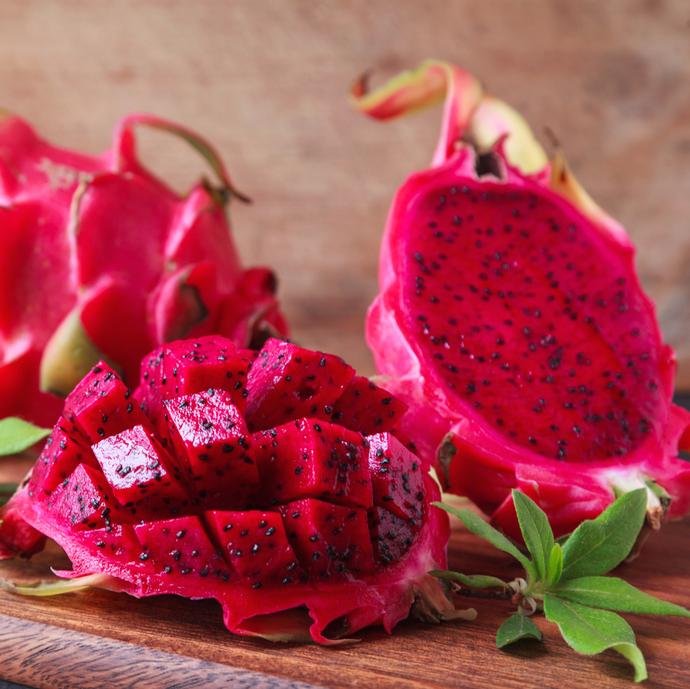
Red Skin with Pink Flesh
This variety has bright red skin and pink flesh inside. The taste is sweet and mild, sitting somewhere between the deep red-fleshed type and the white-fleshed type. Pink-fleshed fruit is attractive on the shelf and sells well in supermarkets. Some farmers prefer it because the colour is softer and appeals to a wider range of consumers.
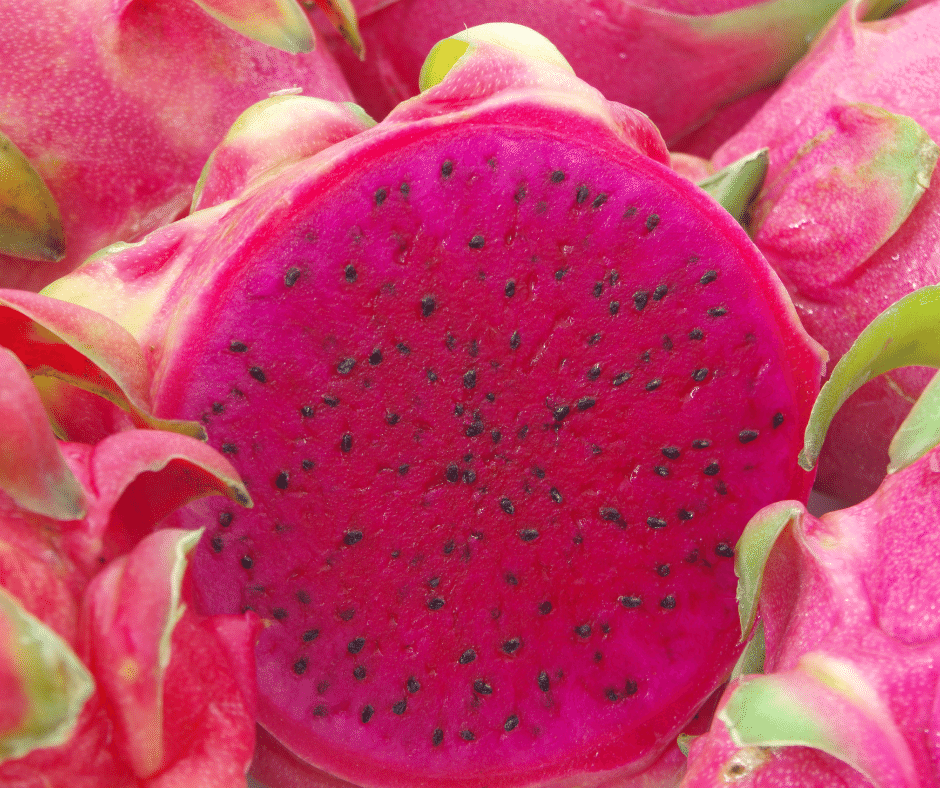
Red Skin with White Flesh
This is the most common dragon fruit in the world, and it is widely grown in Vietnam and Thailand. The fruit has red skin and white flesh. The taste is milder and slightly more sour-sweet than the red-fleshed types. White-fleshed fruit is still popular, especially in supermarket supply chains, but it does not command the same premium as the red-fleshed fruit. Some farmers grow both to spread their harvest and appeal to different buyers.
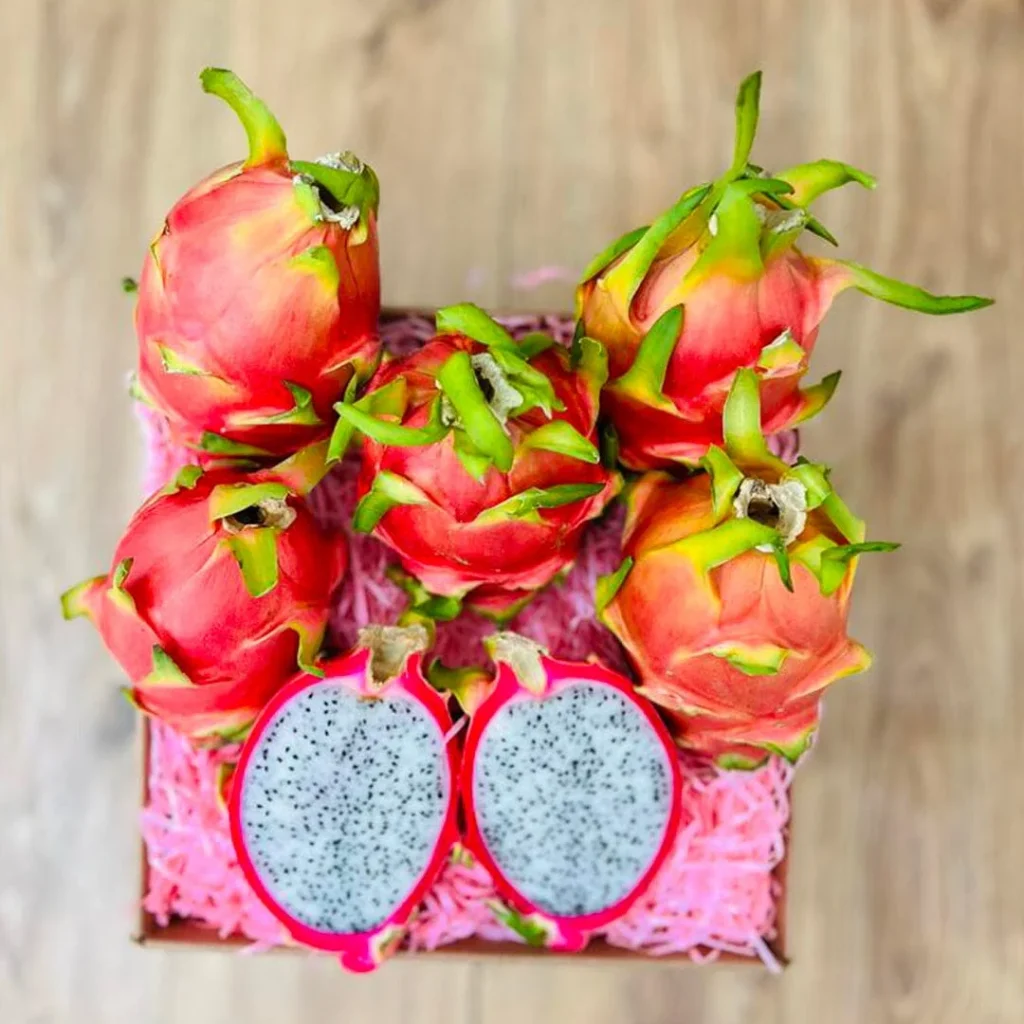
Yellow Skin with White Flesh
The yellow-skinned dragon fruit is a hybrid that is sweeter and higher-yielding than most locally available cultivars. However, it is harder to find and more expensive. Some farmers in Kenya have imported yellow variety cuttings at up to Sh20,000 per piece. This is not the variety for a first-time grower, but it is worth knowing about for the future. If you want to enter the premium market, yellow dragon fruit is worth considering once you have experience.
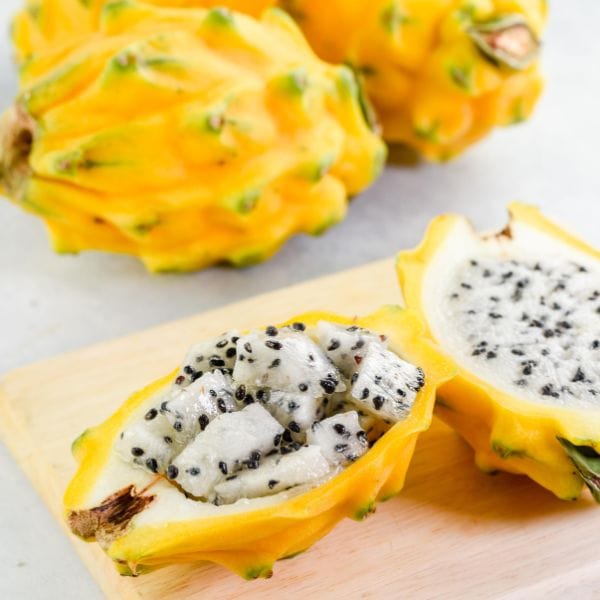
Our advice, especially if this is your first time planting dragon fruit: start with a reliable red-fleshed variety. It is easier to manage, the market is already there, and it will give you the confidence and experience you need before you invest in more premium varieties.
How Much Do Dragon Fruit Seedlings Cost in Kenya?
Prices for dragon fruit seedlings in Kenya vary quite a bit depending on the source, the age of the seedling, and whether the plant is rooted or unrooted.
Unrooted cuttings from roadside sellers can be cheap, sometimes under Ksh 200, but they carry a real risk. They may not root properly, they may be from unknown varieties, and they may carry disease. You will not know until months later, when your cuttings either fail to grow or produce fruit that nobody wants to buy.
Rooted seedlings from certified nurseries give you certainty. They are already established, already hardened, and already growing. At Fruit Africa Veriplant, our dragon fruit seedlings are sold at a flat, transparent price of Ksh 500 per rooted seedling. There are no hidden charges buried in the fine print. What you see is what you pay, whether you are buying five seedlings for your backyard or five hundred for a commercial farm.
We deliberately price this way because we have seen too many farmers get burned buying “cheap” planting material from roadside sellers, only to discover years later that the vines are weak, the fruit is poor quality, or the variety is not what they paid for. In farming, cheap planting material is very often the most expensive mistake you will ever make.
How to Tell a Healthy Dragon Fruit Seedling From a Weak One
Before you hand over your money to any seller, inspect the seedling. Here is what to check.
Stem thickness and colour. A healthy seedling has a thick, firm, green stem. Avoid stems that are thin, pale, yellowing or soft.
Root system. Gently check the base. A healthy rooted seedling has a firm, well-developed root ball, not a loose, dried-out clump. The roots should be white or light brown, not dark or mushy.
No visible pests or disease. Check the stem for soft spots, brown patches, or signs of rot. Check for scale insects, mealybugs or signs of borer damage. A healthy seedling should be clean.
Growth stage. A good field-ready seedling has already formed a callous at the base and has started developing roots. Very tiny plantlets straight from a nursery still need more time to harden off before they can survive direct field planting.
Documentation. Ask the seller which variety you are buying and how it was propagated. A reputable nursery will tell you clearly and will not dodge the question.
If a seller cannot answer basic questions about the variety, the mother plant, or the propagation method, walk away. This is a long-term investment, sometimes a year or more before your first real harvest, and you do not want to discover a problem in year two.
How We Propagate Dragon Fruit Seedlings at Fruit Africa Veriplant
At Fruit Africa Veriplant, we follow a careful process to produce high-quality rooted dragon fruit seedlings. This ensures that every seedling we sell is healthy, vigorous, and true to type.
Step 1: Mother Plant Selection
We select mother plants from vines that are known to produce high-quality fruit with good colour, sweetness and size. These mother plants are healthy and free from disease.
Step 2: Cutting Collection
We take stem cuttings from the mother plants. Each cutting is about 30 centimetres long and has at least three nodes. The cuttings are taken from mature, healthy stems.
Step 3: Callousing
The cuttings are left in a dry, shaded area for several days to allow the cut end to callous over. This step is critical because it prevents the cutting from rotting when it is planted.
Step 4: Rooting
Once the callous has formed, the cuttings are planted in a well-drained rooting medium. They are kept in a controlled environment with the right temperature and humidity to encourage root development.
Step 5: Root Development
Over several weeks, the cuttings develop a healthy root system. We monitor them closely to ensure they are growing well and are free from pests and diseases.
Step 6: Hardening
Once the roots are well developed, the seedlings are gradually exposed to outside conditions to harden them. This prepares them for field planting.
Step 7: Quality Inspection
Every seedling is inspected before it leaves our nursery. We check for a strong root system, healthy green stems, and no signs of disease or pests.
Step 8: Packaging and Delivery
The seedlings are carefully packaged to protect them during transport. We deliver to farmers across the country.
Step-by-Step: Planting Dragon Fruit Seedlings
Once your seedlings arrive, timing and technique matter.
Step 1: Choose the Site
Pick a spot with full sun exposure, at least six to eight hours a day, and soil that drains well. Avoid low-lying areas that flood after heavy rain.
Step 2: Prepare the Support Structure
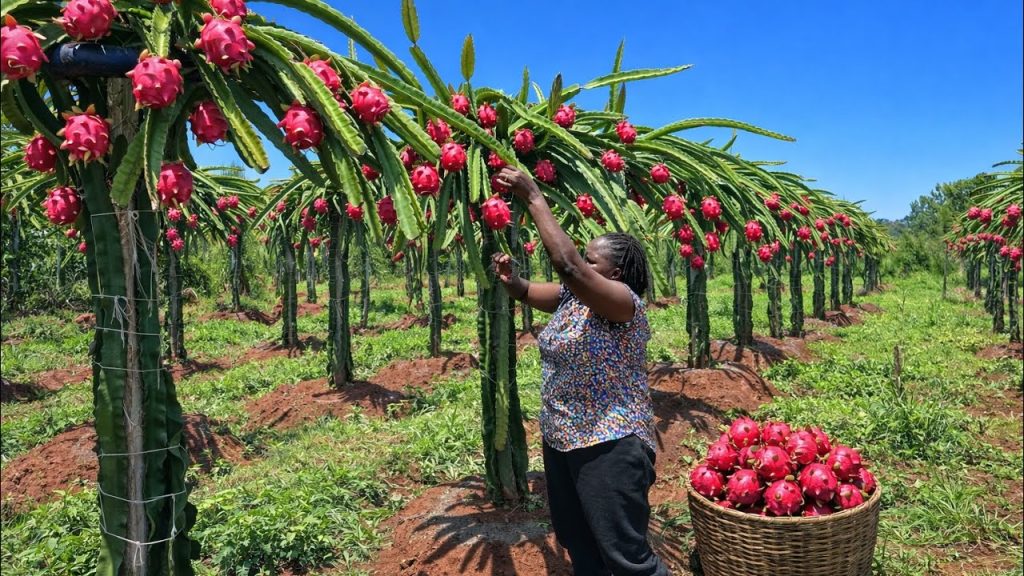
Dragon fruit is a climbing cactus. It needs a strong support to climb on. The standard system is a vertical post, usually a treated wooden pole or concrete pole, standing about 1.5 to 2 metres high. At the top of the post, a cross or a square frame is fixed to give the vine something to spread across. This is where the plant will branch and hang down, producing fruit along the hanging stems.
Step 3: Space Your Posts Correctly
We recommend a spacing of 3 metres by 2 metres between posts. This gives about 750 to 800 posts per acre. Some farmers use wider spacing, but this density works well in Kenyan conditions and gives you a good balance between plant population and ease of management.
Step 4: Plant the Seedlings Around the Post
We recommend planting 2 to 4 seedlings per hole, with the post at the middle. This is a common practice in dragon fruit farming and it is what we advise for Kenyan conditions. Planting more than one vine per post means faster coverage of the support structure, better pollination between the plants, and higher total yield per post. The vines will grow up the post together and spread out across the top frame.
Step 5: Plant at the Right Depth
Place the seedling in the hole so that the base of the stem sits at the same soil level it was growing at in the nursery bag. Planting too deep can cause the stem to rot. Planting too shallow exposes roots to drying out.
Step 6: Water Immediately After Planting
Give a generous first watering to settle the soil around the roots and remove air pockets.
Step 7: Mulch Around the Base
A layer of dry grass, straw or wood chips around the base, kept a little away from the stem itself, helps retain moisture and suppress weeds.
Step 8: Tie the Vines to the Post
Use a soft garden tie or old cloth to loosely secure the seedling to the post. As it grows, add more ties to guide it up the pole and onto the top structure. Do not tie too tightly, as the stem will expand as it grows.
The best planting window in most of Kenya’s dry regions is just before or during the onset of the rains, so the young roots get help establishing before the dry heat sets in fully. That said, with reliable irrigation, dragon fruit can be planted at almost any time of year.
Dragon Fruit Spacing, Posts and Plants Per Acre
Getting the spacing right is one of the most important decisions you will make. It determines how many posts you need, how many seedlings you buy, and how much you can eventually harvest.
We recommend a spacing of 3 metres by 2 metres between posts. This gives roughly 750 to 800 posts per acre. Some farmers use wider spacing of 3 metres by 3 metres, which gives about 450 posts per acre. Others plant more densely at 2.5 metres by 2 metres, which gives about 800 to 810 posts per acre. The choice depends on your soil fertility, water availability and how intensively you want to manage the farm.
The table below shows the population per acre at different spacings, and the number of seedlings you would need if you plant 2, 3 or 4 vines per post.
| Spacing | Posts per Acre | Seedlings at 2 per Post | Seedlings at 3 per Post | Seedlings at 4 per Post |
|---|---|---|---|---|
| 3m x 2m | 750 – 800 | 1,500 – 1,600 | 2,250 – 2,400 | 3,000 – 3,200 |
| 3m x 3m | 450 | 900 | 1,350 | 1,800 |
| 2.5m x 2m | 800 – 810 | 1,600 – 1,620 | 2,400 – 2,430 | 3,200 – 3,240 |
| 4m x 2m | 560 – 570 | 1,120 – 1,140 | 1,680 – 1,710 | 2,240 – 2,280 |
We recommend 3 metres by 2 metres with 2 to 4 vines per post for most Kenyan farmers. It gives you a good balance between plant population, airflow, and ease of movement through the farm. Planting too densely makes it hard to walk between the posts, which makes pruning, spraying and harvesting difficult.
Watering, Feeding and General Care
Dragon fruit is famous for surviving on little water once mature, but young seedlings are a different story. For the first six months to a year, consistent watering is critical to build a strong root system.
Watering Schedule for Young Vines
Water twice a week during establishment, adjusting for rainfall. Newly planted dragon fruit are generally irrigated twice each week. Once established, reduce frequency but water deeply, allowing the soil to dry out somewhat between sessions. Deep, infrequent watering encourages roots to grow downward in search of moisture, which is exactly what you want in a drought-prone area. Drip irrigation is ideal for dragon fruit because it delivers water directly to the root zone without wasting it on evaporation.
Feeding
Apply well-rotted manure or compost around the base twice a year, particularly at the start and towards the end of the rainy season. For optimum growth, give the plant liquid fertilizer with a balanced formula once a month when it is growing. Avoid over-fertilising with nitrogen alone, as it pushes leafy growth at the expense of fruiting.
Weeding and Mulching
Keep the base of young vines free of competing weeds, and maintain mulch to conserve moisture and moderate soil temperature. Weeds, grass and other vegetation around the diameter of each post should be mechanically removed.
Pruning
Pruning is a vital process in maintaining your plant healthy, particularly for plants grown in a small space. Cut dead, dense, or unhealthy stems at least once a year to increase air circulation and light penetration. This also promotes new growth and directs the plant to concentrate its energy on flowering and fruiting. Low-hanging stems or additional shoots that develop at the base of the plants are removed.
Pollination: The Step Many Farmers Get Wrong
Here is something many new dragon fruit farmers do not realise until it is too late: dragon fruit flowers open at night and are usually pollinated by moths and bats. In a small farm or a balcony garden, natural pollinators might not be around. For a better fruiting chance, hand-pollination is recommended. Use a small brush or cotton tip to move pollen from one flower to another.
Some varieties are self-pollinating, while others require cross-pollination. If you plant multiple seedlings per post, you increase the chances of cross-pollination happening naturally, and you also make hand-pollination easier because you have more flowers to work with. This is one more reason why planting 2 to 4 vines per post makes good sense.
How Long Before Your Dragon Fruit Vine Fruits?
Patience is part of the deal with dragon fruit farming. Research and farmer experience in Kenya show that vines grown from rooted cuttings can start producing fruit within 9 to 18 months of planting. The plants reach peak production at the third year of harvest, reaching 32 to 100 fruits per plant. A mature vine can produce 50 fruits or more when well managed using manure and watering. Each fruit weighs between 600 grams and 1.2 kilograms.
That timeline is much faster than many other fruit crops. But remember two things. First, a dragon fruit vine, once mature, keeps producing for up to 20 years, so the early wait is repaid many times over. Second, there is nothing stopping you from using the space between young vines productively while you wait, which brings us to intercropping.
Common Pests, Diseases and How to Handle Them
Dragon fruit is hardy, but it is not invincible. Watch out for these problems.
Fruit Flies
Fruit flies are the most common pest. They attack the fruit when it matures. Farmers use fruit traps and do not apply any chemical to the fruit itself. Covering fruit with plastic, cloth or paper bags can also prevent fruit fly infestation.
Snails
Snails can damage seedlings in the nursery. They can be controlled by the use of magnesium sulfate.
Stem Canker
Stem canker is a fungal disease that affects the stems. It is managed through pruning to ensure sufficient aeration around the canopy at the top of the plant.
Anthracnose
Anthracnose is a fungal disease that affects the base stems close to the surface of the soil. Infected stems are stripped down to their woody stem using a technique called scraping. This removes the source of spores and reduces the likelihood of fungal infection.
Root and Stem Rot
Root and stem rot are usually caused by waterlogging or planting too deep. Good drainage and correct planting depth prevent most cases.
The single biggest protection against most of these problems is starting with clean, healthy planting material in the first place, and avoiding uncertified cuttings from unknown sources, which is exactly why rooted seedlings from a trusted nursery matter so much.
Intercropping: Making Money While You Wait
You do not have to sit idle waiting for your dragon fruit vines to fruit. Because dragon fruit is planted with wide spacing between posts, there is plenty of room between rows for shorter-season crops, especially drought-tolerant ones suited to the same dry conditions, such as onions, watermelon, green grams or even beekeeping alongside the vines for extra honey income. This approach improves land use and gives farmers a mixed income while the vines mature.
Real Cost and Profit Breakdown for a Kenyan Farmer
This is the part most farmers want to see. How much does it cost to plant, and how much can you actually make?
Establishment Cost Per Acre
| Item | Estimated Cost (KES) |
|---|---|
| Seedlings (1,600 at Ksh 500 each, 2 vines per post) | 800,000 |
| Support posts (800 posts at Ksh 250 each) | 200,000 |
| Cross frames and wire | 60,000 |
| Land preparation and planting holes | 40,000 |
| Manure and compost | 40,000 |
| Planting labour | 30,000 |
| Drip irrigation system | 80,000 |
| Mulching material | 20,000 |
| First-year fertilizer and crop care | 40,000 |
| Total First-Year Investment | 1,310,000 |
If you plant 4 vines per post, the seedling cost doubles to Ksh 1,600,000, bringing the total first-year investment to about Ksh 2,110,000. Most farmers start with 2 vines per post and add more later as the vines grow and they gain experience.
Annual Operating Cost After Establishment
| Item | Estimated Cost (KES) |
|---|---|
| Water and irrigation maintenance | 40,000 |
| Manure and fertilizer | 60,000 |
| Pest and disease control | 30,000 |
| Pruning and training labour | 40,000 |
| Harvesting labour | 50,000 |
| Packaging and transport | 60,000 |
| Total Annual Operating Cost | 280,000 |
Yield and Profit Per Acre
| Year | Yield Per Acre (kg) | Price Per Kg (KES) | Revenue (KES) | Operating Cost (KES) | Profit (KES) |
|---|---|---|---|---|---|
| Year 1 | 0 | 350 | 0 | 280,000 | (280,000) |
| Year 2 | 1,500 | 350 | 525,000 | 280,000 | 245,000 |
| Year 3 | 4,000 | 350 | 1,400,000 | 280,000 | 1,120,000 |
| Year 4 | 7,000 | 350 | 2,450,000 | 300,000 | 2,150,000 |
| Year 5+ | 10,000 | 350 | 3,500,000 | 320,000 | 3,180,000 |
At the current wholesale price of Sh350 per kilogram, a mature acre producing 10 tonnes earns Sh3.5 million a year. At retail prices of Sh500 per kilogram, the same acre earns Sh5 million. Even at conservative yields of 5 tonnes per acre, you are looking at Sh1.75 million a year. That is the range we quoted at the start of this article, and the table shows exactly how it builds up year by year.
The investment pays back within the third year if you plant 2 vines per post. From year four onwards, you are in serious profit territory. And remember, the vines keep producing for up to 20 years, so the early investment is repaid many times over.
These are estimates, and actual results depend on variety, management, water availability and market access. But even on the conservative end, dragon fruit compares very favourably to most traditional food crops grown in the same dry regions.
Mistakes First-Time Dragon Fruit Farmers Make
We speak to dozens of farmers every month, and the same mistakes come up again and again.
Buying unrooted cuttings from roadside sellers with no knowledge of the variety, the mother plant, or how the cuttings were handled during transport. Planting too few vines per post, which slows coverage of the support structure and reduces total yield per post. Ignoring pollination, assuming wind or insects will handle it, then wondering why flowering vines never set fruit.
Underwatering during establishment, especially in the first six months, which weakens root development permanently. Using weak or short posts that cannot support the weight of mature vines and fruit. Giving up too early, expecting fruit within the first few months, and abandoning good management once the wait feels long.
Every one of these mistakes is avoidable with the right planting material and a bit of guidance at the start.
Why Buy From Fruit Africa Veriplant
We started Fruit Africa Veriplant because too many Kenyan farmers were being sold false hope in plastic bags. Farmers would travel long distances, pay good money, plant carefully, water faithfully for months, only to find out their “seedlings” were weak, diseased, or not even the right variety.
Here is what you get when you buy dragon fruit seedlings from us. Certainty on variety and quality. Our seedlings are rooted and propagated with care, so you know exactly what you are planting. A fair, transparent price of Ksh 500 per rooted seedling, with no surprise costs added later. Guidance, not just a sale. We talk to every customer about their location, water source and goals before recommending quantities and varieties, and we support you through planting, training and early care. A team that understands Kenyan farming conditions, not just textbook advice copied from foreign manuals.
Whether you are planting five vines in your backyard in Machakos or five hundred posts in Laikipia, we treat the order with the same seriousness, because we know what is riding on it for you.
How to Order Your Seedlings
Ordering is simple.
Call or WhatsApp us on 0714 994 444 to discuss your location, farm size and the varieties available. We will advise on the right number of seedlings, spacing and the recommended number of vines per post. Place your order and arrange delivery or collection. For any further questions, email us at sales@fruitafrica.org.
We supply farmers across Kenya, from the dryland counties leading the dragon fruit push to hot, well-drained pockets in other parts of the country.
Fruit Africa Veriplant Dragon Fruit Seedlings — Ksh 500 each Phone/WhatsApp: 0714 994 444 Email: sales@fruitafrica.org
Frequently Asked Questions
-
How much do dragon fruit seedlings cost in Kenya? At Fruit Africa Veriplant, rooted dragon fruit seedlings cost Ksh 500 each. Prices from other sellers vary depending on whether the plant is rooted or unrooted, and on the variety.
-
Which counties in Kenya are best for growing dragon fruit? Meru, Tharaka Nithi, Laikipia, Makueni, Kitui, Machakos and Homa Bay have seen strong results, thanks to their hot, dry climate and well-drained soils. Other hot, low-rainfall areas with good drainage can also work well.
-
How long does it take for a dragon fruit vine to fruit in Kenya? Vines grown from rooted cuttings can start producing fruit within 9 to 18 months of planting, with peak production at the third year.
-
Can dragon fruit grow outside the dry counties in Kenya? Yes, as long as the site gets plenty of sunshine, has well-drained soil and is not prone to frost or waterlogging. Drip irrigation helps in areas with less natural heat and rainfall reliability.
-
Is it better to buy rooted seedlings or unrooted cuttings? For most farmers, rooted seedlings are the more practical choice. They are already established, more uniform, easier to plant and give certainty on variety and plant health.
-
Do I need to plant more than one vine per post? Yes. We recommend planting 2 to 4 seedlings per hole, with the post at the middle. This speeds up coverage of the support structure, improves pollination and increases total yield per post.
-
How many dragon fruit posts can I plant per acre? At 3 metres by 2 metres spacing, an acre holds roughly 750 to 800 posts. With 2 to 4 vines per post, that is 1,500 to 3,200 seedlings per acre.
-
What can I plant between my dragon fruit posts while I wait for them to mature? Onions, watermelon, green grams and other drought-tolerant crops work well as intercrops, giving you income while the vines establish.
-
How do I order dragon fruit seedlings from Fruit Africa Veriplant? Call or WhatsApp 0714 994 444, or email sales@fruitafrica.org, with your location and the number of seedlings you need. We will guide you on variety choice, spacing and delivery.
-
Do dragon fruit vines need a lot of water? Once established, dragon fruit is drought-tolerant and needs little water. Young vines need regular watering for the first six months to a year to establish a strong root system.
-
What is the best spacing for dragon fruit in Kenya? We recommend 3 metres by 2 metres between posts, with 2 to 4 vines planted around each post.
-
How long do dragon fruit vines produce for? A well-managed vine can produce fruit for up to 20 years.
-
What is the current market price for dragon fruit in Kenya? Wholesale prices are around Sh350 per kilogram, and retail prices are around Sh500 per kilogram, though prices have dropped from the peak of Sh1,000 to Sh1,500 per kilogram in 2022.
-
Do I need to hand-pollinate dragon fruit? Some varieties are self-pollinating, while others need cross-pollination. Hand-pollination with a small brush improves fruit set, especially on small farms where natural pollinators are scarce.
-
What is the biggest pest problem for dragon fruit in Kenya? Fruit flies are the most common pest. Farmers use fruit traps and do not apply chemicals directly to the fruit.
-
Can I grow dragon fruit in a pot? Yes. Dragon fruit grows well in large pots with good drainage, as long as you provide a strong support structure and plenty of sunlight.
-
How tall should the support post be? The standard post height is 1.5 to 2 metres, with a cross or frame at the top for the vine to spread across.
-
What is the Kika1 variety? Kika1 is a locally developed drought-tolerant dragon fruit variety recognised by KEPHIS, developed by Antony Kinoti at Gravity Farm in Meru County.
-
Is dragon fruit farming profitable in Kenya? Yes. A mature acre can earn between Sh1.75 million and Sh5 million a year, with payback within the third year if you plant 2 vines per post. The profitability table above shows how the numbers build up year by year.
-
How do I know if my area is suitable for dragon fruit? If your area is hot, dry, gets plenty of sunshine and has well-drained soil, dragon fruit will likely do well. Call us on 0714 994 444 and we will advise you honestly.
Dragon fruit farming in Kenya is still young, but the direction is clear. Government support is growing, market demand is already there, and the crop itself is built to survive the very conditions that make other farming hard in our drylands. The only thing standing between a farmer and a productive dragon fruit orchard is starting with the right seedling.
If you are ready to plant, Fruit Africa Veriplant has quality rooted dragon fruit seedlings ready at Ksh 500 each. Call or WhatsApp 0714 994 444, or email sales@fruitafrica.org, and let us get your farm growing.




Reviews
There are no reviews yet.