
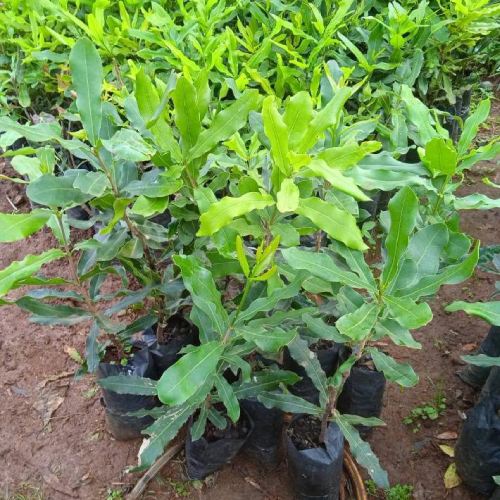
Description
- Buy KEPHIS-certified grafted macadamia seedlings in Kenya (Murang’a 20) at KSh 350. Learn spacing, yield per acre, cost of planting, and farmgate pricing.
Grafted Macadamia Seedlings in Kenya: Price, Murang’a 20 & Farming Guide (2026)
Grafted macadamia seedlings in Kenya cost from KSh 350 each at Fruit Africa Veriplant. The variety we stock is Murang’a 20, a selection that produces far more nuts per tree than the traditional varieties most Kenyan farmers planted years ago. A single grafted Murang’a 20 tree can yield 70 to 150 kilograms of nuts per season under good management.
This guide explains why Murang’a 20 matters, how to plant and manage grafted macadamia seedlings, what the tree produces, and the hard truth about the macadamia market in Kenya. The industry has real potential, but pricing is unpredictable, middlemen control much of the trade, and farmers often receive far less than they deserve.
If you are a farmer in Murang’a, Kiambu, Kirinyaga, Embu, Meru, Nyeri, or any other macadamia-growing region, this guide gives you the technical knowledge to plant, manage, and harvest a profitable orchard. It also gives you the market intelligence to avoid the traps that have cost Kenyan farmers millions of shillings.
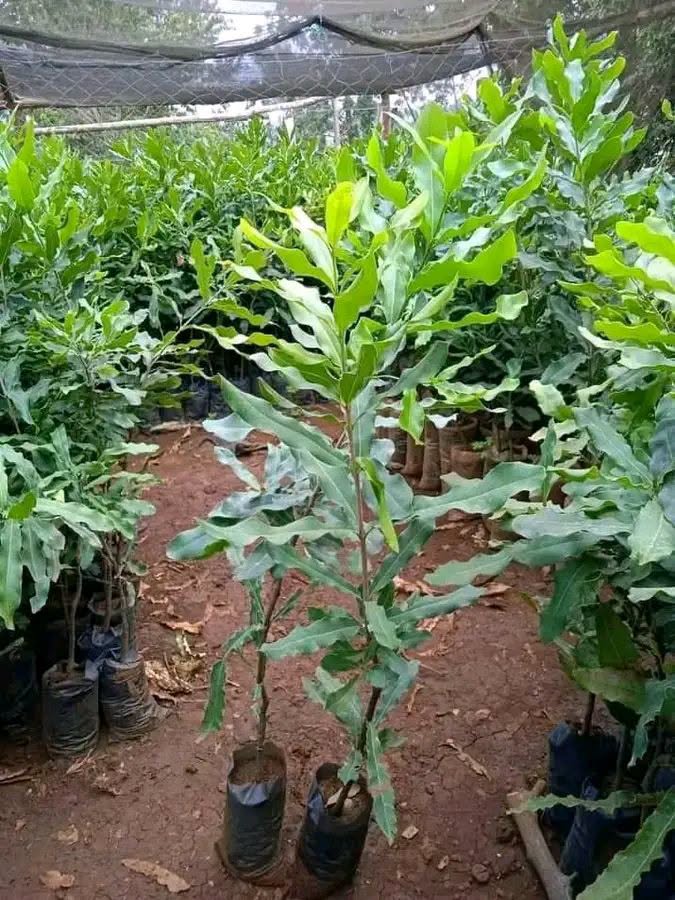
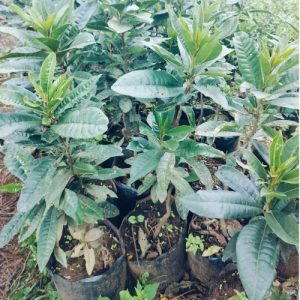
Grafted macadamia seedlings at Fruit Africa Veriplant
Grafted Macadamia Seedlings in Kenya
Grafted macadamia seedlings are young trees created by joining a high-yielding variety to a disease-resistant rootstock. The grafted tree combines the best traits of both. It fruits earlier, produces more nuts, and resists disease better than a seedling grown from seed.
At Fruit Africa Veriplant, we sell grafted macadamia seedlings at KSh 350 each. The variety we stock is Murang’a 20, also known as MRG-20. Our headquarters is in Ruiru, with field bases in Murang’a, Nairobi, and Embu. We source directly from KEPHIS-certified nurseries to give growers disease-free, high-yielding stock.
Farmers who planted seed-grown macadamia trees years ago are now replacing them or grafting over them. A seed-grown tree takes six to eight years to fruit. A grafted tree fruits in three to four years. That difference matters when you are investing land and labour.
The grafted seedling is not just a faster tree. It is a more productive tree. A seed-grown macadamia might produce 30 to 50 kilograms of nuts per season. A grafted Murang’a 20 produces 70 to 150 kilograms. Over the 40 to 60 year life of the tree, that difference compounds into hundreds of thousands of shillings.
Grafted Macadamia Seedlings Price in Kenya
Grafted macadamia seedling prices in Kenya range from KSh 250 to KSh 500 depending on the nursery, variety, and seedling age. Fruit Africa Veriplant sells at KSh 350 per seedling.
Other nurseries list grafted macadamia seedlings at similar prices. Some sell at KSh 300, others at KSh 400. The price depends on the variety, how long the seedling has been in the nursery, and the volume you order.
Why does a grafted seedling cost more than a seed-grown seedling? The answer is in the work. A grafted seedling requires a rootstock raised from seed for six to twelve months, a scion taken from a selected mother tree, skilled labour to make the graft, and months of nursery care while the graft heals and the seedling hardens. A seed-grown seedling requires none of this.
At KSh 350, you are buying a tree that will produce for 40 years or more. The cost per year of production is less than KSh 10. Compare that to the income from a single harvest once the tree matures.
Seedling cost per acre depends on spacing. At 7 metres by 7 metres spacing with 82 trees per acre, seedling cost is KSh 28,700. At 6 metres by 6 metres spacing with 112 trees per acre, seedling cost is KSh 39,200.
Confirm the current price before ordering. Nursery prices shift with availability, seedling age, and order volume.
Where to Buy Grafted Macadamia Seedlings in Kenya
Grafted macadamia seedlings are available from specialist nurseries in Kenya. Fruit Africa Veriplant supplies grafted Murang’a 20 seedlings directly to farmers.
Before buying grafted macadamia seedlings from any supplier, verify the following.
Ask about the variety. Murang’a 20 is the variety we stock. Other nurseries sell MRG-20 under similar names. Confirm the variety in writing.
Ask about the rootstock. A good supplier knows what rootstock was used and why. The rootstock determines disease resistance and adaptability to your soil.
Ask about seedling age. A grafted macadamia seedling ready for transplanting is usually six to twelve months old and about 45 to 60 centimetres tall.
Ask whether the seedling is KEPHIS-certified. Certified seedlings meet quality standards for disease resistance and genetic identity.
Visit the nursery if possible. Inspect the graft union. It should be clean, fully healed, and free of rot or separation.
Fruit Africa Veriplant
Phone: 0714 994 444
WhatsApp: https://wa.link/di12my
Email: sales@fruitafrica.org
Contact Us: https://fruitafrica.org/contact-us/
Request for Quotation: https://fruitafrica.org/request-for-quotation/
Murang’a 20 Macadamia Variety
Murang’a 20 is the variety that changed macadamia farming in Kenya. The variety was selected for high yield, early bearing, and adaptability across Kenyan growing regions.
A single Murang’a 20 tree produces 70 to 150 kilograms of nuts per season. Some farmers report higher yields under exceptional management. Traditional varieties produce 30 to 50 kilograms per tree.
The difference matters. At 82 trees per acre and 70 kilograms per tree, one acre produces 5,740 kilograms. At 150 kilograms per tree, it produces 12,300 kilograms. Even at the conservative end, Murang’a 20 outperforms older varieties significantly.
Murang’a 20 is hardy and adapts well to different climates. It grows in Murang’a, Kiambu, Kirinyaga, Nyeri, Embu, Meru, and other macadamia-growing regions. It tolerates temperatures from 16°C to 25°C and rainfall of 800 to 1,200 millimetres annually.
The tree is disease-resistant. Macadamia trees generally resist most pests and diseases, but Murang’a 20 performs well even in areas where disease pressure is higher.
For farmers replacing coffee or maize, Murang’a 20 offers a high-value alternative. The tree produces for 40 years or more with proper management.
Kiambu, Kirinyaga and Murang’a: The Heart of Kenyan Macadamia
Kiambu, Kirinyaga, and Murang’a are the counties where Kenyan macadamia farming runs deepest. The climate, soil, and altitude in these counties suit the crop.
Murang’a County is where the Murang’a 20 variety was selected. The county has a long history of macadamia farming. Farmers in Murang’a, Kangema, Mathioya, and Kigumo have some of the oldest macadamia trees in Kenya.
Kiambu County borders Murang’a and shares similar growing conditions. Macadamia farms in Kiambu, Gatundu, and Limuru produce high-quality nuts. The proximity to Nairobi gives Kiambu farmers access to processors and buyers.
Kirinyaga County has become a major macadamia producer. The county government has distributed macadamia seedlings to farmers through community investment groups. The county is also establishing a County Aggregation and Industrial Park where macadamia processing industries are expected to be set up.
These three counties, along with Embu, Meru, and Nyeri, form the core of Kenya’s macadamia belt. The crop grows best at altitudes between 1,000 and 2,000 metres above sea level, with well-drained loamy soil and good rainfall.
How to Choose Healthy Grafted Macadamia Seedlings
Size is not the best indicator of seedling quality. A tall seedling in a small bag may be stressed. Look for these qualities instead.
Check the graft union. A healthy graft union is clean and fully healed. There should be no gap between the scion and rootstock. No suckers should grow from below the union.
Check the leaves. Healthy macadamia leaves are dark green and glossy. Pale or yellow leaves suggest nutrient deficiency or root problems.
Check the stem. The stem should be firm and upright. A thin, weak stem will struggle in the field.
Check the roots if possible. Ask the nursery to remove one seedling from its bag as a sample. The root ball should hold together. Brown or mushy roots mean the seedling stayed too wet.
Ask about seedling age. A grafted macadamia seedling ready for transplanting is usually six to twelve months old.
Ask about KEPHIS certification. Certified seedlings meet quality standards and are more reliable than uncertified stock.
What Is Macadamia?
Macadamia is an evergreen tree native to Australia. It produces a hard-shelled nut with a creamy, buttery kernel. The tree grows slowly but produces for decades.
In Kenya, macadamia has traditionally been grown in agroforestry systems rather than plantations. Farmers plant macadamia trees alongside other crops, providing shade and enriching the soil. This method suits smallholder farming and produces high-quality nuts.
Kenya is the third-largest macadamia producer in the world and the second-largest in Africa after South Africa. Production is forecast at 51,850 tonnes in 2026, up from 47,500 tonnes in 2025.
The crop is export-oriented. Kenya restricts the export of raw, unprocessed in-shell macadamia nuts to encourage local processing. Processed kernels are exported to Europe, the United States, and increasingly China.
Macadamia Climate Requirements
Temperature is the first filter. Macadamia performs best at 16°C to 25°C. It tolerates temperatures up to 30°C but suffers above that. Frost damages the tree and reduces yield.
Rainfall matters. Macadamia needs 1,000 to 2,500 millimetres annually. The tree tolerates dry periods once established, but consistent moisture improves yield.
Altitude range is specific. Macadamia grows best at 1,000 to 2,000 metres above sea level. Above 2,000 metres, growth slows and yield drops.
Sunlight supports nut production. Macadamia needs at least six to eight hours of sunlight daily.
Shelter from strong winds matters. Macadamia branches are brittle. Windbreaks protect the tree and reduce nut drop.
Best Soil for Macadamia
Macadamia prefers deep, well-drained loamy or sandy loam soils. The ideal pH range is 5.0 to 6.5.
Soils that hold water or become waterlogged damage the root system. Macadamia roots are sensitive to poor drainage. If your soil stays wet after rain, plant on raised beds or fix drainage before planting.
A soil test before planting tells you the pH and nutrient status. If the pH is below 5.0, lime may be needed. Organic matter is critical. Compost and well-decomposed manure improve soil structure and nutrient availability.
Avoid heavy clay soils. They hold water and restrict root development. Avoid shallow soils over rock or hardpan.
How Many Macadamia Trees Fit on One Acre?
Spacing determines tree population. At 7 metres by 7 metres, you fit 82 trees per acre.
One acre is about 4,047 square metres. At 7m by 7m spacing, each tree occupies 49 square metres. 4,047 divided by 49 gives 82 trees.
At 6m by 6m spacing, each tree occupies 36 square metres. 4,047 divided by 36 gives 112 trees.
At 8m by 8m spacing, each tree occupies 64 square metres. 4,047 divided by 64 gives 63 trees.
At 10m by 10m spacing, each tree occupies 100 square metres. 4,047 divided by 100 gives 40 trees.
The table below summarises the spacing options.
| Spacing | Trees per Acre | Notes |
|---|---|---|
| 10m by 10m | 40 | Very wide, traditional |
| 8m by 8m | 63 | Wide spacing |
| 7m by 7m | 82 | Standard for Murang’a 20 |
| 6m by 6m | 112 | Intensive spacing |
Wider spacing gives each tree more room to develop a full canopy. Closer spacing gives more trees per acre but requires more intensive management. Disease pressure rises when air cannot move between trees.
For most commercial farmers, 7m by 7m is the recommended spacing. It balances tree population with management access. At 6m by 6m, you get more trees per acre but must prune more aggressively to maintain airflow.
How to Prepare Land for Macadamia
Start by clearing the land of weeds, bushes, and debris. Plough to a depth of 30 centimetres, then harrow to create a fine seedbed.
A soil test before planting tells you the pH and nutrient status. If the pH is below 5.0, lime may be needed. Apply lime well before planting based on the test recommendation.
If drainage is a concern, address it during land preparation. Macadamia roots rot in waterlogged soil.
The site should be near accessible roads for transport to markets. Avoid low-lying areas where water collects during heavy rains.
Mark your spacing before digging holes. Use pegs and string to keep rows straight.
How to Prepare Macadamia Planting Holes
Planting holes should be dug 60cm by 60cm by 60cm. Separate topsoil from subsoil.
Mix the topsoil with 20 kilograms of well-decomposed manure and 250 grams of double superphosphate fertiliser.
Do not fill the hole with raw manure and plant immediately. Fresh manure burns roots. The manure must be decomposed before use.
How to Plant Grafted Macadamia Seedlings
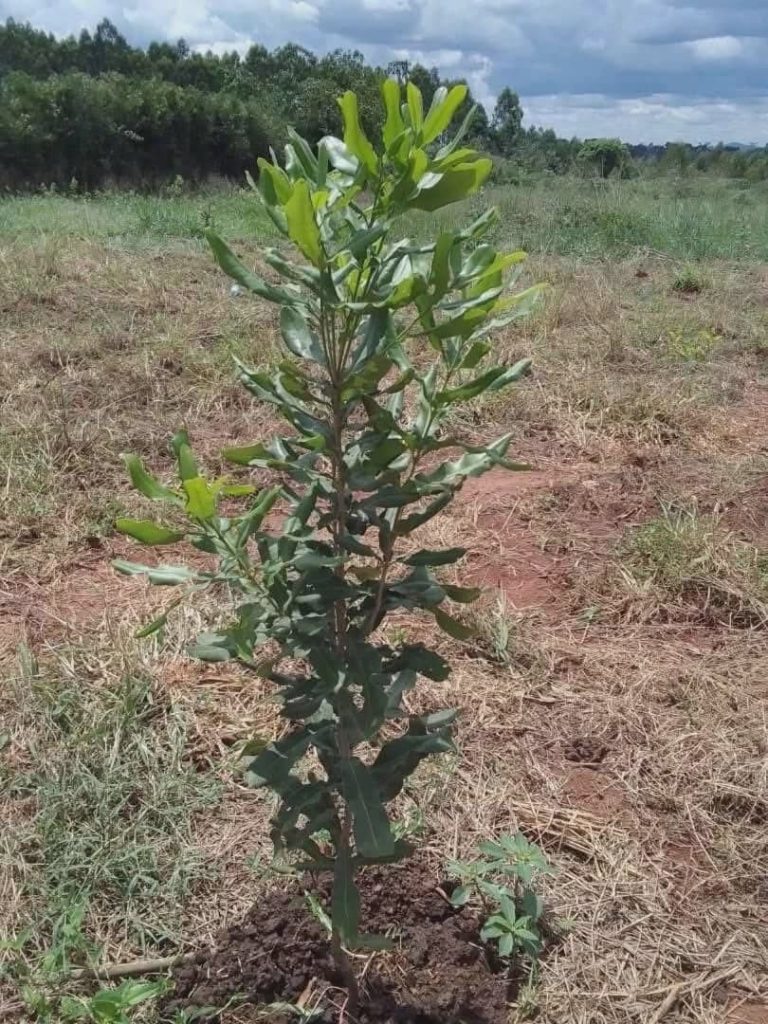
A Transplanted macadamia seedling bought from Fruit Africa Veriplant
Plant at the onset of the rainy season. In Kenya, this means March to May or October to November. If you have irrigation, planting can be done at other times.
Remove the seedling from its container carefully, keeping the root ball intact. Place the seedling in the hole so the graft union sits 5 to 10 centimetres above soil level. Burying the graft union causes rot and can kill the tree.
Backfill with the amended soil mixture. Firm gently to remove air pockets. Do not compact the soil with your foot.
Water thoroughly with 20 litres per plant immediately after planting.
Apply organic mulch around each plant, keeping mulch 10 centimetres away from the stem and graft union. Mulch touching the trunk causes rot.
Stake young trees on windy sites. Protect seedlings from livestock with fencing or individual guards.
Macadamia Watering and Irrigation
Young macadamia seedlings need consistent moisture. Water every two to three days during the first two years, especially in hot areas. Drip irrigation maintains consistent moisture and reduces water waste.
Mature trees need less frequent watering. During dry periods, water mature trees every five to seven days. Apply 20 to 40 litres per tree weekly.
The principle is more useful than a fixed number. The soil around the root zone should stay moist but not saturated. If you squeeze a handful of soil and it drips water, it is too wet. If it crumbles and dust falls off, it is too dry.
Mulch reduces water loss. A good layer of organic mulch can cut irrigation frequency by a third or more.
Macadamia Manure and Fertilizer
Organic matter is the foundation of macadamia nutrition. Compost and well-decomposed manure improve soil structure, water-holding capacity, and nutrient availability.
Apply 20 to 30 kilograms of well-decomposed manure per tree annually for mature trees. Spread around the drip line and incorporate lightly.
For nut production, apply balanced NPK fertiliser every three to four months. Potassium is important for nut size and quality. Apply potassium-rich fertiliser before flowering.
Do not fertilise on a fixed calendar without considering your soil test and the tree’s appearance. Yellowing leaves, poor growth, and small nuts are signals. Address the specific deficiency rather than applying a generic blend.
Macadamia Pests and Diseases
Macadamia is generally disease-resistant, but the tree is not immune to pests and diseases.
Nut borers attack developing nuts and reduce yield. Regular monitoring and removal of infested nuts reduces the population.
Macadamia nut borer is a serious pest in some regions. Control involves timely harvesting and removal of fallen nuts.
Root rot is the most serious disease threat, especially in poorly drained soils. Good drainage and careful watering are the primary controls.
Anthracnose causes dark lesions on leaves and nuts. It spreads in humid conditions with poor air movement. Pruning for airflow and removing infected plant material helps.
For any pesticide use, follow label instructions. Respect pre-harvest intervals. Use protective equipment.
How Long Does Grafted Macadamia Take to Produce?
This is the question that determines whether macadamia fits your farm plan.
Grafted macadamia trees begin producing nuts in three to four years. Seed-grown trees take six to eight years.
Full production is reached in seven to ten years. The tree produces for 30 to 40 years, with some trees living up to 50 years.
The waiting period is shorter than mangosteen but longer than mulberry. Plan for intercropping during the establishment years.
Macadamia Yield Per Tree
A mature Murang’a 20 tree produces 70 to 150 kilograms of nuts per season. Some farmers report higher yields under exceptional management.
Traditional varieties produce 30 to 50 kilograms per tree. The difference is significant.
Yield depends on variety, age, tree density, pruning, irrigation, soil fertility, rainfall, temperature, pest pressure, and management quality.
Macadamia Yield Per Acre
At 7m by 7m spacing with 82 trees per acre, and a conservative 70 kilograms per tree, one acre produces 5,740 kilograms. At 150 kilograms per tree, it produces 12,300 kilograms.
At 6m by 6m spacing with 112 trees per acre, and 70 kilograms per tree, one acre produces 7,840 kilograms. At 150 kilograms per tree, it produces 16,800 kilograms.
The table below shows planning scenarios.
| Trees per Acre | Yield per Tree | Total Yield |
|---|---|---|
| 82 | 70 kg | 5,740 kg |
| 82 | 150 kg | 12,300 kg |
| 112 | 70 kg | 7,840 kg |
| 112 | 150 kg | 16,800 kg |
These are planning scenarios. Actual results depend on management.
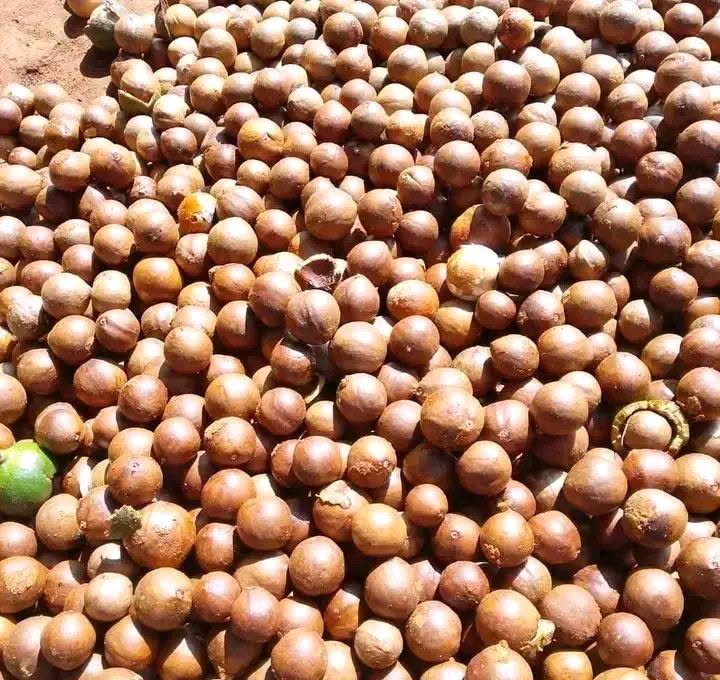
Macadamia Nuts
Macadamia Harvesting
Macadamia nuts fall to the ground when mature. Harvest by collecting fallen nuts regularly. Do not shake the tree to force nuts down. Immature nuts have poor kernel quality.
Collect nuts every few days during the harvest season. Leaving nuts on the ground too long invites mould and insect damage.
Dehusk nuts soon after collection. Dry the nuts in-shell to reduce moisture content. Proper drying prevents mould and improves kernel quality.
The Hard Truth About Macadamia Pricing in Kenya
Macadamia pricing in Kenya is unpredictable. That is the single most important thing a farmer needs to understand before planting.
Farm-gate prices have ranged from KSh 40 to KSh 200 per kilogram in recent seasons. The price depends on who is buying, when you sell, and the quality of your nuts.
Processors have offered KSh 50 to KSh 80 per kilogram in some areas. Exporters have offered up to KSh 200 per kilogram. The gap between what processors pay and what exporters pay is the source of farmer frustration.
In the 2025/2026 season, farmers received KSh 70 to KSh 100 per kilogram at the start of the harvest. Prices reached KSh 120 to KSh 150 per kilogram towards the end of the high season.
The Agriculture Cabinet Secretary set a minimum purchase price of KSh 100 per kilogram and directed processors to absorb domestic supply at fair rates.
But minimum prices are not always enforced. Farmers in some areas report selling for as little as KSh 40 per kilogram.
Some farmers hawk macadamia on the streets at KSh 30 per kilogram because they cannot find a buyer. This is the reality of the market.
Why Macadamia Prices Fluctuate
Several factors drive price fluctuation.
Global market conditions. Macadamia prices depend on global supply and demand. When Australia, South Africa, and China produce large crops, prices drop. When supply tightens, prices rise.
Export restrictions. Kenya bans the export of raw, unprocessed macadamia nuts to encourage local processing. This policy keeps more value in Kenya, but it also limits competition among buyers. When processors are the only buyers, they set the price.
Middlemen and brokers. Traders buy from farmers at low prices and sell to processors or exporters at higher prices. The farmer captures only a fraction of the final value.
Quality. Poorly dried or damaged nuts fetch lower prices. Farmers who dry and sort properly receive better rates.
Timing. Prices fluctuate through the season. Farmers who sell early or late may receive different prices.
The Monopoly by Big Players
The macadamia processing and export sector in Kenya is dominated by a small number of large players. These companies control a significant share of the market.
Major processors and exporters include:
One Acre Fund. Operates a macadamia factory with a production capacity of over 6,000 tons of raw material. Sources directly from smallholder farmers through more than 20 buying centres in Central Kenya.
Superfine Africa Nuts Limited. A processor that sources from around 3,000 farmers across Meru, Kirinyaga, Embu, Nyeri, Murang’a, and Kiambu counties. Employs up to 385 people in peak season.
Exotic EPZ Limited. A women-owned agribusiness that processes and exports macadamia nuts and oils to Europe. Sources from more than 1,300 smallholder farmers through over 10 collection points in more than 10 counties.
Jungle Macs. One of Kenya’s largest macadamia processors and exporters.
Kenya Nut Company. A major processor and exporter of macadamia nuts.
Farmers Choice. A processor operating in the Mt Kenya region.
These companies have significant buying power. When a few large processors dominate the market, farmers have limited options. The processors set the price, and farmers accept it or lose their crop.
The Nut Traders Association of Kenya has called for the suspension of the export ban on raw macadamia, arguing that the restriction limits competition and depresses prices.
Government Interventions in the Macadamia Sector
The government has taken several steps to address the challenges facing macadamia farmers.
Minimum price directive. The Agriculture Cabinet Secretary set a minimum purchase price of KSh 100 per kilogram and directed processors to comply. Failure to comply could result in the reopening of exports.
Export ban on raw nuts. Kenya restricts the export of raw, unprocessed in-shell macadamia nuts under the Agriculture and Food Authority framework. This policy aims to keep processing jobs and value within Kenya.
Zero-tariff agreement with China. A zero-tariff agreement under the Early Harvest Agreement took effect on 1 May 2026, giving Kenyan processed macadamia kernels duty-free access to the Chinese market. This opens a significant new market.
Seasonal harvesting controls. Regulators enforce maturity and quality controls, including seasonal harvesting and trading windows, to protect kernel quality and Kenya’s reputation in premium markets.
KALRO research. The Kenya Agricultural and Livestock Research Organization conducts research on macadamia varieties, pest management, and processing.
How County Governments Are Supporting Macadamia Farming
County governments in macadamia-growing regions have taken direct action to support farmers.
Kirinyaga County has distributed macadamia seedlings to farmers through community investment groups. Governor Anne Waiguru distributed 2,000 macadamia seedlings to 35 Community Investment Groups in Kariti Ward. The county is also establishing the Sagana Agro-Industrial City and the County Aggregation and Industrial Park, where macadamia processing industries are expected to be set up.
Murang’a County has a long history of macadamia farming. The county government supports farmers through extension services and seedling distribution.
Kiambu County benefits from proximity to Nairobi and the presence of processors. The county government promotes macadamia as a high-value crop.
Tharaka Nithi County has trained macadamia farmers on organic farming practices aimed at improving nut quality and accessing international markets.
Other counties including Embu, Meru, and Nyeri have programmes to support macadamia farmers through training, seedling distribution, and market linkages.
The Agroforestry for Nature-Based Enterprises project is building the capacity of 1,250 smallholder farmers across Kiambu, Laikipia, Makueni, Meru, and Trans-Nzoia counties to adopt sustainable agroforestry practices including macadamia.
How the Government Can Save the Industry
Several interventions could stabilise the macadamia industry and improve farmer incomes.
Enforce the minimum price. The KSh 100 per kilogram minimum must be enforced consistently. Processors who pay below the minimum should face penalties.
Increase competition among buyers. Allowing more processors to operate, or regulating the export of raw nuts more carefully, would give farmers more options and better prices.
Strengthen cooperatives. Farmers who sell through cooperatives have more bargaining power than individual farmers selling to middlemen. The government should support cooperative development.
Invest in processing capacity. More local processing facilities would increase demand for raw nuts and reduce the power of existing processors.
Provide quality seedlings. Farmers need access to certified, high-yielding seedlings like Murang’a 20. County governments can establish nurseries and distribute seedlings to farmers.
Improve market information. Farmers need real-time information about prices and buyers. A transparent market information system would reduce exploitation.
Support value addition. Encouraging farmers to process nuts into oil, butter, and other products would increase returns.
Address smuggling. Illegal sales at ultra-low prices and smuggling by middlemen distort the market and undermine government-set minimum prices. Enforcement must be strengthened.
Macadamia Farming Cost Per Acre
Establishment costs for macadamia depend on spacing, seedling price, land condition, labour, manure availability, and whether irrigation is installed.
At KSh 350 per seedling and 82 trees per acre at 7m by 7m spacing, seedling cost is KSh 28,700. At 112 trees per acre at 6m by 6m spacing, seedling cost is KSh 39,200.
A commercial budget for a one-acre orchard using 125 trees estimated KSh 147,000 for first-year establishment, including seedlings, land preparation, manure, fertiliser, drip irrigation, mulch, and planting labour.
The table below organises cost categories.
| Cost | Calculation | Notes |
|---|---|---|
| Seedlings | Number × current price | Confirm before ordering |
| Land preparation | Ploughing, harrowing | Local contractor rates |
| Hole preparation | Labour | Based on hole size and number |
| Manure | 20 kg per hole | Local availability |
| Fertiliser | Soil-test based | Not a fixed recipe |
| Irrigation | System and installation | Drip recommended |
| Labour | Planting, weeding, pruning | First year |
| Mulch | Local material | Straw, grass, or other |
| Fencing | Where required | Protection from livestock |
| Harvesting | Labour and containers | Seasonal |
| Packaging | Market-dependent | Bags, crates |
| Transport | Farm to buyer | Distance and volume |
| Pest management | Monitoring and control | As needed |
Macadamia Farming Profit Per Acre
Profitability depends on yield, price, and how you market your nuts. Separate gross revenue from operating surplus.
Gross revenue = Yield per acre × Selling price per kg.
Operating surplus = Gross revenue – Annual operating costs.
The table below shows profitability scenarios at different yields and prices.
| Trees | Yield/Tree | Total Yield | Price/kg | Gross Revenue |
|---|---|---|---|---|
| 82 | 70 kg | 5,740 kg | KSh 80 | KSh 459,200 |
| 82 | 70 kg | 5,740 kg | KSh 150 | KSh 861,000 |
| 82 | 150 kg | 12,300 kg | KSh 80 | KSh 984,000 |
| 82 | 150 kg | 12,300 kg | KSh 150 | KSh 1,845,000 |
| 112 | 70 kg | 7,840 kg | KSh 80 | KSh 627,200 |
| 112 | 70 kg | 7,840 kg | KSh 150 | KSh 1,176,000 |
| 112 | 150 kg | 16,800 kg | KSh 80 | KSh 1,344,000 |
| 112 | 150 kg | 16,800 kg | KSh 150 | KSh 2,520,000 |
These scenarios show that profitability swings widely with yield and price. At KSh 80 per kilogram, a farmer with 82 trees and 70 kilograms per tree earns KSh 459,200 in gross revenue. At KSh 150 per kilogram, the same farmer earns KSh 861,000.
Annual operating costs for a mature macadamia orchard typically range from KSh 80,000 to KSh 150,000 per acre, covering fertiliser, pest control, labour, irrigation, and harvest.
In the conservative scenario with 82 trees, 70 kilograms per tree, and KSh 80 per kilogram, gross revenue is KSh 459,200. After operating costs of KSh 100,000, operating surplus is KSh 359,200 per acre.
In the moderate scenario with 82 trees, 70 kilograms per tree, and KSh 150 per kilogram, gross revenue is KSh 861,000. After operating costs of KSh 100,000, operating surplus is KSh 761,000 per acre.
In the higher scenario with 112 trees, 150 kilograms per tree, and KSh 150 per kilogram, gross revenue is KSh 2,520,000. After operating costs of KSh 150,000, operating surplus is KSh 2,370,000 per acre.
These scenarios are examples for planning. Do not treat the highest scenario as normal. Macadamia prices are unpredictable. A farmer who achieves high yield but sells at KSh 40 per kilogram earns far less than the scenarios show.
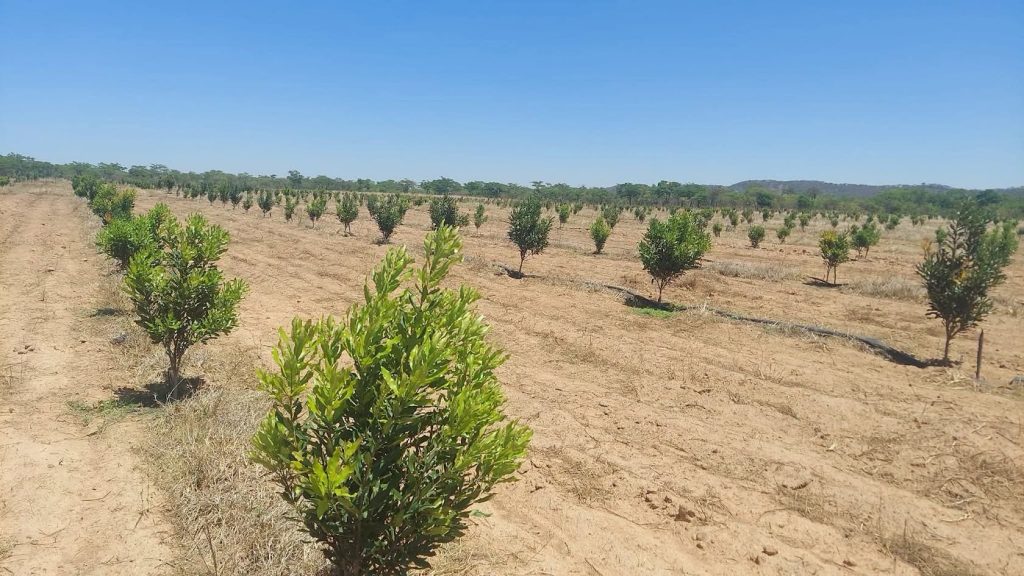
Macadamia Plantation
Intercropping During Establishment Years
Macadamia takes three to four years to produce the first nuts and seven to ten years to reach full production. During the establishment years, the orchard generates no income from nuts. Intercropping provides cash flow while the trees grow.
Suitable intercrops for the first three years include:
Beans. Legumes fix nitrogen and improve soil fertility. Beans mature in three to four months and have a ready market.
Potatoes. Potatoes grow well in the highlands and provide income within four months. They also break soil compaction.
Cabbages and kales. These vegetables have consistent demand in local markets and mature within three to four months.
Onions. Onions take four to five months and fetch good prices in urban markets.
Fodder crops. Farmers with livestock can plant napier grass or desmodium between macadamia rows.
Do not intercrop with crops that compete heavily with macadamia for water and nutrients. Maize and other tall cereals shade young trees and reduce growth.
Stop intercropping when the macadamia canopy closes, usually around year four to five. At that point, the trees need the space and resources for nut production.
Common Mistakes in Macadamia Farming
Planting grafted macadamia seedlings in poorly drained soil is a mistake. Macadamia roots rot when they stay wet. If your soil holds water after rain, fix drainage before planting.
Buying seedlings based only on size is another mistake. A tall seedling in a small bag is often a stressed seedling. Look at the graft union, the leaves, and the roots.
Planting the seedling too deep is a mistake. The graft union should sit 5 to 10 centimetres above soil level. Burying it causes rot.
Establishing a large orchard without a market is a planning mistake. Macadamia is a commodity with unpredictable prices. Understand the market before you plant 100 trees.
Relying on rainfall alone in areas with unreliable precipitation is a mistake. Macadamia needs consistent moisture for good nut production.
Selecting seedlings without confirming the variety is a mistake. If you are buying for high yield, ask for Murang’a 20.
Selling to the first buyer who arrives is a mistake. Compare prices from different buyers. Join a cooperative if one operates in your area.
Can Macadamia Be Grown in Containers?
Macadamia can be grown in containers when young, but the tree will not reach its full potential. The taproot needs deep soil. A standard pot restricts root development, and the tree stays small. Container growing is not suitable for commercial nut production.
Can Macadamia Be Grown on a Small Farm?
Yes. Macadamia is well suited to smallholder farming. A farmer with half an acre can plant 40 to 55 trees at 7m by 7m spacing. A farmer with one acre can plant 82 trees.
Start small. Test the crop on half an acre before planting a full acre. Learn how the trees perform on your soil and how the market responds to your nuts.
Macadamia works well in agroforestry. The trees provide shade, improve soil, and produce a high-value crop.
Is Macadamia Farming Commercially Viable in Kenya?
Macadamia farming is commercially viable for farmers who manage the orchard well and understand the market. It is not a guaranteed income.
Opportunities include strong export demand, high-value nuts, multiple products from the same tree, government support, county government support, and a tree that produces for decades.
Constraints include unpredictable prices, processor monopoly, limited competition among buyers, long wait for first harvest, and the need for proper drying and post-harvest handling.
Do not call macadamia a gold mine. It is a crop with real potential and real challenges. Farmers who plan their market, manage their orchard well, and control costs have a better chance of success than those who plant without understanding the market.
Buying Grafted Macadamia Seedlings for Export
International buyers looking for grafted macadamia seedlings from Fruit Africa Veriplant should reach out through email or WhatsApp. Our team will guide you through the entire process, from variety selection to documentation and logistics.
Fruit Africa Veriplant
Phone: 0714 994 444
WhatsApp: https://wa.link/di12my
Email: sales@fruitafrica.org
Contact Us: https://fruitafrica.org/contact-us/
Request for Quotation: https://fruitafrica.org/request-for-quotation/
Why Buy Grafted Macadamia Seedlings from Fruit Africa Veriplant?
Fruit Africa Veriplant supplies grafted macadamia seedlings to Kenyan farmers and international buyers. The seedlings are raised in our nursery and hardened for field conditions before dispatch.
We sell grafted macadamia seedlings at KSh 350 per seedling in the supplied information. Confirm the current price before ordering because nursery prices and availability can change.
Our variety is Murang’a 20, selected for high yield, early bearing, and adaptability across Kenyan growing regions. We graft onto disease-resistant rootstock to give the tree a strong start.
Contact us to confirm availability, variety, quantity, and delivery details.
Fruit Africa Veriplant
Phone: 0714 994 444
WhatsApp: https://wa.link/di12my
Email: sales@fruitafrica.org
Contact Us: https://fruitafrica.org/contact-us/
Request for Quotation: https://fruitafrica.org/request-for-quotation/
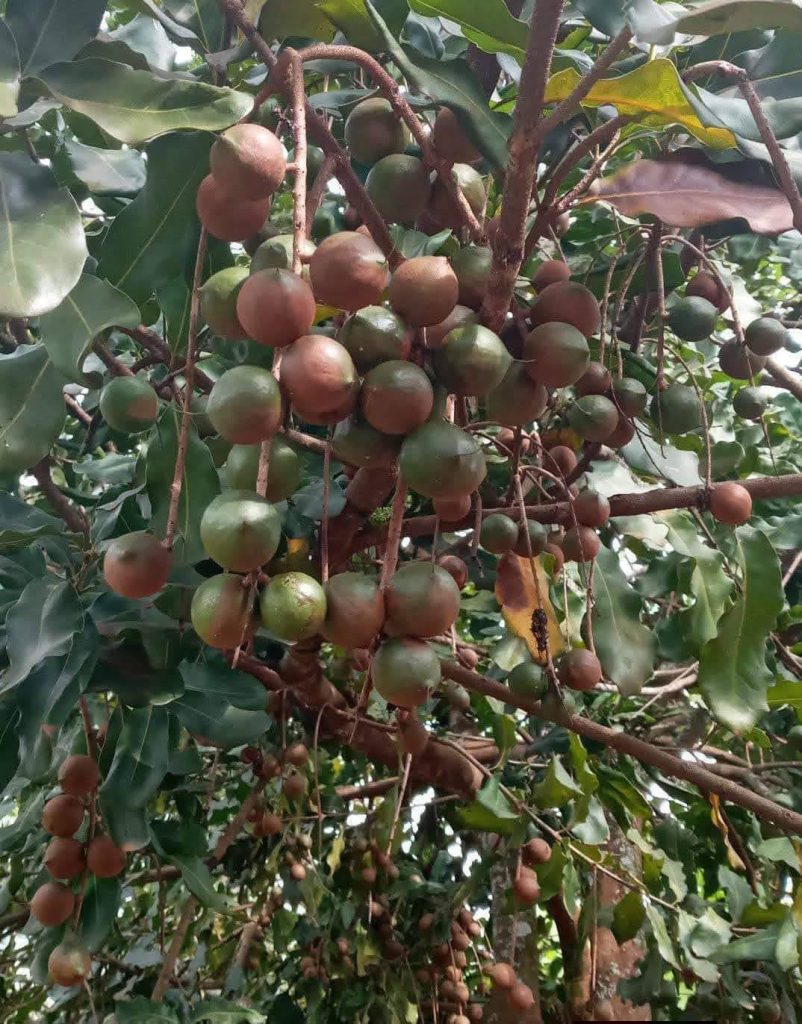
Macadamia Tree
Frequently Asked Questions About Grafted Macadamia Seedlings
1. How much do grafted macadamia seedlings cost in Kenya?
Fruit Africa Veriplant sells grafted macadamia seedlings at KSh 350 each. Other suppliers list them at KSh 250 to KSh 500. Confirm the current price before ordering.
2. Where can I buy grafted macadamia seedlings in Kenya?
Fruit Africa Veriplant supplies grafted Murang’a 20 seedlings from its nursery. Contact through WhatsApp on 0714 994 444 or email sales@fruitafrica.org for current availability.
3. What is Murang’a 20?
Murang’a 20 is a macadamia variety selected for high yield, early bearing, and adaptability. It produces 70 to 150 kilograms of nuts per tree per season, compared to 30 to 50 kilograms for traditional varieties.
4. How long does grafted macadamia take to produce?
Grafted macadamia trees begin producing nuts in three to four years. Full production is reached in seven to ten years. The tree produces for 30 to 40 years.
5. How many macadamia trees fit on one acre?
At 7m by 7m spacing, about 82 trees per acre. At 6m by 6m spacing, about 112 trees. At 8m by 8m spacing, about 63 trees.
6. What is the best spacing for macadamia?
7m by 7m is standard for Murang’a 20. It gives trees enough room to develop full canopies and allows access for harvesting.
7. What climate does macadamia need?
Macadamia needs temperatures of 16°C to 25°C, annual rainfall of 1,000 to 2,500 millimetres, and altitudes of 1,000 to 2,000 metres.
8. What soil is best for macadamia?
Deep, well-drained loamy or sandy loam soil with a pH of 5.0 to 6.5. Drainage is critical. Waterlogged soil kills macadamia roots.
9. How do I prepare a planting hole for macadamia?
Dig a hole 60cm by 60cm by 60cm. Mix topsoil with 20 kilograms of decomposed manure and 250 grams of double superphosphate.
10. How often should I water macadamia seedlings?
Young seedlings need water every two to three days during the first two years. Mature trees need water every five to seven days during dry periods.
11. What fertilizer does macadamia need?
Apply 20 to 30 kilograms of manure per tree annually. Apply balanced NPK fertiliser every three to four months. Potassium is important for nut quality.
12. What pests attack macadamia in Kenya?
Nut borers and macadamia nut borer are the main pests. Root rot and anthracnose are the main diseases.
13. How much do macadamia nuts sell for in Kenya?
Farm-gate prices have ranged from KSh 40 to KSh 200 per kilogram. The government set a minimum price of KSh 100 per kilogram, but enforcement varies.
14. Why are macadamia prices so unpredictable?
Prices depend on global supply and demand, export restrictions, processor buying power, middlemen, nut quality, and timing of sale.
15. Who are the major macadamia buyers in Kenya?
Major processors and exporters include One Acre Fund, Superfine Africa Nuts, Exotic EPZ, Jungle Macs, Kenya Nut Company, and Farmers Choice.
16. How is the government supporting macadamia farmers?
The government set a minimum price of KSh 100 per kilogram, restricts raw nut exports, negotiated a zero-tariff agreement with China, and enforces seasonal harvesting controls.
17. How are county governments supporting macadamia farmers?
Kirinyaga County distributed 2,000 seedlings to community investment groups and is establishing a processing park. Other counties provide training, seedlings, and market linkages.
18. Is macadamia farming profitable in Kenya?
Profitability depends on yield, price, and costs. At 82 trees per acre, 70 kilograms per tree, and KSh 150 per kilogram, gross revenue is KSh 861,000. After operating costs of KSh 100,000, operating surplus is KSh 761,000 per acre.
19. Can macadamia be grown on a small farm?
Yes. A farmer with half an acre can plant 40 to 55 trees. Macadamia works well in agroforestry and integrated farming systems.
20. Can grafted macadamia seedlings be exported from Kenya?
Yes. Fruit Africa Veriplant supplies international buyers. Reach out through WhatsApp or email to discuss your requirements and receive a quotation.
Fruit Africa Veriplant
Phone: 0714 994 444
WhatsApp: https://wa.link/di12my
Email: sales@fruitafrica.org
Contact Us: https://fruitafrica.org/contact-us/
Request for Quotation: https://fruitafrica.org/request-for-quotation/
Final Advice for Farmers Growing Macadamia in Kenya
Macadamia is a long-term crop with real potential and real challenges. The tree produces for decades, but the market is unpredictable. Before you plant, understand what you are getting into.
Buy grafted seedlings from a known variety. Murang’a 20 produces more nuts than traditional varieties. The extra cost per seedling pays back many times over the life of the tree.
Plant at the right spacing. At 7m by 7m, you fit 82 trees per acre. At 6m by 6m, you fit 112. Choose based on your management capacity and soil fertility.
Prepare the planting hole properly. Mix topsoil with decomposed manure and phosphate. Do not bury the graft union.
Water young trees consistently. Mulch around the base. Protect from livestock.
Understand the market before you plant a large orchard. Macadamia prices fluctuate. Processors dominate the buying side. Join a cooperative if one operates in your area.
Dry your nuts properly. Poorly dried nuts fetch lower prices. Proper drying improves kernel quality and marketability.
Plan for the long term. Macadamia takes three to four years to produce first nuts and seven to ten years to reach full production. Intercrop with shorter crops during the establishment years.
Macadamia farming in Kenya has a future. Global demand for macadamia nuts is growing. The government is supporting the sector. County governments are distributing seedlings. But farmers must be realistic about the challenges.
Fruit Africa Veriplant supplies grafted Murang’a 20 macadamia seedlings to Kenyan farmers and international buyers. Request a current quotation for pricing, availability, and delivery details.
Fruit Africa Veriplant
Phone: 0714 994 444
WhatsApp: https://wa.link/di12my
Email: sales@fruitafrica.org
Contact Us: https://fruitafrica.org/contact-us/
Request for Quotation: https://fruitafrica.org/request-for-quotation/

Reviews
There are no reviews yet.